July 27, 2026
The New Architecture of Global Iron Ore Trade
Commodity markets have always been shaped by the push and pull between producers and consumers, but the rules of that contest are being rewritten in real time. Fortescue fair negotiations with China have emerged as a defining test case in this shifting landscape. For most of the past three decades, iron ore trade operated under a relatively stable framework: miners set benchmark prices, steelmakers negotiated mill-by-mill, and volumes flowed according to market signals. That architecture is now being dismantled from the demand side, and the implications extend far beyond any single company or bilateral relationship.
China consumes more than 70% of globally traded seaborne iron ore, a concentration of demand that has always given its steel industry latent negotiating power. What has changed is the institutional machinery through which that power is now being exercised. The emergence of China Mineral Resources Group (CMRG) as a centralised state procurement body has transformed that latent power into a coordinated, tactically sophisticated commercial force, one that is reshaping how the world's largest iron ore exporters do business.
Understanding what Fortescue's push for fair negotiations with China actually means requires stepping back from the immediate dispute and examining the structural forces that produced it. Furthermore, analysing the China demand prospects within the broader seaborne market helps frame just how consequential this shift truly is.
When big ASX news breaks, our subscribers know first
What CMRG Is and Why It Changes Everything
CMRG is a state-owned entity established to coordinate iron ore purchasing across China's domestic steel industry. Rather than allowing individual steel mills to negotiate independently with miners, CMRG consolidates that purchasing activity under a single institutional roof. The effect is a dramatic compression of the buyer side of the market.
To appreciate the significance, consider the scale involved. China is the world's largest steel producer, and its steel sector absorbs iron ore volumes that dwarf all other markets combined. When that buying power is channelled through a single coordinating body, the result is something economists would describe as monopsonistic market power at a level rarely seen in commodity trade history.
How CMRG Applies Commercial Pressure
CMRG's toolkit for applying commercial pressure has evolved rapidly:
- Instructing domestic steel mills to suspend acceptance of specific iron ore product grades during active negotiations
- Discouraging mills from engaging with or evaluating new product categories introduced by targeted miners
- Flagging port-held cargoes as off-limits for mill acceptance, effectively stranding product in-market
- Coordinating mill-level purchasing behaviour to deny miners the ability to grow market share during negotiation windows
These tactics occupy a regulatory grey zone. They do not constitute formal trade sanctions or tariffs, which means they are extremely difficult to challenge through conventional mechanisms such as World Trade Organization dispute proceedings. They are, in effect, commercial pressure applied through administrative coordination rather than legal prohibition.
In early July 2026, CMRG notified Chinese steel mills that from July 15, they must not accept delivery of Fortescue's Super Special Fines product held at ports. This product-level restriction is a textbook application of CMRG's emerging playbook: create cash flow pressure and inventory disruption for the targeted miner without formally severing the trade relationship.
Fortescue's Commercial Exposure: Understanding the Stakes
Fortescue is the world's fourth-largest iron ore producer, a position that carries enormous revenue scale but also significant concentration risk. Its business model is built around high-volume, lower-grade iron ore shipments to Chinese steel mills, making the CMRG negotiation dynamic existential in commercial terms rather than merely routine.
The company's iron ore products span a range of grades and specifications. However, two products are particularly relevant to the current dispute:
- Super Special Fines: A specific iron ore product grade produced by Fortescue that has been subject to CMRG's port-level delivery restriction from July 15, 2026
- Fortune Fines: A lower-grade iron ore product that Fortescue has been introducing to market, with reports indicating CMRG has discouraged Chinese mills from engaging with this grade during the negotiation period
The suppression of Fortune Fines is particularly strategically significant. Lower-grade iron ore products are typically blended by steel mills to optimise costs, and Fortescue's ability to introduce new product grades into the Chinese market is central to its long-term commercial strategy. Consequently, blocking mill engagement with new product categories during negotiations effectively freezes the miner's market development activity at precisely the moment when commercial flexibility matters most.
Australia's Iron Ore Export Economics: The National Dimension
The CMRG negotiation dynamic is not merely a corporate commercial matter. Australia's iron ore export revenues underpin federal and state government budgets at a scale that makes the industry a pillar of national fiscal stability. Indeed, Australia's iron ore leadership in the global market means any structural disruption carries far-reaching consequences for the national economy.
| Metric | Figure |
|---|---|
| Australia's share of global iron ore supply | ~53% |
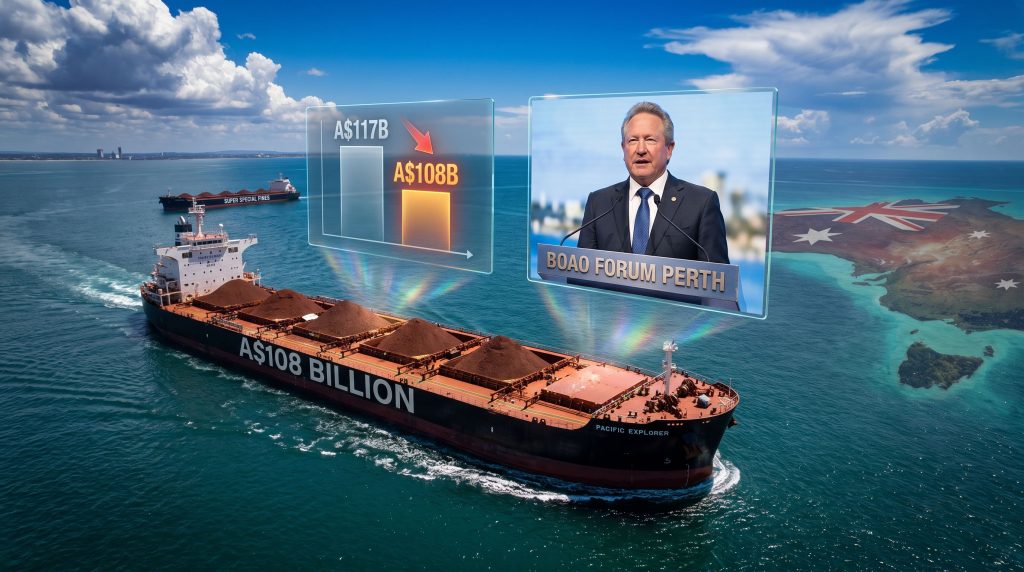
| Projected iron ore export earnings (2026/27) | A$108 billion (~USD $75.57 billion) |
| Prior year export earnings | A$117 billion |
| Year-on-year revenue decline | ~A$9 billion |
The projected A$9 billion decline in iron ore export earnings reflects both rising global supply from competitors and the sustained pricing pressure CMRG is engineering through centralised negotiations. For context, this revenue contraction is of a magnitude that registers directly in Australian government budget forecasts, making the outcome of Fortescue's negotiations with CMRG a matter of national economic consequence.
Decoding the Boao Forum Address: Diplomacy Through Commercial Language
At the Boao Forum Perth, a regional offshoot of the larger Boao Forum for Asia, Fortescue's executive chair Andrew Forrest called for fair talks on iron ore supply terms. His public position emphasised that decades of bilateral iron ore trade had simultaneously supported Australian employment, public services, and business activity while providing China with the reliable, large-volume raw material supply that powered its historic industrial expansion.
Why the Framing Matters Strategically
The rhetorical architecture of this framing is worth examining closely. By invoking shared benefit rather than commercial grievance, Forrest positioned Fortescue's request for Fortescue fair negotiations with China as a defence of a mutually productive relationship rather than a complaint about Chinese commercial tactics. This diplomatic posture serves multiple strategic purposes:
- It avoids language that could be characterised as adversarial, preserving the relationship with China's steel industry
- It frames CMRG's product restrictions as incompatible with genuine partnership, applying reputational pressure without formal accusation
- It signals to the Australian public and government that Fortescue is pursuing a constructive resolution rather than escalation
- It establishes a narrative of reciprocal obligation that can be referenced in future negotiations
The reference to Gabon, where Fortescue is actively developing new iron ore operations, was not incidental to this framing. Forrest's inclusion of Gabon in his partnership narrative subtly signals that Fortescue's long-term supply geography is expanding, reducing its structural dependence on any single bilateral trade relationship over time.
The Gabon Dimension: Geographic Diversification as Negotiating Leverage
Iron ore production geography matters enormously in long-run commercial negotiations. A miner that is entirely dependent on a single customer base has fundamentally diminished negotiating power compared to one with credible alternative market pathways.
Fortescue's development of iron ore operations in Gabon represents more than simple asset diversification. It is a strategic signal embedded in a long negotiation campaign. West African iron ore deposits have attracted interest from multiple major miners over the years, but the logistical challenges of bringing large-volume product to market have historically limited development. Fortescue's commitment to the region signals confidence in the economics of the project and, more importantly, demonstrates to CMRG that the company is actively building supply infrastructure that is not exclusively China-dependent.
Geographic diversification in iron ore is a slow process measured in years and capital allocation cycles, not quarters. But its negotiating value is felt immediately: a credible multi-geography supply platform changes the conversation about pricing and terms even before the first tonne of diversified production ships.
The next major ASX story will hit our subscribers first
What Fair Negotiation Actually Means in Iron Ore Trade
Fortescue's call for fair negotiations raises a question that deserves precise analysis: what does fairness actually look like in a market as structurally imbalanced as seaborne iron ore? In addition, concerns about the broader iron ore price decline affecting all major producers add further urgency to establishing transparent commercial frameworks.
In practice, fair negotiation in iron ore trade typically encompasses the following principles:
- Transparent pricing mechanisms: Contract terms anchored to established benchmark indices rather than unilaterally imposed price targets that lack market reference
- Product access neutrality: Buyers refraining from restricting a seller's access to market during active commercial discussions
- Reciprocal commercial risk: Both parties absorbing proportional exposure from pricing and volume fluctuations rather than one party bearing asymmetric downside
- Continuity of delivery obligations: Cargo acceptance commitments maintained during negotiation periods unless a formal dispute has been raised through agreed channels
CMRG's use of product delivery restrictions and new grade suppression as negotiating instruments sits in direct tension with principles two and four above. Fortescue's public call for fairness is, at its core, an argument that these tactics fall outside the boundaries of legitimate commercial negotiation.
Industry-Wide Implications: Is Fortescue Alone?
The Fortescue situation is the most publicly visible episode in what is clearly a broader structural shift in Chinese iron ore procurement. CMRG has previously applied similar pressure to other major miners, including BHP, establishing a tactical playbook that is now being extended systematically. Indeed, the evolving China steel and iron ore market dynamics suggest this pattern will only intensify in the years ahead.
| Miner | CMRG Engagement Pattern | Status |
|---|---|---|
| BHP | Earlier centralised negotiation pressure | Precedent-setting engagement |
| Fortescue | Product delivery restrictions, port-level cargo holds | Ongoing as of July 2026 |
| Rio Tinto | Monitoring position as largest seaborne exporter | Not yet subject to equivalent product-level restrictions |
The BHP precedent is analytically important because it demonstrates that CMRG's approach is not targeted at Fortescue specifically but represents a systematic campaign to reset the commercial terms of iron ore trade across the entire seaborne supply chain. Every major iron ore exporter should treat the Fortescue situation as a preview of negotiations they are likely to face.
The Iron Ore Grade Dynamic: A Less-Discussed Technical Dimension
One aspect of the CMRG dispute that receives insufficient analytical attention is the iron ore grade dimension. Not all iron ore is equal, and the grade profile of a miner's product mix significantly affects its negotiating vulnerability.
Fortescue's production is weighted toward lower-grade iron ore products, typically in the 56% to 58% Fe (iron content) range, compared to the higher-grade products above 62% Fe produced by competitors such as Rio Tinto and Vale. Lower-grade ores attract a discount to benchmark pricing and require additional blending or processing at the steel mill level to optimise blast furnace productivity.
How Grade Dynamics Shape Negotiating Power
This grade dynamic creates a nuanced negotiating position for Fortescue. On one hand, lower-grade product is more price-sensitive and carries less pricing power in benchmark terms. On the other, Chinese steel mills have developed sophisticated blending strategies that incorporate lower-grade ores to manage input costs, creating a genuine demand base that CMRG cannot simply eliminate without affecting mill economics.
The introduction of Fortune Fines as a new lower-grade product category represents Fortescue's attempt to deepen its penetration of the cost-optimisation segment of Chinese steel mill procurement. Furthermore, the global iron ore market impact of shifting trade policies adds another layer of complexity to Fortescue's commercial calculus. CMRG's decision to discourage mill engagement with this product during negotiations suggests it recognises the strategic value of blocking Fortescue's market development activity at this specific product tier.
Frequently Asked Questions: Fortescue, CMRG, and the Iron Ore Dispute
What is China Mineral Resources Group (CMRG)?
CMRG is a Chinese state-owned procurement entity that coordinates iron ore purchasing across China's domestic steel industry, consolidating buying leverage that was previously distributed across individual mill negotiations.
Why Are Fortescue Fair Negotiations with China Commercially Critical?
China represents Fortescue's single largest customer base. As the world's fourth-largest iron ore producer, Fortescue's revenue concentration in the Chinese market means CMRG negotiations directly affect its financial performance at a material scale.
What is Super Special Fines and Why Was It Targeted?
Super Special Fines is a specific iron ore product grade in Fortescue's portfolio. CMRG instructed Chinese mills not to accept port-held deliveries of this product from July 15, 2026, as a commercial pressure tactic during ongoing supply term negotiations.
What is Fortune Fines and Why Does It Matter Strategically?
Fortune Fines is a lower-grade iron ore product Fortescue has been developing for the Chinese market. CMRG's reported discouragement of mill engagement with this grade during negotiations targets Fortescue's product development strategy specifically, not just its existing sales volumes.
What is the Broader Economic Impact on Australia?
Australia's iron ore export earnings are projected to fall from A$117 billion to approximately A$108 billion in the 2026/27 financial year, a contraction with direct implications for government revenues and national economic planning.
Is This Dispute Unique to Fortescue?
No. CMRG has deployed similar tactics with other major miners including BHP, establishing a systematic approach to resetting commercial terms across the seaborne iron ore market. The Fortescue situation is the latest and most publicly visible application of this strategy.
Key Takeaways for Investors and Industry Observers
- CMRG's centralised procurement model represents a permanent structural shift in global iron ore trade, not a cyclical negotiating posture that will self-correct
- Fortescue's public advocacy for fair negotiations reflects genuine commercial stakes: the leverage imbalance in the current negotiating environment is real and measurable
- The A$9 billion projected decline in Australian iron ore export revenues in 2026/27 sharpens political attention on the negotiation dynamic and may eventually prompt policy-level responses
- Product-level restrictions and new grade suppression are tactically effective precisely because they are difficult to challenge through formal trade mechanisms
- Fortescue's multi-track response, spanning geographic diversification in Gabon, product innovation through Fortune Fines, and public diplomatic engagement at forums such as Boao Forum Perth, reflects a sophisticated long-game strategy rather than reactive crisis management
- The outcome of these negotiations will establish commercial precedents affecting every major seaborne iron ore exporter
This article is intended for informational purposes only and does not constitute financial advice. Projections, forecasts, and forward-looking statements involve uncertainty and should not be relied upon as the basis for investment decisions. Readers are encouraged to conduct their own independent research and consult qualified financial advisers before making any investment-related decisions.
Want to Stay Ahead of the Next Major Mineral Discovery on the ASX?
While the iron ore majors navigate the shifting tides of China's centralised procurement, Discovery Alert's proprietary Discovery IQ model scans ASX announcements in real time, delivering instant alerts on significant mineral discoveries directly to subscribers — explore Discovery Alert's discoveries page to see the historic returns major discoveries have generated, and begin a 14-day free trial to position yourself ahead of the broader market.