
July 27, 2026
When Prices and Inventory Fall Together: Understanding the Aluminium Market's Demand Signal
Most commodity market participants are conditioned to interpret falling exchange inventories as a bullish signal. The conventional logic is straightforward: fewer tonnes sitting in registered warehouses implies stronger physical offtake, which should support or lift prices. Yet aluminium markets periodically challenge this assumption in revealing ways. When both LME aluminium price declines and stocks dip in tandem across multiple sessions, the market communicates something more nuanced: demand is weakening faster than supply is tightening.
That dynamic has been playing out across recent LME aluminium trading sessions, and the July 24 data crystallises the pattern with unusual clarity. Understanding what this means requires looking beyond the headline numbers and into the structural mechanics of how the LME pricing system actually works. Furthermore, broader forces — from US aluminium tariffs to shifting China industrial demand — are amplifying these pressures in ways worth examining carefully.
When big ASX news breaks, our subscribers know first
How the LME Aluminium Pricing Architecture Works
The London Metal Exchange operates one of the most sophisticated pricing frameworks in global commodities. Unlike equity markets where a single price clears the day's activity, the LME publishes aluminium prices across multiple contract tenors simultaneously, each carrying distinct market information.
Cash, Three-Month, and Long-Dated Contracts as a Forward Curve
The cash price reflects the cost of immediate delivery, functioning as the spot benchmark for physical transactions globally. The three-month contract is the LME's primary hedging and trading instrument, representing the most liquid point on the curve and the benchmark used for the majority of producer and consumer hedging strategies. Long-dated contracts such as the December 2027 tenor capture longer-horizon market expectations, embedding assumptions about supply investment cycles, energy costs, and macroeconomic conditions several years forward.
The LME Asian Reference Price serves a distinct purpose: it provides a regionally calibrated benchmark calculated during Asian trading hours, giving buyers and sellers in Asia-Pacific time zones a pricing anchor that reflects activity in their session rather than requiring reliance solely on London closes.
When all of these tenors decline simultaneously and the Asian Reference Price posts the steepest single-session fall, it signals that bearish sentiment is not isolated to one part of the market. It is distributed across the entire pricing structure. You can track live aluminium spot prices to monitor how these movements evolve in real time.
Breaking Down the July 24 LME Aluminium Price Data
Cash Prices Retreat Below the $3,175/t Level
The LME aluminium cash bid closed the July 24 session at USD 3,174.5 per tonne, whilst the cash offer settled at USD 3,175 per tonne. Both registered a 0.59% decline from the prior session, where the bid had been USD 3,193.5 per tonne and the offer USD 3,194 per tonne.
Whilst a sub-0.6% single-session move might appear modest in isolation, its significance lies in the directional consistency it contributes to across multiple trading days.
Three-Month and Long-Dated Contracts Confirm the Trend
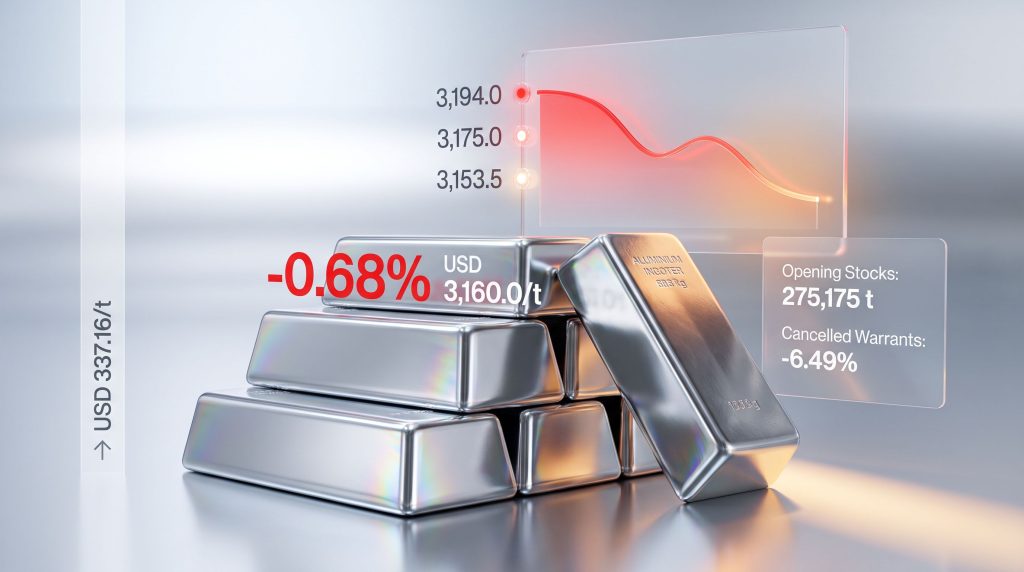
The three-month bid slipped to USD 3,160 per tonne from USD 3,181.5 per tonne, and the three-month offer fell to USD 3,160.5 per tonne from USD 3,182 per tonne, both representing a 0.68% decline. Long-dated December 2027 contracts also weakened, with the bid falling to USD 3,088 per tonne and the offer to USD 3,093 per tonne, each registering a 0.64% drop.
The full pricing picture across contract tenors is presented below:
| Contract Type | Previous Session (USD/t) | July 24 Session (USD/t) | % Change |
|---|---|---|---|
| Cash Bid | 3,193.5 | 3,174.5 | -0.59% |
| Cash Offer | 3,194.0 | 3,175.0 | -0.59% |
| 3-Month Bid | 3,181.5 | 3,160.0 | -0.68% |
| 3-Month Offer | 3,182.0 | 3,160.5 | -0.68% |
| Dec-27 Bid | 3,108.0 | 3,088.0 | -0.64% |
| Dec-27 Offer | 3,113.0 | 3,093.0 | -0.64% |
| Asian Ref. Price (3M) | 3,188.0 | 3,159.5 | -0.89% |
The Asian Reference Price Posts the Sharpest Decline
The LME Asian Reference Price fell 0.89% to USD 3,159.5 per tonne, the steepest single-session percentage decline across all pricing segments. This is noteworthy because Asian demand, particularly from China, is the dominant force in global aluminium consumption.
When the Asian Reference Price leads the decline, it suggests that demand-side pressure is most acutely felt in the region that historically accounts for over half of the world's aluminium consumption. This is not merely a London-based sentiment story; it has physical demand implications at a regional scale.
LME Aluminium Inventory: Reading the Warehouse Data
Opening Stocks Contract to 275,175 Tonnes
Exchange inventory on the LME fell from 276,775 tonnes to 275,175 tonnes on July 24, a reduction of approximately 1,600 tonnes or 0.58%. Whilst this continues a broader drawdown trend visible over recent weeks, the critical analytical question is not whether stocks are falling but why they are falling.
Live Warrants and Cancelled Warrants Tell Contrasting Stories
Live warrants, representing metal held in LME-registered warehouses and available for delivery, edged lower by 0.2% to 245,400 tonnes from 245,900 tonnes. The more significant data point is the 6.49% plunge in cancelled warrants, which dropped from 29,275 tonnes to 27,375 tonnes.
| Inventory Metric | Previous Level | July 24 Level | % Change |
|---|---|---|---|
| Opening Stocks | 276,775 t | 275,175 t | -0.58% |
| Live Warrants | 245,900 t | 245,400 t | -0.20% |
| Cancelled Warrants | 29,275 t | 27,375 t | -6.49% |
Why Cancelled Warrants Are the Most Telling Metric
Cancelled warrants deserve particular attention because they represent metal that has been formally designated for physical removal from LME-registered storage. They function as a leading indicator of near-term physical demand: rising cancelled warrants indicate buyers are pulling metal out of the system, whilst falling cancelled warrants suggest reduced urgency among physical consumers.
A sharp 6.49% drop in cancelled warrants, occurring simultaneously with price declines across all tenors, points toward demand softness rather than supply tightness. When buyers are not rushing to pull metal from warehouses, the market lacks the physical urgency that typically underpins price strength.
For context, recent sessions show a consistent deterioration in this metric:
| Session Reference | Cash Offer (USD/t) | Opening Stocks (t) | Cancelled Warrants (t) |
|---|---|---|---|
| July 15 | 3,153.5 | 284,600 | 36,800 |
| July 23 | 3,194.0 | 276,775 | 29,275 |
| July 24 | 3,175.0 | 275,175 | 27,375 |
The trajectory is unambiguous. Cancelled warrants have declined from 36,800 tonnes in mid-July to 27,375 tonnes by July 24, a reduction of more than 25% over approximately nine trading sessions. This sustained deterioration strengthens the case for a demand-led interpretation of the broader LME aluminium price declines and stocks dip observed throughout this period. For those tracking how inventory trends influence price recovery, recent LME price analysis offers additional context.
The Alumina Price Stability Paradox
LME Alumina Platts Holds at USD 337.16 per Tonne
Whilst all aluminium pricing segments weakened, LME alumina Platts pricing remained unchanged at USD 337.16 per tonne. Alumina is the primary feedstock in aluminium smelting, derived from bauxite refining, and its price stability against a backdrop of weakening aluminium prices creates a critical tension in the production economics of primary smelters.
Margin Compression and Smelter Economics
The aluminium production chain runs from bauxite mining through alumina refining to primary smelting. At the smelting stage, alumina typically represents the single largest variable input cost, often accounting for roughly 30 to 35% of total smelter cash costs depending on energy pricing and location. When aluminium output prices fall whilst alumina input costs remain static, smelter margins compress.
This dynamic has implications that extend beyond individual facility economics:
- High-cost smelters operating with thinner margins may face production curtailment decisions sooner than anticipated
- Alumina producers with long-term fixed-price contracts gain a temporary advantage as spot aluminium price weakness does not immediately erode their returns
- Integrated producers who own both refining and smelting capacity face the squeeze internally, with the alumina division effectively subsidising a loss of profitability in smelting
- Merchant alumina buyers in the spot market face no immediate relief, as the flat alumina price offers no offset against weakening aluminium revenue
The longer this divergence persists, the greater the probability that production discipline enters the aluminium supply equation, which could eventually support prices from the cost side. Strategies adopted by top aluminium companies in navigating such margin pressure are increasingly informing broader industry responses.
Three Macro Forces Driving the Current Weakness
The price declines observed across the July trading sessions do not exist in isolation. Several intersecting macro forces are amplifying downside pressure:
-
U.S. dollar strength: LME aluminium is priced in U.S. dollars. When the dollar appreciates against a basket of other currencies, the effective cost of purchasing aluminium rises for buyers operating in those currencies, dampening demand and exerting downward pressure on dollar-denominated prices. This is a well-documented inverse relationship in base metals markets.
-
Reduced geopolitical risk premiums: Earlier in 2025, supply disruption fears linked to geopolitical events embedded meaningful risk premiums into aluminium futures prices. As those fears recede or are priced out, the premium unwinds, contributing to the mechanical decline in forward prices even if underlying supply fundamentals have not dramatically changed.
-
Speculative positioning adjustments: The LME aluminium market carries significant speculative participation from commodity trading advisors, macro hedge funds, and proprietary traders. When sentiment shifts, these participants adjust positions rapidly, amplifying price moves beyond what fundamental supply-demand shifts would justify in isolation.
In addition, the broader context of tariffs and supply chains continues to introduce uncertainty that weighs on forward-looking demand estimates across the base metals complex.
The next major ASX story will hit our subscribers first
What Physical Buyers, Producers, and Traders Should Be Watching
For Physical Buyers
A softening spot market creates an opportunity to review forward purchasing strategies. Buyers who locked in fixed-price contracts at higher levels earlier in the year may find value in monitoring the forward curve for potential reversion opportunities. The declining three-month contract at USD 3,160 per tonne represents a meaningful discount to where prices traded in earlier sessions above USD 3,200 per tonne.
For Primary Producers
The margin compression dynamic created by stable alumina costs and falling aluminium prices is the most immediate risk. Producers should be stress-testing their cost curves against the current price environment, particularly given that the multi-session downtrend from mid-July suggests this is not a transitory one-day anomaly. The Alcoa aluminium strategy offers one example of how major integrated producers are repositioning in response to shifting market conditions.
For Traders and Speculators
The forward curve's shape, with December 2027 contracts at USD 3,088 to 3,093 per tonne, currently sits below spot cash prices. This contango-adjacent structure reflects market expectations of continued near-term weakness before longer-dated fundamentals reassert themselves. Traders should monitor cancelled warrant data closely, as a sustained recovery in this metric would be an early signal that physical demand is returning to the warehouse system.
Key Takeaways From the July 24 LME Aluminium Session
- All pricing tenors declined in the July 24 session, with the Asian Reference Price registering the sharpest fall at -0.89%
- Cancelled warrants posted the steepest inventory decline at -6.49%, reinforcing a demand-softness interpretation of the broader trend
- Alumina pricing held firm at USD 337.16 per tonne, creating a margin squeeze dynamic for primary smelters
- The pattern across multiple sessions from mid-July onward establishes a sustained directional trend, consistent with LME aluminium price declines and stocks dip behaviour observed in prior cyclical downturns
- Macro headwinds including dollar strength and fading risk premiums remain the dominant short-term price drivers alongside weakening physical demand signals
Disclaimer: This article is intended for informational purposes only and does not constitute financial or investment advice. Price and inventory data referenced reflects publicly reported LME session figures. Market conditions can change rapidly, and readers should conduct their own due diligence before making any trading or investment decisions. Forecasts and analytical interpretations represent assessments based on available data and are subject to revision as market conditions evolve.
Want to Stay Ahead of the Next Major Mineral Discovery on the ASX?
Whilst aluminium market dynamics reward those who read the signals early, Discovery Alert's proprietary Discovery IQ model applies the same principle to ASX mineral discoveries — delivering real-time alerts the moment significant announcements hit the exchange, so subscribers can act before the broader market reacts. Explore historic discovery returns on Discovery Alert's dedicated discoveries page and begin your 14-day free trial today to secure a market-leading edge across the commodities landscape.