
May 14, 2026
How Gulf Crude Pricing Actually Works: The Mechanics Behind ADNOC's Monthly OSP System
Most market participants who track oil prices focus almost exclusively on Brent or WTI futures screens. Yet for the refiners, trading desks, and procurement teams across Asia-Pacific who purchase the majority of Middle Eastern crude, the number that genuinely matters arrives quietly each month in the form of an Official Selling Price notification from a national oil company. These administratively determined prices govern billions of dollars in physical crude transactions and operate according to an entirely different logic than the futures markets most investors watch.
Understanding how these prices are constructed, what drives their movement, and what the latest ADNOC June Murban crude selling price signals about broader market conditions requires stepping back from the headlines and examining the underlying pricing architecture itself.
When big ASX news breaks, our subscribers know first
What an Official Selling Price Actually Is and Why It Exists
An Official Selling Price, commonly referred to as an OSP, is a price level set unilaterally by a national oil company and applied to all term contract deliveries of a specific crude grade for a defined delivery month. It is not a negotiated price, nor is it determined by open market bidding. Instead, it represents the producing state's commercial determination of fair value for its crude, calibrated against benchmark references, competitive peer pricing, and the demand signals emanating from its primary customer base.
The OSP system emerged from the post-1970s restructuring of international oil commerce, when national oil companies across the Gulf region assumed control of their hydrocarbon resources from international majors. Rather than selling crude on open spot markets where prices can fluctuate intraday, Gulf producers preferred the stability and commercial predictability of monthly price declarations applied across long-term supply agreements.
For buyers, OSP-linked term contracts provide supply security and price clarity within a defined monthly window. For producers, the system preserves pricing authority while maintaining the flexibility to adjust commercial positioning month by month without formally renegotiating contracts.
A critical technical distinction that many lay observers miss: an OSP is a retrospective pricing instrument, not a forward-looking forecast. It is calculated based on benchmark performance during a preceding pricing window, meaning the June OSP reflects what happened to relevant benchmark prices during April and May, not what the market expects in June.
The Murban Crude Grade: Why This Particular Oil Commands Attention
Not all crude grades are equal in the eyes of a refinery operator, and Murban occupies a distinctive position in the global crude quality spectrum. Produced from onshore fields in Abu Dhabi and operated by ADNOC, Murban is classified as a light sweet crude, characterised by an API gravity of approximately 40 degrees and a sulfur content of around 0.8%. These specifications place it firmly in the category of crudes that yield high proportions of premium refined products, particularly jet fuel, gasoline, and low-sulfur diesel, without requiring the energy-intensive desulfurization processes that heavier, sourer crudes demand.
For refineries configured to process light sweet feedstocks, Murban offers an attractive yield profile. Asian refiners operating hydroskimming or simple cracking configurations particularly value its processing characteristics, as the crude's natural product slate aligns well with regional refined product demand patterns.
What elevates Murban beyond a simply high-quality feedstock is its evolving role as a pricing benchmark in its own right. The launch of Murban futures trading on ICE Futures Abu Dhabi (IFAD) marked a structural shift in how this crude is priced and traded. Unlike many Gulf crudes that are priced as differentials to the Dubai/Oman assessment or the Argus Sour Crude Index, Murban has been positioned as a self-referencing benchmark, with its futures contract providing the settlement data that feeds directly into ADNOC's monthly OSP calculations. You can track Abu Dhabi Murban crude oil futures in real time to monitor how benchmark movements feed into these pricing decisions.
This self-referencing architecture gives ADNOC a degree of pricing independence that most other Gulf producers lack. Rather than importing price signals from a benchmark influenced by North Sea or US production dynamics, ADNOC anchors its pricing to a contract that reflects actual Murban supply and demand conditions.
ADNOC June Murban Crude Selling Price: The $104.44 Decision Decoded
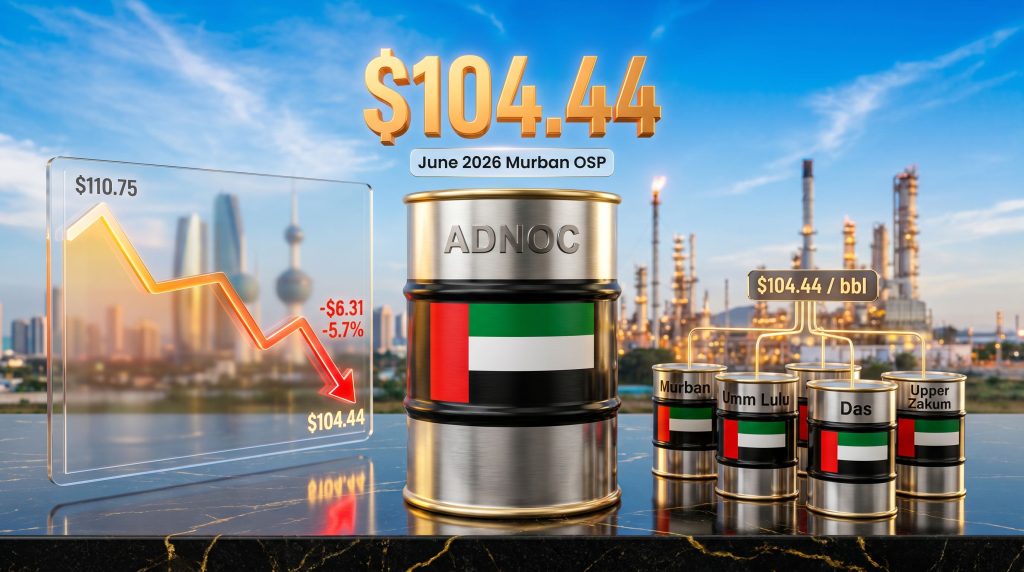
ADNOC set the ADNOC June Murban crude selling price at $104.44 per barrel, as confirmed by Reuters reporting on 14 May 2026. This figure represents a decline of $6.31 per barrel from the May 2026 OSP of $110.75 per barrel, translating to a month-on-month reduction of approximately 5.7%. For broader context on how this fits within longer-term movements, it is worth examining crude oil price trends that have been shaping market expectations through 2025 and into 2026.
The June pricing decision encompassed all four of ADNOC's primary export grades, each set at identical levels with zero differential applied to the Murban benchmark:
| Crude Grade | Differential to Murban (USD/bbl) | June 2026 OSP (USD/bbl) |
|---|---|---|
| Murban | — | $104.44 |
| Umm Lulu | $0.00 | $104.44 |
| Das | $0.00 | $104.44 |
| Upper Zakum | $0.00 | $104.44 |
The uniform zero-differential pricing across all four grades is itself a notable commercial signal. When ADNOC applies identical pricing to grades with distinct quality characteristics, it indicates the producer is managing internal grade competition by removing price incentives for buyers to shift preferences between UAE crude streams. This approach supports stable offtake volumes across the entire export portfolio rather than concentrating demand on any single grade.
The $6.31 per barrel reduction should be interpreted carefully. A move of this magnitude within a single month is material but not unprecedented in the OSP system, and it does not necessarily signal structural deterioration in UAE crude demand. OSP reductions of this scale more commonly reflect benchmark softening during the preceding pricing window rather than any fundamental shift in buyer appetite for Murban crude specifically.
A month-on-month OSP reduction does not equal a demand crisis. It is, in most cases, the mathematical outcome of benchmark futures averaging lower during the calculation window. The commercial relationship between ADNOC and its term contract holders remains intact regardless of the price level.
Furthermore, current crude oil prices across the broader market provide additional context for understanding why this reduction aligns with prevailing conditions rather than representing an isolated commercial decision.
How ADNOC Constructs Its Monthly OSP: A Step-by-Step View
The mechanics of OSP calculation are rarely explained in accessible terms, yet understanding this process is essential for interpreting monthly price movements accurately. ADNOC's approach broadly follows this sequence:
-
Futures settlement monitoring – ADNOC tracks ICE Murban futures contract settlement prices across a defined pricing window, typically spanning several weeks of the preceding month or months.
-
Demand signal assessment – Procurement enquiries, cargo nominations, and feedback from term contract holders across Asia-Pacific, India, and other key markets are evaluated to gauge buyer appetite and competitive positioning.
-
Peer producer benchmarking – ADNOC reviews OSP declarations from regional competitors, including Saudi Aramco's Arab Light pricing against the Argus Sour Crude Index and Kuwait Petroleum Corporation's Export Crude pricing against Dubai/Oman assessments.
-
Internal commercial calibration – ADNOC applies its own strategic commercial considerations, balancing revenue maximisation objectives against the need to maintain competitive positioning and support stable long-term offtake relationships.
-
OSP publication – The final price is announced, typically in the second week of the month preceding the delivery period, consistent with Gulf industry practice.
This structured process means that by the time an OSP appears in the market, it already reflects conditions that prevailed weeks earlier. Traders and analysts who attempt to reconcile current spot market prices with a freshly announced OSP are often comparing two different time periods, a common source of confusion in commodity market analysis.
The Competitive Gulf Pricing Landscape
Murban does not exist in isolation. ADNOC competes for Asian refinery business against a range of other Gulf producers, each with their own OSP methodology and benchmark reference system. Understanding Murban's competitive position requires acknowledging the significant methodological differences that make direct price comparisons inherently imperfect.
Related pricing data from the same period provides useful context. Kuwait Export Crude was reported at $121.82 per barrel, while Oman Blend pricing rose by approximately $3.74 in the same timeframe. However, these figures are not directly comparable to the Murban OSP due to differences in crude quality, benchmark reference, delivery terms, and pricing window conventions.
| Crude Grade | Issuing Producer | Benchmark Reference | Approximate June 2026 Level (USD/bbl) |
|---|---|---|---|
| Murban (UAE) | ADNOC | ICE Murban Futures | $104.44 |
| Kuwait Export Crude | KPC | Dubai/Oman | ~$121.82 |
| Oman Blend | OmanOil | Dubai/Oman | Increased ~$3.74 |
Note: Cross-producer comparisons require adjustment for grade quality differentials, delivery basis, and benchmark methodology. These figures are not directly interchangeable.
The apparently wide gap between Murban and Kuwait Export Crude pricing in this period illustrates precisely why direct comparisons without quality and benchmark adjustments are misleading. Kuwait Export Crude is a heavier, more sulfurous grade that typically trades at a discount to lighter crudes on a quality-adjusted basis, yet its nominal OSP may appear higher when different benchmark references are used.
The next major ASX story will hit our subscribers first
Who Buys Murban and Why Asian Refiners Drive the OSP
The overwhelming majority of ADNOC's Murban exports flow east. Japan, South Korea, India, and China collectively absorb the bulk of UAE crude production, making Asian refinery economics the single most important demand-side factor in ADNOC's pricing calculus.
This geographic concentration has important implications for how ADNOC calibrates its OSP. When Asian refinery margins are healthy and regional product demand is robust, ADNOC has pricing power to maintain or elevate its OSP without risking cargo rejection. When Asian demand signals soften, whether due to economic slowdown, refinery maintenance cycles, or competing crude availability, the feedback typically appears in subsequent OSP adjustments.
Indian state refiners represent a particularly significant component of the Murban buyer base, given their scale of operations and their growing preference for Middle Eastern light crudes that complement their refinery configurations. Independent Chinese refiners, sometimes referred to in industry parlance as teapot refineries, also participate in UAE crude purchasing, though their procurement patterns tend to be more opportunistic than the structured term-contract approach of the major state refiners.
For these buyers, a $6.31 per barrel OSP reduction translates directly into lower crude acquisition costs, improving refinery margins on Murban-based processing runs. Term contract holders benefit from the full reduction on contracted volumes, whereas spot market participants may find the OSP decline already partially reflected in prevailing spot market levels.
The Macro Forces Shaping Murban OSPs in 2026
Several intersecting macro forces are shaping the pricing environment in which ADNOC is operating.
How Does OPEC+ Supply Management Affect OSP Levels?
OPEC's influence on oil markets remains the most structurally significant factor in this landscape. UAE crude production operates within quota frameworks established through OPEC+ collective agreements, meaning ADNOC's export volumes are not simply a function of its own production capacity decisions. The interplay between collective supply discipline and individual commercial pricing objectives creates ongoing tension that OSP watchers must track carefully.
Geopolitical risk in the broader Middle East region introduces asymmetric uncertainty. Reporting from Zawya in the same period as the June OSP announcement referenced IEA assessments suggesting global oil supply could fall below demand in 2026 amid regional conflict dynamics. Separately, the UAE publicly reaffirmed its commitment to diplomatic engagement and non-confrontational postures regarding regional tensions, a stance that supports ADNOC's ability to maintain stable export operations and pricing credibility with long-term customers.
OPEC's revised 2026 demand growth forecast provides the demand-side context. A downward revision to global oil demand growth projections creates headwinds for OSP levels throughout the year, as weaker demand growth reduces the pricing power available to producing nations regardless of supply management efforts.
What Role Do Trade Tensions Play?
The trade war impact on oil adds a further layer of complexity to the pricing environment. Chinese crude import volumes are the single largest swing factor in Asian crude demand, and furthermore, US-China trade impacts carry direct implications for Chinese refinery throughput and therefore Middle Eastern crude absorption. Market attention in the same period was focused on a Trump-Xi summit, with oil prices edging upward as investors assessed potential trade stabilisation outcomes.
Scenario Pathways: Where Could Murban OSPs Head in H2 2026?
The following scenarios are speculative projections based on available market conditions and should not be construed as financial advice or price forecasts.
Scenario 1: Continued Softening
If OPEC's revised demand growth outlook proves accurate and OPEC+ supply increases proceed as scheduled, Murban OSPs could face further pressure through Q3 2026, potentially moving toward the $95 to $100 per barrel range.
Scenario 2: Geopolitical Spike
A material escalation of Middle East supply disruptions could trigger a risk premium re-rating across all Gulf crude grades. Under this scenario, the May-to-June OSP decline could reverse sharply, with Murban returning toward the $110 to $115 per barrel range.
Scenario 3: Moderate Recovery
Stronger-than-expected Chinese crude import activity and positive outcomes from US-China trade negotiations could provide a floor under Asian demand, supporting a modest Murban OSP recovery into the $107 to $109 per barrel range by mid-Q3 2026.
Frequently Asked Questions
What is the ADNOC June 2026 Murban crude official selling price?
ADNOC set the June 2026 official selling price for Murban crude at $104.44 per barrel, announced in May 2026. This represents a decrease of $6.31 per barrel compared to the May 2026 OSP of $110.75 per barrel. (Source: Reuters, Swati Verma, 14 May 2026)
Which other UAE crude grades share the June 2026 price level?
Three additional ADNOC export grades — Umm Lulu, Das, and Upper Zakum — were all set at $104.44 per barrel for June 2026, each carrying a zero differential to the Murban benchmark.
How frequently does ADNOC publish its official selling prices?
ADNOC publishes OSPs on a monthly basis, with the following month's prices typically released during the second week of the current month, consistent with standard Gulf producer practice.
How does the Murban OSP differ from Murban futures contract prices?
The Murban OSP is an administratively determined price applied to physical term contract deliveries, calculated with reference to ICE Murban futures settlement averages over a defined pricing window. Spot futures prices on ICE Futures Abu Dhabi may trade at different levels at any given moment, reflecting real-time supply and demand conditions that the OSP, by design, does not capture in real time.
Is Murban priced the same way as Brent crude?
No. Murban and Brent are distinct crude grades with separate pricing architectures. Murban is a UAE light sweet crude benchmarked through ICE Murban futures traded on ICE Futures Abu Dhabi. Brent is a North Sea benchmark used as a global reference price. The two grades may converge or diverge based on regional supply conditions, quality differentials, and transportation cost variations.
Key Takeaways for Market Participants
-
The ADNOC June Murban crude selling price of $104.44 per barrel reflects benchmark movements during the preceding pricing window rather than signalling a fundamental shift in UAE export strategy.
-
The 5.7% month-on-month reduction from May's $110.75 per barrel level is material but consistent with OSP volatility patterns seen across Gulf producers during periods of benchmark softening.
-
Uniform zero-differential pricing across Murban, Umm Lulu, Das, and Upper Zakum indicates deliberate internal portfolio management rather than competitive grade repositioning.
-
The macro backdrop for H2 2026 remains complex, with OPEC demand revisions, regional geopolitical dynamics, and China's crude import trajectory all capable of influencing future OSP direction in either direction.
-
For energy procurement professionals and commodity analysts, monthly tracking of Murban OSP movements alongside peer producer pricing and ICE Murban futures settlement trends provides one of the most operationally grounded indicators available for assessing Gulf crude market conditions. Analysts at OilPrice.com have similarly cautioned that physical oil premium collapses of this nature may prove temporary, reinforcing the importance of monitoring these movements over successive months rather than reacting to single data points.
This article is intended for informational purposes only and does not constitute financial or investment advice. Scenario projections are speculative and subject to significant uncertainty. Readers should consult primary sources including ADNOC official communications and IEA monthly oil market reports for authoritative data.
Want to Capitalise on the Next Major Commodity Discovery Before the Market Moves?
While Gulf crude pricing mechanics reveal how established commodity markets operate, Discovery Alert's proprietary Discovery IQ model scans the ASX daily to deliver real-time alerts on significant mineral discoveries — turning complex data across 30-plus commodities into clear, actionable insights for both traders and long-term investors. Explore historic examples of major discoveries and their market returns, then begin your 14-day free trial to position yourself ahead of the broader market.