June 16, 2026
The Quiet Restructuring Beneath the Surface of a Luxury Commodity
Commodity markets rarely collapse cleanly and recover cleanly. More often, they undergo prolonged structural reorganisation beneath the surface, where the forces eventually driving recovery bear little resemblance to those that created the downturn in the first place. The natural diamonds market recovery unfolding in 2025 and 2026 fits this pattern precisely. Supply chains are tightening, consumer demographics are rotating, and a synthetic rival that was once predicted to permanently displace natural stones is showing its own structural vulnerabilities.
Understanding why this recovery is more complicated than a simple demand-rebound story requires examining several interlocking dynamics simultaneously rather than treating any single factor as decisive.
When big ASX news breaks, our subscribers know first
Where the Natural Diamonds Market Actually Stands in 2025 and 2026
The natural diamond sector has endured one of its most sustained downturns in living memory. The causes were layered: laboratory-grown diamond producers flooded the market with competitively priced synthetic stones, consumer sentiment in China weakened materially following post-pandemic disappointments, and elevated midstream inventories suppressed rough diamond pricing even as mine production gradually declined.
The numbers tell a sobering story:
| Indicator | Data Point | Context |
|---|---|---|
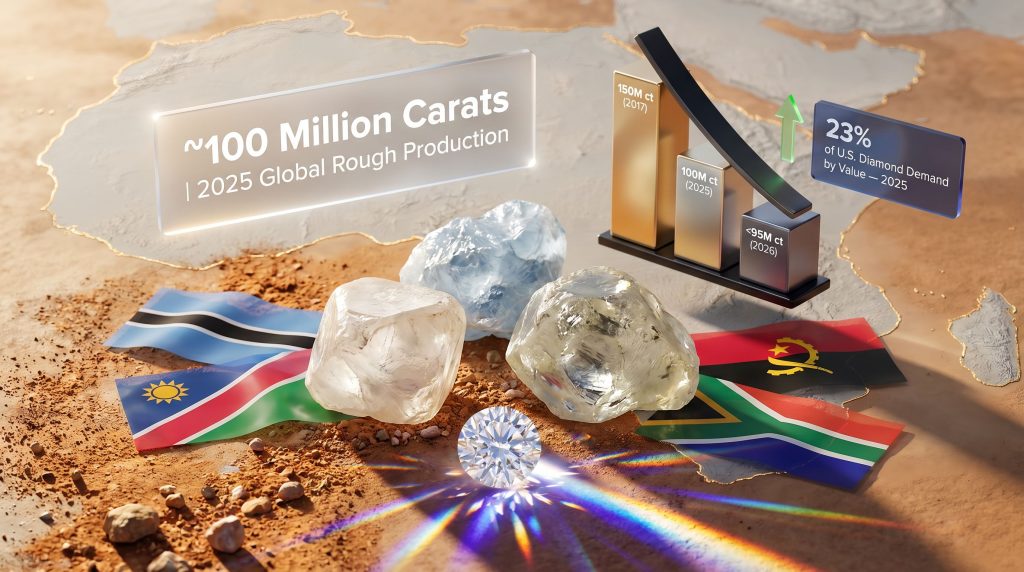
| Global rough production (2017) | ~150 million carats | Peak supply era |
| Global rough production (2025) | ~100 million carats | ~33% contraction over eight years |
| Forecast production (2026) | Below 95 million carats | Lowest level since 1987 |
| De Beers average selling price (Q1 2026) | -19% year-on-year | Ongoing pricing pressure |
| Botswana GDP contraction (2024) | -2.8% | Macro impact on producing nations |
| Gen Z share of U.S. diamond demand by value (2025) | 23% | Second-largest buying cohort |
The absence of a decisive broad-based recovery in 2026 is not surprising given these figures. De Beers reported a 19% decline in average selling price during the first quarter of 2026, signalling that price normalisation remains incomplete. Yet several forward-looking indicators suggest the trajectory is beginning to bend. According to Rapaport's research report, the conditions for a measured recovery are gradually forming, though the path remains uneven across market segments.
The Supply Contraction Story Is More Significant Than It Appears
Why Mine Depletion Is a Structural Issue, Not a Cycle
The decline from approximately 150 million carats in 2017 to just over 100 million carats in 2025 is not primarily a function of producers cutting output in response to low prices, though disciplined supply management has played a role. The more fundamental driver is geological reality: many of the world's largest and most productive diamond deposits are mature assets with declining ore grades and increasing extraction costs. Furthermore, the global diamond production landscape highlights how concentrated these finite reserves are among a handful of nations.
Kimberlite pipe deposits, which host the majority of the world's economically significant diamond reserves, are volcanic formations that were emplaced hundreds of millions of years ago under conditions of extreme heat and pressure within the Earth's mantle. As open-pit operations at these pipes exhaust accessible near-surface ore, producers face the choice of transitioning to underground block cave or sub-level cave mining methods, which require substantially higher capital investment and deliver lower throughput volumes.
Several major operations globally have already made this transition, and the capital expenditure cycle necessary to sustain output from these assets was never fully refreshed during the downturn years.
The practical consequence is that independent analyst Paul Zimnisky's forecast of global rough supply falling below 95 million carats in 2026 represents the lowest production level since 1987. Critically, this supply floor is not easily or quickly reversed even if demand conditions improve sharply. New kimberlite discoveries take years to assess, permit, develop, and bring to production.
Midstream Inventory and Price Floor Formation
Another underappreciated aspect of the supply dynamic involves midstream inventory levels at major cutting and polishing centres, particularly Surat in India, which processes the vast majority of the world's rough diamonds. Elevated polished inventory held by manufacturers and wholesalers created a secondary supply overhang that weighed on rough diamond prices independently of mining output. As these inventories gradually normalise through 2025 and into 2026, the price floor for rough diamonds strengthens incrementally. This is a slow-moving process, but it creates a necessary precondition for any price recovery. In addition, mineral exploration activity remains critical to replenishing the pipeline of future supply.
How the Lab-Grown Diamond Threat Has Evolved
The Competitive Divide Is Sharpening by Price Tier
The narrative that laboratory-grown diamonds would uniformly replace natural stones across all market categories has not materialised in the way that early proponents suggested. The competitive picture is considerably more segmented:
| Market Segment | Lab-Grown Competitive Impact | Natural Diamond Positioning |
|---|---|---|
| Entry-level and mid-tier (below 1 carat) | High, with significant market share captured | Continued pricing pressure |
| Premium segment (1 to 3 carats) | Moderate, price competition intensifying | Selective stabilisation underway |
| Ultra-premium (above 3 carats) | Low, demand for lab-grown drops sharply | Natural diamonds retain meaningful advantage |
| Bridal and engagement | Moderate, consumer education remains critical | Traceability becoming a key differentiator |
The Profitability Squeeze Inside the Synthetic Sector
A lesser-known but commercially significant development is the deteriorating economics of the synthetic diamond industry itself. As Chinese chemical vapour deposition (CVD) reactor capacity expanded aggressively, the cost of producing a one-carat lab-grown diamond fell from several thousand dollars to below a few hundred dollars in less than a decade. This has created intense margin compression throughout the synthetic supply chain.
According to independent analyst Edahn Golan, prices for three-carat laboratory-grown stones declined by approximately 32% in early 2025. Golan observed that after nearly a decade of persistent price declines, the synthetic diamond market appears to be entering a more mature, slower-growth phase, with demand expansion decelerating as the sector moves beyond its early high-volatility period.
Retailers attempted to partially offset falling per-carat margins by promoting larger synthetic stones, leveraging the fact that three-carat lab-grown diamonds had become affordable at price points previously unimaginable. However, this promotional strategy encounters a natural ceiling: consumer demand for larger stones is not proportionally elastic, and stones above three carats face a sharp falloff in buyer interest regardless of price.
De Beers has noted that absolute profitability per transaction has favoured natural diamonds over synthetic alternatives since 2022, a data point that has significant implications for retailer stocking and promotional decisions going forward. Industry observers tracking trends shaping the diamond industry's future note that this profitability dynamic is likely to influence how retailers position natural versus synthetic stones in coming years.
Generation Z and the Structural Demand Rotation
This Demographic Shift Is Not Superficial
Perhaps the most consequential long-term development for the natural diamonds market recovery is the purchasing behaviour of Generation Z consumers, defined as those born between 1997 and 2012. This cohort represented 23% of total U.S. diamond demand by value in 2025, positioning it as the second-largest buying group after Millennials despite being earlier in their peak earning years.
De Beers' Diamond Report, published in June 2026, identified Generation Z as the consumer cohort recording the strongest increase in desirability for natural diamonds between 2023 and 2025. Several attributes of this generation's diamond purchasing behaviour differ meaningfully from preceding cohorts:
- Occasion flexibility: Gen Z consumers are substantially more willing to purchase diamonds outside traditional engagement and wedding contexts, including self-purchases and non-milestone gifting occasions
- Origin consciousness: Verified provenance documentation is treated as a proxy for authenticity and ethical sourcing rather than as a secondary consideration
- Premium willingness: A meaningful proportion of surveyed U.S. female consumers indicated readiness to pay above the standard market price for diamonds carrying verified traceability credentials
- Digital research intensity: This generation conducts extensive pre-purchase research, making transparent supply chain documentation commercially critical rather than optional
The expansion of occasion types driving diamond purchases is particularly significant from a market sizing perspective. Engagement and bridal categories, while remaining important, have historically constrained total addressable demand by tying purchases to specific life events. A demographic that views diamonds as appropriate for self-expression, personal milestones, and non-engagement gifting materially expands the total occasions available for natural diamond sales.
Traceability as a Commercial Value Driver
From Ethical Preference to Purchasing Criterion
The concept of diamond traceability has existed for decades, largely in the context of conflict diamond prevention frameworks established by the Kimberley Process Certification Scheme in 2003. However, the commercial function of traceability is evolving significantly. It is shifting from a compliance mechanism designed to exclude illicit stones into a positive value-creation tool that communicates origin stories, community impact, and authenticity directly to end consumers.
De Beers launched its ORIGIN platform in 2024 to trace and communicate the complete journey of each enrolled diamond from mine to point of sale. Early consumer response data from the U.S. market indicate that a majority of surveyed female consumers would consider purchasing a diamond listed on the platform, and a significant proportion expressed willingness to pay a premium for stones carrying verified origin credentials.
The traceability value chain operates across four distinct stages:
- Mine of origin documentation – verified provenance from specific producing operations or regions
- Supply chain transparency – trackable movement from rough stone through cutting, polishing, and wholesale
- Social impact attribution – documented community investment, employment, and economic development linked to production
- Consumer-facing certification – accessible, verifiable credentials presented at point of sale
Strategic observation: If traceability premiums become standardised across the industry rather than remaining a platform-specific differentiator, African producing nations that can document rich origin narratives tied to community development outcomes stand to benefit disproportionately from the consumer preference trend.
The next major ASX story will hit our subscribers first
The African Producer Dimension
Economic Stakes That Extend Beyond Corporate Revenues
The natural diamonds market recovery carries direct macroeconomic consequences for several African nations where diamond revenues represent a structurally significant share of government income and GDP. The global mining landscape underscores how deeply intertwined national economies can be with single commodity sectors, making recovery dynamics particularly consequential for these producer nations.
| Country | Role in Global Supply | Key Economic Exposure |
|---|---|---|
| Botswana | World's largest producer by value | GDP contracted 2.8% in 2024 from diamond sector weakness |
| Namibia | Major offshore and alluvial producer | High revenue dependency on diamond exports |
| Angola | Significant and growing producer | Expanding production ambitions tied to sector recovery |
| South Africa | Historical production powerhouse with maturing assets | Diversified but materially exposed |
| Democratic Republic of Congo | Significant volume producer | Mixed artisanal and industrial production base |
Botswana's 2.8% GDP contraction in 2024 illustrates the severity of this exposure. Diamond revenues fund a substantial proportion of Botswana's national budget, and extended weakness in rough diamond prices flows directly into fiscal constraints on public services and infrastructure investment.
In 2025, Botswana, South Africa, Namibia, the Democratic Republic of the Congo, and Angola launched a coordinated joint marketing initiative aimed at stimulating global demand for natural diamonds. This collective approach is strategically aligned with the traceability trend, as it allows African producers to position their stones under a shared narrative of authentic African origin, ethical extraction, and community benefit.
Whether this initiative achieves meaningful scale will depend on sustained marketing investment and the development of consumer-facing infrastructure capable of delivering origin stories at the point of purchase. Consequently, the geopolitical landscape for metals and mining in 2025 adds further complexity to how these producing nations navigate international relationships and trade conditions.
Scenario Analysis: Three Pathways Through 2027
Disclaimer: The following scenarios are analytical frameworks intended to illustrate the range of plausible market outcomes based on current observable dynamics. They do not constitute investment advice, and actual market conditions may differ materially from any scenario described.
Scenario 1: Gradual Premium-Led Recovery
Supply discipline holds, and rough diamond prices stabilise in premium segments. Gen Z purchasing power matures incrementally, traceability platforms achieve broader retail adoption, and lab-grown competition stabilises at lower price tiers without materially encroaching on premium categories. Mass-market natural diamond segments continue to face synthetic competition pressure. This scenario likely represents a selective rather than broad-based recovery.
Scenario 2: Demand-Driven Broad Recovery
U.S. consumer confidence strengthens, India polished diamond demand accelerates, and China begins a gradual consumption recovery. Traceability becomes an industry-wide standard, and Gen Z spending power grows faster than anticipated. African producers benefit materially from origin premium dynamics. A broader recovery across multiple price tiers becomes achievable.
Scenario 3: Prolonged Stagnation
Lab-grown competition intensifies in mid-tier categories, macroeconomic headwinds suppress discretionary spending, and supply contraction proves insufficient to offset demand weakness. Diamond-dependent African economies face continued fiscal pressure, and midstream inventory normalisation stalls. Recovery timelines extend beyond 2027.
Key Indicators to Monitor for Natural Diamonds Market Recovery Signals
Analysts and industry observers tracking the natural diamonds market recovery should monitor indicators across three distinct domains. Furthermore, commodity prices and their impact on mining company performance provide an important additional lens for interpreting the signals below.
Demand-side signals:
- U.S. retail diamond jewellery sales volumes, particularly in the premium and bridal categories
- Gen Z purchase frequency and average transaction value by occasion type
- India polished diamond import and export data from the Gem and Jewellery Export Promotion Council
- China luxury goods spending data and consumer confidence indices
Supply-side signals:
- Quarterly global rough diamond production volumes from major producers
- Rough diamond price indices segmented by size and quality category
- Midstream inventory levels at Surat and Antwerp trading centres
- New mine development announcements and associated capital expenditure commitments
Competitive signals:
- Lab-grown diamond price trajectories by carat category, particularly in the one to three carat range
- Retailer promotional mix between natural and synthetic stones, tracked through trade publication surveys
- Consumer awareness surveys measuring understanding of the difference between natural and synthetic diamonds
Frequently Asked Questions: Natural Diamonds Market Recovery
What caused the natural diamond market downturn?
The downturn reflected multiple converging forces: laboratory-grown diamonds captured market share at accessible price points, Chinese luxury demand softened significantly from post-pandemic highs, midstream inventory overhang suppressed rough pricing, and reduced capital investment in new mining capacity created a prolonged structural overhang.
Are natural diamond prices recovering in 2025 and 2026?
Recovery is selective rather than broad. Premium and larger stone categories show early stabilisation, but overall rough diamond pricing remains under pressure. De Beers reported a 19% average selling price decline in Q1 2026, indicating that mass-market price recovery has not yet materialised.
Why does Generation Z matter to the natural diamond recovery?
Gen Z represented 23% of U.S. diamond demand by value in 2025 and recorded the strongest growth in natural diamond desirability of any consumer cohort between 2023 and 2025. As this demographic's purchasing power grows and its consumption occasions expand beyond traditional bridal categories, it represents the most significant new structural demand driver for natural stones.
Is the lab-grown diamond threat to natural diamonds diminishing?
The threat is evolving rather than diminishing uniformly. Lab-grown competition remains intense at lower price tiers but is demonstrably weaker above the three-carat threshold. The synthetic sector's own profitability challenges, with three-carat stone prices declining approximately 32%, suggest that the lab-grown boom phase is transitioning into a more mature, lower-margin market reality.
What role does Africa play in the natural diamond recovery?
African nations supply a significant proportion of the world's natural rough diamonds and carry substantial economic dependency on sector revenues. Botswana, Namibia, Angola, South Africa, and the Democratic Republic of Congo collectively launched a joint marketing campaign in 2025 to stimulate demand, and the traceability trend creates a structural opportunity for African producers to command premiums based on documented origin narratives.
A Recovery in Formation, Not Yet Confirmed
The natural diamonds market recovery is a story of structural realignment rather than straightforward demand rebound. Supply is contracting at a pace dictated partly by geological inevitability, the lab-grown sector is experiencing its own internal pressures, and a new generation of consumers is entering the market with different values and broader purchasing occasions than their predecessors.
What is missing is the demand-side confirmation that would translate supply discipline and generational preference into sustained price recovery. U.S. consumer confidence, Indian polished diamond demand, and a Chinese market rebound remain critical variables that are not yet fully aligned.
Bottom line for market observers: The structural preconditions for a natural diamonds market recovery are assembling, but the timeline and breadth of that recovery depend on variables outside the diamond industry's direct control. Premium segments are the leading edge; mass-market categories are the lagging indicator. The industry's trajectory will ultimately be shaped as much by what consumers believe a natural diamond represents as by what it costs to extract one from the ground.
Readers seeking ongoing coverage of African mining sector developments and commodity market dynamics can find further analysis through Ecofin Agency at ecofinagency.com.
Want to Track the Next Major Mineral Discovery Before the Broader Market Does?
Discovery Alert's proprietary Discovery IQ model delivers real-time alerts on significant ASX mineral discoveries — instantly translating complex geological and commodity data into actionable investment insights for both short-term traders and long-term investors. Explore historic discoveries and the returns they generated to understand the opportunity, then begin your 14-day free trial to position yourself ahead of the market.