June 5, 2026
The Regulatory Void That Natural Hydrogen Cannot Afford
Every transformative energy resource eventually confronts the same structural problem: the laws that govern it were written for something else. Coal was regulated under land tenure frameworks designed for agriculture. Petroleum law borrowed heavily from mining statutes. Natural gas was grafted onto oil regulations for decades before it earned its own legal identity. Natural hydrogen, the geological phenomenon generating serious scientific and commercial interest across multiple continents, now faces exactly this challenge. And Quebec, through its proposed Bill 17, is attempting to solve it before the problem compounds.
Understanding what is at stake with QIMC Bill 17 natural hydrogen Quebec requires stepping back from the immediate legislative timeline and examining why the absence of a purpose-built regulatory framework is not merely an administrative inconvenience. For exploration companies, investors, and provincial policymakers alike, the legal architecture surrounding a nascent resource category is often more consequential than the geology itself.
When big ASX news breaks, our subscribers know first
What Natural Hydrogen Actually Is and Why It Defies Existing Law
Natural hydrogen, sometimes called geological hydrogen or gold hydrogen within industry circles, is hydrogen gas produced through geochemical reactions occurring deep within the Earth's crust. The dominant mechanism is serpentinization, a process in which water percolates through iron and magnesium-rich ultramafic rocks, triggering a chemical reaction that releases hydrogen gas as a byproduct. This is fundamentally different from the two hydrogen production pathways currently dominating energy policy conversations.
Green hydrogen is manufactured using electricity, typically from renewable sources, to split water molecules through electrolysis. Blue hydrogen is derived from natural gas reforming, with carbon capture applied to reduce emissions. Natural hydrogen requires neither process. If it exists in sufficient concentrations and accessible geological structures, it can theoretically be extracted at a fraction of the energy cost of its manufactured counterparts.
This distinction creates an immediate legal problem. Natural hydrogen shares characteristics with both a mineral resource and an energy commodity, fitting neatly into neither category. Provincial mining statutes were designed to govern solid minerals and, in some jurisdictions, certain industrial minerals. Petroleum legislation was constructed around liquid hydrocarbons and associated gases. Neither framework contains the tenure instruments, environmental assessment triggers, royalty structures, or subsurface rights definitions that natural hydrogen extraction would require.
Furthermore, the broader energy transition demand for clean fuels makes resolving this regulatory ambiguity increasingly urgent. The geological settings most associated with natural hydrogen occurrence include:
- Ophiolite complexes, where ancient oceanic crust has been thrust onto continental margins
- Precambrian cratons and shield geology, where deep fluid circulation through ancient basement rocks can sustain long-term hydrogen generation
- Rift zones and fault systems, where crustal extension creates pathways for hydrogen to migrate toward surface
- Ultramafic intrusions embedded within metamorphic terranes
The Abitibi-Témiscamingue region of Quebec sits within Precambrian shield geology, containing the types of ancient basement rock formations and structural complexity that have drawn early-stage natural hydrogen explorers to the area. Quebec Innovative Materials Corporation (QIMC) holds a 5,000-metre drilling permit in this region and has confirmed it has already identified geological targets. The company is positioned to commence drilling once a regulatory framework is legally enacted.
What Bill 17 Proposes and Where It Currently Stands
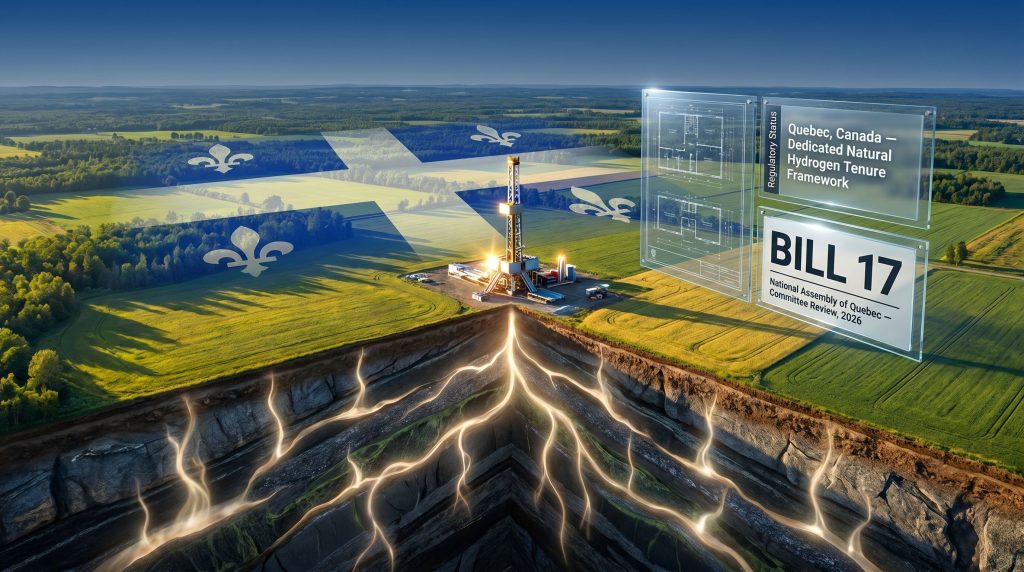
Bill 17 is a piece of proposed provincial legislation currently advancing through the parliamentary committee review stage at the National Assembly of Quebec. As of June 2026, no confirmed timeline for a final vote or royal assent has been publicly established.
The bill's primary purpose is to create a standalone legal framework for natural hydrogen as a distinct subsurface resource category within Quebec. Its core objectives include:
- Establishing a formal legal definition of natural hydrogen that distinguishes it from petroleum and mineral resources under existing Quebec law
- Creating a tenure and licensing system covering exploration rights, drilling authorisations, and eventual extraction concessions
- Defining the oversight responsibilities of provincial regulatory bodies in administering natural hydrogen concessions
- Setting out environmental assessment requirements appropriate to subsurface hydrogen exploration activities
The parliamentary committee stage is a substantive phase of Quebec's legislative process. It involves clause-by-clause examination of the bill's text, testimony from industry participants, environmental advocates, municipal representatives, and technical experts, and the development of amendments before the bill proceeds to a final vote. The committee stage is where legislation is meaningfully shaped, and for Bill 17, this process is actively ongoing.
What is Quebec's Bill 17?
Bill 17 is proposed provincial legislation currently under parliamentary committee review at the National Assembly of Quebec. Its primary purpose is to establish a formal legal and regulatory framework governing the exploration and development of natural hydrogen resources within the province, filling a significant gap left by existing mining and petroleum statutes.
QIMC appeared before the parliamentary committee to present its natural hydrogen development work in the Abitibi-Témiscamingue region, contributing technical knowledge about exploration-stage activities to the legislative deliberation process. The company has expressed support for the bill's advancement as an important step toward establishing a functioning regulatory environment for the sector.
How Quebec's Approach Compares to the Rest of the World
The global regulatory landscape for natural hydrogen remains extraordinarily thin. The following comparison illustrates where different jurisdictions currently stand.
| Jurisdiction | Regulatory Status | Governance Approach |
|---|---|---|
| Quebec, Canada | Bill 17 under committee review (2026) | Standalone dedicated legislation proposed |
| France | Exploratory permits issued | Existing mining code adapted on case-by-case basis |
| United States | Federal land-use permits in place | No dedicated natural hydrogen statute at federal or state level |
| Australia | State-level pilot frameworks emerging | Aligned with geothermal and petroleum codes |
| Mali | Early-stage international exploration activity | Minimal formal governance structure |
| Oman | Ophiolite exploration underway | Regulatory frameworks under development |
What distinguishes Quebec's approach is the deliberate choice to create standalone legislation rather than adapting existing frameworks. France has issued exploratory permits under a modified interpretation of its mining code, a pragmatic but structurally fragile solution that leaves tenure rights ambiguous. The United States has proceeded with federal land-use authorisations on an ad hoc basis. Australia's emerging frameworks tend to borrow from geothermal statutes, which share some subsurface access characteristics but were not designed for hydrogen gas management.
A dedicated legislative framework, by contrast, provides legal certainty across the entire development lifecycle: from initial exploration licensing through to extraction royalties, environmental liability assignment, and community consultation requirements. This certainty is what investment capital requires before it will move from geological targeting to active drilling. Understanding the permitting risk inherent in any nascent resource sector underscores precisely why standalone legislation matters so much at this stage.
The Core Policy Debates Surrounding Bill 17
Water Resource Competition and Agricultural Land Use
The most prominent concern raised during committee hearings involves the potential intersection between natural hydrogen drilling operations and agricultural water resources. Liberal Members of the National Assembly (MNAs) raised questions about whether subsurface drilling programs in Quebec's agricultural regions could compete with farming operations for water access.
This concern is not without foundation. Drilling programs, particularly those reaching depths of several thousand metres, require significant water volumes for drilling fluid preparation, equipment cooling, and borehole stabilisation. In regions where agriculture depends on shallow aquifer systems, the cumulative water demands of an expanding exploration sector could create genuine resource competition.
The hydrological question also extends to contamination risk. While natural hydrogen is non-toxic, the drilling fluids and chemical additives used in exploration programs can pose risks to groundwater if well casing integrity is compromised. Comparative jurisdictions have addressed this through mandatory baseline water testing, setback distances from agricultural water sources, and post-drilling remediation bonds.
In addition, considerations around natural capital in mining operations are increasingly relevant here, as the sector's interaction with water systems and land use becomes subject to greater regulatory and investor scrutiny.
Policy Risk Note: The adequacy of Bill 17's current protective provisions for water-dependent land users has been questioned during committee deliberations. How these concerns are resolved through amendments will significantly influence both the bill's passage timeline and the social licence conditions under which natural hydrogen exploration eventually operates in Quebec.
The Precautionary Principle Versus Development Velocity
A deeper tension running through the committee debates reflects a familiar dynamic in resource legislation: the trade-off between implementing precautionary environmental standards and enabling timely resource development. Opposition members have flagged what they characterise as gaps in the bill's protective provisions, while industry participants have emphasised that excessive regulatory uncertainty delays the investment decisions needed to determine whether Quebec's natural hydrogen resources are commercially viable at all.
The resolution of this tension through the committee amendment process will define the practical operating conditions of Quebec's natural hydrogen sector for years to come. Historical precedent from other Canadian provincial resource bills suggests that protective provisions strengthened during committee review tend to produce more socially durable regulatory frameworks, even if they extend pre-production timelines.
The Chicken-and-Egg Problem in Exploration Capital
One of the less-discussed dynamics in natural hydrogen development is the capital deployment paradox facing exploration companies. Gathering the geological data needed to demonstrate commercial potential requires drilling. Drilling requires regulatory certainty about tenure rights, environmental obligations, and royalty structures. However, that regulatory certainty only exists once legislation passes.
Meanwhile, the geological data needed to make the strongest possible case for dedicated legislation is precisely what cannot be gathered without it. This creates a compounding delay that affects the entire sector's development trajectory.
QIMC's situation illustrates this directly. The company holds a 5,000-metre drilling permit in a geologically prospective region, has completed its geological targeting work, and is operationally ready to drill. The constraint is not geological or logistical. It is legislative. Until Bill 17 or equivalent legislation provides enforceable tenure rights, advancing a capital-intensive drilling program creates legal exposure that institutional investors and project financiers are not prepared to absorb.
This dynamic explains why industry participation in the committee process is substantive rather than merely symbolic. Companies like QIMC are not simply lobbying for a favourable outcome. They are contributing technical knowledge that the legislature genuinely needs to write workable regulations, while simultaneously waiting for the legislative output that will unlock their own capital programs.
The next major ASX story will hit our subscribers first
What Bill 17 Means for Quebec's Energy Identity
Quebec's energy identity has been defined for decades by its extraordinary hydroelectric infrastructure. The province generates over 99% of its electricity from hydropower, making it one of the cleanest large-scale electricity systems in North America. This creates an interesting strategic context for QIMC Bill 17 natural hydrogen Quebec.
Rather than positioning natural hydrogen as a competitor to Quebec's existing clean energy base, it is more accurately understood as a potential complement. Natural hydrogen, if extractable at commercial concentrations, could serve as a zero-emission feedstock for industrial decarbonisation, particularly in hard-to-abate sectors such as steel production, fertiliser manufacturing, and heavy transport, where direct electrification remains technically difficult or prohibitively expensive.
The economic development implications for regions like Abitibi-Témiscamingue are also significant. The region has a long history of resource extraction and the infrastructure, workforce skills, and regulatory familiarity that comes with it. A functioning natural hydrogen sector could generate sustained economic activity in a part of Quebec where resource cycles have historically driven community prosperity.
Frequently Asked Questions: QIMC, Bill 17 and Natural Hydrogen in Quebec
What makes the Abitibi-Témiscamingue region geologically relevant to natural hydrogen?
The region sits within Precambrian shield geology characterised by ancient basement rocks, complex structural fault systems, and the presence of mafic and ultramafic rock types associated with serpentinization reactions. These are precisely the geological conditions under which natural hydrogen generation and accumulation are theorised to occur. The shield environment also offers the geological stability over deep time that allows hydrogen to concentrate in trappable subsurface structures rather than diffusing to surface.
Why is a 5,000-metre drilling permit significant?
A 5,000-metre drilling program represents a substantive exploration commitment. At that depth, drillers can access basement rock horizons where serpentinization reactions are most likely to have generated hydrogen accumulations. For context, many conventional oil and gas exploration wells operate in the 2,000 to 4,000 metre range. A 5,000-metre program signals that the exploration target is deep within the crustal column, consistent with the geological theory underpinning natural hydrogen exploration in shield terranes.
How does natural hydrogen's production cost compare to green and blue hydrogen?
Green hydrogen currently costs between USD $3 and $8 per kilogram to produce, depending on renewable electricity costs. Blue hydrogen ranges from approximately USD $1.50 to $3 per kilogram but carries carbon liability. Natural hydrogen, if extracted at sufficient concentrations from productive geological structures, has been theorised to achieve costs below USD $1 per kilogram at the wellhead, though no large-scale commercial extraction operation has yet established a definitive cost benchmark. These figures are illustrative estimates and should not be treated as confirmed production economics.
What happens to QIMC's drilling program once Bill 17 passes?
With geological targets already identified and a drilling permit in hand, QIMC would be positioned to transition directly from planning to execution once a legally enforceable regulatory framework exists. The passage of Bill 17 would effectively remove the primary legal barrier preventing the deployment of exploration capital into the Abitibi-Témiscamingue program. Understanding the feasibility study process that follows initial exploration drilling further illustrates how much depends on getting this regulatory foundation right.
The Legislative Path Forward and What Investors Should Monitor
For market participants tracking the QIMC Bill 17 natural hydrogen Quebec story, the following milestones represent the key inflection points in the near-term legislative trajectory:
-
Committee stage completion: The National Assembly committee must finalise its clause-by-clause review and agree on any amendments to be incorporated into the bill's final text.
-
Third reading and vote: Bill 17 must pass a vote of the full National Assembly before proceeding to royal assent.
-
Royal assent: The bill becomes law upon receiving royal assent from the Lieutenant Governor of Quebec.
-
Subordinate regulation development: After passage, the provincial government must draft the detailed regulatory instruments covering permit fee structures, environmental assessment thresholds, royalty rates, and reporting requirements. This phase typically takes several months to over a year.
-
Tenure framework activation: Only once subordinate regulations are gazetted and in force can exploration companies rely on the full legal certainty needed to commit institutional capital to drilling programs.
Furthermore, the broader mining geopolitical landscape in 2025 and beyond adds another layer of urgency to Quebec's first-mover positioning. Jurisdictions that establish clear, investable frameworks for emerging resources early tend to attract disproportionate capital relative to those that proceed reactively.
Strategic Outlook: Quebec has a genuine structural opportunity to become one of the first Canadian provinces, and among the first jurisdictions globally, to operate a fully codified natural hydrogen regulatory framework. The completeness and quality of Bill 17's final form will determine whether that first-mover position translates into a functioning exploration sector, or whether regulatory gaps create the same ambiguity the bill was designed to resolve. QIMC's recent announcement of high hydrogen concentrations further reinforces why a robust legislative outcome is so consequential for the sector's development.
This article contains references to forward-looking regulatory timelines and speculative cost projections. Legislative outcomes, exploration results, and commercial development timelines involve material uncertainty. Nothing in this article constitutes investment advice. Readers should conduct independent research and seek qualified financial guidance before making investment decisions.
Want to Track the Next Major Resource Discovery Before the Market Does?
Discovery Alert's proprietary Discovery IQ model scans ASX announcements in real time, instantly identifying significant mineral and energy resource discoveries across more than 30 commodities — including the emerging natural hydrogen sector — and translating complex geological data into clear, actionable investment insights. Explore historic discovery returns on Discovery Alert's dedicated discoveries page and begin your 14-day free trial today to position yourself ahead of the broader market.