July 21, 2026
The Energy Category That Most Analysts Missed
For most of the past century, hydrogen existed in the public imagination primarily as a manufactured industrial chemical, not as a naturally occurring subsurface resource waiting to be tapped. The entire global hydrogen industry was built on the assumption that producing the element required significant energy input, whether through steam methane reforming, electrolysis, or other energy-intensive processes. That assumption shaped infrastructure investment, policy frameworks, and the economics of the entire sector.
What is now becoming clear is that the Earth itself has been producing hydrogen continuously through geological processes, accumulating it in subsurface reservoirs for millions of years. The scientific community's belated recognition of this reality represents one of the most consequential paradigm shifts in energy resource thinking in decades. Furthermore, at the centre of this shift, a discovery in the Canadian Prairies is rewriting assumptions about where the world's next major clean energy source might come from.
The Saskatchewan natural hydrogen discovery at Max Power Mining has placed a previously overlooked province at the epicentre of what may become an entirely new resource category.
When big ASX news breaks, our subscribers know first
Understanding Natural Hydrogen as a Resource Class
Why the Industry Overlooked It for So Long
Prior to roughly 2020, the geological and energy communities gave almost no serious attention to naturally occurring subsurface hydrogen. The gas was known to exist in trace amounts associated with certain geological settings, but it was largely dismissed as a curiosity rather than a commercially relevant resource. The prevailing view was that hydrogen's extreme lightness and reactivity made long-term subsurface accumulation unlikely at meaningful scale.
That view is now being revised rapidly. It turns out that specific geological architectures, particularly those involving Precambrian basement rocks combined with effective cap-rock sealing mechanisms, can trap naturally generated hydrogen in concentrated reservoirs over geological timescales. Identifying those architectures is the new frontier of energy exploration. This mirrors the broader white hydrogen discovery momentum unfolding globally across multiple continents.
The Four Hydrogen Types and Why Cost Changes Everything
To understand why natural hydrogen commands such extraordinary attention, it helps to frame it within the existing hydrogen production landscape. The market currently recognises four broad categories:
| Hydrogen Type | Production Method | Estimated Cost per kg | Carbon Intensity |
|---|---|---|---|
| Grey Hydrogen | Steam methane reforming | ~$1–$2/kg | High |
| Blue Hydrogen | SMR + carbon capture | ~$2–$4/kg | Medium |
| Green Hydrogen | Electrolysis (renewables) | ~$6–$10/kg | Near-zero |
| Natural (Gold) Hydrogen | Geological extraction | ~$0.50/kg (projected) | Zero |
More than 90% of the world's hydrogen supply is currently produced from hydrocarbons, making it a far less clean energy source than its reputation often suggests. Green hydrogen, produced by running renewable electricity through water via electrolysis, carries near-zero carbon intensity but costs between $6 and $10 per kilogram, a price point that makes it uncompetitive with fossil fuels across most applications.
Natural hydrogen, if commercially producible at the projected cost of approximately $0.50 per kilogram, would represent a reduction of 92 to 95 percent versus green hydrogen, while matching it on carbon intensity. That single data point explains the intensity of global interest in the Saskatchewan natural hydrogen discovery at Max Power Mining.
What the Lawson Well Discovery Actually Confirmed
Canada's First Confirmed Subsurface Natural Hydrogen System
In November 2024, Max Power Mining successfully completed the Lawson confirmation well in the Central Butte area of southern Saskatchewan, an agricultural landscape characterised by vast farmland in the southern third of a province comparable in size to the state of Texas. The local farming community demonstrated strong cooperative engagement with surface access, which the company has identified as a meaningful operational advantage.
The technical results from the Lawson well were significant by any measure:
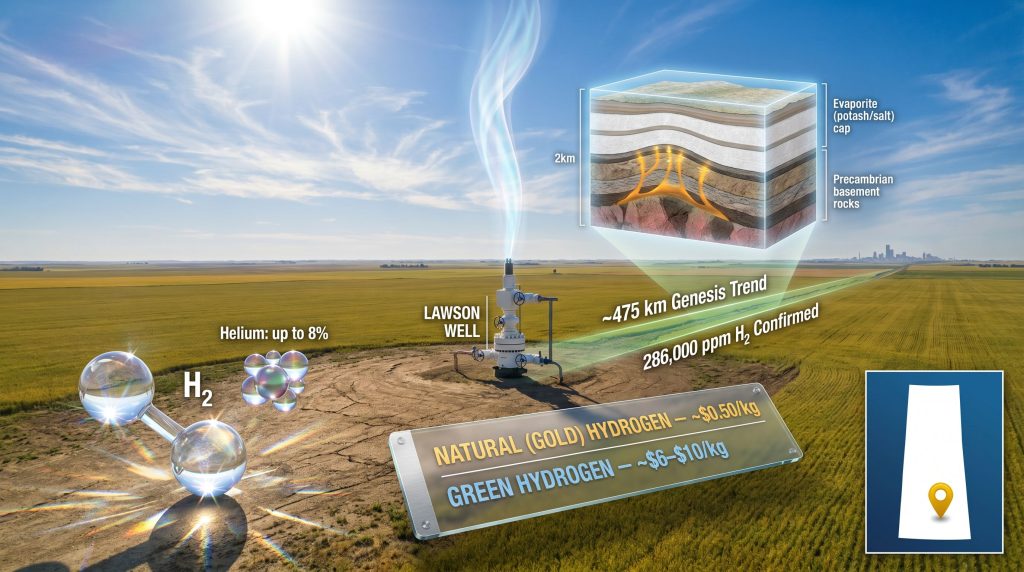
- Hydrogen concentrations reaching up to 286,000 ppm confirmed at the wellbore
- Helium concentrations of up to 8% detected as a co-product with independent market value
- Gas confirmed flowing to surface, a critical technical threshold for commercial viability assessment
- Basement source rocks identified at approximately 2 kilometres depth
- Land package of approximately 1.3 million acres of Saskatchewan exploration permits secured
The confirmation of gas flowing to surface is particularly significant. In exploration terms, detecting a gas in a core sample or formation test is meaningful, but surface flow confirms that the reservoir has sufficient pressure and permeability to deliver product through a wellbore. That distinction separates geological curiosity from commercial prospect.
The helium co-discovery adds a separate commercial dimension. Helium is a strategic industrial gas used in medical imaging, semiconductor manufacturing, and defence applications, and it commands prices well above those of most industrial gases. Consequently, finding it at concentrations up to 8% alongside hydrogen creates a dual-product revenue potential that materially improves the economics of any future production operation.
The Genesis Trend: A 475-Kilometre Geological Corridor
The Lawson well is not an isolated data point. It sits within what Max Power's technical team has defined as the Genesis Trend, a geological corridor extending approximately 475 kilometres from north to south across Saskatchewan. The structural characteristics of this trend include:
- Basement source rocks at approximately 2 kilometres depth, generating hydrogen through ongoing water-rock chemical interaction
- Upward migration channels allowing the lighter-than-air hydrogen molecules to rise from source rocks toward the surface
- Evaporite seal layers (potash and salt formations) acting as pressure-retaining caps that trap hydrogen and helium in concentrated reservoir accumulations
This geological architecture is not coincidental. It is the same basement rock framework responsible for Saskatchewan's world-class uranium and potash industries. The province already hosts the world's largest known uranium reserves and among the largest potash deposits globally. The structural conditions that made those industries possible appear to be the same conditions creating natural hydrogen reservoirs along the Genesis Trend.
The company has identified dozens of potential targets distributed along the full length of the trend, with a second licensed drilling location (the Bracken well) positioned near the Saskatchewan-Montana border to test a distinct play concept at the southern end of the corridor.
Why Saskatchewan Holds a Structural Advantage
Geology, Infrastructure, and Regulatory Familiarity Converging
The geological case for Saskatchewan is compelling on its own terms, but what makes the province's position particularly strong is the convergence of multiple non-geological advantages that most emerging natural hydrogen jurisdictions lack entirely.
Saskatchewan's oil and gas exploration history has produced decades of 3D seismic data coverage across the province. That existing seismic library can be repurposed to identify hydrogen reservoir targets without the cost and time burden of acquiring new data from scratch. The Lawson area already has 3D seismic coverage that identified what the company's technical team describes as a bullseye target covering approximately 12 to 14 square kilometres adjacent to the first well.
The province's regulatory environment, shaped by long experience with uranium and potash extraction, creates familiarity with resource permitting processes that newer jurisdictions cannot replicate quickly. The local farming communities in the southern third of the province have demonstrated receptive engagement with the project, facilitating surface access that can otherwise be a significant timeline constraint for exploration programs. In addition, data-driven mining operations in the region provide an established technical foundation that accelerates exploration workflows considerably.
The Industrial Corridor and Offtake Proximity
Perhaps the most underappreciated aspect of the Saskatchewan natural hydrogen discovery at Max Power Mining is the proximity of the Lawson well to established industrial infrastructure. The Moose Jaw-Regina Industrial Corridor spans approximately 70 kilometres east to west and hosts a concentration of industrial consumers including:
- Potash mining operations requiring significant energy inputs
- Oil and gas refinery infrastructure currently producing and consuming industrial hydrogen
- Agricultural processing facilities with large-scale energy requirements
- Bell's announced data centre development at the eastern end of the corridor
The Lawson site sits approximately 40 kilometres from the nearest city, which has already executed a memorandum of understanding with the company regarding potential offtake from future hydrogen production. That commercial engagement, at the exploration stage, signals the kind of demand-pull dynamic that most early-stage resource projects never experience.
Does Geology Stop at the Border?
The Cross-Border Scale Dimension
Stratigraphic and structural geological trends do not terminate at political boundaries. The evaporite seal formations that extend from one side of Saskatchewan to the other continue southward into Montana and beyond. The Bracken well, positioned near the Saskatchewan-Montana border, is designed partly to test whether the Genesis Trend's commercial characteristics extend into United States territory.
The scale implications of a cross-border system are significant. Analysis linked to the US Geological Survey suggests that subsurface natural hydrogen volumes across North America may exceed the continent's conventional natural gas reserves. The frequently cited framing within the natural hydrogen research community is that if only 2% of estimated North American subsurface natural hydrogen resources were extracted, the energy yield could theoretically sustain clean energy supply for approximately 100 years.
This framing is important context for understanding why a land position of 1.3 million acres in Saskatchewan, established ahead of widespread industry attention, carries disproportionate strategic value relative to what that acreage might cost to assemble today in a competitive environment.
Notably, the company's chairman has observed publicly that a wave of competitor exploration activity is inevitable, drawing a direct parallel to the pattern of capital following major discoveries in the uranium and gold sectors. Establishing land position, technical understanding, and drilling momentum before that wave arrives is the strategic logic underlying the current acceleration of activity.
The Economics of Natural Hydrogen at Scale
Cost Structure and Competitive Positioning
Hydrogen delivers approximately three times the energy output per unit mass compared to gasoline, with zero carbon emissions at the point of use. That energy density advantage, combined with the absence of combustion-related carbon output, makes it structurally attractive for a wide range of applications. The barrier to mass adoption has always been cost, not performance.
At projected production costs of approximately $0.50 per kilogram for natural hydrogen, the competitive position versus every other hydrogen production method is striking. The cost differential versus green hydrogen alone suggests the potential to displace electrolysis-based production across virtually every industrial application where hydrogen is currently used.
End-Use Markets With Near-Term and Long-Term Potential
| Application | Current Fuel | Hydrogen Advantage |
|---|---|---|
| Heavy transport trucks | Diesel | No range or weight penalty versus battery-electric |
| Aviation | Jet fuel | No battery weight constraint for long-haul routes |
| Data centres | Grid electricity | Zero-carbon power plus on-site brine cooling water |
| Gas distribution networks | Natural gas | 20-30% blend-ready existing infrastructure |
| Industrial hydrogen users | Grey or blue hydrogen | Approximately 95% lower production cost |
The pipeline blending opportunity deserves particular emphasis. Both the Saskatchewan and Alberta provincial governments have indicated willingness to blend 20 to 30% natural hydrogen into existing natural gas distribution networks. Given the scale of Western Canada's gas distribution system, this represents an immediately accessible, large-volume market that does not require the construction of new end-use infrastructure.
The data centre co-location model is equally significant. Natural hydrogen production sites in Saskatchewan offer an unusual combination of zero-carbon electricity generation potential and subsurface brine water, which data centres require in large volumes for cooling. Delivering both critical inputs from a single site, without grid dependency, addresses a growing procurement priority for hyperscale computing operators seeking 24/7 zero-carbon baseload power. The company has already received unsolicited inbound interest from technically capable data centre partners, described by the company's leadership as an overwhelming volume of approaches from qualified parties.
Furthermore, hydrogen-powered trucks represent another compelling end-use case, with heavy transport operators increasingly seeking alternatives to diesel that do not compromise on range or payload capacity.
The next major ASX story will hit our subscribers first
Is Natural Hydrogen a Regenerating Resource?
The Geological Mechanism Behind Semi-Renewable Production
One of the least understood aspects of natural hydrogen is whether reservoirs replenish themselves or follow conventional hydrocarbon depletion curves. The answer lies in the underlying chemistry of hydrogen generation.
Natural hydrogen in geological systems is produced primarily through two processes. Serpentinisation occurs when water reacts with iron and magnesium-rich basement rocks (ultramafic and mafic lithologies) at depth, producing hydrogen as a byproduct. Radiolysis involves the splitting of water molecules by radiation from naturally radioactive elements in basement rocks, again generating hydrogen. Both processes are ongoing as long as water and reactive rock remain in contact, which in geological terms means essentially indefinitely.
This distinguishes natural hydrogen from conventional hydrocarbon reservoirs in an important way. Conventional oil and gas reservoirs represent static accumulations formed over millions of years that deplete as production extracts them. Natural hydrogen reservoirs, to varying degrees, receive ongoing replenishment from the continuing chemical reactions below. The rate of replenishment relative to extraction rates is a critical variable that remains to be characterised through extended production testing.
The evaporite seals (potash and salt layers) that trap hydrogen in Saskatchewan's geological architecture function as long-term pressure caps, retaining gas that would otherwise migrate upward and dissipate. Identifying and mapping these seals using 3D seismic data is central to the company's approach for targeting new wells along the Genesis Trend.
The AI Boom and the Demand-Side Acceleration
Why Data Centre Growth Changes the Natural Hydrogen Investment Thesis
Global data centre power demand is expanding rapidly, driven by the computational requirements of artificial intelligence workloads. The energy intensity of large language model training and inference has created a structural need for enormous volumes of reliable, zero-carbon baseload power that intermittent renewable sources struggle to satisfy consistently.
Solar and wind generation, while cost-effective at the margin, cannot provide the 24/7 reliability that mission-critical data centre operations require without substantial battery storage infrastructure, which introduces its own cost and material supply constraints. Natural hydrogen-based electricity generation, producing power on-demand from a stored fuel source, addresses the baseload reliability gap directly.
The co-location opportunity identified in Saskatchewan involves pairing hydrogen-fuelled zero-carbon power generation with the subsurface brine water resource present at depth below the production zone. Data centres require two primary physical inputs at scale: electricity and cooling water. Delivering both from the same site, without dependence on grid power or municipal water supply, creates a compelling value proposition for operators seeking to site new facilities outside congested urban infrastructure corridors.
International engagement with the company's work has reached government and institutional levels across multiple countries, with delegations and speaking invitations from Japan, France, and Washington DC reflecting the breadth of global attention the Saskatchewan discovery has generated.
Commercialisation Pathway and Investor Risk Framework
From Discovery Well to Molecules: A Staged Development Roadmap
The company's leadership has consistently used the phrase months to molecules to characterise the commercialisation timeline, drawing an explicit contrast with conventional mining development cycles that typically span 7 to 15 years from discovery to production. The basis for this comparison is structural: once natural hydrogen flows to surface and gas separation and processing infrastructure is installed, the pathway to first sales is significantly shorter than in hard rock mining.
The development roadmap unfolds across four broad phases:
- Phase 1 (Current): Flow rate testing, porosity and permeability analysis, and resource modelling at the Lawson well to characterise commercial viability
- Phase 2 (Near-term): Consecutive follow-up drilling campaign targeting multiple Genesis Trend locations, beginning with the bullseye 3D seismic target adjacent to Lawson
- Phase 3 (Medium-term): Commercial viability determination, gas separation and processing infrastructure scoping for helium and hydrogen, and offtake contract negotiations
- Phase 4 (12-18 month horizon): Potential transition from exploration-stage activity toward commercially oriented production operations
Key Risk Factors Investors Must Understand
This section involves forward-looking analysis. Investors should conduct independent due diligence and be aware that exploration-stage companies carry substantial uncertainty.
- All current technical claims originate from company-released exploration data. No independent third-party resource certification has been publicly disclosed, which is standard at this stage but represents a meaningful information gap
- The distinction between an exploration discovery and a certified commercial resource is significant from a regulatory, financial, and investment perspective
- Reservoir characterisation data on long-term flow rates, pressure sustainability, and commercial well spacing remains to be determined through upcoming drilling
- Gas separation and compression infrastructure capital requirements have not been publicly quantified
- Competitive dynamics are accelerating globally, and the first-mover land position advantage is time-sensitive as other explorers enter the natural hydrogen sector
How Saskatchewan Compares to Global Natural Hydrogen Analogues
| Region | Geological Setting | Development Stage | Infrastructure Maturity |
|---|---|---|---|
| Saskatchewan, Canada | Precambrian basement plus evaporite seal | Discovery confirmed, drilling underway | High (existing oil, gas, potash networks) |
| Mali (Bourakébougou) | Precambrian craton | Early commercial production | Low |
| Australia (Amadeus Basin) | Precambrian craton | Early exploration | Low to Medium |
| United States (ophiolite belts) | Ophiolite and ultramafic hosted | Academic and early exploration | Variable |
Mali's Bourakébougou field is often cited as the world's first commercially producing natural hydrogen well, providing a proof-of-concept for geological extraction at small scale. What differentiates Saskatchewan is the combination of geological confirmation at scale, existing industrial infrastructure, regulatory maturity from decades of resource extraction experience, and a land position established before widespread competitive interest developed.
Frequently Asked Questions
What is natural hydrogen and how is it different from green or grey hydrogen?
Natural hydrogen (sometimes called gold hydrogen) is hydrogen gas produced through ongoing geological processes within the Earth's crust, rather than manufactured through industrial processes. It requires no energy input to generate, carries zero carbon emissions, and based on current projections could be extracted at a fraction of the cost of electrolysis-based green hydrogen. Unlike grey hydrogen (which is derived from fossil fuels) or green hydrogen (which requires renewable electricity), natural hydrogen exists as a pre-formed subsurface resource.
Where was Canada's first natural hydrogen system discovered?
The Lawson confirmation well, located in the Central Butte area of southern Saskatchewan, produced Canada's first confirmed subsurface natural hydrogen system in November 2024. The discovery sits within the Genesis Trend, a geological corridor approximately 475 kilometres in length running north to south across the province.
What concentration of hydrogen was found at the Lawson well?
Hydrogen concentrations of up to 286,000 ppm were confirmed at the Lawson well, with helium concentrations reaching up to 8% as a commercially significant co-product.
How much land does Max Power Mining hold in Saskatchewan?
The company holds approximately 1.3 million acres of exploration permits covering portions of the Genesis Trend, which extends approximately 475 kilometres north to south across Saskatchewan.
Is natural hydrogen a renewable resource?
Natural hydrogen is more accurately described as semi-renewable. The serpentinisation and radiolysis processes that generate it are ongoing as long as water and reactive basement rocks remain in contact, meaning reservoirs receive continuous replenishment from below. However, whether replenishment rates match or exceed production rates at commercial extraction volumes remains to be determined through extended testing.
What are the main commercial applications for natural hydrogen?
- Pipeline blending into existing natural gas distribution networks at 20-30% concentration
- Standalone zero-carbon power generation for data centre co-location
- Heavy transport decarbonisation where battery-electric alternatives face weight and range constraints
- Aviation applications via hydrogen-combustion jet engine development
- Direct substitution for grey hydrogen in industrial refinery and chemical manufacturing processes
How does natural hydrogen production cost compare to other types?
Projected natural hydrogen production costs of approximately $0.50 per kilogram compare to $6 to $10 per kilogram for green hydrogen produced via electrolysis, representing a potential cost reduction of 92 to 95 percent.
Saskatchewan's Place in the Long-Term Energy Transition
A 50-Year Scenario: Where Natural Hydrogen Fits
Looking across a multi-decade horizon, two zero-carbon energy technologies have emerged as the most credible candidates for large-scale baseload power: small modular nuclear reactors and natural hydrogen. SMR deployment timelines of 8 to 10 years per facility mean that meaningful nuclear capacity additions are a 2030s and 2040s phenomenon at the earliest. Natural hydrogen, with its dramatically shorter path from discovery to production, could serve as a bridging energy source during precisely the period when grid decarbonisation pressure is most acute.
Uranium supply constraints represent a structural ceiling on how rapidly nuclear capacity can expand globally, a dynamic that Max Power's chairman is uniquely positioned to assess given his six-year tenure as chairman of the world's largest uranium producer. Natural hydrogen faces no equivalent feedstock limitation if the regenerative geological processes underlying Saskatchewan's reservoirs prove sustainable at commercial production rates.
The technology ecosystem surrounding hydrogen utilisation is developing rapidly. Hydrogen-combustion engine development for aviation (with Rolls-Royce among the active participants), hydrogen fuel cell heavy transport, and hydrogen refuelling infrastructure in European automotive markets all represent demand accelerators that were largely theoretical five years ago and are now engineering realities at varying stages of deployment. The energy transition in mining sectors across Canada further underscores the urgency of finding cost-competitive clean fuel alternatives at scale.
If USGS-aligned estimates of North American subsurface natural hydrogen volumes prove accurate, the energy transition calculus does not change incrementally. It changes fundamentally, opening the possibility that geological hydrogen extraction becomes the defining energy story of the second half of this century in the same way that oil and gas defined the first half.
The next 12 to 18 months of drilling results along the Genesis Trend will represent the most critical validation window for that thesis. What the Lawson well established is that the resource exists in Saskatchewan at meaningful concentration and that it flows. What the upcoming campaign must demonstrate is whether it exists at basin scale, and whether the economics hold across multiple well locations. That is the question that the Saskatchewan natural hydrogen discovery at Max Power Mining now turns on.
This article contains forward-looking analysis and speculative projections based on publicly available company disclosures and industry research. It does not constitute financial advice. Readers considering investment decisions should conduct independent due diligence and consult a qualified financial adviser. Exploration-stage resource companies carry material uncertainty, and past geological discoveries do not guarantee commercial production outcomes.
Want to Stay Ahead of the Next Major Resource Discovery?
Discovery Alert's proprietary Discovery IQ model delivers real-time ASX alerts the moment significant mineral and energy discoveries are announced, transforming complex geological data into clear, actionable investment insights for both short-term traders and long-term investors. Explore how historic discoveries have generated extraordinary returns and begin your 14-day free trial today to position yourself ahead of the market before the next major find captures widespread attention.