Nelson Resources Ltd
- ASX Code: NES
- Market Cap: $8,354,069
- Shares On Issue (SOI): 2,784,689,566
Nelson Resources Drills Into Higher-Grade Gold at Orleans as 113.5 g/t Result Extends Mineralisation to a Second Underground Level
Nelson Resources Limited (ASX: NES) has reported its strongest underground channel sampling result yet from the Orleans Mine at the Gold Point Project in Nevada, with 113.5 g/t gold and 119 g/t silver over 1.83 metres from the 400-foot level. According to the ASX announcement, the result sits about 10 metres vertically below previously reported high-grade mineralisation on the 300-foot level, supporting the company's view that Orleans hosts a broader structurally controlled gold-silver vein system.
For investors following high-grade gold exploration in Nevada, the update matters because it shifts the geological interpretation. Rather than isolated high-grade patches, the latest underground sampling is being used to support a model of repeatable mineralisation linked to identifiable structures within the main vein.
"The 113.5g/t gold result from the 400-foot level is the highest grade returned from Nelson's underground channel sampling at Orleans and confirms strong mineralisation below the 300-foot level," said Gernot Abl, Non-Executive Chairman. "With high-grade gold-silver now identified on multiple levels, we are gaining confidence that Orleans hosts a broader, structurally controlled vein system rather than isolated occurrences."
When big ASX news breaks, our subscribers know first
What the Underground Sampling Update Showed
In the announcement, Nelson said it collected 22 vertical channel samples across about 160 metres of strike on the exposed hematite-quartz breccia vein fault on the 400-foot level. Samples were taken roughly every 6 to 10 metres, where it was safe to collect them, with individual widths ranging from 1.1 metres to 2.2 metres.
The standout assay came from sample PN0002191901913, which returned 113.5 g/t gold and 119 g/t silver over 1.83 metres. Two other significant 400-foot level channel samples included:
| Sample ID | Width (m) | Au (g/t) | Ag (g/t) | As (ppm) | Pb (ppm) | Sb (ppm) |
|---|---|---|---|---|---|---|
| PN0002191901913 | 1.83 | 113.5 | 119.0 | 1,075 | 2,390 | 192.0 |
| PN0002191901902 | 1.98 | 3.15 | 44.4 | 2,230 | 1,365 | 106.5 |
| PN0002191901904 | 1.14 | 2.08 | 28.1 | 1,650 | 56.3 | 31.1 |
These results build on the previously reported 300-foot level channel sampling, where Nelson had already identified high-grade gold and silver, including:
| Previously Reported 300-Foot Level Results | Width (m) | Au (g/t) | Ag (g/t) |
|---|---|---|---|
| High-grade channel sample | 3.0 | 77.3 | 102 |
| High-grade channel sample | 3.0 | 27.2 | 27 |
| High-grade channel sample | 3.0 | 10.3 | 3,840 |
| High-grade channel sample | 3.0 | 2.72 | 1,865 |
Taken together, the report indicates that high-grade mineralisation is now demonstrated on two separate underground levels. That does not in itself establish continuity suitable for a resource estimate, but it does improve confidence in target positioning ahead of drilling.
Why the Structural Setting Matters
A central theme in the ASX update is structural control. Nelson reported that its highest gold and silver values continue to be associated with brecciated quartz zones and subsidiary faults within the principal Orleans vein fault.
In practical terms, this means the company is not just collecting isolated assays. It is building a framework for where higher grades may occur within the broader vein.
For non-specialist investors, several technical terms in the announcement are worth clarifying:
| Term | Plain-English Explanation |
|---|---|
| Channel sample | A sample cut across an exposed rock face to measure grade across a defined width |
| Breccia | Rock made up of broken angular fragments cemented together |
| Vein fault | A fault or fracture filled with minerals such as quartz, which can host gold and silver |
| Strike length | The horizontal distance a vein or structure can be traced |
| Up-dip | The direction toward shallower levels or closer to surface |
| Stope | An underground area where ore was historically mined |
| Diamond drilling | Drilling that recovers a solid rock core for geological logging and assay testing |
Why does this matter to investors? Because if high-grade zones are linked to mapped structures rather than random occurrences, future drilling can be targeted more efficiently. Furthermore, according to the company, this improved understanding is now being used to refine hole orientation and define priority underground drill targets.
What Is a Hematite-Quartz Breccia Vein Fault?
The report refers repeatedly to the hematite-quartz breccia vein fault at Orleans. This is the main host structure being sampled underground.
A fault is a break in the rock where movement has occurred. When mineral-rich fluids move through that broken rock, they can deposit quartz and metals in the open spaces. If the rock has been strongly fractured, it can form a breccia, which creates more pathways for fluid flow.
In gold systems, these broken and re-cemented zones can become favourable sites for higher-grade mineral deposition. Nelson's update suggests that the best gold and silver values are found where the main fault contains internal brecciated quartz zones or where smaller faults cut across it. This is important because such features can become repeatable drill targets rather than one-off assay surprises.
Collapsed Stope Material May Add Another Target Stream
One of the more interesting parts of the announcement relates to historical mine waste. During rehabilitation work, Nelson collected 10 samples of collapsed material from historic stopes near the Dunfee shaft. This material had been left behind by previous operators.
The reported results included:
- 12.35 g/t gold and 106 g/t silver from sample C239880 on the 400-foot level
- 3.38 g/t gold and 206 g/t silver from sample C239882 on the 300-foot level
- 3.30 g/t gold and 56 g/t silver from sample C239884 on the 300-foot level
According to Nelson, these samples demonstrate that material previously treated as waste remains mineralised. This does not confirm economic extraction potential, but it does suggest that remnant mineralisation adjacent to historic workings could become a meaningful part of the company's underground evaluation programme.
That adds a second angle to the Orleans story. The first is vein extensions and unmined sections of the system. The second is potentially recoverable remnant material in and around old stopes.
Short Mud-Rotary Holes Provided Geological Constraints, Not Resource-Style Data
The report also covered eight short mud-rotary holes completed during rehabilitation. Three were drilled on the 400-foot level and five on the 300-foot level.
Their purpose was not to produce formal drilling intercepts for resource work. Instead, they were used to help define the orientation of the main vein fault and the thickness of remnant mineralisation near existing workings. Nelson said all holes started in hematite-quartz breccia, passed through a clay-rich zone, and ended in shale and limestone of the Wyman Formation, confirming the hanging-wall contact.
Selected intervals reported in the update included:
| Hole ID | Depth (m) | Azimuth | Dip | Best Reported Interval |
|---|---|---|---|---|
| OR-26-001 | 4.88 | 70° | +30° | 0 to 1.22 m @ 0.53 g/t Au |
| OR-26-003 | 5.18 | 25° | +55° | 0 to 1.22 m @ 1.84 g/t Au |
| OR-26-008 | 9.14 | 70° | +50° | 0 to 1.22 m @ 2.33 g/t Au |
Importantly, the company stated that recoveries were poor, averaging about 50%, due to the open-hole mud-rotary method in broken ground. Preferential loss of fine and heavy material is considered likely, and Nelson said the grades should therefore be treated as indicative only.
For investors, that distinction is important. These holes are useful for understanding geology and mine geometry, but they should not be read as equivalent to properly recovered diamond core results.
Diamond Drilling Is Now the Main Near-Term Catalyst
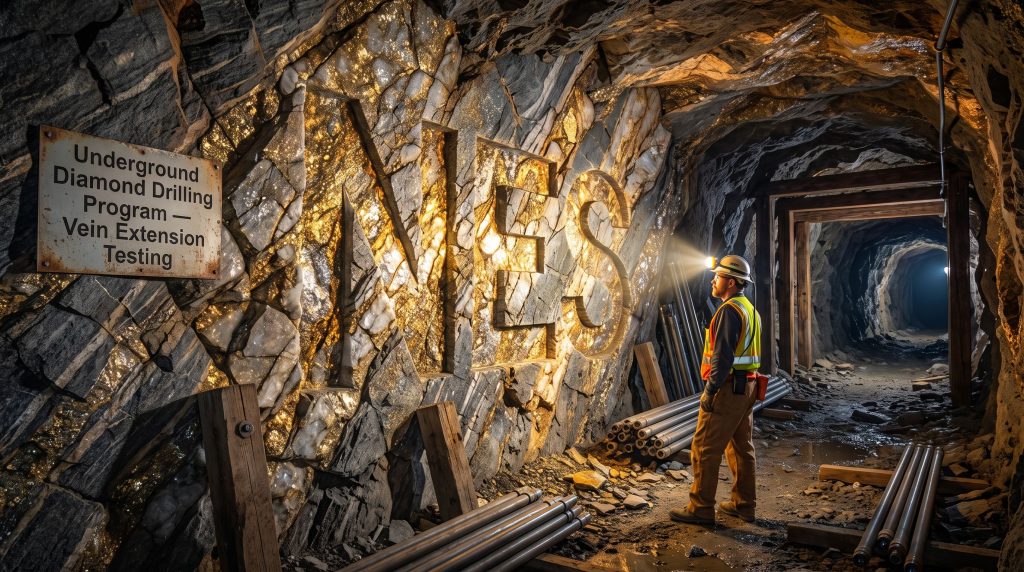
The most immediate next step in the report is the planned start of Orleans' maiden underground diamond drilling programme. Nelson said core drilling equipment is expected to be mobilised to site imminently, with up to 15 diamond core holes planned using a Bazooka drill rig.
According to the announcement, the drill programme is designed to test:
- Extensions of the Orleans vein up to about 40 metres beyond existing workings
- High-grade positions adjacent to historic stopes
- The approximately 70 metres of untested up-dip vein between the 300-foot and 150-foot levels
- The geometry and continuity of high-grade structural positions identified through underground sampling
The broader near-term work programme outlined by the company includes:
| Activity | Detail | Status |
|---|---|---|
| Underground diamond drilling at Orleans | Up to 15 core holes | Imminent |
| Vein extension testing | Up to approximately 40 m beyond workings | Planned |
| Up-dip testing | Approximately 70 m between 300-foot and 150-foot levels | Planned |
| Remnant mineralisation assessment | Adjacent to historic stopes | Planned |
| 3D geological modelling | Integration of sampling, surveys and drilling | Ongoing |
| Metallurgical testwork | Vein and remnant material | Underway |
| Great Western Mine planning | Rehabilitation planning | Commenced |
This is a commercially relevant shift. Channel sampling can indicate where grade occurs along exposed workings, however diamond drilling provides core, structural measurements, and more reliable geological context. It is also the first modern core drilling data expected from Orleans underground positions.
The next major ASX story will hit our subscribers first
What This Changes for the Investment Case
The latest update does not establish a resource, and it does not prove economic extraction. What it does appear to change is the level of confidence in the underlying geological model.
First, the 113.5 g/t gold channel sample extends high-grade mineralisation below the 300-foot level. Second, the company now has sampling data on two levels that point to similar structural controls. Third, near-term drilling targets are being selected from newly mapped underground information rather than broad conceptual positions.
How Does the Broader Gold Point Project Add Context?
The wider Gold Point Project adds considerable context to the Orleans results. Nelson has the right to earn up to a 90% interest in the Nevada project, which the company says includes more than 5 kilometres of underground workings across five historic mines. Historic district production is reported at about 75,000 ounces of gold at average grades of 20 to 30 g/t gold, largely from only four of 15 mapped high-grade gold-silver veins.
The company also describes multiple target styles across the broader district, including:
- High-grade fault-controlled gold-silver veins
- Intrusion-hosted gold-silver mineralisation
- Skarn-style gold-silver-copper-tungsten mineralisation
- Copper-molybdenum-gold porphyry potential
That project breadth may appeal to investors looking for more than a single-vein opportunity. In addition, near-term market attention is likely to remain on Orleans, where the next phase of drilling is expected to test whether channel sample grades can be translated into continuity beyond current workings.
The ASX update indicates that Nelson Resources has extended high-grade gold-silver mineralisation to a second underground level at Orleans, with a top result of 113.5 g/t gold over 1.83 metres. The announcement also shows that structural mapping is becoming more important in target generation, whilst maiden underground diamond drilling is close to starting. For investors, the next material test is whether upcoming core drilling supports continuity along vein extensions, remnant zones, and the untested interval between the 300-foot and 150-foot levels.
Ready to Catch the Next Major ASX Mineral Discovery Before the Market Moves?
Discovery Alert's proprietary Discovery IQ model scans ASX announcements in real time, instantly identifying high-grade mineral discoveries like those emerging across Nevada's historic gold belts — converting complex geological data into clear, actionable investment insights for traders and long-term investors alike. Explore how historic ASX mineral discoveries have generated exceptional returns on Discovery Alert's dedicated discoveries page, and begin your 14-day free trial today to position yourself ahead of the market.