July 9, 2026
The Hidden Bottleneck in the Clean Energy Supply Chain
The global conversation around critical minerals has largely fixated on mining — who digs what, where, and how fast. Yet the far more consequential battlefield lies several steps downstream. Neo Performance Materials rare earth magnet manufacturing in India represents one of the most technically demanding, capital-intensive, and geopolitically sensitive manufacturing capabilities in modern industry. And right now, that capability is overwhelmingly concentrated in a single country.
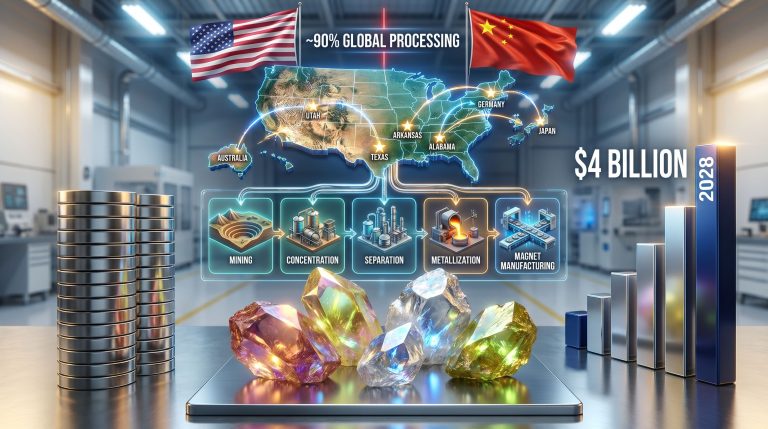
China controls an estimated 85 to 90 percent of global sintered rare earth permanent magnet production. For industries that depend on these magnets — including electric vehicle manufacturers, wind turbine producers, defence contractors, and industrial robotics firms — this concentration represents a structural vulnerability. Given the critical minerals demand surge unfolding globally, no amount of mining diversification alone can resolve this. The real supply chain problem is not in the ground. It is in the factory.
When big ASX news breaks, our subscribers know first
Understanding Sintered Rare Earth Permanent Magnets
Why NdFeB Magnets Are Irreplaceable
Neodymium-iron-boron, or NdFeB, sintered magnets are the highest-energy-density permanent magnets commercially available. Their magnetic strength-to-weight ratio is roughly ten times that of conventional ferrite magnets, making them the only practical choice for compact, high-torque applications where space and weight are constrained.
Key end-use applications include:
- Electric vehicle traction motors, where magnet performance directly determines drivetrain efficiency and vehicle range
- Direct-drive wind turbine generators, particularly offshore installations where maintenance access is limited and reliability is paramount
- Industrial robotics and servo motors, which require precise, high-speed motion control
- Defence systems, including guided munitions, drone propulsion units, and naval propulsion
Rare earth permanent magnets are not optional components that can be substituted with marginal performance trade-offs. In traction motors and wind generators, alternative magnet technologies would require significantly larger, heavier, and less efficient machine designs, fundamentally compromising product economics.
Furthermore, what makes sintered REPM manufacturing uniquely difficult is the multi-stage production process. Producing a finished magnet requires rare earth separation, oxide-to-metal reduction, alloy strip casting, hydrogen decrepitation, jet milling into fine powder, magnetic field alignment and pressing, sintering under vacuum, post-sinter heat treatment, coating, and precision machining.
Each stage demands specialised equipment, process expertise, and tightly controlled environmental conditions. Consequently, magnet production capacity cannot be replicated quickly, even with substantial capital investment. Understanding the broader rare earth processing challenges helps explain why this remains true even for well-resourced nations.
India's ₹7,280 Crore Incentive Scheme: What It Actually Entails
Breaking Down the Policy Framework
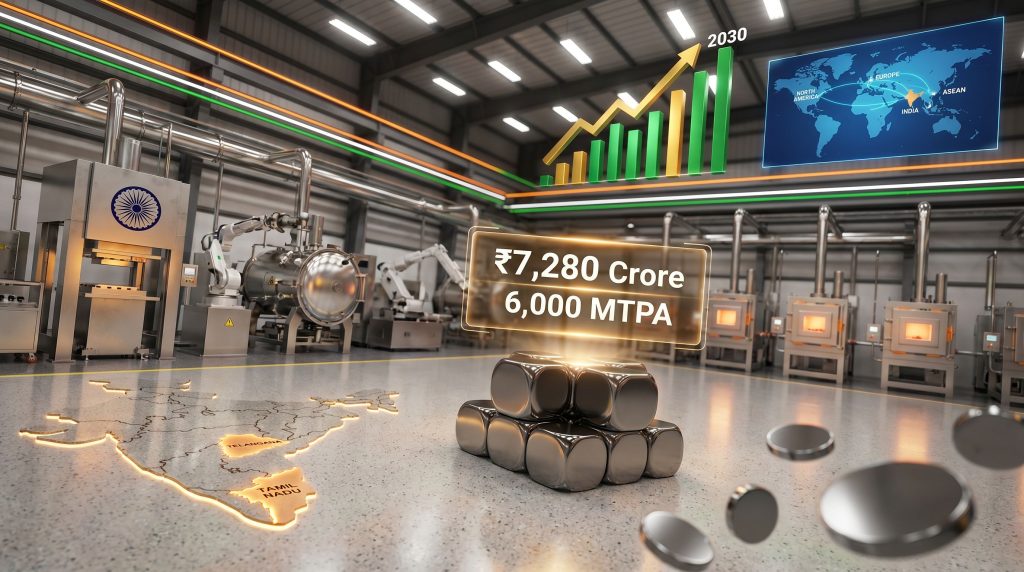
In November 2025, the Indian government approved a ₹7,280 crore scheme (approximately USD $870 million) specifically designed to promote the domestic manufacturing of sintered rare earth permanent magnets. The scheme's central objective is the establishment of 6,000 metric tons per annum (MTPA) of integrated REPM manufacturing capacity within India.
| Scheme Parameter | Detail |
|---|---|
| Total Incentive Value | ₹7,280 crore (~USD $870 million) |
| Approval Date | November 2025 |
| Manufacturing Capacity Target | 6,000 MTPA (integrated REPM) |
| Primary Beneficiaries | Domestic and international magnet manufacturers |
| Strategic Objective | Reduce dependency on Chinese magnet supply chains |
The word integrated carries significant weight in this context. An integrated facility encompasses the full production chain — from processing of rare earth concentrates through alloy production to final magnet sintering. This contrasts with a simpler downstream-only sintering operation that would remain dependent on imported alloy inputs, typically sourced from China. Integrated capacity delivers far greater supply chain resilience because it internalises the most technically sensitive processing stages.
India's Rare Earth Mineral Endowment
A less widely discussed advantage India holds is its own rare earth resource base. India possesses meaningful rare earth mineral deposits, primarily in the form of monazite-bearing beach and inland placer sands concentrated in states including Kerala, Odisha, Andhra Pradesh, and Jharkhand. India's total monazite reserves are estimated among the world's largest.
However, historical processing constraints have prevented the country from fully capitalising on this endowment. Crucially, monazite contains both light rare earths — including neodymium and praseodymium, the primary magnet-relevant elements — and thorium, a mildly radioactive element that complicates processing under standard industrial licensing frameworks.
This regulatory complexity around thorium handling has historically suppressed India's rare earth processing activity despite its mineral wealth. In addition, it makes the new incentive scheme's emphasis on integrated manufacturing all the more ambitious from a technical and regulatory standpoint.
Neo Performance Materials: Strategic Logic Behind the India Evaluation
A Non-Chinese Leader With Global Reach
Neo Performance Materials, headquartered in Toronto, Canada, occupies a rare position in the global critical materials landscape. As one of the world's foremost non-Chinese producers spanning rare earth processing, magnetic powders, sintered magnets, specialty chemicals, and rare metals, the company operates across multiple manufacturing jurisdictions with an explicit strategic focus on building supply chain capacity outside China.
The company's interest in India aligns with a core industrial logic: the rare earth magnet sector's most valuable competitive position belongs to manufacturers who can operate profitably at scale outside of China's sphere of production. Neo Performance Materials rare earth magnet manufacturing in India is among the most closely watched developments in the sector, with the company engaged in active discussions with multiple state governments.
Tamil Nadu and Telangana have emerged as the primary candidate jurisdictions. As of mid-2026, however, no formal investment commitment, confirmed facility size, or operational timeline for an India facility has been publicly disclosed. The company is understood to be assessing the full package of incentives each state is prepared to offer before making a final capital allocation decision.
The Estonia Proof-of-Concept
Neo's flagship sintered magnet manufacturing facility, located in Narva, Estonia, serves as the most direct technical precedent for what an India operation could look like. The Narva plant became Europe's first mass-producing sintered rare earth permanent magnet facility — a landmark achievement in Western supply chain sovereignty, and a significant step forward for the Europe battery boost agenda.
Traction-motor-grade magnet samples began shipping from the Estonia facility in April 2025, with commercial-scale deliveries targeted from mid-2026 onward. This operational progression demonstrates that Neo possesses the engineering know-how, equipment sourcing capabilities, and process management systems needed to establish sintered magnet production in a new geography.
Tamil Nadu vs. Telangana: The State-Level Competition
Both Tamil Nadu and Telangana have emerged as front-runners in discussions with international rare earth magnet manufacturers, and for good structural reasons.
Tamil Nadu offers:
- Established heavy manufacturing and automotive industry clusters, particularly around Chennai
- Strong port infrastructure enabling raw material imports and finished product exports
- A skilled technical workforce with experience in precision manufacturing
- Proactive state-level industrial investment attraction programmes
Telangana offers:
- A growing reputation as an industrial and pharmaceutical manufacturing hub centred on Hyderabad
- Competitive land acquisition and allocation processes for large-scale facilities
- Strong electronics and advanced manufacturing ecosystems
- Aggressive investment incentive structures at the state level
The dynamic between these two states illustrates a broader feature of India's federal investment attraction model: central government schemes establish the financial framework, while states compete on supplementary incentives including land, power tariffs, tax concessions, and workforce training support.
Comparing India to Other Emerging Magnet Manufacturing Geographies
The race to build non-Chinese sintered rare earth magnet production capacity is genuinely global. India enters this competition with a distinctive profile.
| Geography | Key Advantage | Current Status | Notes |
|---|---|---|---|
| Estonia (Europe) | EU market proximity, skilled labour | Operational (Neo, from 2025) | First mass-producing facility in Europe |
| India | Large domestic EV market, mineral endowment, government incentives | Pre-investment / incentive phase | 6,000 MTPA national target |
| United States | IRA funding mechanisms, defence demand | Early-stage multiple projects | Long permitting timelines remain a factor |
| Japan | Advanced magnet technology heritage | Mature but upstream China-dependent | Active diversification of feedstock sources |
| Australia | Rare earth mining strength | Primarily upstream-focused | Processing investment at early stages |
India's domestic demand profile is a genuinely differentiating factor. The country's electric vehicle market is on a steep adoption trajectory, supported by its FAME scheme. Wind energy capacity additions under the National Electricity Plan are accelerating. Furthermore, India's defence modernisation programme is generating incremental demand for high-performance permanent magnets in advanced systems.
Unlike most other jurisdictions building rare earth magnet capacity primarily for export markets, India could absorb a meaningful share of its own magnet output domestically. The rare earth strategic importance of this distinction should not be underestimated.
The next major ASX story will hit our subscribers first
Key Challenges That Could Slow India's Magnet Manufacturing Ambitions
The Processing Infrastructure Gap
Despite its mineral wealth, India's rare earth processing and refining infrastructure remains substantially underdeveloped relative to the ambition of the new incentive scheme. The technical complexity of rare earth separation — particularly the solvent extraction processes required to isolate individual rare earth elements to the purities needed for magnet-grade alloy production — has historically remained concentrated in China.
This concentration exists partly because of decades of process refinement and partly because of the low-cost chemical inputs and large-scale infrastructure China has assembled. Building this capability from a relatively low base is achievable, but it requires time, capital, and deep technical expertise.
Upstream Feedstock Dependency
Even a fully operational India sintered magnet facility would initially face questions about feedstock sourcing. Magnet-grade neodymium-praseodymium (NdPr) metal and NdFeB alloy strip are currently produced predominantly in China. Securing a reliable, non-Chinese supply of these intermediate inputs is a prerequisite for genuine supply chain independence.
India's participation in the Quad framework and its bilateral critical minerals agreements with Australia, Canada, and the United States create potential pathways to upstream supply security. This mirrors challenges already seen in America's rare earth supply chain, where translating diplomatic frameworks into operational supply contracts has taken considerable time.
Regulatory Complexity
The thorium content of India's primary rare earth mineral sources introduces a regulatory overlay that standard industrial investors rarely encounter. Processing monazite to extract rare earth content requires operating under India's Atomic Minerals Directorate framework, which governs radioactive material handling.
This does not make Indian rare earth processing impossible, but it adds a compliance dimension that increases project complexity and lead times compared to jurisdictions working with non-radioactive rare earth feedstocks.
Scenario Analysis: Three Pathways for India's Rare Earth Magnet Sector
The trajectory of Neo Performance Materials rare earth magnet manufacturing in India will depend on the interaction of investment decisions, feedstock supply arrangements, and state-level execution capability. Three distinct scenarios are plausible over the 2025 to 2030 timeframe.
Scenario A: Full Integration Achieved
India attracts multiple international manufacturers including Neo Performance Materials, builds out the full 6,000 MTPA integrated capacity target, and develops domestic rare earth processing to supply magnet-grade alloys. India becomes a top-three non-Chinese magnet producer by the early 2030s.
Scenario B: Partial Build-Out
Downstream sintering capacity is established, but upstream processing gaps persist, leaving India-based facilities dependent on imported alloy inputs. Supply chain resilience is partially improved but remains exposed to upstream concentration risks.
Scenario C: Incentive Mismatch
International manufacturers find the combination of central scheme incentives and state-level supplementary offers insufficient to justify the capital risk relative to alternative geographies. Investment is delayed by three to five years, allowing other jurisdictions to capture first-mover advantages.
Frequently Asked Questions
What is Neo Performance Materials' core business?
Neo Performance Materials is a Toronto-headquartered advanced industrial materials company and one of the world's leading non-Chinese producers across rare earth processing, magnetic powders, sintered magnets, specialty chemicals, and rare metals, with operations across multiple continents.
Has Neo Performance Materials confirmed an India manufacturing facility?
No formal investment commitment, confirmed capital amount, or operational timeline for an India facility has been publicly announced as of mid-2026. The company is understood to be evaluating the opportunity and engaging with state governments including Tamil Nadu and Telangana.
What is India's rare earth magnet manufacturing target?
The Indian government approved a ₹7,280 crore (~USD $870 million) incentive scheme in November 2025, targeting the creation of 6,000 MTPA of integrated rare earth permanent magnet manufacturing capacity within India.
Why are Tamil Nadu and Telangana the leading candidate states?
Both states combine established industrial infrastructure, competitive port access, skilled manufacturing workforces, and proactive state-level investment incentive frameworks. They are understood to be actively competing to present the most attractive conditions to international rare earth magnet investors.
What is the difference between sintered and bonded rare earth magnets?
Sintered magnets are produced through powder metallurgy, yielding much higher magnetic performance and energy density than bonded magnets, which mix magnetic powders with polymer binders. Sintered NdFeB magnets are the preferred choice for high-performance applications including EV traction motors and wind generators.
Where does Neo Performance Materials currently manufacture sintered magnets?
Neo's primary sintered magnet manufacturing facility is located in Narva, Estonia, which became Europe's first mass-producing sintered rare earth permanent magnet plant. The facility began shipping traction-motor-grade samples in April 2025, with commercial-scale delivery targeted from mid-2026.
The Investment and Policy Outlook
Near-Term Catalysts to Monitor
- Final investment decisions by international rare earth magnet manufacturers responding formally to the ₹7,280 crore scheme's incentive structures
- Supplementary state-level incentive announcements from Tamil Nadu and Telangana
- Progress in India's rare earth separation and processing infrastructure — the upstream enabler for genuine integration
- Global EV and wind energy demand growth sustaining the commercial case for expanded magnet production capacity
The Longer Strategic Arc
The decisions taken between 2025 and 2027 in India's rare earth magnet sector will carry consequences well beyond the immediate investment cycle. If India successfully attracts integrated magnet manufacturing at scale, it has the potential to serve not only its own rapidly growing industrial economy but also ASEAN markets, Middle Eastern industrialisation programmes, and European customers seeking supply chain diversification.
The convergence of a substantial government incentive scheme, active interest from one of the world's leading non-Chinese magnet producers, a large and growing domestic demand base, and a genuine rare earth mineral endowment creates a structurally credible foundation for India's emergence as a significant force in global rare earth magnet manufacturing. Whether that foundation translates into operational capacity depends on execution quality, feedstock supply strategy, and the ability of state governments to deliver incentive packages that make the investment economics genuinely compelling for international manufacturers.
Readers seeking further context on India's energy and industrial materials sectors can explore ongoing coverage published by ET EnergyWorld at energy.economictimes.indiatimes.com.
Disclaimer: This article contains forward-looking statements, scenario projections, and analytical assessments that involve inherent uncertainty. No information contained herein constitutes financial or investment advice. Readers should conduct independent due diligence before making any investment decisions related to companies or sectors discussed.
Want to Stay Ahead of ASX Mineral Discoveries Shaping the Critical Minerals Race?
Discovery Alert's proprietary Discovery IQ model delivers real-time alerts on significant ASX mineral discoveries — instantly translating complex data across more than 30 commodities into clear, actionable insights for investors at every level. Start your 14-day free trial today and explore Discovery Alert's discoveries page to understand why major mineral discoveries have historically generated substantial market returns.