July 9, 2026
The Mine-to-Magnet Problem: Why Building a US Rare Earth Supply Chain Outside China Is Harder Than It Looks
Permanent magnets are invisible to most consumers, yet they sit at the functional core of nearly every technology that defines the modern world. Electric vehicle motors, wind turbine generators, missile guidance systems, MRI machines, and the miniaturised motors inside smartphones all depend on a specific class of magnet, the neodymium-iron-boron (NdFeB) type, whose performance characteristics remain unmatched by any known substitute. The strategic problem is not that these magnets are scarce. It is that the materials required to make them, and the industrial infrastructure to process those materials, are concentrated in a single country to a degree that would be considered unacceptable in almost any other sector of the global economy.
Understanding why the United States is now deploying billions of dollars to construct a US rare earth supply chain outside China requires understanding the full depth of that concentration, not just at the mining level, but across every processing stage between ore in the ground and finished magnet in a defence system.
When big ASX news breaks, our subscribers know first
The Concentration Problem Is Worse Than Most People Realise
Public discussion of rare earth dependency tends to focus on mining, where China controls approximately 60% of global output, according to the US Congressional Research Service. That figure, while significant, understates the actual structural risk. China's dominance over the processing and separation stage, where mined ore is chemically refined into usable rare earth oxides and metals, sits at approximately 90% of global capacity. This means that even ore extracted from mines in Australia, the United States, or Canada has historically flowed into Chinese refining facilities before it could be used in manufactured products.
The dependency extends well beyond rare earths into adjacent critical minerals and semiconductors that underpin the same technology sectors:
| Mineral | China's Global Production Share | Strategic End Use |
|---|---|---|
| Gallium | ~100% | Semiconductors, defence electronics |
| Bismuth | ~87.5% | Pharmaceuticals, specialty alloys |
| Silicon | ~87% | Solar panels, semiconductors |
| Magnesium | ~86.4% | Aerospace, automotive lightweighting |
| Tungsten | ~78.8% | Armor-piercing munitions, cutting tools |
| Rare earth processing | ~90% | Permanent magnets, catalysts, phosphors |
| Rare earth mining | ~60% | Upstream ore supply |
Source: US Geological Survey data and US Congressional Research Service, June 2026
The United States currently imports 67% of its rare earth consumption, relies on imports for 100% of its natural graphite, and sources more than 50% of its lithium from foreign suppliers, according to USGS data. Only one commercially active rare earth mine operates within US borders. These numbers frame the urgency of what happened across five weeks in June 2026 in ways that individual deal announcements rarely capture on their own.
What a Complete Domestic Supply Chain Actually Requires
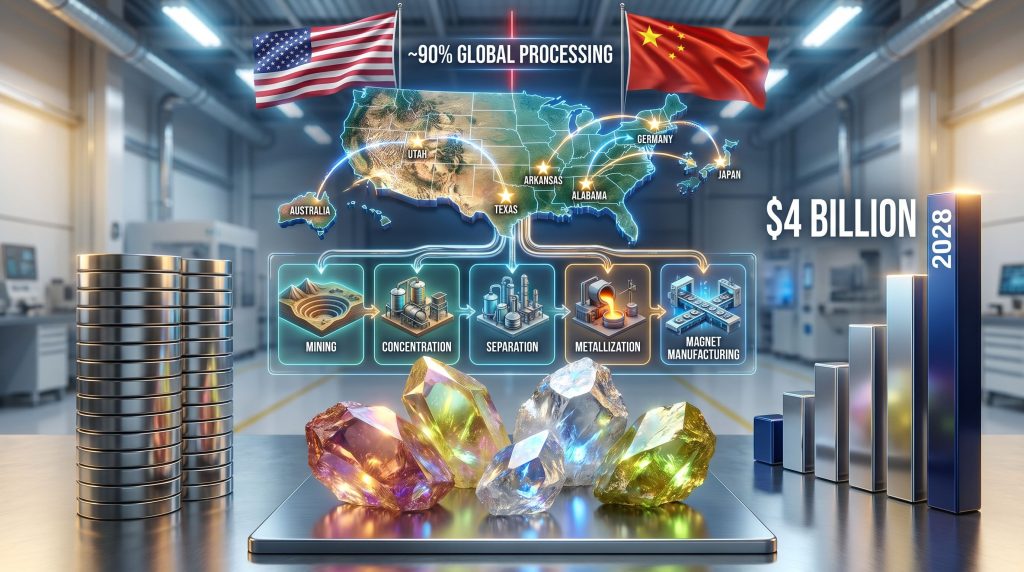
One of the most consequential misunderstandings in public debate about rare earth independence is the assumption that building more mines solves the problem. It does not. Mining is only the first of five interdependent stages in a mine-to-magnet value chain, and it is arguably not the most critical bottleneck.
| Supply Chain Stage | Current US Status | Primary Bottleneck |
|---|---|---|
| Mining and ore extraction | Partially active (1 operating mine) | Permitting timelines averaging 29 years |
| Concentration and beneficiation | Limited domestic infrastructure | Environmental regulatory complexity |
| Separation and refining | Emerging, new facilities under development | ~90% Chinese global share |
| Metallization and alloy production | Early-stage buildout | Capital intensity, technical knowledge gaps |
| Magnet manufacturing | Near-zero domestic capacity prior to 2026 | Entire sector historically offshored |
The processing gap, specifically separation, metallisation, and magnet manufacturing, is where the strategic vulnerability is most acute. A country can mine rare earth ore domestically and still remain entirely dependent on Chinese processing infrastructure if it lacks the downstream industrial capacity to convert that ore into usable materials. The rare earth processing challenges involved at this stage are often underestimated by policymakers focused solely on mining output.
The 29-Year Permitting Problem
The United States has the second-longest mine development timeline in the world, averaging 29 years from discovery to production. This is not primarily a geological constraint. It reflects the layered complexity of federal and state environmental review processes, legal challenge mechanisms, and remediation bonding requirements that make domestic mine development structurally slower and more expensive than in most competitor nations.
Even with executive orders streamlining federal land access, the regulatory architecture governing processing facilities introduces additional delay risk that timelines built on political momentum alone cannot reliably eliminate.
The June 2026 Funding Wave: Four Federal Channels, Seven Deals
Between June 2 and June 26, 2026, the US government committed approximately $2.9 billion in direct federal funding across seven distinct transactions. Private capital co-invested alongside federal commitments added a further $1.4 billion, bringing the total combined buildout value to more than $4 billion. What makes this funding wave analytically significant is not just its scale but its architecture: four different federal agencies deployed capital simultaneously, each targeting a different segment of the supply chain, in a configuration that suggests deliberate coordination rather than sequential opportunism.
Channel 1: The CHIPS Act and the Commerce Department
The largest single federal commitment in the wave came not from the Pentagon but from the Department of Commerce through the CHIPS Act, a legislative instrument originally designed to support semiconductor manufacturing. USA Rare Earth secured a funding agreement worth up to $1.6 billion, structured as $277 million in direct grants combined with $1.3 billion in senior secured loan capacity. The funding targets an integrated heavy rare earth value chain spanning mining at the company's Round Top, Texas deposit, through to metallisation and magnet production, with a 2028 production start date.
The use of CHIPS Act mechanisms for rare earth funding reflects a recognition that semiconductor supply chains and critical mineral supply chains are not separable problems. Gallium, a mineral of which China produces essentially the entire global supply, is indispensable to compound semiconductors used in radar, satellite communications, and 5G infrastructure. Funding rare earth and critical mineral capacity through the same legislative vehicle as chips is architecturally coherent, even if it surprises observers who read the CHIPS Act narrowly.
Channel 2: Department of Defense Direct Loans
On June 18, the Pentagon's Office of Strategic Capital issued two loans totalling $1.225 billion in a single day:
- $725 million to Energy Fuels for construction of a rare earth separation and metallisation facility designed to supply domestic permanent magnet manufacturers
- $500 million to Phoenix Tailings toward its Freedom Facility processing complex, which when combined with private co-investment brought total project funding to $1 billion
Both facilities target 2028 operational readiness, aligning with defence procurement timelines and the broader coordinated schedule across the funding wave. The materials these facilities will process, principally neodymium, praseodymium, dysprosium, and terbium, are the four rare earth elements at the core of NdFeB permanent magnet production and the specific inputs used in missile guidance systems, radar arrays, and electric motors in military platforms.
Channel 3: Department of Energy Research Funding
The Department of Energy contributed $72 million through its Advanced Research Projects Agency-Energy (ARPA-E) arm, split across two parallel programmes: one focused on accelerating the discovery and characterisation of domestic critical mineral deposits, and another targeting next-generation permanent magnet development that could reduce dependence on specific rare earth inputs currently dominated by Chinese supply. This funding operates on a longer timeframe than the production-focused commitments from Commerce and Defence, representing investment in future capacity rather than the 2028 production window.
Channel 4: US Army Military Base Access
On June 26, the Army announced a first-of-its-kind policy allowing critical minerals processors to establish and operate facilities on active military installations through long-term leases, executed under Executive Order 14241 signed in March 2025. Four installations were activated:
| Installation | State | Processor | Material Focus |
|---|---|---|---|
| Anniston Army Depot | Alabama | Empire State Mines (Titan Mining subsidiary) | Graphite processing |
| Pine Bluff Arsenal | Arkansas | Empire State Mines (Titan Mining subsidiary) | Graphite processing |
| Red River Army Depot | Texas | EnergyX | Lithium processing |
| Tooele Army Depot | Utah | Ioneer and REalloys | Boron and heavy rare earths (Dy, Tb) |
The strategic logic of using military land is multi-layered. Federal installations bypass state-level permitting delays that have historically extended project timelines by years. Physical security infrastructure already exists on site. Furthermore, proximity to defence procurement end-users reduces logistical complexity, and the arrangement formally integrates critical minerals supply into national security infrastructure rather than treating it as a commercial commodity question with an optional defence dimension.
Development across these four sites could commence as early as 2027, with initial operating capability targeted for 2028.
The Geopolitical Escalation Running Alongside the Funding Wave
The June 2026 funding surge did not occur in a stable geopolitical environment. On June 8, the US added 65 Chinese companies to its Section 1260H Chinese Military Companies list, including major electric vehicle manufacturers and battery producers, barring them from supplying the Department of Defence. China's counter-response came on June 22, when Beijing placed ten US entities on its own export control list, explicitly targeting rare earth producers operating domestically, including MP Materials and USA Rare Earth.
This tit-for-tat escalation is not incidental context. It directly validates the urgency of the buildout. The US is not investing in domestic supply chain capacity as a precautionary measure against a theoretical risk. It is responding to demonstrated and active supply chain weaponisation by a geopolitical competitor.
The rare earth geopolitics at play here also reveal something important about Chinese processing dominance. Chinese control of refining capacity means that export restrictions need not target ore exports to be effective. Restricting the export of processed rare earth oxides, separation chemicals, or metallisation technology can achieve supply disruption even when upstream mining occurs entirely outside China. The US strategy of simultaneously funding separation, metallisation, and magnet manufacturing, rather than additional mining alone, reflects an understanding of exactly this vulnerability. As IEA analysis of export controls on critical minerals has highlighted, supply concentration risks are no longer theoretical — they are now an operational reality.
The International Coalition: Pax Silica and Allied Supply
On June 23, the European Union along with Germany, the Netherlands, and Greece formally joined the US-led Pax Silica Forum, an initiative launched in December 2025 to build resilient supply chains for technologies foundational to artificial intelligence, including the critical minerals and silicon inputs that flow through China-linked processing networks. The forum's membership now spans 19 nations across four continents, including Australia, Finland, India, Israel, Japan, Norway, Qatar, South Korea, Singapore, Sweden, the Philippines, the UAE, and the UK.
The timing of European accession, coinciding with the peak of the domestic US funding wave, reinforces a dual-track strategy: build domestic capacity while simultaneously diversifying allied supply to provide interim security during the ramp-up phase. America's rare earth supply chain had already established bilateral supply partnerships with Japan and Australia through Defence Department contracts exceeding $330 million awarded to Lynas USA and MP Materials, including a $120 million heavy rare earth separation facility in Texas built by Lynas to process Australian-sourced material outside Chinese refining networks entirely.
Malaysia represents one of the few non-Chinese jurisdictions with meaningful existing refining infrastructure, though its recent policy shift toward restricting unrefined rare earth exports signals a broader trend among mineral-rich nations toward capturing more domestic value-add rather than exporting raw or semi-processed material.
The next major ASX story will hit our subscribers first
Progress Made and Vulnerabilities That Remain
The US rare earth supply chain buildout has produced measurable results. Domestic production of refined rare earth minerals grew by more than 400% year-on-year in 2024, reducing refined import dependency from over 95% to approximately 80%. That trajectory represents the most significant domestic production acceleration in decades, even if the absolute dependency level remains high.
The structural vulnerabilities that persist beyond the June 2026 funding wave deserve equal attention. As research into US rare earth efforts has noted, the challenges extend well beyond simply finding mineral deposits. Consequently, the following risks require ongoing scrutiny:
-
The 2028 gap window: All four of the largest funded projects share a 2028 production target, leaving a two-year period during which Chinese export control escalation could create material shortages before domestic capacity comes online.
-
End-to-end integration risk: Funding separation and metallisation facilities does not automatically create a functioning magnet manufacturing sector. Workforce development, proprietary process technology for magnet production, and commercial supply agreements between upstream processors and downstream manufacturers all require parallel development that funding announcements do not guarantee.
-
Price competitiveness: Chinese rare earth producers operate with substantial state subsidy support, enabling export pricing below the cost of production for Western competitors. Without sustained offtake commitments or tariff protections, new US facilities face structural cost disadvantages once operational, a dynamic that has undermined previous rounds of domestic rare earth investment.
-
Permitting timelines: The 29-year average mine development timeline in the US remains a structural constraint that executive orders and emergency designations can accelerate at the margins but cannot eliminate.
Three Scenarios for the 2028 Production Horizon
The June 2026 funding wave will ultimately be judged on whether committed capital translates into operational capacity on schedule. Three plausible trajectories exist for rare earth supply chains at this critical juncture.
Scenario 1: On-Schedule Execution. All four 2028-targeted facilities reach initial operating capability as planned. The US establishes functional domestic separation, metallisation, and magnet manufacturing for the first time. Refined rare earth import dependency falls below 60% by 2030, and the buildout becomes the template for further expansion.
Scenario 2: Partial Delivery. Two to three of the four major projects reach operational status by 2028 to 2029, with delays attributable to construction complexity, workforce constraints, or permitting complications. The US achieves meaningful but incomplete supply chain independence and remains dependent on Australian and Japanese allied supply for gap-filling during the transition period.
Scenario 3: Forced Acceleration. Chinese export restrictions on processed rare earth materials or separation chemicals trigger a supply disruption before 2028 facilities are operational. Emergency federal procurement, military stockpile drawdowns, and allied supply agreements are activated at higher cost and under compressed timelines, potentially advancing some facility starts through emergency authorisation but at significant economic penalty.
The June 2026 funding wave represents the most concentrated and structurally coherent investment in US rare earth supply chain independence since the Cold War era of domestic rare earth production. Whether it converts policy intent into industrial reality by 2028 will determine whether the dependency problem is genuinely resolved or merely migrates from one form of Chinese leverage to another.
This article contains forward-looking statements and scenario projections based on publicly available data and announced investment commitments. Actual timelines, production capacities, and supply chain outcomes may differ materially from projections. Readers should conduct independent due diligence before making investment or procurement decisions based on this analysis.
For ongoing price data, market analysis, and forecasting tools covering rare earths and critical minerals, visit Fastmarkets.
Want to Track the Next Major Rare Earth or Critical Mineral Discovery Before the Market Does?
Discovery Alert's proprietary Discovery IQ model scans ASX announcements in real time, instantly identifying significant mineral discoveries across rare earths and critical minerals and translating complex data into actionable investment insights — explore historic discovery returns on the Discovery Alert discoveries page to understand what's at stake, and begin your 14-day free trial to position yourself ahead of the broader market.