July 9, 2026
The Geological Rarity That Could Rebalance Global Rare Earth Power
Most critical mineral deposits are defined by what they contain. A select few are defined by what they contain that almost nothing else on Earth does. Heavy rare earth elements sit at the intersection of extreme geological scarcity and irreplaceable industrial utility, and the gap between global demand for these materials and the supply available outside of China has been widening for years.
Understanding why this matters requires stepping back from individual project announcements and examining the mineralogical reality underpinning the entire sector. Heavy rare earth elements, particularly dysprosium and terbium, are not interchangeable with their lighter counterparts. They serve a specific, thermally critical function inside the permanent magnets that power electric vehicle drivetrains and wind turbine generators. Without them, magnet performance degrades at elevated temperatures, making substitution essentially impossible with current technology.
This is the geological and geopolitical backdrop against which the Critical Minerals Tanbreez rare earths project Greenland must be evaluated.
When big ASX news breaks, our subscribers know first
Understanding the HREE Grade Problem in Western Mining
The global rare earth industry broadly divides deposits into light rare earth element (LREE) concentrations and those carrying meaningful heavy rare earth element (HREE) content. The distinction matters enormously because most of the world's accessible rare earth deposits are overwhelmingly LREE-dominant, with HREE fractions typically representing less than 5% of total rare earth oxide content.
This compositional skew is not a minor technicality. It means that even when Western nations develop new rare earth mines, the specific elements most needed for defence-grade magnets and high-performance EV motors remain scarce in the production output. The result is a structural bottleneck: Western rare earth supply chains are often frustrated not by a lack of rare earth mines, but by a lack of heavy rare earth content within those mines.
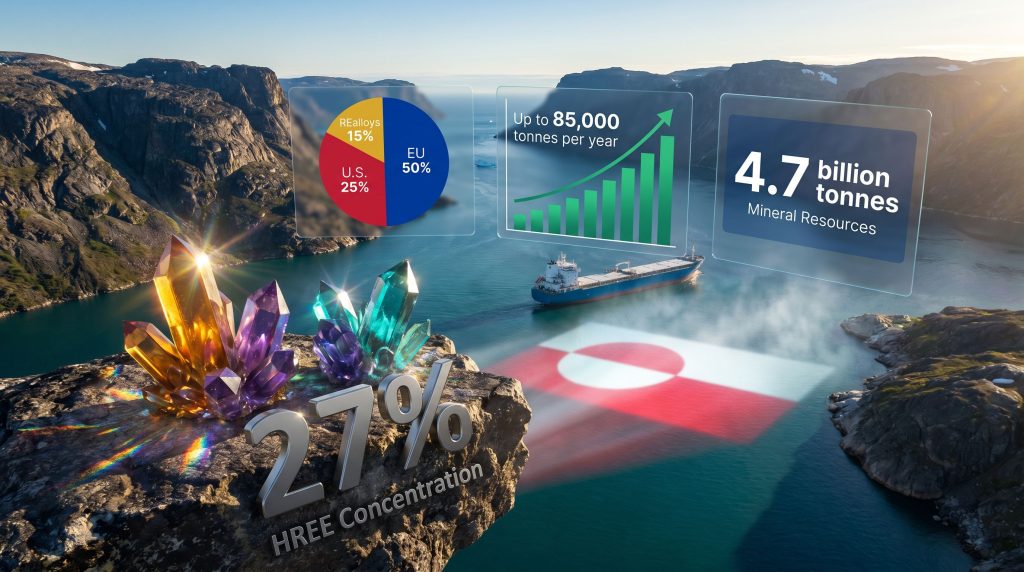
Tanbreez disrupts this pattern fundamentally. The deposit's HREE concentration sits at approximately 27% of total rare earth content, a figure that is not simply above average but is an order of magnitude above the global norm. This grade differential is the single most important technical characteristic of the project, because it directly determines:
- The volume of ore required per unit of valuable HREE output
- The operating cost structure at varying commodity price environments
- The project's resilience to price suppression tactics from competing producers
- The economic case for processing infrastructure investment by downstream partners
A deposit with 27% HREE content processes dramatically less waste rock to yield the same quantity of dysprosium or terbium compared to a 3% HREE deposit. At scale, this compression of ore-to-product ratios creates a durable cost advantage that lower-grade alternatives simply cannot replicate.
What the Tanbreez Deposit Actually Contains
Located in southern Greenland, the Tanbreez rare earth deposit hosts one of the largest known rare earth resource bases anywhere in the Western world. The deposit's confirmed resource base of an estimated 4.7 billion tonnes of multi-element mineralisation encompasses not just rare earths but also zirconium, tantalum, hafnium, and niobium, creating a polymetallic revenue profile that can buffer the project against single-commodity price cycles.
Confirmed reserves meeting commercial extraction standards exceed 50 million tonnes, providing the long mine-life visibility that large-scale offtake partners and project financiers typically require before committing capital.
The specific HREE suite at Tanbreez includes the four most strategically critical elements:
- Dysprosium – essential for high-temperature permanent magnet stability in EV motors and wind turbines
- Terbium – a critical co-additive with dysprosium in NdFeB magnet formulations
- Neodymium – the dominant rare earth by weight in permanent magnet alloys
- Praseodymium – increasingly used as a neodymium substitute in certain magnet grades
The combination of HREE richness, massive tonnage, and multi-element diversification makes Tanbreez structurally distinct from nearly every comparable undeveloped deposit in non-Chinese jurisdictions.
Greenland's Logistics Advantage: A Rarely Discussed Competitive Factor
Mining projects are often assessed purely on their geology, with logistics treated as a secondary consideration. However, for rare earth projects targeting European and North American processing facilities, shipping access is actually a first-order variable in project economics and timeline feasibility.
Southern Greenland's geography provides Tanbreez with a logistical profile that most remote mineral deposits cannot match. The deposit sits in close proximity to deep-water fjords that allow direct vessel access to North Atlantic shipping lanes without the icebreaker requirements or seasonal access windows that constrain extraction projects further north.
This matters for several practical reasons:
- Year-round export capability removes the seasonal inventory buildup costs that compress margins at Arctic-zone projects
- Deep-water access accommodates bulk carriers rather than smaller, higher-cost vessels
- Proximity to the North Atlantic corridor minimises transit time and fuel costs to both European and East Coast North American ports
- Reduced permafrost conditions in the southern region lower civil infrastructure costs compared to higher-latitude Greenlandic sites
These logistical characteristics are not minor conveniences. Furthermore, they translate directly into competitive concentrate export economics at a time when Western processing facilities are actively seeking reliable, cost-competitive feedstock supply.
Critical Metals Corp.: Corporate Structure and Strategic Positioning
The Critical Minerals Tanbreez rare earths project Greenland is controlled by Critical Metals Corp. (Nasdaq: CRML), which secured a 92.5% controlling interest in the project in 2025 following formal approval from the Greenland Government. The Nasdaq listing provides US institutional capital market access and the compliance framework that US government financing partners require.
The company's strategic direction has sharpened considerably around a pure-play HREE positioning thesis, with management explicitly framing Tanbreez as the core vehicle for long-term shareholder value creation. This framing has direct implications for how the company is now approaching the rest of its asset portfolio.
The Portfolio Rationalisation: What Clear Street's Mandate Signals
Critical Metals Corp. has engaged Clear Street as financial adviser to conduct a formal evaluation of its non-core asset holdings. The mandate covers a range of value-realisation mechanisms, potentially including asset sales, joint ventures, strategic alliances, spin-offs, or other structural separations.
This type of formal non-core review carries specific signalling value in the junior mining sector. When a company retains a named financial adviser for a structured portfolio evaluation rather than pursuing opportunistic bilateral discussions, it indicates:
- Management has concluded that portfolio complexity is suppressing the valuation of the flagship asset
- The board has set a defined process timeline, creating accountability for execution
- The company is prepared to accept non-dilutive capital from asset monetisation rather than returning to equity markets
- Pure-play positioning is being prioritised as a valuation re-rating catalyst
The conglomerate discount phenomenon is well-documented in junior resource equities. Markets frequently assign lower valuations per unit of net asset value to companies holding multiple assets across different commodities, geographies, and development stages, because capital allocation decisions become harder to predict and management attention is spread across competing priorities.
The Wolfsberg Lithium Project: A Valuable Asset in the Wrong Portfolio
Among the assets under review is the Wolfsberg lithium project in Austria, described as one of Europe's more advanced hard-rock lithium development assets. Wolfsberg is positioned to supply lithium hydroxide to European battery manufacturers and EV supply chains, addressing the EU's urgent need to develop domestic battery material feedstock.
Despite its genuine strategic merit in the European energy transition context, Wolfsberg sits outside the HREE focus that now defines Critical Metals Corp.'s investment thesis. A successful transaction for Wolfsberg would serve two purposes simultaneously: it would generate non-dilutive development capital for Tanbreez, and it would remove a competing capital demand from management's bandwidth.
For acquirers, Wolfsberg represents an opportunity to access a permitted or near-permitted European lithium asset without the exploration risk of earlier-stage projects, at a point when European battery supply chain development is an urgent policy priority across the continent.
The Financing Architecture: U.S. Export-Import Bank Support
The U.S. Export-Import Bank has committed a $120 million non-dilutive loan to support Tanbreez development under its Supply Chain Resiliency Initiative, a programme specifically designed to reduce Western dependency on Chinese critical mineral supply chains. This financing commitment reflects the US government's assessment that Tanbreez's development is consistent with national supply chain security objectives.
Non-dilutive project financing of this scale reduces the equity capital requirement for Phase 1 development and lowers the cost of capital for the overall project, which materially improves projected returns for equity investors. In addition, the involvement of a US government financing body underscores the geopolitical significance of this asset.
The next major ASX story will hit our subscribers first
Permitting Status: Why Full Licensing Matters More Than Most Investors Realise
The Greenland Government issued a full Exploitation License to the Tanbreez project in August 2020. In the rare earth development sector, this milestone carries disproportionate strategic weight, and its significance is frequently underestimated by investors focused on resource size or grade alone.
Permitting delays in the critical minerals sector routinely extend project timelines by five to ten years. In jurisdictions with complex environmental review processes, community consultation requirements, and multi-agency approval frameworks, even well-funded projects with strong geology can spend a decade in regulatory limbo. Tanbreez's fully permitted status eliminates this risk category entirely, compressing the path from development decision to first production. Consequently, this positions the project well ahead of most Western HREE alternatives.
Development Timeline and Production Targets
The following table summarises the key development milestones and production parameters currently targeted for the Critical Minerals Tanbreez rare earths project Greenland:
| Development Milestone | Target Date | Key Metric |
|---|---|---|
| Ore production commencement | Late 2028 / Early 2029 | Initial mining operations |
| First concentrate exports | Q3 2029 | Shipments to offtake partners |
| Annual rare earth material output | At full capacity | Up to 85,000 tonnes per year |
| Phase 1 capital expenditure | Phase 1 | Approximately $290 million |
At full operational capacity, Tanbreez's projected annual output of up to 85,000 tonnes could represent a material contribution to Western HREE supply. Some industry analyses have suggested that full production could enable Western nations to access up to 50% of the global heavy rare earth market outside of Chinese-controlled channels, though investors should treat such projections as scenario estimates subject to commodity price, production ramp-up, and processing capacity variables.
The $290 million Phase 1 capital requirement is considered relatively modest when benchmarked against comparable large-scale HREE development projects globally, particularly given the scale of the resource and the quality of the HREE grade.
Offtake Architecture: Demand Secured Before First Production
One of the most structurally important characteristics of Tanbreez's development profile is the degree to which production is already committed to Western buyers before a single tonne of ore has been mined commercially.
| Offtake Partner / Region | Allocation | Key Materials Covered |
|---|---|---|
| REalloys (15-year agreement) | 15% of Phase 1 production | Dysprosium, terbium (magnet materials) |
| European Union (via Romania) | 50% of offtake | Broad rare earth concentrate |
| United States | 25% of offtake | Strategic defence and technology supply |
With approximately 90% of Phase 1 production already allocated under long-term agreements, Tanbreez is structurally insulated from the spot market price volatility that has historically undermined junior rare earth developers who reach production without secured buyers.
The REalloys agreement is particularly notable because it targets the permanent magnet supply chain specifically, where terbium demand pressures are most acutely felt globally. Long-term agreements of this nature at the pre-production stage are rare in the junior mining sector and reflect strong commercial validation of the project's supply chain relevance.
Competitive Benchmarking: How Tanbreez Compares to Western Alternatives
| Comparison Factor | Tanbreez (Greenland) | Typical Western HREE Project |
|---|---|---|
| HREE as % of total REE content | ~27% | Less than 5% |
| Total resource estimate | 4.7 billion tonnes | Typically under 500 million tonnes |
| Permitting status | Fully permitted (since 2020) | Often at exploration or pre-feasibility stage |
| Shipping access | Year-round deep-water fjord access | Variable; often landlocked or seasonal |
| Projected annual output | Up to 85,000 tonnes | Typically 5,000-20,000 tonnes |
| Phase 1 capex | ~$290 million | Often comparable or higher for smaller output |
The grade differential alone would be sufficient to distinguish Tanbreez from most competing Western HREE development assets. Furthermore, the combination of grade, tonnage, permitting, logistics, and pre-committed offtake creates a risk-adjusted development profile with few peers in the non-Chinese rare earth space.
Key Risks and Considerations for Investors
Despite the project's compelling characteristics, investors should assess the following risk factors carefully:
- Processing infrastructure dependency: Greenland does not currently host domestic rare earth separation facilities, meaning Tanbreez concentrate will require shipment to third-party processors in Europe or North America, introducing logistical cost and rare earth processing challenges that will affect net realised pricing
- Capital funding completeness: The $290 million Phase 1 requirement must be fully assembled through the EXIM Bank loan, equity capital markets, and potential offtake prepayments. Any funding shortfall could extend the timeline to first production
- Greenland's jurisdictional evolution: The Greenland critical minerals race and Greenland's political relationship with Denmark, alongside the growing strategic interest of multiple Western powers in the territory, introduces a layer of jurisdictional uncertainty that has no direct precedent in conventional mining jurisdictions
- Chinese pricing response risk: A credible ramp-up at Tanbreez could trigger deliberate price suppression from Chinese producers attempting to undermine Western project economics, a tactic with historical precedent in the rare earth sector dating back to the early 2010s
- Portfolio transition execution: The Clear Street-led non-core asset review introduces near-term corporate complexity. Delays in concluding transactions for assets like Wolfsberg could slow capital redeployment toward Tanbreez milestones
- Forecast uncertainty: All production targets, output volumes, and market share projections represent forward-looking estimates subject to material variation. Investors should not treat these figures as guaranteed outcomes
Frequently Asked Questions
What rare earth elements does the Tanbreez project produce?
Tanbreez hosts dysprosium, terbium, neodymium, and praseodymium as its primary rare earth outputs, alongside co-products including zirconium, tantalum, hafnium, and niobium. Its approximately 27% HREE concentration by total rare earth content is exceptionally high relative to global deposit averages.
Is the Tanbreez critical minerals project fully permitted?
The Greenland Government issued a full Exploitation License in August 2020, making Tanbreez one of very few large-scale HREE deposits in the Western world with complete mining authorisation already in place.
When is Tanbreez expected to begin production?
Ore production is currently targeted for late 2028 or early 2029, with first concentrate exports anticipated in Q3 2029, subject to completion of project financing and construction phases.
What is the Wolfsberg lithium project?
Wolfsberg is a hard-rock lithium development asset in Austria, positioned to supply European battery manufacturers with lithium hydroxide. It is currently under formal strategic review as part of Critical Metals Corp.'s non-core asset evaluation process, with the objective of realising value and redeploying capital toward Tanbreez.
How much of Tanbreez Phase 1 production is already committed?
Approximately 90% of Phase 1 output is allocated under existing offtake agreements: 50% to the European Union via Romania, 25% to US strategic buyers, and 15% to REalloys under a 15-year agreement specifically covering dysprosium and terbium supply. For further context on how this project fits the broader geopolitical picture, Reuters has reported on the US government's active efforts to keep Tanbreez out of Chinese hands.
This article is intended for informational purposes only and does not constitute financial or investment advice. All forward-looking statements, production targets, market share projections, and financial estimates discussed in this article are subject to material risks, uncertainties, and assumptions. Past performance of comparable projects is not indicative of future results. Readers seeking further context on Western rare earth supply chain development may find additional coverage at Mining Weekly, which provides ongoing reporting on critical minerals policy and project development.
Want to Stay Ahead of the Next Major Critical Minerals Discovery?
Discovery Alert's proprietary Discovery IQ model delivers real-time alerts on significant ASX mineral discoveries — instantly cutting through complex data to surface actionable opportunities across rare earths and beyond. Explore historic discoveries and their returns to understand what's possible, then start your 14-day free trial at Discovery Alert to position yourself ahead of the broader market.