July 8, 2026
When Supply Chain Security Becomes a Commercial Reality
The global critical minerals landscape has shifted from theoretical risk frameworks to active procurement competition. For years, Western industrial planners warned about concentration risk in rare earth supply chains. Those warnings have now crystallised into urgent commercial action, with manufacturers, trading houses, and defense contractors racing to establish qualifying supplier relationships before supply constraints tighten further.
Within this intensifying environment, the dispatch of physical heavy rare earth concentrate samples to prospective buyers in multiple countries is no longer a routine technical milestone. It is a strategic signal. For Victory Metals (ASX: VTM), the successful shipment of Victory Metals heavy rare earth concentrate samples to offtake partners across Australia, Japan, and the United States marks a transition from development-stage aspiration to active commercial engagement, placing the North Stanmore project directly inside the conversations that will shape Western rare earth supply chains for decades.
When big ASX news breaks, our subscribers know first
Understanding Why Heavy Rare Earths Occupy a Different Risk Category
Not all rare earth elements carry the same strategic weight. The 17 elements that make up the rare earth group are broadly divided into light rare earth elements (LREEs) and heavy rare earth elements (HREEs), and the distinction matters enormously to investors and industrial buyers alike.
LREEs such as cerium and lanthanum are relatively abundant and face fewer supply constraints. HREEs, by contrast, are far scarcer in economically recoverable concentrations and are indispensable for the highest-value applications in modern technology. Specifically:
- Dysprosium (Dy) and terbium (Tb) are required to maintain the coercivity of neodymium-iron-boron (NdFeB) permanent magnets at elevated operating temperatures, making them non-substitutable in EV traction motors and wind turbine generators.
- Yttrium (Y) is critical for phosphors, lasers, fuel cells, and various defense electronics applications.
- Scandium enhances aluminium alloys used in aerospace and defense structures, with only a handful of economically viable global sources.
- Hafnium serves as a control rod material in nuclear reactors and a high-k dielectric material in advanced semiconductors.
China's rare earth export restrictions in 2025 on seven rare earth elements, which directly overlap with North Stanmore's ore profile, have transformed what was once a theoretical supply risk into an immediate procurement crisis for Western manufacturers. China controls an estimated 85–90% of global HREE processing capacity, making this development particularly consequential.
The elements subject to Chinese export restrictions are precisely those that dominate North Stanmore's concentrate composition, creating a structural alignment between the project's output and the most acute supply gap in Western industrial supply chains.
North Stanmore: Technical Foundations of a Globally Significant Deposit
Resource Scale and Grade Quality
Located near Cue in the Murchison region of Western Australia, the North Stanmore Heavy Rare Earth Project has established itself as Australia's largest and most technically advanced HREE clay-hosted deposit. The project's mineral resource stands at 320.6 million tonnes as of August 2025, with the majority classified as indicated, providing the geological confidence required for long-life production planning.
What distinguishes North Stanmore from most competing rare earth projects globally is not simply its scale, but the composition of its ore system. The deposit's HREE-to-total rare earth oxide (TREO) ratio averages approximately 39%, a figure that substantially exceeds the global norm for rare earth deposits, where HREE fractions often fall below 10–15% of total rare earth content.
| Metric | Detail |
|---|---|
| Location | Cue, Western Australia |
| Mineral Resource | 320.6 million tonnes (Aug 2025) |
| HREE/TREO Ratio | ~39% average |
| Key HREEs | Dysprosium, Terbium, Yttrium |
| Critical By-Products | Nickel, Cobalt, Copper, Scandium, Hafnium |
| Radioactivity Profile | Negligible |
| PFS Completion Target | August 2026 |
The Processing Advantage: Ambient Temperature Flotation
Clay-hosted rare earth deposits, sometimes referred to as ionic adsorption clays (IAC), represent a geologically distinct ore type where rare earth ions are loosely bound to clay mineral surfaces rather than locked within hard rock crystal structures. This bonding mechanism is the fundamental reason why IAC deposits are amenable to low-cost, low-energy hydrometallurgical extraction methods.
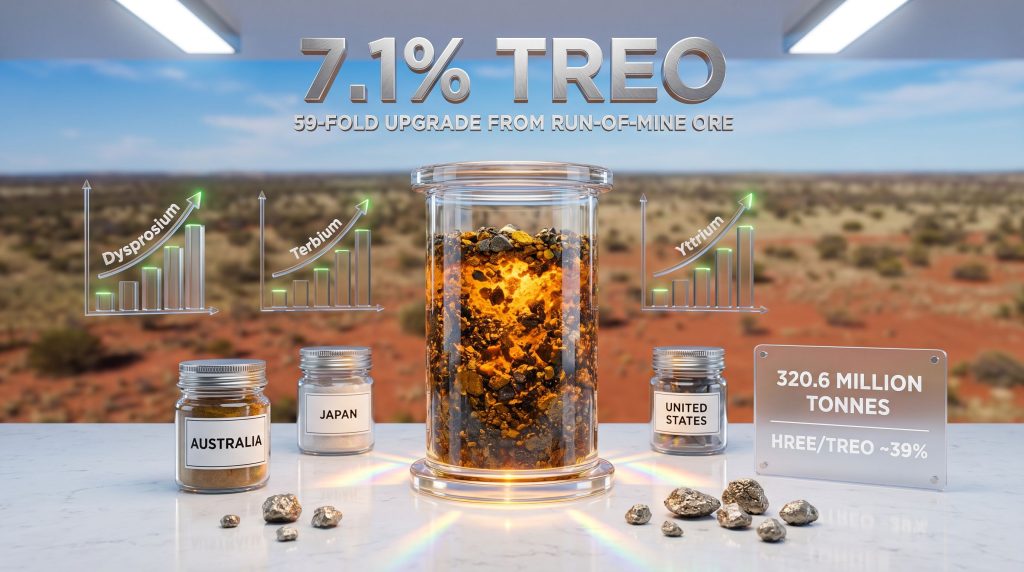
Victory Metals' Perth-based flotation pilot plant has demonstrated a critical processing achievement: the production of concentrate grading 7.1% total rare earth oxide (TREO), representing a 59-fold upgrade from run-of-mine ore grade. Furthermore, the processing programme has demonstrated the removal of approximately 99% of undesirable gangue elements, yielding a high-purity product suited to downstream refining and separation.
Critically, the plant operates at ambient temperatures, without the energy-intensive high-temperature roasting steps required in hard-rock rare earth processing. However, these rare earth processing challenges are well-documented, and Victory Metals' approach significantly reduces projected operating costs and simplifies the plant's environmental footprint — both material considerations for offtake partners evaluating long-term supply economics. You can explore rare earth processing challenges in greater detail to understand the broader context.
| Processing Metric | Achievement |
|---|---|
| Concentrate Grade | 7.1% TREO |
| Upgrade Factor | 59-fold from run-of-mine ore |
| Gangue Removal Rate | ~99% |
| Operating Temperature | Ambient (no high-temperature requirement) |
| Research Partner | Curtin University |
| Federal Research Funding | AU$350,000 |
The Curtin University Research Programme
Victory Metals has secured AU$350,000 in Australian federal government funding to support a two-year collaborative research programme with Curtin University, focused on advancing recovery rates and separation efficiency for HREEs derived from North Stanmore's concentrate. This academic partnership serves a dual commercial purpose: it generates independent scientific validation of the project's processing claims and creates a pathway for further performance improvements that could enhance project economics ahead of the PFS completion in August 2026.
The Product Qualification Campaign: What Shipping Samples Actually Signals
Why Physical Concentrate Matters More Than Certificates Alone
In the rare earth supply chain, a laboratory certificate confirming elemental composition is a necessary but insufficient commercial credential. What sophisticated industrial buyers require before committing to volume and pricing discussions is independent verification of the producer's ability to consistently replicate concentrate quality at pilot scale under continuous operating conditions.
The product qualification process typically involves buyers conducting their own laboratory analysis across several dimensions:
- Elemental composition verification against claimed TREO and individual HREE concentrations.
- Impurity profiling, particularly for radioactive elements (thorium and uranium), which influence regulatory handling requirements.
- Particle size distribution analysis to assess compatibility with downstream processing equipment.
- Leachability testing to evaluate how efficiently the buyer's refining or separation infrastructure can extract individual rare earth elements from the concentrate.
- Repeatability assessment, requiring multiple sample batches produced under the same continuous conditions.
North Stanmore's negligible radioactivity profile is a commercially meaningful attribute here. High thorium or uranium content in rare earth concentrate creates significant regulatory complexity for buyers, particularly in Japan and the United States, where radioactive material handling is tightly controlled. A clean radioactivity profile consequently simplifies the buyer's qualification pathway and reduces the regulatory burden associated with importing and processing the material.
Three Jurisdictions, Three Strategic Rationales
The simultaneous dispatch of Victory Metals heavy rare earth concentrate samples to offtake partners across three distinct markets reflects a deliberate geographic diversification strategy rather than speculative outreach.
Japan has maintained an institutionalised commitment to rare earth supply diversification since China's 2010 export restrictions caused acute supply disruptions to Japanese industry. Japanese trading houses and industrial conglomerates have since developed sophisticated frameworks for evaluating and engaging with rare earth projects globally, making Japan's industrial buyers among the most commercially capable qualification partners available to Western producers.
The United States presents demand driven by a combination of defense procurement imperatives and clean energy manufacturing expansion. The US Department of Defense has formally identified dysprosium and terbium as materials of particular strategic concern, given their role in the permanent magnets used in military motors, guidance systems, and autonomous platforms. American industrial interest in qualifying North Stanmore's concentrate reflects the practical step of establishing supplier credentials ahead of anticipated procurement programmes.
Australia represents an emerging domestic offtake opportunity. In addition, as Australia's critical minerals strategy continues to evolve, local buyers are increasingly seeking to capture more of the value chain from Australia's rare earth endowment, with downstream processing ambitions growing accordingly.
The Sumitomo Relationship: From MoU to Letter of Intent
Understanding the Commercial Progression
The evolution of Victory Metals' relationship with Sumitomo Corporation, one of Japan's largest and most globally active trading conglomerates, follows a structured commercial pathway that investors in resource development projects should understand clearly.
A memorandum of understanding (MoU), signed in 2024, established the intent to explore a commercial relationship but carried no binding obligations. The subsequent elevation to a letter of intent (LOI) represents a materially higher level of commitment. An LOI in the rare earth offtake context typically signals that the counterparty has completed sufficient internal technical and commercial due diligence to commit resources to a structured negotiation process covering pricing mechanisms, volume parameters, and product specifications.
| Parameter | Detail |
|---|---|
| Partner | Sumitomo Corporation (Japan) |
| Instrument | Letter of Intent (LOI) |
| Predecessor Agreement | MoU (2024) |
| Potential Offtake Volume | Up to 30% of North Stanmore MREC output |
| Estimated Annual Volume | ~1,000 tonnes per year |
| Pilot Sales Target Date | 2027 |
| Next Steps | Technical studies, pricing, customer engagement |
Why Sumitomo's Network Amplifies the Commercial Significance
Sumitomo Corporation's value to Victory Metals extends beyond the volume parameters of the LOI itself. As one of Japan's major general trading companies (sogo shosha), Sumitomo maintains established relationships across Japan's advanced manufacturing ecosystem, including permanent magnet producers, electronics manufacturers, and specialty metals processors.
Furthermore, a binding offtake agreement with a counterparty of this standing would carry substantial weight in project financing discussions, since lenders to mining developments typically require demonstrated offtake coverage before committing to project debt facilities. The Victory Metals and Sumitomo partnership is therefore viewed by market observers as a significant step towards financial close.
Pilot plant sales to Sumitomo are targeted to commence as early as 2027, providing a potential early revenue pathway that precedes full commercial production and further validates the project's commercial readiness ahead of financing milestones.
Investors should note that the LOI remains non-binding at this stage, and the path to a formal offtake agreement is subject to the successful completion of technical studies, pricing negotiations, and product qualification outcomes. These remain material risks to the commercial timeline.
The Saprolite Reclassification: A Geological Development With Economic Consequences
Understanding the Ore Type Distinction
One of the more technically nuanced but commercially significant developments at North Stanmore involves the reclassification of a substantial volume of previously logged saprock as saprolite. For investors unfamiliar with lateritic rare earth geology, this distinction carries direct economic implications.
In a lateritic weathering profile, the ore column is typically divided into several zones from surface downward:
- Laterite/ferricrete (uppermost, heavily oxidised)
- Saprolite (deeply weathered, clay-rich zone where rare earth ions are adsorbed onto clay mineral surfaces)
- Saprock (partially weathered transitional zone with lower clay content and reduced rare earth extractability)
- Fresh rock (unweathered basement)
Saprolite is the economically critical zone for ionic adsorption clay rare earth deposits. The rare earth elements in this zone are loosely bound to clay minerals and can be extracted using low-energy leaching processes. Saprock, by contrast, contains rare earths that are more tightly bound within mineral structures, making them less amenable to low-cost extraction without additional processing steps.
The reclassification means that a substantial volume of material previously excluded from Victory Metals' optimal processing scenario is now directly amenable to the same flotation and leach methodology on which all of the company's metallurgical testwork has been conducted. This consequently expands the ore inventory available for inclusion in the updated PFS without requiring additional metallurgical development work, reducing both time and cost requirements for the project's next development phase.
PFS Implications and Timeline
The updated prefeasibility study, which will incorporate the expanded saprolite inventory, is targeted for completion in August 2026. A larger saprolite resource base translates into improved project economics through one or a combination of extended mine life, higher production throughput, or improved strip ratio, depending on the production scenarios optimised within the PFS. The reclassification also reduces geological risk, as the additional material has already been characterised through existing testwork programmes.
The next major ASX story will hit our subscribers first
Production Scale and the Commercial Pathway to 20,000 Tonnes Per Year
Target Production and What It Means Globally
Victory Metals' production planning targets output of 20,000 tonnes per year of mixed rare earth element concentrate (MREC) at commercial scale. To contextualise this figure, global ex-China HREE production remains severely constrained, with only a handful of projects worldwide capable of producing meaningful HREE volumes outside Chinese jurisdiction.
The broader critical minerals demand surge underscores why a Western-aligned producer consistently delivering 20,000 tonnes per year of high-HREE-content MREC would represent a genuinely material addition to non-Chinese supply. This is particularly true given that North Stanmore's ~39% HREE-to-TREO ratio means a disproportionately high fraction of its output consists of the highest-value, most strategically sensitive elements.
The Offtake-to-Finance Linkage
The current product qualification campaign, including the dispatch of Victory Metals heavy rare earth concentrate samples to offtake partners, sits at the intersection of commercial and financial strategy. In project finance structures commonly applied to mining developments, binding offtake agreements fulfil two critical functions:
- They provide revenue certainty that lenders require to model debt serviceability.
- They demonstrate independent market validation of the product, reducing the perceived technical and commercial risk of the project.
Each successful qualification outcome across the three target jurisdictions narrows the gap between the current pilot plant stage and the conditions required to assemble a project financing package. Rising HREE prices, driven by Chinese export restrictions and accelerating demand from EV and defense sectors, further strengthen Victory's negotiating position in offtake pricing discussions. Buyers, however, increasingly face the choice between establishing supply relationships now or competing for increasingly scarce volumes at higher future prices.
This article contains forward-looking statements and references to commercial frameworks that remain subject to material risks and uncertainties. The outcomes of product qualification programmes, offtake negotiations, and project financing processes cannot be guaranteed. Investors should conduct their own due diligence and seek independent financial advice before making investment decisions.
Ready to Catch the Next Major Mineral Discovery Before the Market Does?
Discovery Alert's proprietary Discovery IQ model scans ASX announcements in real time, instantly identifying significant mineral discoveries across critical commodities — from rare earths to base metals — and delivering actionable alerts directly to subscribers. Explore historic discoveries and their exceptional returns, then begin your 14-day free trial at Discovery Alert to position yourself ahead of the broader market.