August 24, 2026
The Hidden Architecture of Supply Chain Vulnerability
For most of the past three decades, the concentration of critical mineral processing in a single dominant nation was treated as an acceptable inefficiency rather than a systemic risk. Industrialised economies benefited from low-cost supply, and the political conditions that made that supply reliable seemed durable. That assumption has now collapsed, and the policy scramble underway among allied nations reflects just how exposed their industrial bases have become.
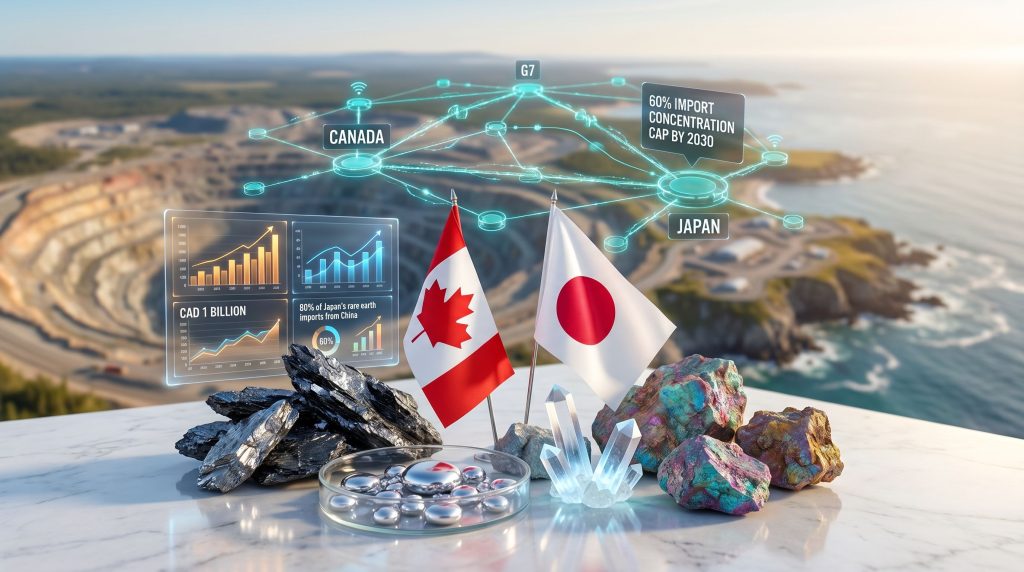
The Canada and Japan critical minerals pact, formalised through a landmark trade mission and anchored by more than CAD 1 billion (approximately USD 706 million) in signed commercial agreements, represents one of the most tangible responses to this structural exposure. However, to understand why this agreement carries genuine strategic weight, it is necessary to look beyond the headline figures and examine the deeper mechanics of mineral dependency, processing bottlenecks, and the slow-building architecture of allied supply chain realignment.
When big ASX news breaks, our subscribers know first
What Makes These Minerals Different From Ordinary Commodities
The word "critical" in critical minerals has a precise meaning that is frequently misunderstood. It does not simply mean important. It describes the intersection of two conditions: high economic indispensability and concentrated supply risk. A mineral can be abundant globally but still qualify as critical if its processing infrastructure is controlled by a single actor. This is precisely the situation with graphite, gallium, germanium, and rare earth elements (REEs), where critical minerals demand continues to accelerate well beyond current supply capacity.
China currently accounts for approximately 60% of global rare earth mining and more than 90% of global refining capacity. For gallium, a by-product of aluminium and zinc smelting, Chinese dominance in primary production is even more pronounced. These are not temporary market positions. They reflect decades of deliberate industrial policy, subsidised infrastructure investment, and the willingness to operate at margins that discouraged competing investment elsewhere.
The downstream applications of these minerals span the most strategically sensitive sectors of the modern economy:
- Electric vehicles: Graphite is the dominant anode material in lithium-ion batteries; REEs, particularly neodymium and dysprosium, are essential for the permanent magnets in EV drive motors
- Renewable energy infrastructure: Wind turbine generators rely on REE-based magnets; grid storage systems consume significant graphite volumes
- Semiconductors and advanced electronics: Gallium-based compounds underpin gallium nitride (GaN) chips used in 5G infrastructure, power electronics, and radar; germanium is critical for fibre optic systems and infrared optics
- Defence and aerospace: Missile guidance systems, electronic warfare equipment, and advanced communications platforms all depend on REEs and gallium-based semiconductors
China's Export Controls: A Chronology of Escalation
The catalyst that transformed a long-standing structural vulnerability into an immediate policy crisis was China's progressive tightening of export controls on critical minerals. China's rare earth restrictions escalated through a deliberate sequence:
| Year | Measure | Minerals Affected |
|---|---|---|
| 2023 | Initial export licensing requirements introduced | Gallium, germanium |
| April 2025 | Expanded controls targeting heavy REEs | Multiple rare earth elements and related products |
| Late 2025 | Second wave of restrictions broadened scope | Additional REEs, processing equipment, and technologies |
| 2025 | Dual-use product export restrictions imposed | Targeted 20 Japanese companies specifically |
Each successive restriction compressed planning horizons for manufacturers, defence contractors, and technology producers across the allied world. For Japan, the exposure is particularly acute. Approximately 80% of Japan's rare earth imports originate from China, a dependency built over decades as alternative supply chains never developed at competitive cost or scale.
Furthermore, the economic leverage created by controlling refining rather than just mining is often underappreciated. Raw ore exists in meaningful quantities across multiple continents, but the processing infrastructure required to convert it into battery-grade graphite, separated REE oxides, or refined gallium metal is overwhelmingly concentrated in China. Building alternative refining capacity from greenfield investment takes an estimated 10 to 15 years and requires billions in capital, meaning no short-term fix exists for nations that failed to invest earlier.
The Architecture of the Canada-Japan Agreement
The pact between Canada and Japan is structured as a non-legally binding memorandum of cooperation. This design choice is deliberate. It preserves flexibility for commercial negotiation while establishing clear political intent, creating the conditions for private sector investment without the constraints of treaty-level obligations.
Canada deployed its largest-ever trade mission to the Asia-Pacific region to formalise this relationship, with approximately 300 delegates from around 180 companies and organisations converging on Tokyo. The scale of the mission was itself a strategic signal, demonstrating institutional commitment beyond a routine diplomatic exchange. According to Reuters reporting on the partnership, both governments are actively considering joint stockpiling arrangements as a direct counterweight to Chinese supply leverage.
The structural components of the agreement span the full value chain:
| Component | Description | Strategic Purpose |
|---|---|---|
| Joint Stockpiling | Shared physical reserves of gallium, graphite, and REEs | Buffer against supply disruption |
| Long-Term Offtake Agreements | Pre-committed purchase contracts from Canadian producers | Revenue certainty for miners; supply certainty for Japan |
| Joint Mining Investments | Equity stakes and co-investment in Canadian extraction projects | Upstream supply security |
| Battery Supply Chain MOU | Integrated cooperation from mining through to battery production | End-to-end value chain resilience |
| Commercial Agreements | Over CAD 1 billion in signed deals | Immediate commercial momentum |
Canada's International Trade Minister Maninder Sidhu confirmed that both governments are actively assessing the feasibility of joint stockpiling mechanisms, acknowledging that the concept requires rigorous operational planning before it can function as a genuine resilience tool.
The Panasonic Graphite Model as Commercial Proof of Concept
One of the most significant indicators that this pact is more than diplomatic theatre is the existing commercial relationship between Panasonic and a Canadian battery-grade graphite producer. This agreement, covering graphite production in Canada destined for Japanese battery manufacturing, provides a working template for the broader framework. It demonstrates that the logistical, commercial, and quality-assurance challenges of Canadian mineral supply reaching Japanese industrial users are solvable problems, not theoretical obstacles.
Panasonic's positioning here is strategically coherent. As a major supplier to Toyota and other Japanese automakers through its battery operations, securing anode material outside of Chinese supply chains insulates its production capacity from Beijing's export licensing regime.
Canada's Geological and Geopolitical Advantage
Canada's appeal as Japan's preferred critical minerals partner rests on a combination of factors that few other resource-rich nations can replicate simultaneously:
- Geological endowment: Canada holds significant deposits of battery-suitable graphite, gallium as a by-product of domestic zinc and aluminium smelting operations, and a range of REE-bearing formations at various stages of exploration and development
- Political and regulatory stability: Rule of law, transparent permitting frameworks, and established investor protections reduce the sovereign risk premium that applies to resource projects in many competing jurisdictions
- Pacific Coast access: Existing port infrastructure and the precedent of Japanese industrial investment in Canadian energy projects (most notably Mitsubishi's participation in LNG Canada) reduce logistics complexity for mineral exports destined for Japanese manufacturing centres
- Processing sector development: While Canada's critical minerals refining capacity remains nascent relative to Chinese operations, federal investment frameworks are accelerating infrastructure buildout, and Japanese processing technology partnerships could compress development timelines
Mitsubishi's interest in transitioning from LNG investment into critical minerals equity participation reflects a broader pattern among Japanese industrial conglomerates seeking resource security through upstream ownership rather than spot market purchases.
Understanding Joint Stockpiling: Mechanics and Challenges
Strategic mineral stockpiling deserves more analytical attention than it typically receives in policy discussions. The concept draws from the International Energy Agency's strategic petroleum reserve model, where member nations maintain minimum oil inventories to buffer against supply shocks. Applying this framework to solid minerals introduces a different set of operational realities.
A joint allied stockpile differs from a national reserve in that two or more governments share governance of the physical inventory. This creates several technical and political challenges that the Canada-Japan feasibility study must resolve:
- Cost-sharing arrangements: Storage, insurance, security, and inventory management costs must be allocated between parties on terms both governments can sustain politically
- Release trigger definitions: The conditions under which reserves are drawn down must be precisely specified, whether they represent price thresholds, confirmed export bans, or declared supply emergencies
- Physical location and access rights: Determining which country hosts the inventory and under what conditions the other party can access it during a crisis is a genuinely complex governance question
- Material degradation considerations: Some processed forms of graphite and certain gallium compounds have shelf-life and storage sensitivity characteristics that affect long-term stockpile viability
- Valuation methodology: Fluctuating spot prices for minerals make ongoing inventory valuation contentious for national accounting purposes
Joint stockpiling is considerably easier to announce than to implement. The feasibility study phase currently underway between Canada and Japan is the critical determinant of whether this mechanism becomes a genuine industrial resilience tool or remains a diplomatic gesture with limited operational consequence.
The next major ASX story will hit our subscribers first
The G7 Framework and Allied Network Effects
The Canada and Japan critical minerals pact does not exist in isolation. It is one component of a rapidly consolidating allied critical minerals network that spans the G7 and beyond. At the most recent G7 summit held in France, member nations formally agreed to reduce import concentration from any single non-G7 supplier to below 60% across critical mineral categories by 2030. This target directly addresses China's dominant market position and creates a policy mandate that the bilateral Canada-Japan framework directly advances.
A parallel framework between the United States and Japan, which includes a Rapid Response Group for coordinated stockpiling, positions Canada as the key raw material node in a triangular architecture connecting North American rare earth supply with Japanese industrial demand.
| Framework | Parties | Key Mechanism | Legally Binding? |
|---|---|---|---|
| Canada-Japan Pact | Canada, Japan | Stockpiling, offtake, joint investment | No (MOU) |
| US-Japan Framework | USA, Japan | Rapid Response Group, coordinated stockpiling | No (MOU) |
| G7 Supply Chain Agreement | G7 Nations | 60% import concentration cap by 2030 | Political commitment |
| EU Critical Raw Materials Act | EU Member States | Strategic reserve targets, domestic processing | Yes (Regulation) |
The European critical raw materials strategy stands out as the only legally binding framework in this comparison, offering a potential model for future formalisation of the allied mineral network. In addition, the IEA's Canada-Japan sectoral working group provides technical coordination infrastructure that underpins the broader diplomatic commitments both nations have made.
Sector-Level Impact: Where the Pact Creates Real Value
Electric Vehicles and Battery Production
Japanese automakers including Toyota, Honda, and Nissan, alongside battery producers such as Panasonic and TDK, face direct supply chain exposure from Chinese graphite and REE restrictions. Long-term offtake agreements with Canadian producers allow these companies to lock in both volume and pricing outside of Chinese market dynamics.
For anode-grade graphite specifically, the quality specifications are exacting: battery manufacturers require material with carbon purity typically exceeding 99.95% for synthetic graphite and carefully controlled particle size distributions for natural graphite, making supplier qualification a multi-year process that rewards early relationship-building.
Defence Industrial Bases
Gallium is the foundational material for GaN semiconductors, which are now the dominant technology platform for advanced radar, electronic warfare systems, and military communications. A joint gallium stockpile providing an estimated 12 to 24 months of buffer supply (subject to agreed reserve volumes) would materially reduce the leverage China holds over defence procurement in both countries.
Semiconductors and Advanced Electronics
Germanium and gallium restrictions directly constrain chip fabrication for civilian and defence applications. Japanese semiconductor manufacturers operating under current export licensing uncertainty face planning horizon compression that affects capital allocation decisions. Canadian supply partnerships reduce this single-source dependency, though the timeline for meaningful volume replacement remains measured in years rather than months. Consequently, the pressure on rare earth supply chains to diversify away from a single dominant supplier has never been more acute.
Key Risks Investors and Policymakers Should Understand
The Canada and Japan critical minerals pact carries genuine strategic logic, but several structural risks could limit its effectiveness:
- The processing gap: Canada's raw material endowment is credible, but the country has limited domestic refining capacity for battery-grade graphite and REE separation. Japanese processing technology must be physically deployed in Canada to close this gap, not merely promised through diplomatic channels
- Timeline asymmetry: Japan's supply vulnerability is immediate; building Canadian processing infrastructure to commercially meaningful scale requires a multi-year investment cycle that creates a coverage gap
- Non-binding architecture: Without enforceable commitments, private sector capital deployment may lag behind political announcements, particularly if commodity price cycles reduce urgency
- Cost competitiveness: Chinese producers operate with the benefit of decades of scale, integrated supply chains, and historical subsidy support. Canadian alternatives will carry a cost premium that must be absorbed somewhere in the value chain
- Geopolitical optionality: Any material improvement in Japan-China or Canada-China trade relations could reduce the urgency underpinning private sector participation in the pact
Frequently Asked Questions: Canada and Japan Critical Minerals Pact
What minerals are covered by the Canada and Japan critical minerals pact?
The partnership focuses primarily on graphite, gallium, germanium, and rare earth elements, all materials where China currently controls dominant shares of both mining output and processing capacity.
Is the agreement legally binding?
No. The current framework operates as a non-legally binding memorandum of cooperation that establishes policy direction and facilitates private-sector collaboration without creating enforceable legal obligations on either government.
How much has been committed under the deal?
Companies from both countries signed commercial agreements and investment commitments exceeding CAD 1 billion (approximately USD 706 million) during Canada's largest-ever Asia-Pacific trade mission.
What is the significance of the Panasonic graphite agreement?
It serves as the operational proof of concept for the broader pact, demonstrating that Canadian mineral supply can meet Japanese industrial quality standards and reach Japanese manufacturers through viable commercial and logistical structures.
How does this relate to the G7 supply chain agenda?
The pact directly supports the G7's stated goal of reducing import concentration from any single non-G7 supplier to below 60% across critical mineral categories by 2030.
From Political Signal to Industrial Reality
The milestones that will determine whether the Canada and Japan critical minerals pact delivers lasting industrial value are largely operational rather than diplomatic. Completion of the joint stockpiling feasibility study, expansion of the Panasonic graphite template to additional minerals and partners, Mitsubishi's transition from LNG equity participation to active critical minerals investment, and measurable progress toward reducing Japan's Chinese REE dependency to below 80% by 2027-2028 will collectively define whether this agreement becomes a structural pillar of allied supply chain architecture or a well-intentioned framework that struggled to translate into physical infrastructure.
The broader transformation underway across the allied world is not aimed at eliminating commercial relationships with China. It is aimed at removing the leverage asymmetry that allows any single supplier to weaponise export controls against the industrial capacity of its trading partners. Canada's emergence as a tier-one critical minerals partner for Asian allies represents a fundamental repositioning of its resource economy, from a commodity exporter operating at the margins of global value chains to a strategic supply anchor for the industries that will define the next half-century of economic competition.
Disclaimer: This article contains forward-looking analysis, market projections, and assessments of geopolitical and commercial developments. These represent informed perspectives based on publicly available information and are not financial advice. Timelines, investment figures, and policy outcomes referenced herein are subject to change. Readers should conduct independent research before making investment or business decisions.
Want To Track The Next Major Critical Minerals Discovery Before The Market Does?
Discovery Alert's proprietary Discovery IQ model scans ASX announcements in real time, instantly identifying significant mineral discoveries across graphite, rare earths, gallium, and more than 30 other commodities — turning complex data into actionable investment insights for both short-term traders and long-term investors. Explore historic examples of what major mineral discoveries can return and begin your 14-day free trial at Discovery Alert to position yourself ahead of the market.