July 8, 2026
The Hidden Mineral Wealth Buried in America's Coal Legacy
Beneath decades of environmental scrutiny and industrial decline, a counterintuitive reality is emerging across America's coal country: the mountains of waste left behind by a century of coal mining may hold the key to powering the next generation of clean energy technology. The logic of critical mineral extraction from coal waste tailings flips the conventional narrative entirely, transforming one of the most persistent environmental liabilities in American industry into a domestic resource asset of growing strategic significance.
This is not a fringe theory. It is backed by federal research programs, university studies, and an accelerating pipeline of pilot projects demonstrating that the mineralogy of coal byproducts is far richer than the industry ever acknowledged during its operational prime.
When big ASX news breaks, our subscribers know first
What Critical Minerals Are Found in Coal Waste Tailings?
The Mineralogy of Coal Byproducts
Coal forms over millions of years through the geological compression of organic material, and the surrounding rock chemistry leaves a distinct fingerprint in the resulting waste streams. Rare earth elements accumulate naturally within fly ash, bottom ash, finely stratified clays, and under-clays generated as unavoidable byproducts of both coal combustion and preparation processes.
Beyond rare earth elements (REEs), recoverable materials from coal waste streams include:
- Cobalt and manganese, both critical to lithium-ion battery cathode chemistry
- Nickel, a key input for high-energy-density battery formulations
- Lithium, increasingly targeted from clay-hosted deposits within coal sequences
- Aluminum, recoverable in commercially meaningful concentrations from fly ash matrices
Furthermore, what makes this resource class particularly interesting from a geological standpoint is that coal basin REE concentrations are not uniformly distributed. Low-rank coals from basins like the Powder River Basin in Wyoming tend to produce fly ash with distinct REE profiles compared to the bituminous coals mined in Appalachia. The specific REE suite available for recovery, and its economic grade, varies significantly by coal type, combustion temperature, and the original sedimentary environment of the coal seam.
How Significant Is the Resource Base?
The scale of the resource is striking when examined against conventional domestic REE production figures. Research from Penn State has been instrumental in demonstrating just how substantial these unconventional deposits can be.
| Resource Category | Estimated Volume / Value |
|---|---|
| REEs in accessible U.S. coal ash | ~11 million tons |
| Estimated extractable financial value | ~$8.4 billion |
| Coal ash produced (1985 to 2021) | ~1,873 million tons |
| Potentially recoverable fraction | ~70% |
| Multiple of current domestic REE reserves | ~8x |
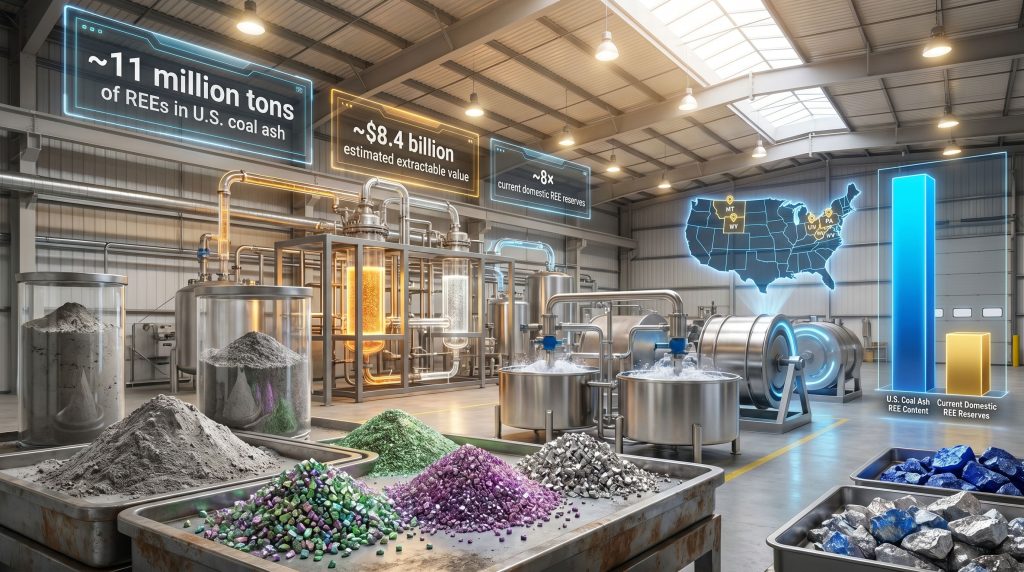
Accessible coal ash stockpiles across the United States contain an estimated 11 million tons of rare earth elements, representing approximately eight times the nation's current domestic REE reserve base, with an extractable financial value estimated at around $8.4 billion.
Approximately 1,873 million tons of coal ash was produced between 1985 and 2021 and stored in landfills and surface impoundments across the country. Roughly 70% of this material is considered potentially recoverable using existing or near-commercial processing technologies, making the aggregate resource base one of the largest untapped unconventional critical mineral inventories in the world.
How Is Critical Mineral Extraction from Coal Waste Tailings Actually Performed?
Stage 1: Beneficiation and Physical Separation
The first step in processing coal waste for critical minerals involves liberating target mineral fractions from the bulk material through size reduction. Crushing and grinding prepare the feed material for downstream physical concentration techniques, which typically include:
- Froth flotation to exploit differences in surface hydrophobicity between mineral species
- Gravity separation using density contrasts between REE-bearing minerals and gangue material
- Magnetic concentration targeting magnetically susceptible mineral phases
An important but underappreciated step in coal-specific processing involves the reprocessing of coal middling streams, which are the intermediate fractions generated during coal preparation. These streams can be treated to remove residual carbon, yielding a graphite-bearing product as a co-product, before the mineral fraction proceeds to hydrometallurgical treatment.
Stage 2: Chemical Leaching and Selective Precipitation
Once a physical preconcentrate is generated, target metals are dissolved into aqueous solution through controlled chemical leaching. The selective recovery of individual metal species then relies on pH-staged precipitation, a technique where the addition of soda ash and the purging of carbon dioxide gas drives pH changes that cause specific metals to drop out of solution sequentially.
This approach allows iron, aluminium, and REEs to be recovered at environmentally compliant pH thresholds without generating the hazardous secondary waste streams that have historically complicated hydrometallurgical operations. The ability to manage waste chemistry within regulatory limits is a critical commercial consideration, as legacy mine sites already carry significant environmental compliance obligations.
Stage 3: Chemical-Free Recovery Pathways
One of the more technically interesting developments in this space is the application of ozone purging as a reagent-free method for recovering cobalt and manganese from solution. By introducing ozone gas into a leachate containing dissolved cobalt and manganese, operators can selectively oxidise and precipitate these metals without the need for chemical reagents.
The practical advantages of this approach are significant:
- Higher product purity compared to chemically precipitated equivalents
- Reduced environmental compliance burden due to the elimination of reagent waste streams
- Lower operational cost in contexts where reagent supply chains are expensive or unreliable
- Direct applicability to acid mine drainage treatment, where cobalt and manganese are often present in elevated concentrations alongside REEs
Acid mine drainage, which flows naturally from abandoned and active coal mines throughout Appalachia and the western United States, represents both an environmental problem and an underexploited feedstock. Treating it for mineral recovery simultaneously addresses regulatory remediation obligations and generates a revenue-bearing product stream.
Stage 4: Solvent Extraction and Final Refining
The output of beneficiation and leaching stages is typically a preconcentrate containing between 1% and 2% REE content by mass. While this grade is insufficient for direct commercial sale, it serves as the feed material for solvent extraction circuits, which use liquid-liquid extraction principles to separate individual rare earth elements from one another and upgrade them to high-purity compounds.
| Processing Stage | Primary Technology | Target Output |
|---|---|---|
| Beneficiation | Flotation, gravity, magnetic separation | Mineral preconcentrate |
| Chemical leaching | Soda ash / CO₂ purging | REE, Al, Fe precipitates |
| Chemical-free recovery | Ozone purging | Cobalt, manganese |
| Solvent extraction | Liquid-liquid extraction circuits | High-purity REE compounds |
| Coal middlings reprocessing | Roasting and leaching | REEs, lithium, nickel, manganese |
The final refined compounds produced through solvent extraction can be fed directly into downstream magnet manufacturing, battery material production, or defence electronics supply chains, closing the loop between waste remediation and advanced technology inputs.
Where Are the Leading Pilot Projects for Coal Waste Critical Mineral Recovery?
West Virginia: Acid Mine Drainage Recovery
West Virginia's dense legacy of underground coal mining has produced extensive acid mine drainage networks throughout the state. Pilot operations here have deployed densely woven filtration bag systems to percolate mine drainage water and concentrate dissolved REEs into a 1 to 2% preconcentrate suitable for downstream solvent extraction. The dual environmental benefit of these operations is a key design principle: REE recovery occurs simultaneously with acid mine drainage remediation, reducing the net cost of both activities.
Wyoming: NETL Fly Ash Programme
The National Energy Technology Laboratory operates a pilot-scale facility in Wyoming focused on extracting REEs from Powder River Basin coal fly ash. Low-rank coals from this region produce large volumes of fly ash with geographically concentrated stockpiles, making them an attractive high-volume feedstock for centralised processing. Federal research infrastructure at NETL is supporting the scale-up pathway development needed to bridge the gap between laboratory demonstration and commercial operation.
Pennsylvania: Mercer Clay and Acid Mine Drainage
Pennsylvania represents one of the most layered opportunities in this sector. Mercer Clay deposits, which are sedimentary clay units stratigraphically associated with Pennsylvanian-age coal seams, have demonstrated lithium recovery rates projected to exceed 90% under optimised processing conditions. Simultaneously, acid mine drainage streams at Pennsylvania coal operations are being targeted for REE recovery, leveraging the state's extensive pre-existing coal mining infrastructure as a cost-effective feedstock delivery mechanism.
Montana: Berkeley Pit Scale-Up
A facility currently under development at Montana's Berkeley Pit is targeting 40 tons of REE production per year from toxic mine wastewater. This project represents one of the most advanced commercial-scale demonstrations in the sector and serves as a proof-of-concept for the waste-to-resource economics that underpin the broader industry thesis. Its success or failure will carry significant weight in attracting private capital to similar facilities nationally.
What Are the Economic and Operational Advantages Over Conventional REE Mining?
The Cost Structure Advantage
Conventional rare earth mining requires sequential investment across exploration, resource delineation, feasibility studies, mine construction, and primary beneficiation before a single unit of saleable product is produced. A definitive feasibility study for a greenfield REE project, for instance, can consume years of capital before generating any revenue. Coal waste tailings operations bypass most of this cost structure entirely, as the material is already surfaced, often partially processed, and situated near existing road, rail, water, and power infrastructure.
Environmental Remediation as a Financial Offset
Coal waste tailings carry ongoing environmental liability for their owners, including groundwater monitoring, leachate management, and eventual closure costs. Critical mineral extraction from coal waste tailings directly reduces the volume of regulated waste requiring management, creating a cost offset that improves project economics in ways that are difficult to replicate in greenfield contexts. Regulatory incentives tied to hazardous waste volume reduction add a further financial dimension that strengthens the business case.
Supply Chain Security
Perhaps the most strategically compelling dimension of this opportunity is its implications for supply chain independence. China currently controls the majority of global rare earth refining and separation capacity, creating a structural vulnerability in the rare earth supply chains for electric vehicles, wind turbines, and defence electronics. Domestic production of REEs from coal waste tailings directly reduces this exposure.
A Colorado School of Mines study has suggested that recovering 90% of available byproducts from existing U.S. industrial waste streams could supply nearly the entirety of domestic critical mineral requirements, without the need to develop a single new conventional mine.
What Is the U.S. Department of Energy's Role in Scaling This Industry?
Federal Funding Architecture
The DOE's Office of Critical Minerals and Energy Innovation serves as the primary federal grant-making body for this emerging sector. Its funding opportunity titled "Mines and Metals Capacity Expansion: Piloting Byproduct Critical Minerals and Materials Recovery at Domestic Industrial Facilities" provides competitive grant funding designed to advance pilot-to-commercial scale transitions.
It is important to note that grant awards under this framework are contingent on completion of negotiation processes with the DOE. Official award amounts are confirmed only after those negotiations conclude, and disbursement is typically structured around milestone-based compliance requirements rather than upfront payment. Investors and industry observers should interpret selection announcements as indicators of technical merit recognition, not as confirmed financial commitments.
CONSOL Innovations LLC, a subsidiary of Core Natural Resources, has been selected under this funding opportunity to pursue the development of a pilot-scale facility for the extraction of rare earth elements and critical materials from coal waste tailings sourced from Core's Pennsylvania Mining Complex. Core's Innovations team has described this as an important step toward understanding the opportunities for critical materials recovery from the company's mining byproducts, with the broader aim of increasing coal's long-term value proposition through this project.
The NETL Research Backbone
The National Energy Technology Laboratory has maintained a long-running research programme on REE and critical material recovery from coal and coal byproducts that predates the current policy environment by more than a decade. This institutional research base, developed through partnerships with universities and national laboratories, has been instrumental in advancing technology readiness levels for hydrometallurgical processing of coal-derived feedstocks. The pathway from DOE-funded pilot to commercially financed full-scale facility depends heavily on the technical credibility established through NETL's foundational work.
The next major ASX story will hit our subscribers first
What Workforce and Capacity Challenges Must Be Solved Before This Industry Scales?
The Hydrometallurgical Skills Gap
One of the least-discussed barriers to scaling critical mineral extraction from coal waste tailings is the shortage of trained hydrometallurgical engineers and processing technicians in coal-producing regions. The workforce skills required for solvent extraction circuit operation, reagent management, and process control are fundamentally different from those developed in conventional coal mining and preparation. Community college and technical training programmes in states like West Virginia, Pennsylvania, and Wyoming will consequently need significant investment to build this capacity from the ground up.
Infrastructure and Capital Constraints
Many legacy coal waste sites present logistical challenges beyond their mineral potential. Grid connectivity, water access, and site geotechnical conditions can all add materially to facility capital requirements. The permitting timeline for new processing facilities on or adjacent to existing mine sites introduces further uncertainty into project scheduling and financing, particularly for first-mover projects that cannot rely on established regulatory precedent.
Technology Readiness and Commercial Validation
Most leading extraction processes for coal-derived critical minerals currently sit at technology readiness levels that reflect pilot-scale demonstration rather than bankable commercial-scale design. The gap between these two states is where many resource extraction projects have historically failed to attract the capital needed to proceed. Offtake agreements with downstream manufacturers and strategic partnerships with established processing companies are increasingly being used to de-risk early-stage facilities and provide the revenue certainty needed to unlock project financing.
How Does Critical Mineral Extraction Transform Coal's Long-Term Value Proposition?
Coal Operations as Multi-Commodity Platforms
The integration of critical mineral processing into existing coal preparation plant infrastructure offers a model for extending the economic life of assets that would otherwise face accelerating value decline as thermal coal demand contracts. By adding REE, lithium, cobalt, and manganese recovery streams to operations already equipped with crushing, screening, and materials handling infrastructure, coal companies can evolve into multi-commodity resource platforms without the capital intensity of building standalone processing facilities from scratch. The broader critical minerals demand surge makes this transition increasingly commercially compelling.
Feeding the Clean Energy Supply Chain
There is a striking symmetry in the observation that coal, widely characterised as the antithesis of clean energy, may supply the raw materials that enable it. REEs recovered from coal fly ash feed into the permanent magnets used in wind turbines and electric vehicle motors. Furthermore, direct lithium extraction methods being developed for coal-associated clay deposits could accelerate the recovery of battery-grade lithium from these unconventional sources. Cobalt and manganese from acid mine drainage, in addition, support cathode chemistry for next-generation battery formats.
This repositioning of coal waste as a feedstock for energy transition minerals does not require resolving the debate about coal combustion's role in energy policy. It simply recognises that the geological legacy of coal is a mineral resource, and that mineral resource represents a domestic industrial input of growing importance regardless of how the energy transition ultimately unfolds. CSIRO research has further validated this potential, demonstrating that coal waste streams contain REE concentrations worthy of serious commercial consideration.
Frequently Asked Questions: Critical Mineral Extraction from Coal Waste Tailings
What critical minerals can be recovered from coal waste tailings?
Rare earth elements, lithium, cobalt, manganese, nickel, and aluminium are among the primary recoverable materials. Concentrations vary by coal basin geology, waste type, and the specific processing history of the material.
Is coal waste tailings extraction economically viable at commercial scale?
Pilot programmes have demonstrated technical feasibility across multiple U.S. states. Commercial viability at scale depends on continued reductions in processing costs, REE market pricing dynamics, and the availability of federal co-investment to bridge the pilot-to-commercial transition gap.
How does REE extraction from coal ash compare to conventional REE mining?
Coal ash extraction avoids primary mining costs and benefits from co-located feedstock and existing infrastructure. However, it requires sophisticated hydrometallurgical processing and faces challenges in maintaining consistent REE concentration grades across heterogeneous feedstocks.
What environmental risks are associated with processing coal waste for critical minerals?
Properly designed extraction systems reduce net environmental risk by remediating legacy waste volumes. Chemical leaching processes require careful containment and wastewater management, and process design must account for the full suite of contaminants present in coal waste matrices.
Which U.S. states have the most significant coal waste critical mineral potential?
Pennsylvania, West Virginia, Wyoming, and Kentucky represent the highest-potential regions based on coal ash volume, REE concentration data, and existing research and processing infrastructure.
How long before coal waste critical mineral extraction reaches commercial scale?
Federal research programmes and industry analysts broadly suggest a five-to-ten-year horizon for first-mover commercial facilities, contingent on pilot programme outcomes, sustained policy support, and the development of offtake markets for recovered products.
Disclaimer: This article contains forward-looking statements, projections, and estimates drawn from publicly available research and government programme data. These figures involve inherent uncertainty and should not be interpreted as investment advice. Resource estimates and commercial timelines are subject to change based on technological development, market conditions, and regulatory outcomes. Readers should conduct independent due diligence before making any investment decisions.
Want to Stay Ahead of the Next Major Critical Minerals Discovery?
Discovery Alert's proprietary Discovery IQ model scans ASX announcements in real time, instantly identifying significant mineral discoveries — including the critical minerals driving the clean energy transition — and delivering actionable alerts directly to subscribers. Explore how historic mineral discoveries have generated substantial returns and begin your 14-day free trial at Discovery Alert to position yourself ahead of the broader market.