July 8, 2026
The Grade-Geometry Combination That Separates Real Rare Earth Projects From the Rest
In rare earth exploration, grade alone rarely tells the full story. Some of the world's most celebrated REE discoveries have ultimately disappointed investors not because the mineralisation was low quality, but because the geometry was wrong: too deep, too narrow, too structurally complex to mine economically. The projects that consistently attract sustained capital attention share a different profile entirely. They combine high TREO grades with broad, continuous widths, shallow depth from surface, and a deposit style that lends itself to bulk open-pit extraction. That combination is rarer than most market participants appreciate, and it forms the analytical lens through which the latest Kendrick Resources Teufelskuppe Namibia rare earth drill results deserve to be understood.
When big ASX news breaks, our subscribers know first
Why Carbonatite-Hosted REE Deposits Occupy a Special Position in the Critical Minerals Hierarchy
Not all rare earth deposit types are created equal. Ion adsorption clays, monazite placers, and carbonatite intrusions each carry fundamentally different economic profiles, processing requirements, and grade characteristics. Among these, carbonatite-hosted deposits are broadly regarded by exploration geologists as the most economically viable at scale, for several interconnected reasons. As critical minerals demand accelerates globally, this distinction is becoming increasingly important to investors.
Carbonatites are igneous rocks formed from carbon-rich magmatic systems, and they concentrate rare earth elements through a well-understood geochemical process. The REE mineralisation tends to be pervasive and disseminated throughout the rock mass rather than confined to narrow structural veins, which means a single drill hole passing through a carbonatite body is more likely to return consistently mineralised intervals across its entire length.
This characteristic is critical for resource modelling because it supports continuous grade estimation between drill holes, reducing the statistical uncertainty that plagues more structurally controlled deposit types.
The Teufelskuppe carbonatite complex in Namibia fits squarely within this deposit category. What distinguishes it further is that the mineralised carbonatite sits at or near surface, a characteristic that directly translates to lower strip ratios, reduced capital expenditure for early production, and a more straightforward path to bulk-tonnage resource definition.
Namibia as a Host Jurisdiction: What Investors Need to Know
Namibia carries a mining regulatory pedigree that distinguishes it from many African peers. The country operates under the Minerals (Prospecting and Mining) Act and has a long track record of hosting internationally significant mining operations, including the Rössing uranium mine, one of the world's largest open-pit uranium operations, and the Husab uranium project. Its legal framework for mineral rights is considered transparent and commercially functional by international standards.
Beyond jurisdiction, Namibia's geographical position within the broader African critical minerals landscape is increasingly relevant. As Western industrial nations accelerate efforts to develop non-Chinese rare earth supply chains, southern African projects with established regulatory frameworks and proximity to Atlantic shipping lanes are attracting renewed attention from both investors and potential offtake partners.
It is worth noting that while the global policy environment around critical minerals has created structural tailwinds for projects like Teufelskuppe, no specific government funding, project designation, or accelerated permitting has been confirmed for the TK project at this stage. Investors should evaluate the project on its geological and technical merits rather than assumed policy support.
Project Fundamentals: Ownership, Scale, and the Internal Estimate
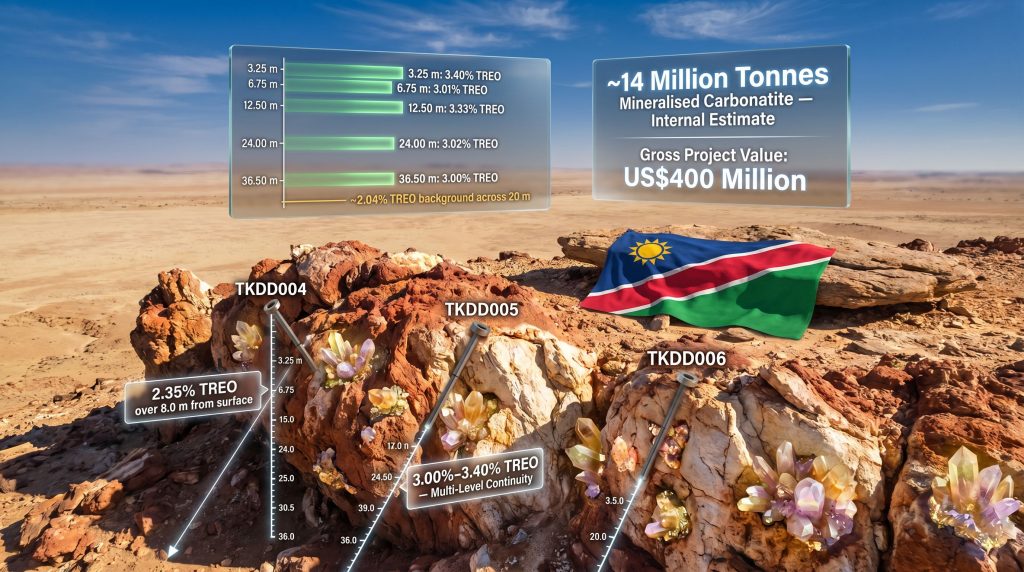
Kendrick Resources, listed on the AIM market of the London Stock Exchange, holds a 70% interest in the Teufelskuppe project. The project's current internal geological estimate encompasses approximately 14 million tonnes of above-ground mineralised carbonatite, with a gross estimated project value of approximately US$400 million (N$7.3 billion). It is essential to understand that this figure represents an internal estimate only and has not been reported in accordance with JORC 2012 or any equivalent reporting code.
The primary objective of the current drilling campaign is to generate the certified assay data and spatial coverage needed to underpin a formal, JORC-compliant Mineral Resource Estimate.
The mineralogy at TK is dominated by light rare earth elements (LREEs): cerium (Ce), lanthanum (La), neodymium (Nd), and praseodymium (Pr). This LREE basket is commercially significant because neodymium and praseodymium are the key inputs for neodymium-iron-boron (NdFeB) permanent magnets, the technology that powers electric vehicle motors, direct-drive wind turbines, and a growing range of industrial applications. Historic surface channel sampling at TK has returned an average grade of 3.1% TREO, with values ranging from 2.2% to 7.06% TREO across the carbonatite surface exposure.
Breaking Down the Latest Drill Results: TKDD004 to TKDD006
TKDD004: Continuous Mineralisation Commencing at Surface
Drill hole TKDD004 returned continuous REE mineralisation from the surface down to 5.50 m depth, averaging 2.30% TREO across the entire interval. Within this broader zone, two higher-grade sub-intervals were identified:
- 3.21% TREO over 0.50 m from 3.25 m depth
- 3.61% TREO over 0.75 m from 4.75 m depth
The fact that mineralisation begins precisely at surface is more significant than it might initially appear. In open-pit mining economics, the depth at which ore-grade material is first encountered controls the amount of waste rock that must be removed before revenue-generating material can be extracted. When mineralisation commences at surface, the pre-strip requirement is effectively zero for the shallowest portions of the orebody, which has a direct and meaningful positive impact on the project's projected capital intensity.
All results from TKDD004 are based on portable X-ray fluorescence (pXRF) analysis and remain subject to validation by certified laboratory assay.
TKDD005: The Widest Shallow Interval in the Campaign to Date
TKDD005 was specifically designed to test the lateral and vertical continuity of shallow mineralisation across a broader footprint. The hole returned a single, broad intersection of 2.35% TREO over 8.00 m from surface, representing the widest near-surface interval reported in the current drill campaign.
The significance of this result extends beyond the headline grade. An 8-metre width of consistently mineralised material from surface supports the interpretation of a bulk-tonnage, open-pittable resource geometry rather than a structurally restricted, narrow-vein system. Furthermore, in resource modelling, wider intervals reduce the sensitivity of tonnage estimates to small variations in geological domain boundaries, which improves overall resource confidence.
TKDD006: Multi-Level High-Grade Intercepts Extending to Depth
TKDD006 delivered the most structurally detailed picture of the TK system so far in this campaign, intersecting multiple discrete high-grade intervals across a broad mineralised corridor extending to at least 36.5 m below surface. These new drill results have further reinforced confidence in the system's vertical continuity.
TKDD006 High-Grade Interval Summary:
| Interval | From (m) | To (m) | Width (m) | TREO Grade (%) |
|---|---|---|---|---|
| 1 | 3.25 | 5.75 | 2.50 | 3.40 |
| 2 | 9.75 | 11.25 | 1.50 | 3.01 |
| 3 | 17.25 | 20.00 | 2.75 | 3.33 |
| 4 | 22.25 | 25.00 | 2.75 | 3.02 |
| 5 | 32.75 | 36.50 | 3.75 | 3.00 |
Perhaps the most analytically important element of TKDD006 is not the high-grade intervals themselves, but what sits between them. The sections of drill core between these highlighted zones return an average grade of approximately 2.04% TREO across a combined 20 m of intercept. In most global REE deposit contexts, 2.04% TREO would itself be considered above-average ore grade.
The TK system therefore exhibits what geologists sometimes describe as a high-grade-within-high-grade architecture: a background of solid mineralisation punctuated by multiple zones of elevated concentration. This structural character is particularly well-suited to bulk open-pit resource models because it means selective mining of only the highest-grade intervals is not required to generate an economically attractive average head grade.
Historical Drill Hole Context: How the Programme Has Evolved
The progression from the earliest holes at TK through to the current campaign reveals a deliberate strategic shift from high-grade discovery drilling toward resource definition and continuity testing.
Comparative Drill Results Across the TK Campaign:
| Drill Hole | Notable Interval | Grade | Width/Depth | Notes |
|---|---|---|---|---|
| TKDD001 | 42–46 m depth | 10.47% TREO | 4.0 m | Previously unanalysed core |
| TKDD001 | Near-surface | 5.10% TREO | 7.25 m | High-grade pXRF cluster |
| TKDD002 | Deep LREE intercept | 3.40% LREO | 7.0 m at 109 m | Deep system confirmed |
| TKDD002 | Peak point value | 14.80% LREO | Point sample | Exceptional spot grade |
| TKDD004 | Surface to 5.5 m | 2.30% TREO avg | 5.5 m | Latest campaign, from surface |
| TKDD005 | Surface to 8.0 m | 2.35% TREO | 8.0 m | Widest shallow interval |
| TKDD006 | Multiple zones | 3.00–3.40% TREO | Various | Multi-level continuity to 36.5 m |
The peak values of 14.80% LREO from TKDD002 and 10.47% TREO from TKDD001 establish an important upper boundary for the system's grade potential. Meanwhile, the more recent holes demonstrate that broad, consistent grades of 2.0–3.5% TREO are achievable across multiple drill holes and depths, which is the critical signal for resource building. Single high-grade intercepts attract attention; repeated high grades across systematic drilling build resources.
TKDD002's deep intercept at 109 m depth is also worth contextualising. It suggests the carbonatite system has meaningful vertical continuity well below the current near-surface drilling focus, which could have significant implications for total resource endowment once deeper resource definition work is undertaken. Properly interpreting these drill results is therefore essential for understanding the project's full potential.
Understanding pXRF Analysis: Speed, Value, and Its Limitations
What is pXRF? Portable X-ray fluorescence (pXRF) is a field-deployable analytical instrument that measures elemental concentrations in rock samples by directing X-ray energy at the material and measuring the characteristic fluorescent radiation emitted by different elements. In REE exploration, pXRF allows exploration teams to generate rapid, cost-effective grade estimates from drill core during an active drilling campaign, enabling real-time targeting decisions without waiting weeks for laboratory results.
Advantages of pXRF in REE exploration:
- Provides real-time grade data during active drilling, allowing immediate re-targeting if needed
- Enables rapid identification of high-grade intervals for priority laboratory submission
- Substantially reduces the time lag between drilling and initial grade interpretation
- Cost-effective compared to a full laboratory assay program run in isolation
Key limitations that investors must understand:
- Sample surface texture, moisture content, and mineralogical matrix can affect analytical accuracy
- Individual rare earth elements may not be fully resolved at the field instrument level, particularly heavy REEs present at low concentrations
- Results require calibration against certified reference standards to establish their reliability
- JORC 2012 reporting standards mandate certified laboratory assays for formal resource estimation; pXRF data cannot independently support a Mineral Resource classification
All drill core from TKDD004, TKDD005, and TKDD006 has been logged and submitted to an independent certified laboratory for assay validation. The transition from pXRF results to laboratory-certified grades is the next critical milestone in the TK resource definition timeline.
The next major ASX story will hit our subscribers first
The Path to a JORC-Compliant Mineral Resource Estimate
The conversion of drilling data into a formally reportable Mineral Resource is a multi-stage technical process governed by the JORC Code 2012, which is the international standard for public reporting of exploration results, mineral resources, and ore reserves in Australia and widely adopted globally.
Step-by-step resource definition pathway for Teufelskuppe:
- Ongoing diamond drilling to expand spatial coverage across the carbonatite complex and test strike and depth extensions
- pXRF screening of all drill core for rapid zone identification and laboratory submission prioritisation
- Certified laboratory assay validation to convert pXRF data into JORC-reportable grade measurements
- Geological domain modelling constructing three-dimensional wireframes that define the boundaries of mineralised zones
- Geostatistical estimation applying established methods such as ordinary kriging to interpolate grade and tonnage between drill holes
- Competent Person review and sign-off by a suitably qualified geologist in accordance with JORC 2012
- Mineral Resource classification into Inferred, Indicated, or Measured categories based on data density and geological confidence
The ~14 million tonne internal estimate currently attributed to TK's above-ground mineralised carbonatite is not a JORC resource and should not be interpreted as one. However, the ongoing drilling programme is demonstrating that additional mineralisation extends below the surface exposure, potentially adding to the total endowment. At a grade of 2.0–3.0% TREO, a 14 Mt resource would represent a substantial contained REE inventory by global standards.
How Teufelskuppe Grades Compare Globally
To contextualise the TK grade profile, it is instructive to benchmark the project against the broader global carbonatite REE development pipeline.
Conceptual Grade Benchmarking: Carbonatite REE Projects
| Project Category | Typical TREO Grade Range | Mining Mode | Development Stage |
|---|---|---|---|
| Low-grade bulk tonnage | 0.30–0.80% | Open pit | Various |
| Mid-grade carbonatite | 0.80–1.50% | Open pit / underground | Advanced |
| High-grade carbonatite | 1.50–3.00% | Open pit preferred | Development/Exploration |
| Teufelskuppe (TK) | 2.00–3.50% avg; up to 14.8% peak | Near-surface open pit | Exploration/Resource Definition |
A sustained average TREO grade of 2.0–3.5% from near-surface carbonatite mineralisation is genuinely high-grade by global comparison. Many operating and advanced-stage REE projects globally have economic cut-off grades below 0.5% TREO, meaning TK's background mineralisation alone significantly exceeds the production threshold at numerous peer operations.
Understanding the economic significance of cut-off grades is therefore essential context when evaluating TK's relative position within the global development pipeline. The near-surface character of the mineralisation is a key economic differentiator. Shallow open-pit REE operations carry substantially lower capital intensity and simpler operational logistics than deep open-pit or underground equivalents, translating directly into improved project economics and a more accessible funding threshold for early-stage development capital.
Key Risk Factors Every Investor Should Understand
Technical and Geological Risks
- pXRF-to-laboratory variance: Field analytical data may not perfectly replicate certified assay grades. All results from the current campaign remain preliminary until laboratory validation is published.
- Resource classification uncertainty: Until a JORC resource is formally defined, grade and tonnage figures are indicative only and should not form the basis of investment decisions independently.
- Metallurgical recovery: High in-ground TREO grades do not automatically translate to high processing recoveries. Rare earth separations are chemically complex, and processing challenges for rare earths represent a critical next step that has not yet been reported for TK.
- Depth continuity: While TKDD006 confirms mineralisation to 36.5 m and TKDD002 shows grades at 109 m depth, the full vertical extent and grade continuity at depth remain to be systematically defined.
Market and Commercial Risks
- REE prices are subject to significant volatility, with China controlling an estimated 85–90% of global rare earth refining capacity, giving it substantial pricing influence over the LREE basket.
- Cerium and lanthanum, while present in the TK deposit, face weaker demand dynamics than the magnet rare earths neodymium and praseodymium. The commercial value of any TK resource will depend significantly on the relative proportions of these elements within the LREE basket.
- REE project development timelines from exploration to production typically span 8–15 years, requiring sustained access to capital across multiple market cycles.
- Offtake and downstream processing partnerships are critical given the technical complexity of rare earth separation and refining, which requires specialised hydrometallurgical facilities not commonly co-located with mining operations.
This article contains forward-looking analysis and references to exploration-stage projects. Nothing in this article constitutes financial or investment advice. Investors should conduct their own due diligence and seek independent professional advice before making any investment decisions.
Frequently Asked Questions: Kendrick Resources Teufelskuppe Drill Results
What is the Teufelskuppe project?
Teufelskuppe is a carbonatite-hosted rare earth element project located in Namibia, in which AIM-listed Kendrick Resources holds a 70% interest. The project is currently at the exploration and resource definition stage, with active diamond drilling targeting a JORC-compliant Mineral Resource Estimate.
What grades has drilling returned at Teufelskuppe?
Recent drilling has returned average grades of 2.30–2.35% TREO across broad near-surface intervals, with high-grade sub-intervals ranging from 3.00% to 3.61% TREO. Earlier holes recorded exceptional values including 10.47% TREO over 4 m (TKDD001) and a peak of 14.80% LREO from TKDD002.
How deep is the mineralisation at Teufelskuppe?
The latest drilling confirms mineralisation from surface to at least 36.5 m depth in TKDD006, while TKDD002 demonstrated significant LREE grades at 109 m depth, suggesting the system has substantial vertical extent beyond the current near-surface drilling focus.
What is the significance of near-surface REE mineralisation?
Near-surface mineralisation enables lower-cost open-pit mining with minimal pre-strip requirements. This reduces upfront capital expenditure and improves project economics compared to deeper open-pit or underground REE operations, making near-surface deposits more accessible to development financing.
Are the drill results JORC-compliant?
Results from TKDD004 to TKDD006 are currently based on pXRF analysis and are considered preliminary. All drill core has been submitted to an independent certified laboratory for validation. JORC-compliant reporting requires certified assay data and a formal Competent Person sign-off, which remain pending.
What rare earth elements are present at Teufelskuppe?
The deposit is dominated by light rare earth elements (LREEs): cerium, lanthanum, neodymium, and praseodymium. Neodymium and praseodymium are the most commercially valuable components of this basket, given their critical role in NdFeB permanent magnet manufacturing for electric vehicles and wind energy systems.
Summary: What the Data Tells Us About TK's Trajectory
Key Project Metrics at a Glance:
| Metric | Value |
|---|---|
| Kendrick Resources project interest | 70% |
| Internal mineralised carbonatite estimate | ~14 million tonnes |
| Gross estimated project value (internal) | US$400 million / N$7.3 billion |
| TKDD005 widest shallow interval | 2.35% TREO over 8.0 m from surface |
| TKDD006 deepest high-grade interval | 3.00% TREO over 3.75 m (32.75–36.50 m) |
| Background grade between high-grade zones (TKDD006) | ~2.04% TREO across combined 20 m |
| Historic surface channel sampling average | 3.1% TREO |
| Peak grade recorded (TKDD001) | 10.47% TREO over 4.0 m |
| Deep system intercept (TKDD002) | 14.80% LREO peak at 109 m depth |
| Primary REE types | LREEs: Ce, La, Nd, Pr |
The Kendrick Resources Teufelskuppe Namibia rare earth drill results published to date describe a carbonatite system that consistently delivers above-peer grades across multiple holes, from surface to meaningful depths, with broad intersection widths that support bulk open-pit resource modelling. Proactive Investors has reported that Kendrick's shares responded positively to the release of these results, reflecting growing market recognition of the project's grade credentials.
The transition from an internal geological estimate to a JORC-compliant Mineral Resource Estimate represents the single most significant near-term value inflection point for the project. Until certified laboratory assays are published and a formal resource is defined, all grade and tonnage figures remain indicative. What the current drilling programme has unambiguously demonstrated, however, is that the mineralised system is continuous, near-surface, and consistently high grade by global benchmarks. In a rare earth development landscape where those three attributes rarely coexist, that combination demands attention.
Want to Track the Next Major Critical Minerals Discovery the Moment It Hits the ASX?
Discovery Alert's proprietary Discovery IQ model delivers real-time alerts on significant ASX mineral discoveries — including in the critical minerals and rare earth space — instantly converting complex geological data into actionable investment insights for subscribers at every experience level. Explore historic examples of exceptional discovery returns and begin your 14-day free trial today to position yourself ahead of the market.