
July 8, 2026
The Geopolitics of Heavy Rare Earths and Why Ownership Disputes Are Becoming Battlegrounds
Rare earth supply chains have long operated in the background of global industrial policy, invisible to most investors yet foundational to some of the most consequential technologies of the modern era. High-performance magnets, precision-guided munitions, electric vehicle drivetrains, and next-generation wind turbines all share a common dependency on a narrow class of elements. When a Western nation attempts to pry that control loose, the resistance it encounters reveals the strategic importance of rare earths to global power competition. The Northern Minerals China-linked investors divestment order is a defining example of exactly this tension.
That dynamic is now playing out in the remote East Kimberley region of Western Australia, where a prolonged regulatory confrontation between the Australian federal government and a group of China-linked investors has exposed the limits of foreign investment enforcement when strategic incentives run deep enough.
When big ASX news breaks, our subscribers know first
Browns Range and the Strategic Value of Heavy Rare Earth Deposits
Not all rare earth projects are equal. The distinction between light rare earth elements (LREEs) and heavy rare earth elements (HREEs) is critical to understanding why the Browns Range project commands such geopolitical attention. Light rare earths such as cerium and lanthanum are relatively abundant and widely distributed globally. Heavy rare earths, by contrast, are far scarcer, geologically more complex to extract, and overwhelmingly concentrated in Chinese-controlled deposits and processing infrastructure.
Browns Range is enriched specifically in dysprosium and terbium, two HREEs that occupy a unique position in the technology supply chain:
- Dysprosium is prized for its exceptional resistance to demagnetisation at elevated temperatures, making it indispensable in the high-flux magnets used across defence platforms, EV motors, and wind turbine generators
- Terbium amplifies the performance of neodymium-iron-boron (NdFeB) magnets at high temperatures and is used in solid-state lighting and certain sonar applications
- Together, dysprosium and terbium are classified among the most supply-critical elements in Western defence and clean energy manufacturing
China currently accounts for the large majority of global HREE production and refines an even greater proportion of global output through its vertically integrated processing infrastructure. Geologists and supply chain analysts widely regard HREE deposits outside of Chinese control as strategically asymmetric assets, meaning their value to potential competitors exceeds what their market capitalisation alone would suggest.
A Three-Year Regulatory Escalation With No Precedent
The Australian government's engagement with China-linked ownership of Northern Minerals has not been a single intervention but a multi-year campaign that has steadily intensified. Understanding the sequence of events is essential for contextualising the current impasse.
| Year | Regulatory Action | Outcome |
|---|---|---|
| 2023 | Treasurer blocked a China-linked fund from increasing its proportional stake | First formal FIRB intervention at Northern Minerals |
| 2024 | Five entities ordered to sell 613.6 million shares (~10.4% of company) | Partial compliance; one entity found to have transferred shares to a related party |
| 2024-2025 | Legal action against Hong Kong Ying Tak Ltd and former director | $14 million fine imposed for breaching the Foreign Acquisitions and Takeovers Act |
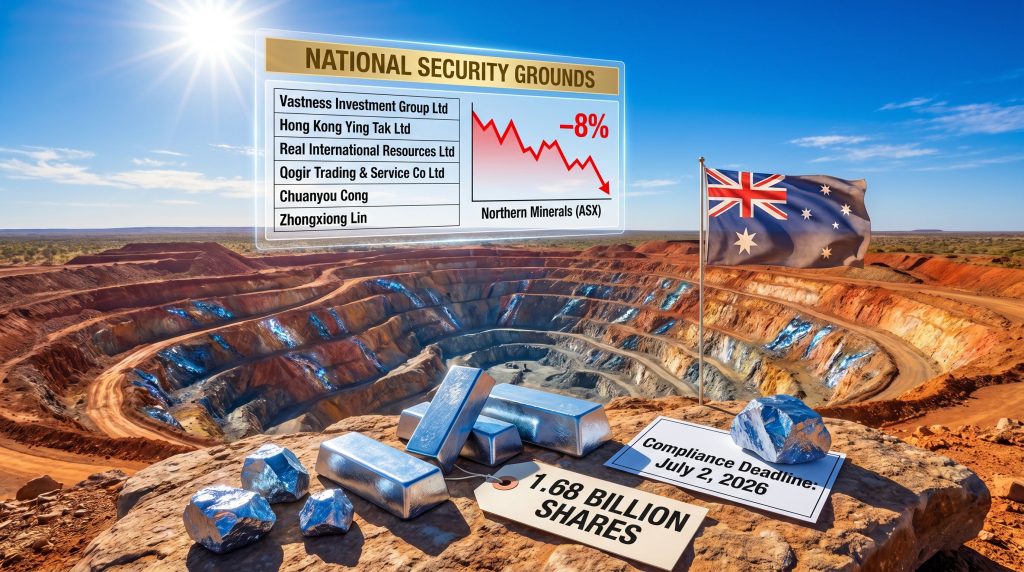
| May 2026 | Six investors ordered to divest ~1.68 billion shares by July 2, 2026 | Deadline passed with majority of shares still held by same six investors |
| July 8, 2026 | Northern Minerals ASX disclosure confirms non-compliance | Enforcement escalation under active consideration |
Ian Satchwell, a senior fellow at the Australian Strategic Policy Institute, has characterised the government's three-year engagement as without precedent in Australian foreign investment history. His assessment, reported by ABC News, is that such behaviour had never previously been exhibited by investors in any Australian company. Furthermore, while the situation was extraordinary, it was also explicable given China's dominance in global heavy rare earth markets and its clear strategic interest in delaying or controlling independent production elsewhere.
China's rare earth export restrictions have reinforced precisely why Western governments are unwilling to allow strategic mineral assets to remain under foreign influence. The Northern Minerals situation is, in many respects, a direct consequence of that broader geopolitical pressure.
Who Are the Six Investors and Why Does Their Structure Matter?
The six entities named in the May 2026 disposal order are not a homogenous group. They span multiple jurisdictions and corporate structures, a feature that is itself analytically significant.
| Entity | Jurisdiction | Type |
|---|---|---|
| Vastness Investment Group Ltd | Mainland China | Corporate |
| Hong Kong Ying Tak Ltd | Hong Kong | Corporate (prior non-compliance) |
| Real International Resources Ltd | British Virgin Islands | Offshore holding company |
| Qogir Trading & Service Co Ltd | Mainland China | Corporate |
| Chuanyou Cong | Mainland China | Individual |
| Zhongxiong Lin | Mainland China | Individual |
The use of British Virgin Islands registered entities is particularly notable. Offshore holding structures in low-transparency jurisdictions are a well-documented mechanism for obscuring beneficial ownership, complicating the task of foreign investment screening bodies attempting to trace the ultimate controllers of a given asset. Australian regulators have flagged this practice in the context of foreign investment in critical mineral assets, and it represents a structural challenge that existing screening frameworks were not specifically designed to address at scale.
The inclusion of both individual investors and corporate entities across multiple jurisdictions creates a fragmented enforcement target, where legal orders issued in Australia may have limited practical reach depending on where assets and decision-makers are actually located.
The Enforcement Gap: Where Australian Law Meets Its Limits
The Foreign Acquisitions and Takeovers Act gives the Treasurer substantial powers to intervene in foreign investment on national interest grounds. Those powers include issuing binding disposal orders, pursuing civil litigation, imposing financial penalties, and potentially restricting the voting rights of non-compliant shareholders. On paper, the framework is robust.
In practice, however, enforcement against offshore investors becomes structurally difficult when those investors are domiciled in jurisdictions that do not have bilateral legal cooperation or mutual enforcement treaties with Australia. A share registry can confirm that shares remain registered to a given entity. Compelling that entity to execute a sale is a different matter entirely when its principals are physically and legally beyond the practical reach of Australian courts.
The $14 million penalty imposed in the earlier round of non-compliance demonstrated that financial consequences are available as a deterrent. However, for investors with state-adjacent strategic motivations, financial penalties may represent an acceptable cost relative to the strategic value of maintaining a blocking or delaying presence in a critical mineral asset. This is a fundamentally different calculus to that of a commercially motivated investor who simply wants to maximise returns.
Satchwell acknowledged in his ABC News commentary that beyond issuing orders and appealing to the federal court to enforce them, the government's practical options are constrained, particularly when the identities and locations of the investors remain only partially known.
Potential Enforcement Pathways Going Forward
- Federal Court application to seek judicial enforcement of the disposal orders, which would carry greater legal authority but face the same offshore jurisdiction challenges
- Share registry restrictions that limit or extinguish the voting rights of non-compliant shareholders, reducing their influence on corporate decisions without requiring a completed sale
- Legislative reform to strengthen the Foreign Acquisitions and Takeovers Act, potentially introducing custodianship powers or compulsory acquisition mechanisms for strategically sensitive assets
- Allied coordination through Five Eyes and Quad frameworks to apply coordinated financial or diplomatic pressure on entities with exposure to Western financial systems
Why Non-Compliance Is Rational From a Geopolitical Standpoint
From a purely financial perspective, defying a government divestment order appears irrational. The legal exposure, reputational risk, and prospect of forced sale at a disadvantageous price all argue for cooperation. However, the Northern Minerals situation is not primarily a financial dispute. It is a geopolitical one.
Consider the strategic incentive structure facing China-linked investors in this asset:
- Market control preservation: Any independently operated HREE producer outside Chinese processing infrastructure represents a direct challenge to China's leverage over downstream manufacturers globally
- Delay as a value-destruction tool: Regulatory uncertainty, combined with restricted access to capital from allied-nation investors, slows the project's development timeline, potentially by years
- Precedent avoidance: Voluntary compliance would signal to other China-linked investors across the broader critical minerals sector that Australian divestment orders are consistently enforceable, with significant downstream implications for other strategic positions
- Financial disadvantage: Northern Minerals' share price had fallen to less than half the level of a placement completed in October 2025, making a forced open-market sale financially costly for the investors at current valuations
Chinese government officials publicly called on Australia to respect the legitimate rights of investors and maintain what they described as a transparent and fair business environment, framing the divestment orders as discriminatory. This diplomatic positioning suggests the non-compliance is not simply the independent decision of six private investors but is embedded in a broader state-level response to Western critical mineral sovereignty efforts.
The next major ASX story will hit our subscribers first
Market Impact and Project Development Implications
The ongoing ownership dispute has had measurable consequences for Northern Minerals as a listed company and for the Browns Range project's development trajectory.
Following the May 2026 divestment directive, Northern Minerals' share price declined by more than 8%, reflecting investor uncertainty about the regulatory overhang and the project's near-term capital-raising capacity. The stock was already trading at a significant discount to its October 2025 placement price, indicating that the prolonged ownership conflict had been steadily eroding market confidence.
The practical project-level consequences are equally significant:
- Unresolved ownership uncertainty creates barriers to securing long-term offtake agreements with Western manufacturers or defence supply chain participants
- Allied-nation strategic funds and institutional investors with sensitivity to beneficial ownership structures may defer commitment until the share register is fully resolved
- Northern Minerals' plan to send Browns Range ore to Iluka Resources' Eneabba refinery for processing represents an important downstream pathway, but that pathway requires a stable operational and financing environment to execute
Northern Minerals confirmed it would provide share registry information to Treasury to assist in compliance assessment, but declined to make further public comment beyond its ASX disclosure obligations.
How Australia's Response Fits Within a Global Policy Realignment
Australia is not acting in isolation. Across allied nations, foreign investment screening in the critical minerals sector has tightened materially over the past three to four years, driven by a shared recognition that supply chain concentration in strategic competitor nations represents a systemic vulnerability. Indeed, Australia's critical minerals strategy has been explicitly shaped by this recognition, placing sovereignty over strategic assets at its centre.
| Country | Policy Mechanism | Notable Action |
|---|---|---|
| Australia | FIRB screening and Treasurer divestment powers | Three interventions at Northern Minerals (2023-2026) |
| United States | CFIUS review and forced divestiture authority | Multiple Chinese divestiture orders across semiconductor and mining sectors |
| Canada | Investment Canada Act national security review | Ordered divestiture of Chinese-linked lithium mining stakes (2022-2023) |
| United Kingdom | National Security and Investment Act (2021) | Expanded mandatory notification requirements for critical mineral transactions |
What makes the Northern Minerals China-linked investors divestment order distinct within this global context is not the intervention itself but the persistence of non-compliance across multiple rounds of regulatory action spanning three years. No comparable situation, involving the same asset and the same pattern of defiance, appears to have occurred in any other allied nation's foreign investment history.
Treasury's position, as communicated publicly, is that the government expects foreign investors to comply with Australian law and will take whatever further action is necessary to protect national interests and the integrity of the foreign investment framework.
The Structural Lesson for Australian Critical Mineral Policy
The Northern Minerals situation exposes a fundamental architectural tension in how Australia's foreign investment regime was designed. The Foreign Acquisitions and Takeovers Act and the FIRB process were constructed primarily as entry-point screening mechanisms, intended to evaluate and if necessary block foreign investment before it becomes entrenched. They were not designed with equivalent force for the exit-point problem: compelling divestment from investors who are already deeply embedded in a company's share register.
The case makes a compelling argument for proactive ownership monitoring as a continuous regulatory function rather than a one-time approval process. It also raises questions about whether Australia needs statutory custodianship powers analogous to those available in some other jurisdictions, where a regulator can assume management or voting control of disputed shares during enforcement proceedings without waiting for a completed sale.
Furthermore, the broader rare earth supply chain buildout across allied nations will depend, in part, on whether governments can demonstrate that their foreign investment enforcement mechanisms carry genuine teeth. For investors and analysts tracking the critical minerals sector, the metals and mining geopolitics underpinning this case will likely shape how allied nations design their foreign investment enforcement frameworks for the remainder of this decade.
This article is intended for informational and analytical purposes only and does not constitute financial or investment advice. Forward-looking statements and regulatory outcome projections involve inherent uncertainty. Readers should conduct their own independent research before making investment decisions.
Want to Track the Next Major Rare Earth Discovery Before the Market Does?
Discovery Alert's proprietary Discovery IQ model scans ASX announcements in real time, instantly alerting subscribers to significant mineral discoveries — including critical and rare earth elements — and turning complex geological data into actionable investment insights. Explore historic discoveries and their exceptional market returns to understand the opportunity, then begin your 14-day free trial at Discovery Alert and position yourself ahead of the broader market.