July 8, 2026
The Mineralogical Divide That Separates Korsnäs From the Rest of Europe's Rare Earth Landscape
Rare earth processing is not a single discipline. It is a series of mineralogy-specific engineering decisions, each shaped by the precise way target elements are hosted within the rock matrix. Two deposits can share identical total rare earth oxide grades yet behave completely differently under identical processing conditions. Understanding this principle is the key to reading what the latest metallurgical test results from the European Resources Korsnäs magnet rare earths extraction programme actually mean, and why the numbers produced by ANSTO carry more weight than a surface-level reading suggests.
The Korsnäs deposit, held by European Resources (ASX: ERE), is built around a monazite-apatite mineral system. This is a fundamentally different host architecture compared with the carbonatite-hosted deposits that dominate much of the global rare earth development pipeline. In carbonatite systems, rare earth elements are typically dispersed through carbonate mineral matrices and respond to acid dissolution in a more uniform pattern.
At Korsnäs, the critical elements are split across two mineralogically distinct hosts: the magnet-critical neodymium and praseodymium sit predominantly within monazite phosphate grains, while the heavier rare earths including terbium, dysprosium, and yttrium are locked within apatite crystal structures. This dual-phase architecture creates both a processing challenge and a strategic opportunity.
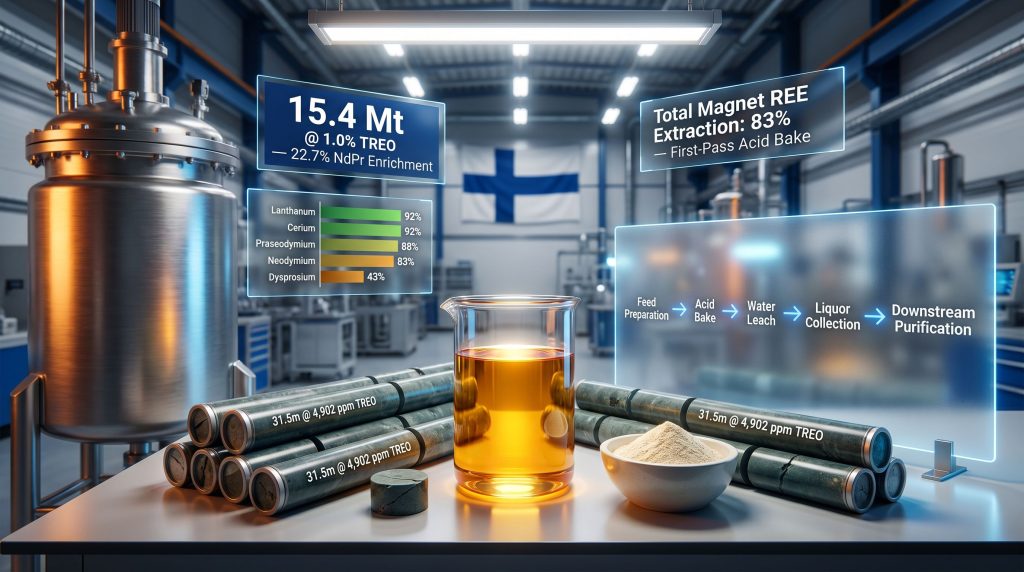
The inferred resource stands at 15.4 million tonnes grading 1.0% total rare earth oxide (TREO), with a NdPr enrichment ratio of approximately 22.7% of the total rare earth fraction. A single drill intercept of 31.5 metres returned 4,902 parts per million TREO with NdPr content at 28 to 30% of the rare earth suite, which is well above what most European rare earth projects can demonstrate at the drill hole scale.
NdPr enrichment above roughly 22% is widely regarded within the industry as a threshold indicator for permanent magnet feedstock viability. The majority of European rare earth occurrences fall below this level, which means the Korsnäs mineralogy places it in a structurally differentiated position relative to regional peers.
When big ASX news breaks, our subscribers know first
What the Acid-Bake Flowsheet Is Actually Doing to the Korsnäs Concentrate
A Step-by-Step Breakdown of the Direct Processing Route
The acid-bake and water-leach process is the standard commercial route for processing monazite-dominated rare earth concentrates. It has been used at industrial scale in facilities across China, Malaysia, and historically in the United States and France. Understanding why it works, and where its limitations appear, is essential to interpreting the ANSTO test results correctly.
The process operates through five sequential stages:
-
Feed preparation involves conditioning the concentrate material from the legacy lanthanide stockpile at Korsnäs, which was produced by previous operators and allows metallurgical testing to proceed ahead of full resource drilling completion.
-
Acid bake applies concentrated sulphuric acid to the concentrate at elevated temperature, typically between 200 and 300 degrees Celsius. The acid attacks the phosphate matrix of monazite, converting rare earth phosphates into water-soluble rare earth sulphates.
-
Water leach dissolves the rare earth sulphate compounds into an aqueous solution, separating the soluble rare earth fraction from the insoluble gangue residue.
-
Liquor collection recovers the rare earth-bearing pregnant leach solution, with the residue fraction containing elements that did not dissolve under bake conditions.
-
Downstream purification removes impurities from the leach liquor, including radionuclides such as uranium and thorium, before solvent extraction separates individual rare earth elements.
The alternative to this approach is the alkaline crack method, which uses sodium hydroxide rather than sulphuric acid to decompose monazite. While the alkaline route avoids some of the radionuclide extraction issues by leaving thorium preferentially in the solid phase, it generates larger waste volumes and faces higher reagent costs. The acid-bake route remains dominant for monazite feeds at commercial scale precisely because its rare earth recovery rates for light rare earths are consistently higher.
| Flowsheet Route | Best Suited Feed | REE Recovery Range | Key Challenge |
|---|---|---|---|
| Acid Bake + Water Leach | Monazite-dominant | 80-90% light REEs | Radionuclide management |
| Alkaline Crack | Monazite + mixed | 75-88% | Reagent costs, waste volume |
| Hydrochloric Pre-Leach | Apatite-rich | Higher HREEs | Lower LREE recovery |
| Combined Pre-Leach + Acid Bake | Dual-hosted (monazite + apatite) | Optimisation in progress | Integration complexity |
Interpreting the ANSTO Extraction Numbers
The ANSTO metallurgical results from the direct bake test produced praseodymium extraction of 88% and neodymium at 83%, giving a total magnet rare earth extraction of 83% and combined TREO extraction of 86%. Lanthanum and cerium both extracted at 92%, consistent with the predictable behaviour of light rare earths from well-structured monazite feeds.
What makes these figures meaningful is the context in which they were achieved. This was a first-pass direct bake test, conducted without any pre-leach optimisation or feed conditioning designed specifically to improve magnet rare earth recovery. The fact that 83% magnet rare earth extraction emerged from an unoptimised first pass is a technically credible result.
In commercial rare earth metallurgy, first-pass acid-bake recoveries above 80% for magnet rare earths are generally regarded as strong indicators that a monazite-hosted feed will respond well to further optimisation. Many projects require multiple test iterations and flowsheet modifications before reaching this performance level.
The Apatite Problem: Why Heavy Rare Earth Recovery Tells a Different Story
The Chemistry Behind the Underperformance of Terbium, Dysprosium, and Yttrium
The direct bake test produced a distinctly different picture for heavy rare earths. Terbium extracted at 49%, dysprosium at 43%, and yttrium at 43% under bake conditions. These figures are not anomalous or unexpected given what is known about the Korsnäs mineralogy. They are the chemically predictable result of what happens when apatite-hosted rare earths encounter high-sulphate conditions.
The mechanism works as follows: apatite contains significant calcium in its crystal structure. When sulphuric acid is applied at elevated temperature, calcium reacts with sulphate to form calcium sulphate, a compound with very low solubility under these conditions. As calcium sulphate precipitates out of solution during the bake, it physically encapsulates or co-precipitates with the heavy rare earth elements that were associated with the apatite grains. Consequently, terbium, dysprosium, and yttrium end up trapped in the residue rather than transferred into the leach liquor.
Earlier hydrochloric acid pre-leach work conducted by ANSTO produced an inverse pattern. Heavy rare earth indicators responded better under hydrochloric pre-leach conditions, while light rare earths lagged. This complementary dataset is important because it confirms a specific mineralogical architecture: the pre-leach preferentially accesses the apatite-hosted heavy rare earth fraction by dissolving calcite and mobilising apatite before the sulphate environment of the bake stage can lock these elements into calcium sulphate precipitate. The rare earth processing challenges inherent to dual-hosted systems such as this are well recognised across the industry.
Designing the Integrated Two-Stage Flowsheet
The logical engineering response is a sequenced combined flowsheet. A hydrochloric acid pre-leach stage runs first, targeting calcite dissolution and mobilising the apatite-associated heavy rare earths. The conditioned material then moves into the acid-bake and water-leach stage to unlock the monazite-hosted magnet metal fraction.
The key optimisation variables for this combined circuit include:
-
Hydrochloric acid concentration and temperature in the pre-leach stage to maximise heavy rare earth mobilisation without dissolving unwanted gangue phases
-
Residence time in both stages and the physical form of feed material entering each reactor
-
Management of the chloride-sulphate interface between the two processing stages to prevent cross-contamination of reagent streams
-
Integration of the wet high-gradient magnetic separation (WHGMS) beneficiation step, which has demonstrated TREO upgrade ratios of up to 129% for Type 2 material under the EU REMHub research programme, conducted in collaboration with GTK Mintec and Oulu University
The distinction between having a defined conceptual flowsheet architecture and having a validated, integrated processing circuit is significant. The former means engineers understand what the solution looks like. The latter requires bench-scale optimisation, pilot-scale confirmation, and ultimately scoping study integration.
From bench-scale test results to a fully validated integrated flowsheet, the typical rare earth project timeline runs 12 to 24 months of optimisation work under best-case conditions. The Korsnäs programme has established the conceptual framework; the execution phase is what remains.
Uranium, Thorium, and Aluminium: Reading the Impurity Data Correctly
Why Near-Complete Radionuclide Extraction Is Expected, Not Alarming
Monazite is a thorium-bearing phosphate mineral. This is not an unusual geological characteristic; it is a defining chemical property of the monazite mineral group. Thorium and uranium substitute into the monazite crystal lattice as trace components, and when sulphuric acid decomposes the monazite matrix during an acid bake, both radionuclides are released into solution with high efficiency. The ANSTO test produced uranium and thorium extraction above 96% under direct bake conditions. This is the expected result for monazite processing, not an anomalous or problematic outcome.
The engineering response is standard: a dedicated radionuclide removal stage is incorporated into the downstream purification circuit between the leach liquor and the solvent extraction circuit. This approach is used at commercial rare earth processing facilities that handle monazite feeds. In the European regulatory context, the EURATOM framework governs the management of naturally occurring radioactive material (NORM) in rare earth processing, and Finnish operators would be subject to these requirements as well as Finnish Radiation and Nuclear Safety Authority (STUK) regulations.
The aluminium extraction data is more positively framed. With aluminium extracting at 46% under bake conditions, the TREO-to-aluminium ratio in the leach liquor improved from 2.4 in the feed to 3.8 in the liquor. This selectivity improvement is practically useful because it reduces the aluminium load entering the downstream solvent extraction circuit, where high aluminium concentrations can interfere with rare earth separation efficiency.
Impurity Extraction Summary
| Impurity | Extraction Rate | Downstream Implication |
|---|---|---|
| Uranium | >96% | Dedicated radionuclide removal stage required |
| Thorium | >96% | NORM management circuit required under EURATOM/STUK |
| Aluminium | 46% | TREO:Al ratio improves from 2.4 to 3.8, positive for solvent extraction design |
| Calcium Sulphate | Precipitates in residue | Suppresses HREEs under direct bake; addressed via pre-leach |
How European Resources Korsnäs Fits Within the European Processing Gap
A Continent With Ore But Without Separation Infrastructure
Europe's rare earth challenge is frequently framed as a supply security problem rooted in geological scarcity. The more accurate diagnosis is that the continent has credible mineral occurrences but lacks the processing and chemical separation infrastructure to convert ore into separated rare earth oxides. Building that infrastructure requires projects that can demonstrate commercial-grade metallurgical recoveries, which is precisely why the European Resources Korsnäs magnet rare earths extraction results carry weight beyond a single company's development timeline.
The EU Critical Raw Materials Act has established 2030 targets requiring that 10% of the EU's annual consumption of strategic raw materials comes from domestic extraction, 40% from domestic processing, and 15% from recycling. Rare earths are among the materials targeted under this framework. Furthermore, reaching the processing benchmark in particular requires investment in separation facilities that do not currently exist at scale within the EU. These goals are closely tied to the broader critical raw materials transition agenda driving European industrial policy.
Korsnäs Versus European Rare Earth Development Peers
| Project | Country | Resource Type | NdPr Enrichment | Processing Stage | Key Differentiator |
|---|---|---|---|---|---|
| Korsnäs (ERE) | Finland | Monazite-Apatite | ~22.7% | Bench-scale metallurgy | EU-funded REMHub programme, legacy concentrate stockpile |
| Sokli | Finland | Carbonatite (phosphate) | Lower NdPr focus | Pre-feasibility | Polymetallic optionality |
| Norra Kärr | Sweden | Eudialyte | High HREE | Permitting stalled | Heavy rare earth-enriched profile |
| Tanbreez | Greenland | Kakortokite | Mixed | Early-stage | Scale offset by remote location |
In addition, Finland's position within the EU framework creates a different operating environment compared with projects in non-EU jurisdictions. This is particularly relevant in terms of access to EU research co-funding mechanisms and the broader industrial policy architecture developing around critical mineral processing capacity. For instance, the Tanbreez REE project illustrates how remote jurisdiction adds complexity that even significant scale cannot fully offset.
The Strategic Value of the Legacy Concentrate Stockpile
Why Pre-Processed Material Changes the Development Calculus
One of the least-appreciated aspects of the Korsnäs project among investors unfamiliar with rare earth development sequencing is the existence of a historical lanthanide concentrate stockpile produced by previous operators. This material was already processed through primary concentration steps before European Resources acquired the asset.
The practical consequence is significant. Rather than needing to mine fresh ore, crush it, grind it, and float it through a conventional beneficiation circuit before generating metallurgical test feed, European Resources can take samples directly from the existing stockpile and progress flowsheet testing immediately. This compresses the timeline for generating flowsheet validation data by potentially years relative to a greenfield project starting from ore.
The stockpile also provides a degree of feed representativeness that is sometimes difficult to achieve with small drill core samples. Bulk sampling from a concentrate that was produced from a larger historical mining campaign can reflect the mineralogical variability of the deposit more accurately than a handful of drill holes.
The 15.4 million tonne inferred resource and the legacy stockpile represent parallel value pathways operating on different timelines. The stockpile enables near-term flowsheet validation; the hard-rock resource underpins long-term production scale.
The next major ASX story will hit our subscribers first
What Must Happen Before a Scoping Study Becomes Possible
The Technical Milestones Between Now and Economic Assessment
Translating the current bench-scale results into a document the market can use to assign a development-stage valuation requires clearing several sequential technical gates:
-
Milestone 1: Combined pre-leach plus acid-bake integrated flowsheet test results. This is the single most important near-term data point for establishing total rare earth recovery across both the monazite and apatite fractions.
-
Milestone 2: Impurity removal circuit design. The radionuclide management stage must be engineered and validated before any downstream solvent extraction configuration can be finalised, because uranium and thorium concentrations in the leach liquor directly affect solvent extraction chemistry and reagent selection.
-
Milestone 3: Mineral resource upgrade from inferred to indicated classification. Scoping studies require a resource with sufficient geological confidence to support meaningful economic assumptions. An inferred resource carries material uncertainty relative to indicated or measured classifications.
-
Milestone 4: Scoping study completion. This translates bench-scale recoveries, resource estimates, and processing assumptions into a capital cost framework and operating cost structure that investors can evaluate against comparable development projects.
Projects at the stage Korsnäs currently occupies, with encouraging metallurgical signals, an inferred-only resource, and no offtake or financing structure, typically require three to five years of further technical work before reaching a construction decision. The ANSTO results represent meaningful de-risking steps within that broader development arc, not production signals.
FAQ: Korsnäs Rare Earth Project and European Magnet Metal Supply Chains
What Rare Earth Elements Does Korsnäs Primarily Target?
The project is focused on neodymium and praseodymium, the magnet rare earths used in high-performance permanent magnets for electric vehicle motors and wind turbine generators. The deposit also hosts lanthanum, cerium, terbium, dysprosium, and yttrium. The NdPr fraction at approximately 22.7% enrichment is the primary economic driver.
Why Did Terbium, Dysprosium, and Yttrium Perform Poorly in the Direct Bake Test?
These elements are hosted within apatite at Korsnäs rather than monazite. Under acid-bake conditions, calcium from the apatite matrix reacts with sulphate to produce calcium sulphate precipitate, which traps the heavy rare earths in the solid residue. A hydrochloric acid pre-leach stage before the bake step is the engineering solution to this problem.
Is High Uranium and Thorium Extraction a Risk for the Project?
It is a known engineering design requirement rather than a project-threatening variable. Monazite universally contains elevated thorium and uranium, and near-complete extraction of these elements into the leach liquor is standard behaviour. A dedicated radionuclide removal circuit within the purification train is the accepted commercial response.
What Does a 22.7% NdPr Enrichment Ratio Mean in Practical Terms?
Roughly 22.7% of the total rare earth oxide content consists of neodymium and praseodymium. Higher NdPr enrichment translates directly to greater revenue per tonne of ore processed because these two elements command the highest prices within the rare earth suite due to their irreplaceable role in permanent magnet manufacturing. Growing critical minerals demand from the energy transition continues to underpin this dynamic.
What Is the REMHub Programme?
REMHub is an EU co-funded research programme that supports rare earth metallurgical and mineralogical work in partnership with European academic and technical institutions including GTK Mintec and Oulu University. Wet high-gradient magnetic separation trials conducted under this programme demonstrated TREO upgrade ratios of up to 129% for certain Korsnäs material types, providing beneficiation data that feeds into the broader flowsheet design for the project.
Key Takeaways on the European Resources Korsnäs Magnet Rare Earths Extraction Programme
-
83% total magnet rare earth extraction on a first-pass direct bake test is a technically credible result that validates the core processing assumption for the monazite fraction
-
The dual monazite-apatite hosting structure means a two-stage integrated flowsheet is required; the conceptual architecture is now defined but optimisation work on integration remains
-
Uranium and thorium extraction above 96% is expected behaviour for monazite feeds and has well-established engineering solutions in commercial rare earth processing
-
The 15.4 million tonne inferred resource at 1.0% TREO with 22.7% NdPr enrichment provides credible scale, though inferred classification limits what a scoping study can confidently quantify
-
The legacy concentrate stockpile compresses the flowsheet validation timeline materially relative to projects that must mine fresh ore before generating test feed
-
The next critical data point is the combined pre-leach plus acid-bake integrated test result, which will determine whether total rare earth recovery across both mineral hosts reaches commercially meaningful levels. The broader context of rare earth supply chains in Europe makes this outcome particularly consequential
This article is for informational purposes only and does not constitute financial advice. Past metallurgical test results do not guarantee future project economics or development outcomes. Investors should conduct independent due diligence and consider seeking professional financial advice before making investment decisions. For further analysis of ASX-listed rare earth developers and critical mineral stocks, visit stocksdownunder.com.
Want to Track the Next Major ASX Mineral Discovery the Moment It's Announced?
Discovery Alert's proprietary Discovery IQ model scans ASX announcements in real time, instantly identifying significant mineral discoveries across rare earths and 30+ other commodities — turning complex data into clear, actionable opportunities for both short-term traders and long-term investors. Explore historic discoveries and their extraordinary returns, then begin your 14-day free trial at Discovery Alert to position yourself ahead of the market.