August 14, 2026
The Rare Earth Recycling Gap That Global Supply Chains Can No Longer Ignore
Across the global economy, a quiet vulnerability has been compounding for decades. The permanent magnets powering everything from electric vehicle drivetrains to missile guidance systems depend on a handful of rare earth elements, primarily neodymium, praseodymium, dysprosium, and terbium, whose processing remains overwhelmingly concentrated in a single country. Furthermore, even as policymakers and manufacturers grapple with primary supply chain exposure, an equally significant problem has gone largely unaddressed: the enormous volume of end-of-life magnets and electronic waste being discarded every year with virtually no rare earth recovery taking place.
This is the structural gap that makes the Oklahoma support for Iondrive's rare earth recycling module one of the more strategically consequential developments in the U.S. critical minerals landscape in recent years.
When big ASX news breaks, our subscribers know first
America's Secondary Rare Earth Problem: Bigger Than Most Investors Realise
The conversation around rare earth supply chains has historically centred on mining, processing, and geopolitical access to primary deposits. What receives far less attention is the secondary supply side, the latent reservoir of rare earth elements locked inside products already manufactured, already deployed, and already approaching end of life.
Neodymium-iron-boron (NdFeB) magnets, the dominant permanent magnet type used across defence, industrial motors, wind turbines, and consumer electronics, contain meaningful concentrations of both light rare earth elements (neodymium and praseodymium) and heavy rare earth elements (dysprosium and terbium). Heavy rare earths in particular carry significant strategic weight because their global supply is even more geographically concentrated than light rare earths, and their role in high-temperature magnet performance is irreplaceable with current technology.
Despite the strategic value embedded in these materials, the overwhelming majority of end-of-life NdFeB magnets generated in the United States are currently not recovered for their rare earth content domestically. They are either landfilled or exported, with no separation of the critical elements they contain.
This represents a compounding loss. Each magnet that reaches end of life without rare earth recovery is a unit of strategic material that must be replaced through primary supply, almost all of which flows through foreign processing infrastructure. At the scale of millions of motors, drives, hard disk drives, and industrial systems retiring each year, the cumulative rare earth content being discarded is substantial.
Why Recovering Rare Earths from Waste Streams Is Technically Demanding
The rare earth processing challenges involved in separating rare earth elements from mixed waste streams are genuinely complex, and this technical difficulty explains why secondary recovery infrastructure has lagged so far behind primary supply chain investment.
Rare earth elements share nearly identical ionic radii and chemical behaviours, which makes selective separation from one another, and from the iron, boron, copper, and other metals present in magnet and e-waste streams, exceptionally challenging. Conventional hydrometallurgical approaches rely on concentrated acids and solvent extraction circuits that generate significant quantities of hazardous waste and require careful management of radioactive thorium or uranium impurities sometimes present in rare earth feeds.
Pyrometallurgical methods operate at extreme temperatures and tend to produce low selectivity for individual rare earth elements, making them poorly suited to producing the refined oxide outputs that downstream magnet manufacturers require. The result, consequently, is a technical barrier that has historically made secondary rare earth recovery economically marginal at smaller scales, reinforcing reliance on primary supply.
What Makes IONSolv Technically Distinctive
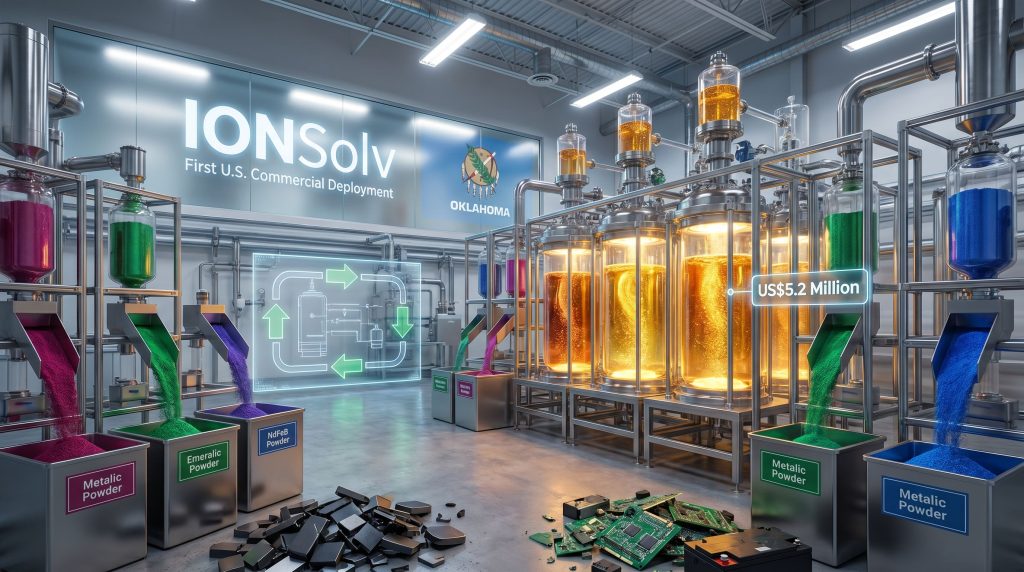
Iondrive's IONSolv platform, developed in collaboration with the University of Adelaide, approaches this challenge from a different direction. Rather than relying on aggressive acid leaching or high-temperature smelting, the platform uses reusable, non-toxic ionic liquid solvents that can selectively extract target metals from complex waste streams at comparatively low operating temperatures.
The closed-loop architecture of the system is particularly significant from both an economic and environmental standpoint. Solvents are regenerated and recirculated through the process rather than consumed, which reduces ongoing reagent costs and eliminates the large-volume waste streams associated with conventional hydrometallurgy. This innovative critical minerals processing technology also reduces energy intensity through lower operating temperatures, a meaningful consideration given that energy costs represent a major component of operating expenditure in mineral processing.
| Attribute | IONSolv Platform | Conventional Hydrometallurgy | Pyrometallurgy |
|---|---|---|---|
| Operating temperature | Low | Moderate to High | Very High |
| Chemical inputs | Non-toxic, reusable solvents | Harsh acids and reagents | Flux agents, reductants |
| Waste generation | Minimal (closed-loop) | Significant effluent streams | Slag and gas emissions |
| Modularity | High | Low to Moderate | Low |
| Selectivity for REEs | High | Variable | Low |
The platform's feedstock flexibility is also notable. IONSolv has demonstrated the ability to process:
- End-of-life NdFeB permanent magnets from motors, drives, and consumer electronics
- Printed circuit boards and broader electronic waste streams
- Battery black mass from spent lithium-ion cells
- Solar module components and wind turbine materials
- Mine tailings and intermediate process residues
This feedstock diversity insulates the commercial model from dependence on any single waste stream and positions the technology as a platform rather than a single-application tool.
Breaking Down the Oklahoma Support for Iondrive's Rare Earth Recycling Module
The formal expression of Oklahoma support for Iondrive's rare earth recycling module comes through a Letter of Support issued by the Oklahoma Department of Commerce (ODOC), identifying existing state and local incentive programs with an estimated aggregate value of up to US$5.2 million for the first commercial module. That figure scales to more than US$15 million if Iondrive proceeds with two additional modules of comparable scope in the state.
Critical caveat for investors: These figures represent estimated potential value based on existing legislated programs. They do not constitute a binding commitment, offer, or guarantee of funding. Each incentive is subject to individual application, assessment, approval, and ongoing performance compliance requirements.
The identified incentive support draws exclusively from performance-based legislative programs, meaning disbursements are tied to measurable outcomes such as payroll creation, tax generation, and workforce development metrics. This structure differs meaningfully from discretionary grants, which are assessed separately and are not included in the stated estimates.
Beyond the incentive framework, the ODOC has indicated its readiness to assist with:
- Site identification and evaluation
- Utility engagement and infrastructure coordination
- Introductions to local economic development authorities
- Connections to feedstock sourcing partners and supply chain ecosystem participants
This operational facilitation, while not carrying a dollar value, reduces friction in the pre-construction phase and signals genuine institutional engagement rather than a passive letter of endorsement.
Why Oklahoma Emerged as the Preferred Location
Oklahoma's candidacy for Iondrive's first U.S. commercial module reflects a combination of industrial infrastructure, workforce characteristics, and energy access that aligns with the requirements of modular mineral processing operations. Competitive utility costs matter significantly for a process that, while lower temperature than conventional alternatives, still carries meaningful energy requirements at commercial scale.
The state's positioning also benefits from proximity to an emerging regional rare earth ecosystem. The U.S. Department of Energy has backed a USA Rare Earth processing pilot, and Pentagon investment of approximately US$1 billion has been directed toward rare earth processing and permanent magnet manufacturing capacity in the broader region. The co-location of rare earth oxide recovery infrastructure with magnet manufacturing investment creates a logical vertical integration opportunity, with recovered rare earth oxides potentially feeding directly into domestic magnet production.
The convergence of secondary rare earth recovery and magnet manufacturing investment within the same geographic corridor represents a deliberate industrial clustering strategy, reducing the logistical costs and geopolitical risks associated with moving intermediate rare earth materials across long supply chains.
The Engineering Pathway from Concept to Commercial Operation
Following independent verification of IONSolv's rare earth recovery performance, Iondrive's immediate technical priority is completing a Process Validation and Engineering Definition (PVED) program in partnership with ProProcess, a process engineering group with specialist expertise in designing modular mineral processing facilities.
The PVED program is expected to produce:
- Design criteria and process flow diagrams specific to the Oklahoma module configuration
- Mass balances and material accounting frameworks for each feedstock type
- Equipment specifications and vendor engagement data
- The technical inputs required to advance into Front-End Engineering Design (FEED)
The progression from current status to commercial operations follows a defined sequence:
- Independent performance verification (completed)
- Process Validation and Engineering Definition with ProProcess (current stage)
- Front-End Engineering Design (FEED)
- Final Investment Decision (FID)
- Module construction and commissioning
- Commercial rare earth oxide recovery operations
The modular architecture underpinning this pathway is strategically important. Each IONSolv unit is designed as a replicable, self-contained processing module rather than a bespoke large-scale facility. This allows the commercial model to be validated at initial scale before capital is committed to expansion, reducing the financial risk profile typically associated with first-of-kind processing infrastructure.
Oklahoma's incentive structure reinforces this logic explicitly. The scaling of identified incentive value from one to three modules creates a financial framework that rewards incremental expansion as feedstock supply and market demand are demonstrated, rather than requiring a large upfront capital commitment to unlock state support.
The Broader U.S. Rare Earth Recycling Landscape
Iondrive's Oklahoma initiative sits within a rapidly evolving policy and investment environment. The critical minerals demand surge has driven federal frameworks, including Defense Production Act support and Department of Energy critical minerals programs, to increasingly prioritise secondary rare earth recovery as a supply chain resilience tool. Policymakers recognise that building domestic recycling infrastructure can deliver strategic supply faster than developing new primary mining and processing operations from greenfield status.
What remains underdeveloped relative to policy ambition is actual commercial infrastructure. Most NdFeB magnet waste generated domestically still exits the U.S. without rare earth recovery, either through conventional waste disposal or export. The gap between the volume of strategic material embedded in end-of-life products and the processing capacity available to recover it represents both the challenge and the commercial opportunity that Iondrive's modular platform is designed to address.
Distributed, modular processing infrastructure carries specific advantages over large centralised facilities in this context:
- Geographic distribution reduces the systemic risk created by concentrating processing in a single location
- Feedstock flexibility across multiple waste stream types reduces vulnerability to disruptions in any single input category
- Smaller capital increments allow the sector to scale with demonstrated feedstock availability rather than ahead of it
- Proximity to waste generators reduces collection and transport logistics costs
The next major ASX story will hit our subscribers first
Frequently Asked Questions
What is the IONSolv platform?
IONSolv is a proprietary closed-loop ionic liquid solvent technology developed by Iondrive in collaboration with the University of Adelaide. It recovers rare earth elements and other critical minerals from complex waste streams, including end-of-life NdFeB magnets, electronic waste, and battery black mass, using reusable, non-toxic solvents at lower operating temperatures than conventional extraction methods.
What has Oklahoma committed to Iondrive?
The Oklahoma Department of Commerce has issued a Letter of Support identifying existing state and local incentive programs with an estimated potential value of up to US$5.2 million for Iondrive's first commercial module, scalable to more than US$15 million across three modules. These are estimates only and are not binding commitments. For further details, the full ASX announcement outlines the complete scope of the support arrangement.
What are the next steps before construction begins?
Iondrive must complete its Process Validation and Engineering Definition program with ProProcess, advance through Front-End Engineering Design, and reach a Final Investment Decision before construction of the first Oklahoma module can proceed.
Are the identified incentives non-dilutive?
Yes. The identified support mechanisms are performance-based government incentive programs, not equity or debt instruments, meaning they do not dilute shareholder ownership or create debt obligations for Iondrive if accessed.
What the Oklahoma Development Signals for Investors and the Sector
The Oklahoma support for Iondrive's rare earth recycling module carries implications that extend beyond a single project announcement. It represents evidence that state-level economic development policy is beginning to actively facilitate rare earth recycling infrastructure, not simply endorse it in principle.
For the broader critical minerals investment landscape, several dynamics are worth tracking:
- Recycling as near-term supply: Secondary rare earth recovery from existing waste streams can potentially deliver refined oxide outputs faster than new primary mining projects, which typically carry decade-long development timelines
- Modular scalability as a risk management tool: The replicable module architecture reduces the binary risk of large capital commitments before commercial performance is validated
- Regional clustering: The deliberate co-location of processing and manufacturing investment in the same geography creates logistical and commercial synergies that strengthen the investment case for both activities
- Performance-based incentives: State incentive structures tied to measurable economic outcomes align government and private sector interests more effectively than unconditional grants
This article contains references to forward-looking statements and estimated financial figures. All incentive values represent potential estimates only and are subject to program-specific application, assessment, approval, and performance requirements. This content is informational in nature and does not constitute financial or investment advice. Readers should conduct their own due diligence before making investment decisions.
Ready to Position Yourself Ahead of the Next Major Critical Minerals Discovery?
Discovery Alert's proprietary Discovery IQ model delivers real-time alerts on significant ASX mineral discoveries — instantly turning complex data across more than 30 commodities into clear, actionable investment insights for both short-term traders and long-term investors. Start your 14-day free trial today and explore Discovery Alert's discoveries page to see how historic mineral discoveries have generated extraordinary market returns.