July 8, 2026
The Qualification Race That Will Define Western Rare Earth Supply Chains
The global rare earth industry is entering a phase where the competitive advantages that matter most are not measured in tonnes of ore extracted or hectares of tenement held. They are measured in months. Specifically, the months required to move a separated oxide through a downstream manufacturer's internal qualification process and emerge on the other side as an approved, trusted supplier. In heavy rare earth elements, where separation complexity is highest, non-Chinese supply shallowest, and demand trajectories steepest, the producers who initiate and complete qualification programs earliest will occupy a structurally privileged position that later entrants cannot easily displace.
Understanding this dynamic reframes how investors, industry analysts, and procurement specialists should interpret recent milestones in Western rare earth separation. The production and distribution of Ucore dysprosium oxide qualification samples at 99.9% purity is not simply a technical announcement. It is a competitive positioning event inside a race where qualification timelines, not production capacity, determine who secures long-term offtake agreements as commercial-scale Western separation facilities come online toward the end of this decade. Furthermore, the rare earth supply chain importance cannot be overstated when considering how these early qualification milestones translate into lasting supplier advantages.
When big ASX news breaks, our subscribers know first
Why Dysprosium Is the Most Strategically Sensitive Rare Earth Element
To understand why producing verified 99.9% dysprosium oxide (Dy₂O₃) represents such a meaningful industrial milestone, it helps to understand what dysprosium actually does inside a magnet and why its supply characteristics make it uniquely vulnerable to disruption.
Dysprosium is not the primary magnetic constituent of neodymium-iron-boron (NdFeB) permanent magnets. Neodymium and praseodymium provide the fundamental magnetic performance. Dysprosium functions as a high-value additive that dramatically enhances coercivity, which is the resistance of a magnet to demagnetization under thermal stress. Without dysprosium additions, NdFeB magnets operating in high-temperature environments, including electric vehicle traction motors, aerospace actuators, and industrial robotics servo systems, lose magnetic performance rapidly and unpredictably.
Even small concentrations of dysprosium, typically between 1% and 6% by weight depending on the application, can push a magnet's thermal operating ceiling from roughly 80 degrees Celsius to well above 180 degrees Celsius. This is why dysprosium commands a price premium substantially above the more abundant light rare earth elements and why any interruption to its supply chain creates immediate engineering consequences for manufacturers.
The supply geography compounds the risk. Heavy rare earths including dysprosium and terbium are disproportionately concentrated in ionic clay deposits located predominantly in southern China. Unlike the carbonatite-hosted rare earth deposits more common in Western nations, ionic clay deposits have naturally higher heavy rare earth ratios relative to total rare earth content. This geological reality means that even as new light rare earth mines advance in the United States, Canada, and Australia, they produce feedstocks that are naturally lean in heavy rare earth content, leaving the dysprosium supply question largely unresolved by upstream diversification alone. The broader rare earth geopolitical impact of this concentration risk is consequently driving allied nations to accelerate separation capacity development outside Chinese borders.
The Ionic Clay Feedstock Advantage and Its Separation Implications
Ionic clays are a geologically distinctive rare earth source type that deserves more attention in Western critical minerals conversations. Unlike hard rock carbonatite deposits where rare earth minerals are chemically bound into complex crystalline structures requiring intensive cracking and leaching, ionic clay deposits host rare earth ions adsorbed onto the surfaces of clay minerals. This makes them far easier to extract using simple leaching chemistry but produces a mixed rare earth solution that still requires sophisticated separation to yield individual high-purity oxides.
Ionic clay deposits tend to yield a heavier rare earth distribution than most hard rock deposits. This is precisely why Ucore's processing campaign using approximately two metric tons of mixed rare earth oxide derived from a third-party Western ionic clay source is significant. It demonstrates that RapidSX technology can process an unconventional, HREE-enriched feedstock type and produce market-grade dysprosium oxide, which is a capability with direct implications for future feedstock sourcing strategies targeting non-Chinese ionic clay resources being explored in Southeast Asia, Madagascar, and select locations across the Americas.
The Technical Architecture Behind 99.9% Dy₂O₃ Production
Achieving 99.9% purity in dysprosium oxide is not trivially difficult. The lanthanide series elements are chemically nearly identical, sharing the same valence electron configuration and differing primarily in the number of electrons in their inner 4f shell. This similarity makes selective separation by conventional precipitation or magnetic methods essentially impossible at commercial scale, requiring instead the precise equilibrium chemistry of liquid-liquid solvent extraction.
The challenge with dysprosium specifically is that it sits adjacent to holmium, erbium, and terbium in the lanthanide series, and each of these elements must be substantially removed to reach the 99.9% threshold that downstream magnet manufacturers require. Conventional mixer-settler solvent extraction systems address this through extensive horizontal staging, but require large physical footprints, significant capital investment, and substantial equilibration time before stable operation is achieved. In addition, the rare earth processing challenges associated with heavy rare earth separation are considerably more demanding than those encountered with light rare earth elements.
Ucore's RapidSX technology approaches this separation challenge through a column-based architecture where the organic and aqueous phases interact through a fundamentally different contact mechanism than conventional mixer-settlers. The result is a more compact system that achieves equivalent or superior mass transfer efficiency in a smaller physical envelope.
Production Parameters for the Kingston Qualification Campaign
| Parameter | Detail |
|---|---|
| Oxide Produced | Dysprosium Oxide (Dy₂O₃) |
| Purity Level | 99.9% |
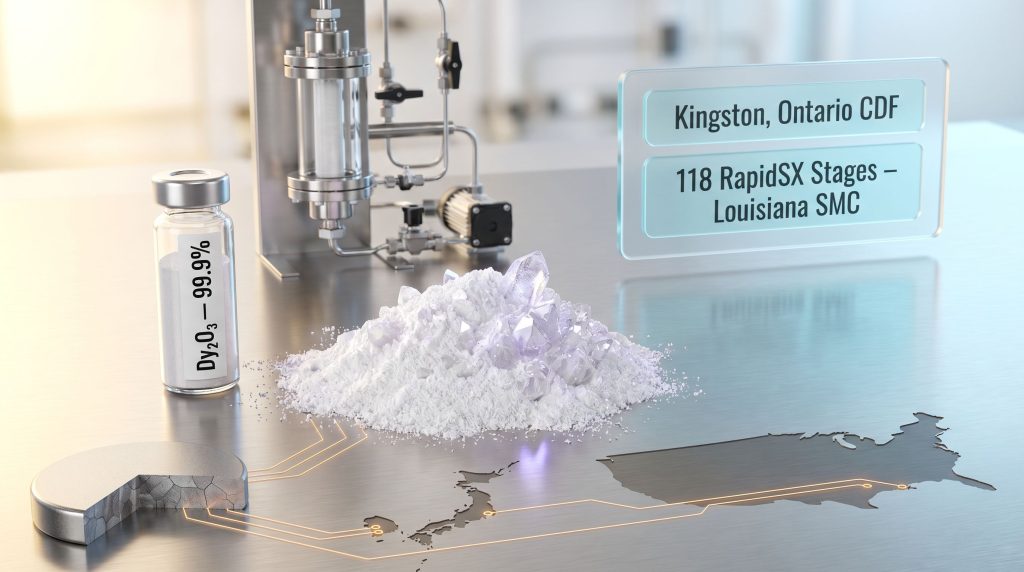
| Production Facility | Kingston, Ontario Commercialization and Demonstration Facility |
| Feedstock Origin | ~2 metric tons of mixed rare earth oxide from a third-party Western ionic clay source |
| Primary Separation Technology | RapidSX 52-stage Demonstration Plant |
| Secondary Purification | Complementary solvent extraction polishing circuit |
| Target Markets | Japan, South Korea, and the United States |
| End-Use Applications | NdFeB permanent magnets, advanced electronics, defense systems |
The use of a supplementary solvent extraction polishing circuit alongside the RapidSX primary plant is a technically important detail. It indicates that achieving 99.9% Dy₂O₃ from a complex ionic clay-derived mixed oxide feedstock required sequential purification stages, and that the Kingston facility's operational architecture is flexible enough to accommodate multi-circuit separation workflows. This flexibility has direct relevance to Louisiana SMC process design, where the initial Machine A configuration is planned to incorporate approximately 118 RapidSX stages, more than double the current demonstration scale. According to Ucore's official RapidSX technology documentation, this scalable architecture is a central feature of the platform's commercial design philosophy.
RapidSX vs. Conventional Solvent Extraction: A Structural Comparison
| Feature | Conventional SX (Mixer-Settler) | RapidSX (Column-Based) |
|---|---|---|
| Physical Footprint | Large horizontal infrastructure requirement | Compact vertical column architecture |
| Scalability | Difficult to modularize | Designed for modular staged expansion |
| Stage Configuration | Fixed large-scale installations | Configurable, e.g., 52-stage demo to 118-stage commercial |
| Capital Intensity | High upfront capital requirements | Reduced infrastructure costs |
| Equilibration Time | Extended startup period | Faster operational stabilization |
| Separation Flexibility | Optimised for specific element sets | Adaptable across light and heavy REE separations |
What the Qualification Sample Process Actually Tests
A qualification sample programme in the rare earth industry is a structured technical evaluation process, not a sample giveaway. When a separated oxide producer submits material to a downstream magnet manufacturer or advanced materials company, the customer subjects that material to a battery of internal tests that assess far more than headline purity figures.
Downstream customers evaluate Ucore dysprosium oxide qualification samples against criteria that typically include:
- Phase composition and crystallographic consistency to verify that the oxide is in the correct chemical form for their processing inputs
- Trace contaminant profiles, particularly for elements that are magnetically or chemically disruptive at parts-per-million levels
- Batch-to-batch consistency, which cannot be assessed from a single sample but begins to be characterised through the qualification dialogue
- Physical properties including particle size distribution, density, and solubility characteristics that affect downstream processing behaviour
- Process compatibility with the customer's existing reduction, alloying, and magnet fabrication workflows
This is why Ucore's chief operating officer emphasised that dysprosium oxide quality evaluation by downstream customers extends well beyond individual oxide parameters. The qualification process is a two-way technical exchange that generates customer-specific feedback, which Ucore has confirmed is being directly incorporated into Louisiana SMC engineering and commercial planning. Notably, independent reporting on Ucore's dysprosium milestone has highlighted the significance of this feedback loop for Western separation credibility.
The step-by-step qualification pathway typically follows this sequence:
- Separation and purification of target element from mixed rare earth feedstock
- Production of oxide to specified purity threshold (99.9% Dy₂O₃)
- Submission to downstream customer's technical and compliance teams
- Customer evaluation against internal manufacturing standards and application requirements
- Feedback integration into the producer's process refinement and commercial planning
- Progression toward structured offtake or supply framework negotiations
Qualification timelines in this sector commonly run between 12 and 24 months depending on application complexity and manufacturer protocols. This means that producers initiating qualification programmes in 2025 and 2026 are establishing supplier relationships that will convert into contracted supply agreements precisely as Western commercial separation facilities like the Louisiana SMC target operational commissioning.
Ucore's Dual-Oxide Strategy: NdPr and Dysprosium as Complementary Pillars
Understanding Ucore's current market development activities requires recognising that NdPr oxide and dysprosium oxide serve entirely different functions in the rare earth permanent magnet supply chain, yet both are essential for a Western producer positioning itself as a complete allied-market rare earth separator.
| Oxide | Purity | Status | Target Customers |
|---|---|---|---|
| Neodymium-Praseodymium (NdPr) | ≥99.5% | Shipped to manufacturers | North American and European magnet producers |
| Dysprosium (Dy₂O₃) | 99.9% | Produced, qualification distribution underway | Japanese, South Korean, and US industrial customers |
| Terbium (Tb) | TBD | Planned future production | Louisiana SMC product suite |
NdPr oxide forms the primary magnetic foundation of NdFeB permanent magnets, constituting the bulk of the alloy by weight. Dysprosium and terbium are added in much smaller quantities, but their contribution to magnet performance in demanding applications is disproportionate to their concentration. A manufacturer unable to secure either input is unable to produce a complete high-performance magnet regardless of how abundant the other elements are.
This is why Ucore's CEO has characterised the first-mover advantage in Western heavy rare earth separation as being fundamentally about qualification status rather than production volume. A producer that has completed customer qualification for both NdPr and dysprosium oxide occupies a comprehensive supplier position that a purely light rare earth separator cannot match. However, China's rare earth strategy continues to exert considerable influence over global pricing and availability, reinforcing the urgency for allied-market producers to accelerate their own qualification timelines.
Why Japan and South Korea Are the Strategic Targets for HREE Qualification
The selection of Japan and South Korea as primary qualification sample recipients reflects a sophisticated understanding of where verified high-purity dysprosium oxide is most urgently needed and most likely to convert into structured supply relationships.
Japan in particular has operated under a rare earth supply security imperative since the 2010 period when Chinese export restrictions on rare earths triggered a severe supply disruption for Japanese manufacturers. That episode, which sent dysprosium spot prices to extreme levels and forced Japanese electronics and automotive companies to scramble for alternative supply, institutionalised a procurement culture in Japan that strongly prioritises supplier diversification and long-term supply security. Japanese manufacturers have maintained stockpiling programmes and diversification mandates that persist today, making them structurally receptive to qualifying new non-Chinese rare earth suppliers.
South Korea's situation is analogous. As a major producer of EV batteries, electronics, and advanced manufacturing equipment, South Korea faces significant rare earth dependency risk and has been actively developing supply chain resilience frameworks targeting exactly the HREE separation gap that Ucore's Kingston programme addresses. Furthermore, America's rare earth supply chain development adds a third strategic dimension, with US industrial customers similarly prioritising non-Chinese qualification programmes across both light and heavy rare earth categories.
The Sumitomo Corporation of Americas Partnership as a Market Access Instrument
Ucore's strategic cooperation framework with Sumitomo Corporation of Americas, announced in June 2026, provides a structured commercial channel into Japanese industrial procurement networks that independent Western rare earth producers would otherwise require decades to develop independently.
Under the framework, SCOA serves as Ucore's distribution partner for designated separated rare earth products sold to selected customer segments in Japan and other mutually agreed industrial markets. The arrangement encompasses both feedstock sourcing collaboration for the Louisiana SMC and downstream offtake development for middle and heavy rare earth elements used in high-performance magnets and advanced materials.
Sumitomo Corporation is one of Japan's largest integrated trading houses with institutional relationships spanning Japanese manufacturing, electronics, automotive, and energy sectors. Its role as a distribution partner for Ucore's separated rare earth products provides a level of commercial credibility and procurement network access that Western rare earth producers operating without such partnerships cannot readily replicate.
This is not a superficial marketing arrangement. In Japanese business culture, supplier relationships are built over extended periods through demonstrated reliability, technical competence, and institutional endorsement. SCOA's involvement provides exactly the institutional endorsement layer that accelerates the path from qualification sample submission to structured supply discussions.
The next major ASX story will hit our subscribers first
Downstream Applications Driving HREE Demand Growth
The urgency behind developing non-Chinese dysprosium oxide supply is directly proportional to the growth trajectories of the end-use sectors that depend on it.
| Application Sector | Why Dysprosium Is Critical | Demand Growth Driver |
|---|---|---|
| Electric Vehicles | Improves NdFeB magnet coercivity for traction motors at high operating temperatures | Global EV fleet expansion and motor efficiency requirements |
| Industrial Robotics | High-torque servo motors require thermally stable permanent magnets | Industry 4.0 adoption and manufacturing automation |
| Aerospace and Defence | Actuators, guidance systems, and radar components require HREE-enhanced magnets | Defence modernisation programmes across allied nations |
| Renewable Energy | Direct-drive wind turbine generators use large NdFeB magnets | Offshore wind capacity expansion programmes |
| Advanced Electronics | Miniaturised high-performance magnetic components | Consumer and industrial electronics demand |
The compounding demand signal across EV, defence, and renewable energy sectors means that the window for establishing first-mover qualification status in Western HREE separation is narrowing. Each year that passes without non-Chinese Ucore dysprosium oxide qualification samples advancing through customer programmes is a year in which the structural supply gap widens relative to accelerating downstream demand.
Kingston CDF as Commercial Bridge, Not Just Technical Laboratory
One of the less appreciated aspects of Ucore's demonstration facility strategy is that the Kingston CDF is performing commercially productive work now, not simply building toward future production. The facility is simultaneously validating RapidSX separation performance at multi-tonne feedstock scale, generating market-ready qualification samples to customer specifications, developing quality management systems and process documentation, and producing customer feedback data that is being actively integrated into Louisiana SMC engineering.
The feedstock-to-product workflow demonstrated at Kingston, including multi-step separation sequencing and polishing circuit integration, mirrors the planned operational architecture at the Louisiana facility at commercial scale. This means that every separation campaign conducted in Ontario is generating process data with direct engineering relevance to the Louisiana SMC design parameters, reducing technical risk at the commercial facility before a single piece of equipment is installed in Alexandria.
From an investor perspective, this dual function of the demonstration facility as both a technical validation platform and an active commercial development tool represents a more capital-efficient approach to rare earth commercialisation than building pilot facilities that serve purely internal validation purposes.
Frequently Asked Questions: Ucore Dysprosium Oxide Qualification Samples
What purity level did Ucore achieve for its dysprosium oxide qualification samples?
Ucore produced dysprosium oxide at 99.9% purity (Dy₂O₃) at its Kingston, Ontario Commercialization and Demonstration Facility, consistent with the minimum quality thresholds required by rare earth permanent magnet and advanced electronics manufacturers.
What feedstock was used to produce the dysprosium oxide?
The separation campaign began with approximately two metric tons of mixed rare earth oxide sourced from a third-party Western ionic clay deposit, processed through Ucore's 52-stage RapidSX Demonstration Plant followed by a complementary solvent extraction polishing circuit.
Which countries are receiving Ucore's dysprosium oxide qualification samples?
The qualification samples are targeted at manufacturers and industrial customers in Japan, South Korea, and the United States, three of the most strategically significant allied markets for rare earth permanent magnet and advanced electronics production.
How does the dysprosium qualification programme relate to Ucore's Louisiana facility?
Customer feedback from the dysprosium oxide qualification process is being directly incorporated into engineering and commercial planning for Ucore's Strategic Metals Complex in Alexandria, Louisiana, planned to include approximately 118 RapidSX stages in its initial Machine A configuration.
What is the difference between Ucore's NdPr and dysprosium oxide milestones?
Ucore previously shipped ≥99.5% neodymium-praseodymium oxide qualification samples to North American and European magnet manufacturers. The 99.9% dysprosium oxide represents a complementary milestone targeting the heavy rare earth component of the magnet supply chain, with samples directed toward Asian and US industrial customers.
What role does Sumitomo Corporation of Americas play in Ucore's qualification strategy?
Under a strategic cooperation framework announced in June 2026, Sumitomo Corporation of Americas is designated as Ucore's distribution partner for selected separated rare earth products in Japan and other agreed markets, providing institutional market access to Japanese industrial procurement networks.
This article is intended for informational purposes only and does not constitute financial or investment advice. Statements regarding future production timelines, commercial agreements, and qualification outcomes involve forward-looking assumptions that are subject to material risks and uncertainties. Readers should conduct their own due diligence before making investment decisions.
Want to Track the Next Major Rare Earth Discovery Before the Market Does?
Discovery Alert's proprietary Discovery IQ model instantly scans ASX announcements across 30+ commodities — including rare earth elements — delivering real-time alerts on significant mineral discoveries so subscribers can act ahead of the broader market; explore historic examples of exceptional discovery returns or start your 14-day free trial today to position yourself at the forefront of the next major find.