July 8, 2026
The Bottleneck Nobody Talks About: Why Heavy Rare Earth Metallisation Is the West's Achilles Heel
For decades, Western policymakers and investors focused their rare earth anxiety on mining. The prevailing assumption was that if you could dig the ore out of the ground outside of China, the supply chain problem would largely solve itself. That assumption turned out to be dangerously wrong.
The real chokepoint was never extraction. It was everything that comes after: the separation of individual rare earth oxides, the conversion of those oxides into metals and alloys, and ultimately the sintering of those materials into the high-performance permanent magnets that sit inside electric motors, missile guidance systems, wind turbine generators, and industrial robots.
China did not dominate rare earths by controlling the mines. It dominated them by controlling the entire downstream value chain, a position built over three decades of patient industrial policy that the West is only now beginning to seriously contest. Furthermore, the rare earth supply chains that underpin modern defence and clean energy industries remain overwhelmingly concentrated in a single country.
It is within this structural context that the REalloys and JS Link rare earth magnet manufacturing partnership deserves to be understood, not as a corporate press release, but as a concrete attempt to close a gap that has frustrated Western defence planners, automotive engineers, and energy transition policymakers for years.
When big ASX news breaks, our subscribers know first
Understanding What a Letter of Intent Actually Means in Critical Minerals
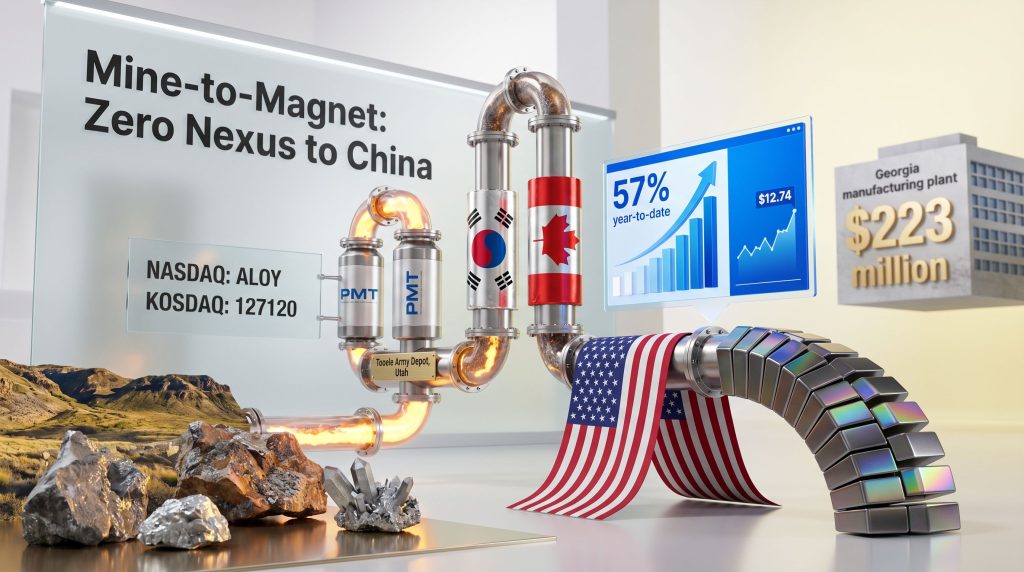
The agreement between REalloys (NASDAQ: ALOY) and South Korea's JS Link (KOSDAQ: 127120) takes the form of a letter of intent, a non-binding document that signals strategic alignment without creating enforceable commercial obligations. In most sectors, an LOI would be unremarkable. In critical minerals, it carries different weight.
Critical minerals partnerships are structurally complex. They involve matching upstream resource timelines to downstream manufacturing investment cycles, navigating multiple regulatory jurisdictions, securing government financing that is often conditional on project milestones, and satisfying due diligence requirements that can run for 12 to 24 months or longer. LOIs in this space are not casual expressions of interest.
They represent a mutual commitment to invest significant management time and capital into evaluating whether a deeper relationship is commercially viable. In addition, the critical minerals demand surge across defence, automotive, and energy sectors is intensifying the urgency with which these partnerships are being pursued.
That said, the non-binding nature of the agreement is a material risk that investors must hold clearly in mind. Either party can walk away without financial penalty if due diligence reveals incompatible commercial terms, capital structure mismatches, or regulatory obstacles. The strategic logic of the partnership is compelling; its execution is not yet assured.
The gap between strategic intent and operational reality in critical minerals has claimed numerous high-profile partnerships. The distinction between an LOI and a binding offtake or joint venture agreement represents one of the most important analytical filters for investors evaluating this sector.
How REalloys Has Constructed Its Three-Layer Platform
What distinguishes REalloys from many junior rare earth companies is the degree to which it has articulated and begun executing a vertically integrated architecture, rather than simply owning a deposit and hoping a downstream buyer materialises.
The company's platform is structured across three distinct layers:
Upstream: The Hoidas Lake rare earth project in Saskatchewan, Canada, serves as the feedstock foundation. Saskatchewan is frequently overlooked in rare earth discussions dominated by Australian and American projects, but the province offers several structural advantages: a mature mining regulatory framework, established infrastructure corridors, and proximity to North American industrial centres.
Midstream: REalloys has assembled a midstream capability through its strategic partnership with the Saskatchewan Research Council and its acquisition of PMT Critical Minerals. The PMT acquisition is particularly significant because it addresses what is arguably the most underappreciated bottleneck in Western rare earth supply chains: heavy rare earth metallisation.
Downstream (Proposed): The JS Link collaboration, if it progresses to a binding agreement, would extend the platform into large-scale permanent magnet manufacturing, completing the theoretical arc from ore to finished component.
Why Heavy Rare Earth Metallisation Deserves More Attention
Most public commentary on rare earth supply chains focuses on light rare earths, particularly neodymium and praseodymium, the primary inputs for standard neodymium-iron-boron (NdFeB) permanent magnets. However, the highest-performance magnets, those required in aerospace, defence, and advanced robotics applications, also require heavy rare earth elements: dysprosium and terbium.
These heavy rare earths are added during the metallisation and alloying stage to increase the coercivity of magnets, meaning their resistance to demagnetisation at high operating temperatures. Without dysprosium or terbium additions, NdFeB magnets lose performance in the thermal environments characteristic of electric vehicle motors and military hardware.
Western capacity for heavy rare earth metallisation is extremely limited. The acquisition of PMT Critical Minerals gives REalloys exposure to this capability, which is not merely a midstream processing step but a genuine strategic differentiator. The rare earth processing challenges involved in heavy rare earth metallisation have long prevented non-Chinese entities from competing at commercial scale.
JS Link's Manufacturing Footprint and What It Brings to the Partnership
JS Link is not a speculative start-up. The South Korean company operates established permanent magnet manufacturing facilities and brings genuine technology and operational expertise to the proposed collaboration. Its existing presence in South Korea provides a proven manufacturing base, while its expansion pipeline signals serious ambition in the Western market.
The company is developing a magnet manufacturing facility in Malaysia in partnership with Lynas Rare Earths, one of the few non-Chinese rare earth producers of genuine scale. That deal, announced concurrently with the REalloys LOI, illustrates both JS Link's geographic diversification strategy and the fact that the company is pursuing multiple supply chain anchor points simultaneously.
Most significantly for the North American context, JS Link is developing a permanent magnet plant worth $223 million in Georgia, USA. This facility, if completed, would represent one of the most substantial non-Chinese magnet manufacturing investments in North America. The Georgia plant's potential to serve as the downstream anchor for REalloys-sourced and processed materials is the central integration thesis of the partnership.
| Supply Chain Stage | Current Western Leaders | REalloys / JS Link Position |
|---|---|---|
| Mining and Feedstock | MP Materials, Lynas Rare Earths | REalloys via Hoidas Lake |
| Separation and Processing | MP Materials, Lynas, Ucore | REalloys with Saskatchewan Research Council |
| Heavy Rare Earth Metallisation | Very limited Western capacity | REalloys via PMT Critical Minerals acquisition |
| Permanent Magnet Manufacturing | Vacuumschmelze, MP Materials, JS Link | JS Link Georgia plant (proposed) |
The US Defence Dimension and the Tooele Army Depot
REalloys' conditional selection under the US Army's Army Strategic Capital Initiatives programme to evaluate the development of rare earth processing facilities at the Tooele Army Depot in Utah adds a layer of institutional credibility to the company's broader strategy. A defence-anchored processing facility at an existing Army depot represents a fundamentally different risk profile than a greenfield industrial site.
The Tooele Army Depot is an active military installation in Utah with existing infrastructure and a history of industrial operations. Embedding a rare earth processing facility within such a site would align REalloys' commercial operations directly with defence procurement requirements, a positioning that has significant implications for the company's ability to access non-dilutive government financing mechanisms such as Defense Production Act Title III funding or Department of Energy loan guarantees.
It is important to note that this selection is conditional and remains under evaluation. It does not represent confirmed government funding or a binding commitment from the US Army. Investors should treat it as a credibility signal and a potential financing pathway, not a guaranteed outcome.
How Does This Fit the Broader Strategic Picture?
China's rare earth strategy of dominating downstream processing and manufacturing is precisely what makes Tooele significant. A domestically embedded, defence-linked processing node is one of the few structural countermeasures that can meaningfully reduce Western vulnerability. Consequently, institutional support of this kind tends to attract additional government co-investment over time.
Scenario Analysis: Three Pathways for the REalloys-JS Link Platform
The trajectory of the REalloys and JS Link rare earth magnet manufacturing partnership can be usefully mapped across three forward-looking scenarios:
Scenario A: Full Integration (Bull Case)
- Binding agreements are executed within approximately 18 months of the LOI signing
- The Tooele Army Depot processing facility receives final programme approval
- JS Link's Georgia plant becomes the operational downstream anchor for REalloys-sourced materials
- The combined platform achieves commercial magnet production targeting 2029 to 2030
- Outcome: The first vertically integrated, non-Chinese rare earth magnet supply chain at commercial scale in North America
Scenario B: Partial Integration (Base Case)
- The LOI converts to a limited commercial offtake or processing agreement rather than full vertical integration
- Financing complexity and regulatory timelines delay the full mine-to-magnet vision
- REalloys advances processing capabilities independently while JS Link progresses manufacturing separately
- Outcome: Meaningful but structurally incomplete supply chain diversification
Scenario C: LOI Lapses (Bear Case)
- Due diligence reveals irreconcilable differences in commercial terms, capital structure, or strategic priorities
- JS Link redirects attention to its Lynas-Malaysia facility and Georgia plant as standalone investments
- Outcome: Both companies continue independently; the North American magnet manufacturing gap persists in the near term
The next major ASX story will hit our subscribers first
Capital, Financing, and Market Sentiment
REalloys completed a $100 million equity financing round that provides meaningful near-term operational runway. This capital base is important context: the company is not dependent on the JS Link partnership to survive in the short term, which gives it negotiating leverage in the due diligence process.
JS Link's commitment of $223 million to the Georgia manufacturing facility signals genuine balance sheet conviction but also raises questions about financing structure and timeline, particularly in a capital market environment where large industrial projects face elevated construction cost uncertainty.
From a market sentiment perspective, REalloys' stock traded at $12.74 on July 7, 2026, reflecting an 11.83% decline over the prior week, despite the company having gained approximately 57% year-to-date. This pattern, short-term profit-taking following a substantial re-rating, is characteristic of how critical minerals equities behave when strategic news intersects with a market that is simultaneously enthusiastic about the sector thesis and uncertain about execution timelines.
Investors in early-stage critical minerals companies frequently face a structural tension between the genuine strategic importance of a project and the long lead times before commercial revenue materialises. The REalloys situation illustrates this dynamic clearly: the strategic architecture is coherent, but the gap between LOI and operational platform spans years, not months.
Frequently Asked Questions
What is the REalloys and JS Link partnership?
REalloys and JS Link have signed a non-binding letter of intent to explore the development of a fully integrated North American rare earth magnet manufacturing platform, designed to operate without Chinese supply chain involvement at any stage.
What makes Hoidas Lake strategically important?
The Hoidas Lake rare earth project in Saskatchewan provides the upstream feedstock foundation for REalloys' broader platform. Saskatchewan's established mining regulatory framework and infrastructure access make it a more commercially viable jurisdiction than its lower public profile might suggest.
Is the LOI legally binding?
No. The letter of intent is explicitly non-binding. Both companies must complete due diligence and negotiate definitive agreements before any formal commercial obligations are created.
What end markets will the platform serve?
The proposed platform targets US defence, aerospace, automotive, robotics, artificial intelligence infrastructure, and energy transition industries, all sectors with structural and growing demand for critical minerals for semiconductors and high-performance permanent magnets.
Why does heavy rare earth metallisation matter so much?
Heavy rare earth elements like dysprosium and terbium are added during the metallisation stage to increase a magnet's thermal stability and resistance to demagnetisation. Without this capability, a supply chain cannot serve the highest-value defence and advanced industrial end markets.
What is JS Link's role in the partnership?
JS Link contributes permanent magnet manufacturing technology, proven operational expertise across South Korea and Malaysia, and a $223 million plant under development in Georgia, USA, which represents the proposed downstream anchor of the combined North American platform.
Why This Partnership Is More Than a Headline
The REalloys and JS Link rare earth magnet manufacturing partnership matters because it attempts to address the supply chain gap that matters most: the downstream one. Western governments and investors have funded dozens of exploration and mining projects over the past decade, but the persistent failure has been in building the processing and manufacturing infrastructure that converts raw rare earth material into strategic industrial components.
If the REalloys platform reaches full integration, combining Hoidas Lake's feedstock, the Saskatchewan Research Council's processing expertise, PMT Critical Minerals' heavy rare earth metallisation capability, and JS Link's permanent magnet manufacturing technology, it would represent something genuinely rare in this sector: a complete, non-Chinese, vertically integrated rare earth supply chain anchored in North American and allied jurisdictions.
Whether the LOI converts to that outcome depends on due diligence findings, capital markets conditions, regulatory timelines, and the negotiating dynamics between two companies operating across different continents and strategic contexts. The structural logic is sound. The execution challenge is formidable.
This article contains forward-looking analysis and scenario projections. Nothing in this article constitutes financial advice. Investors should conduct their own due diligence and seek independent financial counsel before making investment decisions. Past share price performance is not indicative of future results.
Want to Capitalise on the Next Major Critical Minerals Discovery Before the Market Does?
Discovery Alert's proprietary Discovery IQ model delivers real-time alerts on significant ASX mineral discoveries — instantly cutting through complex data to surface actionable opportunities in critical minerals, rare earths, and beyond. Explore how historic discoveries have generated substantial returns on Discovery Alert's dedicated discoveries page, and begin your 14-day free trial today to position yourself ahead of the broader market.