July 8, 2026
The Minerals That Nations Are Racing to Secure
Across the global economy, a quiet but consequential competition is intensifying. It has nothing to do with oil fields or grain harvests. Instead, it centres on a handful of obscure metals whose names rarely appear in mainstream financial reporting, yet whose absence would halt the production of fighter jet sensors, 5G base stations, fibre optic networks, and next-generation batteries almost immediately.
Germanium, gallium, and antimony occupy this uncomfortable strategic position: simultaneously indispensable and dangerously concentrated in supply. For Western governments and allied industrial powers, closing that vulnerability gap has become a defining policy priority of the 2020s. The Teck Trail smelter strategic metals agreement, announced in July 2026, represents one of the most substantive responses to that challenge yet attempted in North America.
When big ASX news breaks, our subscribers know first
Why Supply Concentration Is the Core Problem
The Geography of Critical Mineral Risk
Understanding why the Teck Trail smelter strategic metals agreement matters requires first grasping just how lopsided the global production map has become for these three metals. The surge in critical minerals demand has intensified pressure on supply chains that were never designed to absorb geopolitical shocks of this magnitude.
China accounts for the overwhelming majority of refined germanium and gallium output globally, with estimates from the US Geological Survey and the European Commission consistently placing Chinese production at well above 80% of global supply for both metals. Antimony tells a similar story, with China historically controlling more than half of world mine production, supplemented by output from Russia and Tajikistan.
This concentration is not accidental. Decades of low-cost processing, integrated industrial policy, and tolerance for environmental externalities allowed China to build commanding positions across the critical minerals processing value chain while Western nations remained focused on upstream extraction.
The consequences became visible when China's export controls on germanium and gallium began in 2023, followed by further tightening measures in subsequent years. These policy shifts sent ripples through industries that had treated these metals as reliable commodity inputs rather than geopolitical instruments.
The vulnerability is structural rather than cyclical. No amount of spot market purchasing can substitute for the absence of diversified, allied-nation processing capacity when export restrictions are applied at the source.
What Makes These Three Metals Strategically Distinct
Not all critical minerals carry the same risk profile. Germanium, gallium, and antimony are particularly acute cases because of their dual-use nature across both civilian and defence applications.
| Metal | Primary Civilian Uses | Defence and Security Applications | Supply Risk Level |
|---|---|---|---|
| Germanium | Fibre optic cables, infrared lenses, solar cells | Infrared targeting systems, night vision optics | Severe |
| Gallium | LED lighting, 5G semiconductors, power electronics | Radar, electronic warfare, satellite communications | Severe |
| Antimony | Flame retardants, industrial chemicals | Ammunition primers, armour-piercing alloys, pyrotechnics | High |
Gallium nitride semiconductors, in particular, represent a generational shift in electronics. GaN transistors operate at higher voltages, higher temperatures, and higher frequencies than silicon equivalents, making them the material of choice for next-generation radar arrays, high-efficiency power converters, and advanced telecommunications hardware. The transition from legacy materials to GaN is accelerating precisely when gallium supply security is most uncertain.
Furthermore, germanium's role in fibre optic infrastructure is similarly non-substitutable in the near term. Germanium dioxide is used to increase the refractive index of fibre optic glass cores, a function no commercially viable alternative currently replicates at scale. With global fibre network build-out continuing at pace to support data centre expansion and broadband rollout, demand is structurally growing even as supply remains constrained. The broader energy security minerals challenge underscores precisely why allied nations are moving with such urgency.
Decoding the Teck Trail Smelter Strategic Metals Agreement
Structure, Parties, and Commercial Architecture
The Teck Trail smelter strategic metals agreement involves three principal parties: Teck Resources, Canada Growth Fund Inc. (CGF), and Natural Resources Canada's Canada Critical Minerals Accelerator, which is managed operationally by Export Development Canada.
The commercial architecture is worth examining carefully, because its design reveals the intent behind the transaction. Rather than a straightforward grant or concessional loan, CGF is deploying capital in an equity-like structure directly into the Trail Operations facility. This is a meaningful distinction. Equity-like instruments typically carry return expectations and potential upside participation, which changes the incentive alignment between government and private operator compared with grant-based funding mechanisms.
The financial parameters announced by Natural Resources Canada are substantial:
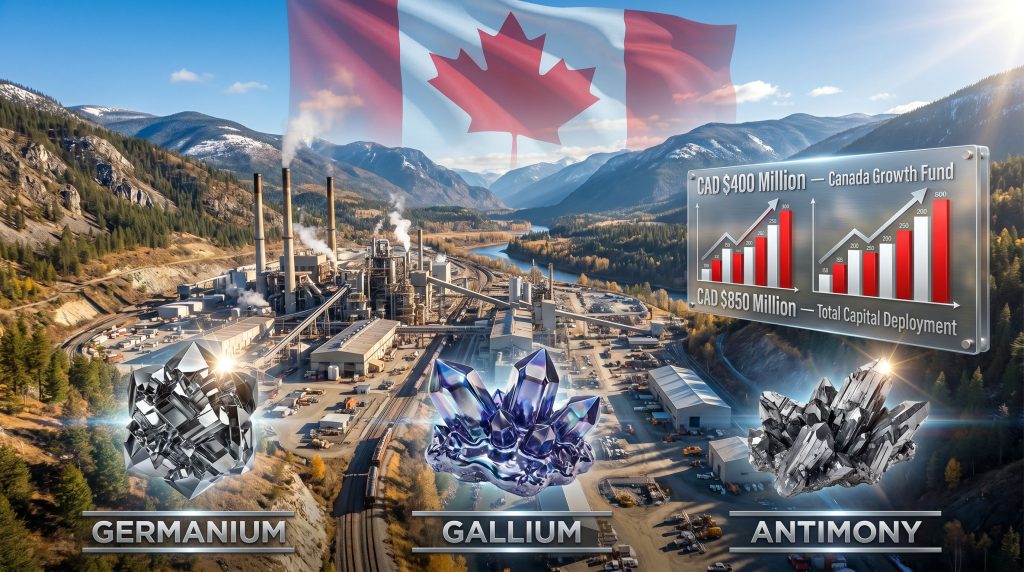
- CGF equity-like investment: up to CAD $400 million directly into the Trail facility
- Total Teck capital programme: up to CAD $850 million encompassing feed source diversification, capacity sustaining, and expansion works
- Government offtake rights: a structured right to purchase a portion of future germanium, antimony, and gallium production from Trail
The offtake structure is arguably as significant as the capital commitment itself. A government-backed offtake agreement functions as a demand-side anchor, providing revenue certainty that enables private operators to justify the risk premium associated with major brownfield expansion projects. It also communicates to allied trading partners that Canada is preparing to be a consistent, contractually reliable supplier rather than simply an opportunistic exporter.
What Production Outcomes Are Contemplated?
The agreement sets out aspirational production targets that, if achieved through the completion of definitive documentation and regulatory approvals, would materially shift Canada's position in global critical minerals supply.
Specifically, the framework contemplates:
- Doubling existing germanium production capacity at Trail Operations
- Doubling existing antimony production capacity at the facility
- Establishing entirely new gallium production capacity, which does not currently exist at Trail at commercial scale
Trail Operations already holds the distinction of being North America's largest germanium producer, operating as a fully integrated polymetallic smelting and refining complex that generates 19 distinct products from diverse feed sources. Doubling output from that base would represent a genuine step-change in North American supply availability.
It is critical to note that the commercial arrangements remain conditional. Definitive documentation must be negotiated and executed, and applicable regulatory and governmental approvals must be satisfied before capital is formally deployed.
Trail Operations: Why This Facility Is Uniquely Positioned
The Polymetallic Processing Advantage
Located in Trail, British Columbia, Teck's Trail Operations facility is one of the most technically sophisticated smelting and refining complexes on the continent. Its polymetallic processing capability — the ability to extract and refine multiple metals from complex, mixed feed sources — is central to its strategic value.
Unlike single-commodity processing plants that are vulnerable to feed grade variability or mine depletion, Trail's integrated model allows it to draw from a portfolio of feed sources across multiple mines and concentrates. This structural flexibility reduces single-point-of-failure risk that plagues greenfield critical minerals projects, where production depends entirely on one deposit's continuity and grade performance.
Brownfield Expansion Economics: A Decisive Advantage
One of the most underappreciated aspects of the Trail agreement is the economic efficiency of expanding an existing facility versus building new processing infrastructure. Brownfield expansions at operating polymetallic smelters carry several structural advantages over greenfield alternatives:
- Lower capital intensity per unit of incremental capacity, because shared infrastructure (power, water, logistics, workforce) already exists
- Compressed permitting timelines, since the facility operates under existing environmental and operating licences that require modification rather than initiation
- Faster commissioning, because engineering, procurement, and construction can leverage established site knowledge and contractor relationships
- Lower technical risk, given that the process chemistry is understood and proven at scale
When geopolitical urgency is high and allied governments need supply diversification within years rather than decades, these operational realities are not abstract advantages. They are decisive factors in prioritising which projects can actually deliver material at the speed the situation demands.
Canada's Policy Architecture and the Inaugural Accelerator Transaction
The Canada Critical Minerals Accelerator: A New Instrument
The Canada Critical Minerals Accelerator represents a structural evolution in how Canada approaches critical minerals development. Administered by Natural Resources Canada and managed by Export Development Canada, the Accelerator is designed to bridge the gap between policy intent and commercial execution at operating scale.
Prior Canadian critical minerals programmes have often focused on exploration-stage support or loan facilities for junior miners. The Accelerator's mandate, however, appears oriented toward production-stage assets and processing infrastructure, where the leverage on supply chain outcomes is highest.
The Trail agreement serves as the programme's inaugural transaction, which carries significance beyond the capital deployed. First transactions under new policy instruments establish precedent: for deal structure, for the type of assets that qualify, for the role of government offtake rights, and for how co-investment with private operators is structured. Every subsequent Accelerator transaction will be benchmarked against the Trail template.
British Columbia's Role in the Initiative
The Province of British Columbia has designated the Trail Strategic Metals Initiative as one of 18 priority resource projects identified at the provincial level. This designation creates a framework for enhanced inter-governmental coordination and more structured engagement between provincial permitting authorities and project proponents.
It is important to note that priority designation at the provincial level reflects the province's own economic and resource development objectives, and should not be interpreted as a guarantee of accelerated regulatory outcomes. Permitting processes remain subject to their own legislative and procedural requirements.
The Geopolitical Signal Embedded in the Offtake Structure
Why Government Offtake Rights Matter Beyond Economics
The inclusion of government offtake rights in the Teck Trail smelter strategic metals agreement is a feature that extends well beyond conventional project finance logic. When a sovereign government contractually commits to purchasing a portion of future production from a critical minerals facility, it communicates several things simultaneously to global partners:
- Supply reliability: Canada is not merely facilitating production but is itself a committed buyer, aligning national interest with delivery certainty
- Credit enhancement: Government purchase commitments reduce counterparty risk for other offtake partners and downstream manufacturers
- Alliance signalling: Allied nations in the Five Eyes and G7 frameworks can read offtake structures as an indication of Canada's seriousness as a strategic supplier
This approach mirrors frameworks being deployed by the United States under its Defence Production Act Title III authorities, by Australia through its Critical Minerals Facility, and by the European Union under the European critical raw materials Act. The convergence of allied nation approaches toward offtake-anchored investment structures reflects a shared recognition that private capital alone will not close the critical minerals supply gap at the pace geopolitical conditions demand.
Scenario Analysis: Potential Outcomes for the Trail Initiative
| Scenario | Key Assumptions | Supply Chain Outcome |
|---|---|---|
| Base Case | Definitive documentation executed; approvals obtained on schedule | Germanium and antimony output doubles; gallium production commences; Trail becomes a multi-metal strategic supplier |
| Upside Case | Feed source portfolio expands beyond initial scope; additional product streams unlocked | Trail anchors a broader Canadian strategic metals processing cluster; further capacity increments feasible |
| Delay Case | Definitive documentation or approvals encounter timeline slippage | Capital deployment deferred; strategic framework and commercial intent preserved for future execution |
Disclaimer: The above scenarios represent analytical projections based on publicly available information and are not forecasts or guarantees. Actual outcomes will depend on the satisfaction of conditions precedent, regulatory processes, market conditions, and operational factors that cannot be predicted with certainty.
The next major ASX story will hit our subscribers first
Canada's Broader Ambition: From Resource Exporter to Strategic Processor
The Industrial Policy Shift Underway
Canada has historically occupied a position in the global minerals economy that is characterised by resource extraction and concentrate export, with value-added processing occurring elsewhere. The Trail agreement is a visible expression of a deliberate effort to move up the value chain and capture the processing premium domestically.
This shift places Canada in direct strategic alignment with allied nation frameworks. The US Inflation Reduction Act's critical minerals provisions, Australia's Critical Minerals Strategy, and the EU Critical Raw Materials Act all share a common design principle: incentivising the build-out of allied-nation processing capacity to reduce collective dependence on concentrated, non-allied sources. Consequently, the antimony shortage risks facing defence and industrial sectors make initiatives like Trail's expansion all the more pressing.
The Reliability Premium and Canada's Positioning
In an era of resource nationalism and supply chain fragmentation, there is a measurable premium attached to supply that is predictable, contractually structured, and sourced from jurisdictions with stable institutions and transparent regulatory frameworks.
Canada's combination of institutional stability, existing mining infrastructure, environmental credibility among import-conscious allied nations, and alignment with major technology consumer markets in the US, EU, Japan, and South Korea positions it to command that reliability premium. The Trail agreement is an attempt to convert that positioning from theoretical to operational.
Whether the full CAD $850 million programme ultimately reaches deployment, and whether the production targets are achieved within the timelines the initiative requires, will depend on the successful completion of conditions that remain outstanding. But as a statement of industrial policy direction, and as a commercial template for what allied-nation critical minerals investment can look like, the Teck Trail smelter strategic metals agreement marks a meaningful inflection point in Canada's strategic minerals ambition.
Frequently Asked Questions
What is the Teck Trail smelter strategic metals agreement?
A Strategic Investment Agreement between Teck Resources, Canada Growth Fund Inc., and Natural Resources Canada's Canada Critical Minerals Accelerator, structured to expand germanium, gallium, and antimony production capacity at Teck's Trail Operations facility in British Columbia. The agreement involves up to CAD $400 million in CGF equity-like investment as part of a broader programme totalling up to CAD $850 million.
Why are germanium, gallium, and antimony classified as strategic metals?
These three metals are essential inputs for advanced defence electronics, fibre optic infrastructure, next-generation semiconductors, energy storage systems, and clean energy technologies. Their supply is heavily concentrated in a small number of producing nations, creating material geopolitical and industrial risk for Western economies.
What is the Canada Critical Minerals Accelerator?
An initiative of Natural Resources Canada, managed by Export Development Canada, designed to accelerate the production of critical minerals in Canada at scale. The Trail Operations agreement represents the programme's inaugural transaction.
How much could Trail's production capacity increase?
The agreement contemplates the potential to double existing germanium and antimony production capacity and to establish new gallium production capacity at Trail, subject to definitive documentation and applicable approvals being completed.
Is the investment finalised?
No. The commercial arrangements are conditional upon the negotiation and execution of definitive documentation and the satisfaction of applicable regulatory and governmental approvals. The agreement establishes the commercial framework and intent, not a completed transaction.
Want to Track the Next Major Strategic Metals Discovery Before the Market Does?
Discovery Alert's proprietary Discovery IQ model scans ASX announcements in real time, instantly identifying significant mineral discoveries across critical commodities like germanium, gallium, and antimony — turning complex data into actionable investment insights. Explore historic discoveries and their extraordinary returns, then begin your 14-day free trial at Discovery Alert to position yourself ahead of the broader market.