July 24, 2026
South Africa's Ferrochrome Industry at an Electricity Crossroads
Energy-intensive industries have always lived and died by the cost of power. Across the global metals landscape, the economics of smelting are defined not by ore quality or processing technology alone, but by the price of electricity flowing into arc furnaces running around the clock. When that cost shifts materially, entire industrial ecosystems can tip from viability to irrelevance within a single budget cycle. South Africa's ferrochrome sector is now confronting exactly that inflection point, and the outcome of the Nersa ferrochrome tariff public consultations currently underway will determine whether one of the country's most strategically significant industrial bases survives intact or continues its decade-long contraction.
When big ASX news breaks, our subscribers know first
The Structural Cost Problem That Has Been Building for a Decade
Ferrochrome smelting is among the most electricity-dependent industrial processes in existence. Electricity accounts for approximately 40% of total production costs at South African ferrochrome smelters, according to reporting by Terence Creamer in Mining Weekly (April 28, 2026). This single cost component dwarfs most other variables in the production equation, meaning tariff levels exert more influence over smelter viability than ore grades, labour costs, or logistics. When electricity prices move sharply upward, the entire margin structure of ferrochrome production compresses almost immediately.
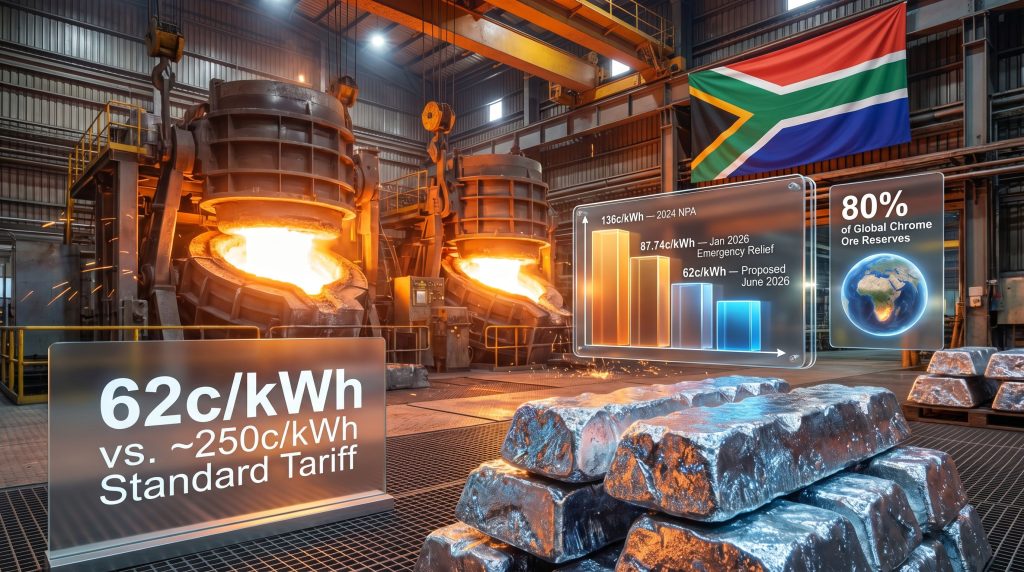
The historical context makes the current situation even more striking. South Africa holds an estimated up to 80% of the world's chrome ore reserves, making it the most resource-endowed chrome-producing nation on earth. In a rational industrial world, that reserve concentration should translate into dominant downstream processing capacity. Furthermore, as noted in analysis of South Africa ferroalloys, the country's strategic position in global chrome supply chains carries profound long-term significance. Instead, as electricity tariffs escalated sharply over the preceding decade, smelting capacity contracted significantly.
The country that holds the overwhelming majority of the world's chrome ore has found itself progressively unable to economically process that ore domestically. The competitive pressure has been sharpened by the China steel market and its growing role as a destination for South African chrome ore exports. Chinese smelters operate under a fundamentally different electricity cost structure, where state management of energy pricing and large-scale coal-based generation capacity creates a cost floor that South African producers have found increasingly difficult to match.
As Chinese ferrochrome production expanded, South African smelters faced the compounding pressure of both rising input costs at home and intensifying competition in the markets they serve. The pattern illustrates a broader principle relevant to resource-rich developing economies: natural resource endowment does not automatically confer downstream processing advantage. Infrastructure costs, particularly electricity, can override geological advantages entirely. When a smelter in a resource-poor importing country can process chrome ore more cheaply than a smelter adjacent to the mine, the case for domestic beneficiation collapses on pure economics.
Understanding the Nersa Ferrochrome Tariff Public Consultations: The Regulatory Process Explained
The Nersa ferrochrome tariff public consultations represent the formal regulatory mechanism through which South Africa's electricity regulator evaluates proposed amendments to negotiated electricity supply agreements between Eskom and major industrial consumers. The National Energy Regulator of South Africa holds statutory authority to adjudicate such amendments, applying regulatory principles around efficiency, affordability, and sustainability before issuing a binding determination.
The current process was initiated following Eskom's formal application, submitted on April 10, 2026, to amend the Negotiated Pricing Agreements governing electricity supply to ferrochrome smelters operated by Samancor Chrome and the Glencore-Merafe Chrome Venture. Nersa's consultation paper was approved for release by its electricity subcommittee on April 17, 2026, formally opening the stakeholder engagement phase. The process operates under the Interim Framework for Long-Term Negotiated Pricing Agreements, which mandates stakeholder consultation before any determination can be issued.
The following timeline summarises the key milestones in the adjudication process, as confirmed by Mining Weekly (Terence Creamer, April 28, 2026):
| Milestone | Date |
|---|---|
| Eskom application submitted | April 10, 2026 |
| Nersa consultation paper published | April 17, 2026 |
| Written submissions deadline | May 22, 2026 |
| Public hearings scheduled | May 25, 2026 |
| Nersa decision targeted | May 29, 2026 |
| Proposed tariff commencement | June 2026 (subject to approval) |
Originally, Nersa indicated it would finalise its adjudication by the end of June 2026. However, persistent calls from industry for an accelerated determination, intensified by declining global ferrochrome prices and ongoing smelter viability pressures, prompted the regulator to compress the timeline by approximately four to five weeks. A decision targeted for May 29, 2026 would allow the proposed tariff to take effect from June 1, 2026, providing critical certainty for producers heading into the second half of the year.
The 62c/kWh Proposal: What It Is, How It Works, and What Changed
At the centre of the Nersa ferrochrome tariff public consultations is Eskom's proposal to implement a 62c/kWh tariff applicable to ten ferrochrome smelters in total: six operated by Samancor Chrome and four operated by the Glencore-Merafe Chrome Venture. The tariff would apply for a five-year term, extending the original NPA framework by an additional two years beyond its initial duration.
To understand the significance of the proposed rate, the tariff trajectory over recent years provides essential context:
| Period | Applicable Tariff | Key Context |
|---|---|---|
| Start of 2024 | 136c/kWh | Initial NPA implementation |
| January 2026 | 87.74c/kWh | Emergency hardship relief (12-month interim) |
| Proposed from June 2026 | 62c/kWh | Eskom's long-term NPA amendment |
| Eskom standard tariff | ~250c/kWh | General industrial/commercial rate |
The proposed 62c/kWh rate represents a 75% discount to Eskom's standard approved tariff of approximately 250c/kWh, and a further 29% reduction from the January 2026 interim relief rate of 87.74c/kWh. The progression from 136c/kWh in 2024, to 87.74c/kWh in early 2026, to a proposed 62c/kWh from June 2026 reflects both the deteriorating economics of ferrochrome smelting under sustained market pressure and the evolving commercial logic of Eskom's demand retention strategy.
The January 2026 interim relief was itself a significant regulatory milestone. Nersa approved the 87.74c/kWh emergency rate after both Samancor Chrome and Glencore-Merafe invoked hardship clauses embedded in their existing NPA frameworks, triggering a formal review process. The consultation that accompanied that decision attracted 13 written submissions and 6 oral presentations, all of which were supportive, representing an unusually cohesive stakeholder response that ultimately facilitated a swift determination.
Eskom made its 62c/kWh offer in early April 2026, following detailed negotiations on the terms and conditions associated with the amended NPAs. Prior to that offer, both ferrochrome producers had indicated that smelter closures and significant workforce retrenchments were unavoidable under the prevailing cost structure, according to Mining Weekly (Terence Creamer, April 28, 2026).
The Seven-Component Contracting Framework
Eskom's application to Nersa incorporates a differentiated, risk-adjusted contracting structure built around seven core elements, as reported by Mining Weekly (Terence Creamer, April 28, 2026):
- Price path – the defined tariff level and trajectory over the five-year term
- Economic hardship clause – a mechanism allowing relief if operating conditions deteriorate materially beyond defined thresholds
- Yearly escalations – annual adjustments linked to the Producer Price Index (PPI) rather than Eskom's standard tariff escalation methodology
- Deferred revenue mechanism – provisions for managing the timing of revenue flows between Eskom and the smelters
- Upside-sharing arrangement – a mechanism to distribute financial benefits if smelter profitability improves beyond agreed benchmarks
- Take-or-pay provision – minimum consumption commitments providing Eskom with baseline revenue certainty
- Security guarantees – financial assurances protecting Eskom against counterparty default risk
The PPI-linked escalation methodology is particularly significant from an industry perspective. Eskom's standard tariff escalation has historically exceeded PPI by a considerable margin, with the utility's tariff increases tracking its own cost base rather than economy-wide producer inflation. Linking future escalations to PPI rather than Eskom's internal cost drivers could materially insulate smelters from the above-inflation electricity cost increases that repeatedly destabilised ferrochrome economics over the preceding decade.
The upside-sharing arrangement embedded in the framework is an unusual structural innovation. Rather than a fixed discount arrangement, this mechanism creates a financial alignment between Eskom and its ferrochrome customers, giving the utility a participation interest in the commercial recovery of the smelting sector it is subsidising.
What Nersa Is Asking Stakeholders to Consider
Nersa's consultation paper has structured its request for stakeholder input around five core dimensions. Understanding these areas clarifies what the regulator is weighing and signals the analytical framework it will apply when issuing its determination:
- The appropriateness of the 62c/kWh tariff level relative to ferrochrome production cost structures and international competitiveness benchmarks, particularly against Chinese smelting costs
- The temporary load-retention mechanism and whether Eskom's framing of the arrangement as a system-optimisation tool is technically and commercially justified given current grid conditions
- The five-year contract duration and whether a term of that length is appropriate given the inherent volatility of ferrochrome markets and the structural uncertainties facing the electricity sector
- The seven-component contracting framework and stakeholder views on each structural element, including the PPI escalation model, the upside-sharing arrangement, and the take-or-pay provisions
- Anticipated socioeconomic impacts, including employment preservation at smelter facilities, effects on local communities, and broader industrial policy implications for South Africa's beneficiation objectives
Eskom's Financial Rationale: The Load Retention Argument
Eskom has framed its 62c/kWh proposal not as a charitable concession to a struggling industry but as a commercially rational decision given the utility's current operating environment. The consultation paper states that retaining the ferrochrome load would preserve approximately 12.8 TWh of annual electricity demand, the loss of which would create what the document describes as irreversible revenue impacts for Eskom, according to Mining Weekly (Terence Creamer, April 28, 2026).
Eskom board member Clive Le Roux has publicly articulated the commercial logic underpinning this position. As reported by Mining Weekly (Terence Creamer, April 28, 2026), Le Roux argued that the utility generates more revenue by supplying electricity to ferrochrome smelters at 62c/kWh than it would by losing that load entirely, noting that as demand falls, the marginal cost of supplying electricity into a lower-demand economy also falls, meaning the incremental revenue from retained industrial load exceeds its marginal supply cost even at the discounted rate.
This argument is grounded in the economics of surplus generation capacity. Eskom currently operates with excess capacity, partly because of improvements to its coal-fired fleet following years of underperformance, and partly because demand has contracted as commercial and residential customers across South Africa have installed solar panels and battery storage systems. Fixed costs in power generation are substantial and unavoidable regardless of whether that capacity is dispatched. When marginal supply costs are low, selling additional electricity at a discounted rate can still generate positive contribution margins, making the commercial case for demand retention more compelling than it might appear at face value.
Key Stakeholders: Competing Perspectives and Commercial Interests
The Industry Case for Tariff Relief
Both Samancor Chrome and the Glencore-Merafe Chrome Venture have consistently maintained that commercially viable operations require a tariff at or below 62c/kWh. Their position is that the electricity cost disadvantage relative to Chinese competitors has become so severe that no amount of operational efficiency improvement can bridge the gap at higher tariff levels. These steel market challenges mirror difficulties faced by energy-intensive producers across the broader metals sector globally.
Broader ferroalloy industry participants have used the ferrochrome process as an opportunity to call on Eskom to extend comparable NPA amendments to all ferroalloy smelters, not only the chrome-related facilities covered by the current application. The precedent-setting character of the Nersa decision is clearly understood by other energy-intensive industrial operators watching the process closely.
South32 and Eskom have separately confirmed they are in active discussions regarding a long-term electricity supply solution for the Hillside aluminium smelter in KwaZulu-Natal, as reported by Mining Weekly (Terence Creamer, April 28, 2026). Aluminium smelting shares a comparable electricity cost intensity profile with ferrochrome smelting, and the Hillside discussions represent the most advanced parallel case to the ferrochrome negotiations currently before Nersa.
Equity and Cross-Subsidy Concerns
The public hearings are expected to attract stakeholders with fundamentally different perspectives on the equity dimensions of industrial tariff relief. Consumer advocacy groups and representatives of small businesses and low-income households are anticipated to challenge whether providing deeply discounted electricity to large industrial consumers is consistent with Eskom's obligations to its broader customer base.
This concern has historical grounding. Previous NPA arrangements have effectively been cross-subsidised by standard-tariff customers, a pattern that generated significant criticism in prior regulatory cycles. Eskom has committed that the current arrangement will be ringfenced and will not adversely affect other customer categories, but this assurance will face rigorous scrutiny during the public hearing process.
The taxpayer dimension adds another layer of complexity. Eskom currently operates under a R230-billion debt relief package extended by the National Treasury, as confirmed by Mining Weekly (Terence Creamer, April 28, 2026). Critics of the proposed tariff will likely argue that providing industrial discounts while carrying this level of public financial support creates a questionable allocation of fiscal resources, particularly while household energy affordability remains a significant social challenge.
The next major ASX story will hit our subscribers first
The Broader Industrial Policy Stakes
The Nersa ferrochrome tariff public consultations carry implications that extend well beyond the immediate commercial interests of Samancor and Glencore-Merafe. At a deeper level, the decision will signal what kind of industrial economy South Africa chooses to operate. Furthermore, the trade impacts on metals globally have reinforced how critical domestic policy settings are to maintaining competitive industrial capacity.
South Africa's dominant position in global chrome ore reserves creates a theoretical comparative advantage in ferrochrome production that few countries can replicate. When smelting activity migrates to China, the economic transformation is fundamental: South Africa shifts from a value-added exporter to a raw material supplier. The difference in export revenue, employment intensity, skills development, and industrial multiplier effects between these two positions is substantial.
Ferrochrome production is also directly relevant to the stainless steel market, as ferrochrome is the primary chromium input for stainless steel manufacturing. The geographic concentration of chrome ore reserves means that long-term stainless steel supply security is indirectly tied to the viability of South African smelting infrastructure. If South African smelting capacity is progressively dismantled, rebuilding it in future would require significant capital investment and an extended period of operational ramp-up.
Eskom has signalled openness to extending comparable NPA frameworks to other electricity-intensive industries subject to commercial and regulatory conditions, as reported by Mining Weekly (Terence Creamer, April 28, 2026). Whether the seven-component contracting framework developed for ferrochrome becomes a standardised template for future large industrial supply agreements will depend partly on how the current Nersa process concludes and what regulatory language accompanies the determination.
International investors and industrial operators assessing South Africa as a destination for energy-intensive manufacturing will interpret the Nersa decision as a signal of the country's capacity to provide competitive and predictable electricity cost conditions over multi-year investment horizons.
What to Watch as the Decision Approaches
Several indicators will signal the direction and character of Nersa's eventual determination:
- Volume and balance of submissions: If the May 22 written submission process reproduces the January 2026 pattern of unanimous support, Nersa's path to approval is clearer. Significant opposition from consumer or civil society groups would complicate both the timeline and the regulatory reasoning required
- Eskom's ringfencing evidence: The credibility and specificity of financial modelling demonstrating that no other customer category bears additional costs will be a focal point of the hearings
- Socioeconomic impact weighting: The degree to which Nersa prioritises employment preservation and industrial policy objectives relative to equity concerns for smaller consumers will shape both the outcome and the precedent set for future applications
- Regulatory language on load retention: The specific framing Nersa uses to characterise the load-retention justification will determine how future NPA applications from other energy-intensive industries are assessed
- PPI escalation precedent: Whether Nersa endorses PPI-linked escalation as an appropriate methodology will have lasting implications for how industrial electricity pricing is structured across the sector
As Engineering News reported, Nersa aims to make its ferrochrome tariff call by the end of May, reflecting the urgency felt across both the regulator and industry. A Nersa determination issued on or before May 29, 2026 would allow the 62c/kWh tariff to take effect from June 1, 2026, providing ferrochrome producers with commercial certainty heading into the second half of the year — a period that carries particular weight given current global ferrochrome price conditions.
Frequently Asked Questions: Nersa Ferrochrome Tariff Consultations
What exactly are the Nersa ferrochrome tariff public consultations?
The Nersa ferrochrome tariff public consultations are a formal regulatory engagement process initiated by the National Energy Regulator of South Africa to evaluate Eskom's application to amend Negotiated Pricing Agreements with Samancor Chrome and the Glencore-Merafe Chrome Venture. The process allows any registered stakeholder to submit written evidence and present oral arguments before Nersa issues a binding determination on whether to approve Eskom's proposed 62c/kWh tariff for a five-year term.
Who can participate?
Any registered stakeholder may submit written comments by the May 22, 2026 deadline and attend or present at the public hearings scheduled for May 25, 2026. This includes industry associations, consumer groups, civil society organisations, and individual members of the public who can demonstrate a legitimate interest in the outcome.
What happens if Nersa rejects the 62c/kWh proposal?
A rejection or material upward modification of the proposed tariff would, based on statements from both Samancor Chrome and Glencore-Merafe, likely trigger smelter closures and significant workforce retrenchments. The producers have consistently maintained that any tariff materially above 62c/kWh renders South African ferrochrome smelting commercially unviable relative to Chinese competition.
Does the proposed tariff affect Eskom's revenue position?
Eskom's position, as articulated by board member Clive Le Roux and documented in Mining Weekly (Terence Creamer, April 28, 2026), is that retaining the ferrochrome load at 62c/kWh generates greater revenue than losing that demand entirely. The utility's surplus generation capacity means the marginal cost of supplying the incremental electricity is low, making the discounted rate financially superior to a zero-volume outcome. Consequently, industry analysts have broadly supported the acceleration of the tariff relief process on precisely these commercial grounds.
Could this tariff framework extend to other industries?
Eskom has indicated openness to considering comparable NPA amendments for other electricity-intensive industries. The South32-Eskom discussions regarding the Hillside aluminium smelter represent the most publicly confirmed parallel process, and broader ferroalloy industry participants have formally called for equivalent tariff treatment.
Disclaimer: This article is intended for informational purposes only and does not constitute financial or investment advice. References to tariff levels, timelines, and financial figures reflect information reported in cited sources as of the publication date. Regulatory decisions, commercial negotiations, and market conditions may have changed subsequent to the source material's publication date. Readers should conduct independent due diligence before making any decisions based on information contained in this article.
Want To Track The Commodity Investments Shaped By Decisions Like This One?
When regulatory rulings reshape the economics of energy-intensive industries such as ferrochrome, the ripple effects across ASX-listed resource stocks can be both rapid and significant — and Discovery Alert's proprietary Discovery IQ model scans ASX announcements in real time, delivering instant alerts on major mineral discoveries so subscribers can act before the broader market catches on. Explore historic discoveries and their returns or start your 14-day free trial at Discovery Alert to gain a market-leading edge in the commodities and resources sector.