August 20, 2026
Underground Mining's Quiet Revolution: Why Intelligence Is the New Infrastructure
The history of underground mining technology follows a predictable arc from brute force to precision. Blasting gave way to mechanised drilling. Manual tramming gave way to diesel haulage. And now, haulage itself is giving way to something far more consequential: systems that not only move material but perceive, adapt, and optimise in real time. The transition from mechanisation to autonomous intelligence is not a future event. It is already underway, and the commercial results are beginning to reflect it at scale.
For large original equipment manufacturers serving the underground sector, this shift is rewriting the traditional revenue model. Equipment sales, once the primary metric of growth, are increasingly a gateway to something more durable: aftermarket ecosystems that expand in proportion to fleet sophistication. Understanding where Sandvik AutoMine Aura and Diemme Filtration fit within this structural change is essential context for anyone tracking the direction of mining capital.
When big ASX news breaks, our subscribers know first
Why Aftermarket Revenue Is Now the Dominant Growth Engine
Fleet Age, Utilisation, and Machine Complexity: A Triple Tailwind
In the current mining equipment cycle, three independent forces are converging to produce an unusually durable aftermarket growth environment. Each factor would be meaningful on its own. Together, they are compounding.
First, the global underground fleet is ageing. Machines purchased during previous commodity cycles are now requiring higher-frequency maintenance, more frequent parts replacement, and increasingly specialised servicing. This structural reality is generating demand that does not fluctuate with commodity prices in the same way equipment orders do.
Second, customers are running their equipment harder. In an environment where capital discipline remains a priority for mining operators, maximising the productive hours of existing assets is preferable to ordering new machines. Higher utilisation intensity accelerates wear cycles and amplifies parts consumption.
Third, newer machines entering the fleet carry a higher aftermarket revenue yield per unit. This is not incidental. As underground equipment becomes more technologically sophisticated, incorporating automation software, embedded sensor arrays, and data-driven mining operations integration, the complexity of servicing increases in parallel.
Third-party service providers lack the firmware access, diagnostic tooling, and component supply chains to compete effectively at this technical level. The result is a natural gravitation of aftermarket work back to the original equipment manufacturer.
Sandvik's CEO Stefan Widing outlined this dynamic directly during the company's Q2 2026 results call, noting that primary aftermarket growth drivers include parts and services and digital technologies, with automation and mine planning software both contributing meaningfully to that digital segment.
Q2 2026 Mining Division Performance
The financial results from the June 2026 quarter illustrate how thoroughly these dynamics are reshaping revenue composition.
| Financial Metric | Q2 2026 Result | Year-on-Year Change |
|---|---|---|
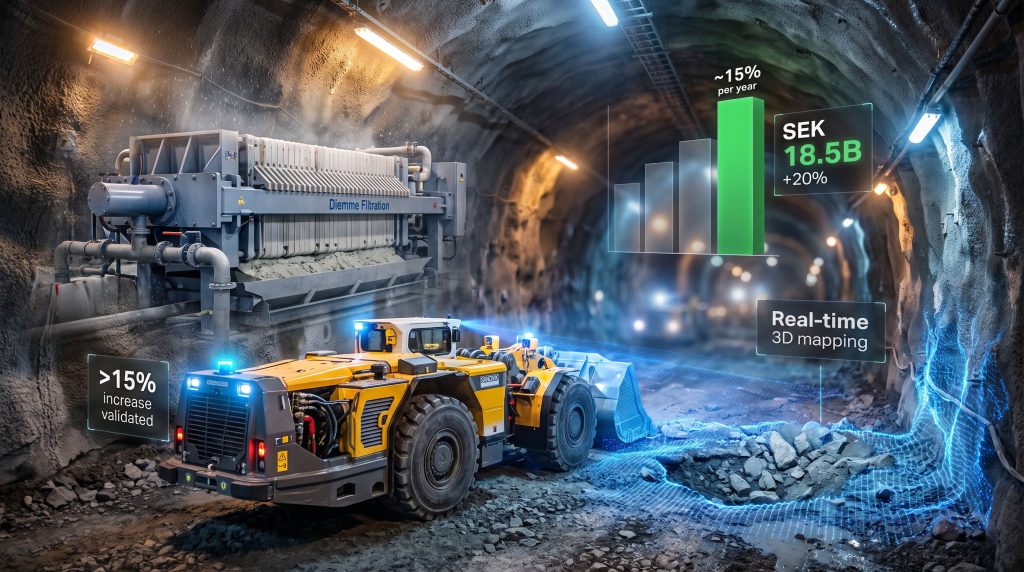
| Mining Division Revenue | SEK 18.5B (~US$1.9B) | +20% |
| Mining Division Orders | SEK 20B (~US$2.06B) | +12% |
| Division EBITA | SEK 3.79B (~US$390M) | +21% |
| Adjusted EBITA Margin | 20.5% | Expanding |
| Equipment Orders Growth | +2% YoY | On strong prior-year base |
| Aftermarket Growth | Double-digit | Continued multi-year trend |
Equipment orders grew just 2% year-on-year, but this figure should be contextualised against an exceptionally strong comparative period in 2025. The more significant story is that aftermarket expansion continued at double-digit rates, sustaining a trend that has now been running across multiple consecutive reporting periods. Revenue growth of 20% outpacing order growth of 12% reflects the compounding contribution of installed base services rather than a surge in new machine placements.
What Sandvik AutoMine Aura Actually Changes
A Ground-Up Rebuild, Not a Feature Refresh
Automation terminology in mining can be misleading. Many systems described as autonomous rely on predetermined path-following in known environments, with human intervention required whenever conditions deviate from what was mapped during system setup. These systems function reliably in stable, well-characterised tunnels, but underground mines are rarely static.
Rock falls, water ingress, equipment movement, and progressive excavation continuously alter the working environment. Furthermore, the broader trend of mining automation transformation has raised expectations considerably across the industry, meaning incremental upgrades no longer satisfy operator demand.
Sandvik AutoMine Aura and Diemme Filtration together represent part of a broader shift toward intelligence-led operations. The previous AutoMine system used 2D navigation, meaning it operated on a flat-plane map of tunnel layouts without the capacity to perceive vertical variation in the floor surface. Potholes, loose rock accumulations, and surface discontinuities were invisible to the system's navigational logic.
The practical consequence was conservative speed parameters, frequent stoppages triggered by unexpected ground conditions, and a ceiling on the productivity gains automation could deliver.
The Technical Advance: Real-Time 3D Tunnel Mapping
The transition to real-time 3D mapping is more significant than a specification upgrade. It represents a fundamental change in how the machine understands its operating environment.
Rather than comparing live sensor data against a pre-recorded 2D map, AutoMine Aura continuously builds and updates a three-dimensional model of the tunnel as the machine moves through it. This enables detection of ground-level features that previously required human assessment, including surface depressions, debris accumulations, and gradient changes.
The practical outcome, validated in live mine environments, is a greater than 15% improvement in automated equipment travel speed. In underground haulage operations where machine cycle times directly determine tonnes moved per shift, this improvement translates to material throughput gains without additional capital expenditure on equipment or personnel.
"The distinction between pre-mapped 2D navigation and live 3D environmental modelling is analogous to the difference between following a printed street map and using real-time GPS with live traffic and road condition data. One assumes a static world; the other responds to what is actually there."
Performance Comparison: Legacy AutoMine vs AutoMine Aura
| Metric | Legacy AutoMine Platform | AutoMine Aura |
|---|---|---|
| Navigation System | 2D mapping | Real-time 3D mapping |
| Hazard Detection | Limited to flat-plane data | Ground-level obstacle detection |
| Equipment Speed Improvement | Baseline | >15% validated |
| Technology Architecture | Legacy stack | Modern, scalable rebuild |
| Validation Environment | Internal testing | Live customer mine environments |
Widing emphasised that the performance gains have been confirmed by customers operating in their actual mine environments, not controlled test facilities. This distinction matters considerably for procurement confidence. Mines are complex, variable systems. Technology that performs in a test environment but degrades under real operating conditions carries significant adoption risk. Customer-validated performance data removes a substantial portion of that uncertainty.
Integration Without Infrastructure Replacement
One underappreciated aspect of AutoMine Aura's commercial positioning is its compatibility with existing mine communication and fleet management infrastructure. Underground automation upgrades have historically required substantial parallel investment in communications networks, control systems, and monitoring infrastructure.
Systems that demand wholesale infrastructure replacement face a far higher adoption barrier than those capable of layering onto established mine-site architecture. Consequently, the scalable design of AutoMine Aura also allows mines to implement autonomy incrementally, expanding the scope of automated operations as confidence grows, without committing upfront to full-fleet conversion. This approach to AI-powered mining efficiency reflects a growing industry preference for phased adoption over disruptive wholesale change.
The Filtration Market: Structural Growth Driven by Regulatory Necessity
Why Tailings Management Has Become a Primary Operational Risk
Tailings — the mineral-depleted slurry remaining after ore processing — represent one of the largest and most complex waste streams in industrial production. Historically, mines managed tailings through wet storage in engineered dams, a practice that is efficient in the short term but carries substantial long-term environmental and safety liability.
The catastrophic failures at Samarco in Brazil in 2015 and Brumadinho in 2019 fundamentally altered the regulatory and reputational calculus around wet tailings storage, accelerating an industry-wide review of tailings management practices across major mining jurisdictions.
The consequence for filtration technology is straightforward: dry-stack tailings, which require large-scale filter press infrastructure to convert wet slurry into a stackable dry cake, have moved from an optional best practice to an increasingly essential compliance requirement. In a growing number of jurisdictions, obtaining and maintaining mine operating permits now depends on demonstrating credible plans for tailings facility de-risking.
Diemme Filtration: Market Position and Commercial Metrics
Diemme Filtration is an Italian manufacturer of industrial filter presses and thickeners specialising in solid-liquid separation for mining concentrate processing and tailings dewatering. The company holds a market-leading position in the large filter press segment most directly relevant to tailings management at scale.
| Metric | Detail |
|---|---|
| 2026 Forecast Revenue | SEK 1.1 billion (~US$113 million) |
| Core Total Addressable Market | SEK 20 billion (~US$2 billion) |
| Market Growth Rate | ~15% per year |
| Margin Profile | Accretive to acquirer |
| Aftermarket Revenue Share | High |
| Geographic Origin | Italy |
The filtration market's approximately 15% annual growth rate significantly outpaces broader mining equipment market expansion. Widing noted explicitly that filtration is growing faster than mining activity more broadly, driven by regulatory pressure to de-risk tailings dam infrastructure and by the role filter press capability plays in the mine permitting process itself.
"A mine operator that cannot demonstrate credible tailings dewatering capacity may find that regulatory approval for expansion, or renewal of existing operating permits, becomes increasingly difficult to obtain. This transforms filter press procurement from a capital optimisation decision into an operational necessity."
The Aftermarket Logic Behind the Acquisition
Filter press systems are not set-and-forget installations. They require regular replacement of filter cloths, maintenance of hydraulic pressing mechanisms, and periodic overhaul of feed pump systems. This consumables and maintenance profile generates recurring revenue streams that closely mirror the parts-and-service dynamics of Sandvik's established underground equipment business.
High aftermarket penetration is, in Sandvik's explicit acquisition framework, a defining attribute of an attractive niche market. The filtration business delivers this profile with structural growth tailwinds added on top. In addition, the acquisition of Diemme reflects how mine reclamation innovation is increasingly shaping capital allocation decisions at the OEM level.
The Acquisition Playbook: Niche Markets, Long Horizons, Compounding Returns
How Sandvik Defines an Attractive Bolt-On
Sandvik's approach to portfolio expansion in the mining segment follows a framework that prioritises aftermarket economics, technical differentiation, and structural market growth over headline revenue size. The 2022 acquisition of Schenck's mining screen and feeder business established the template.
| Dimension | Schenck (2022) | Diemme Filtration (2026) |
|---|---|---|
| Product Category | Screens and feeders | Filter presses and thickeners |
| Integration Timeline | ~3 years to full scale | Integration phase beginning |
| Aftermarket Profile | High | High |
| Market Growth Driver | Processing throughput | Regulatory and ESG compliance |
| Strategic Fit | Rock processing expansion | Tailings management entry |
Widing's characterisation of Sandvik's acquisition pacing is instructive. The company does not pursue volume-driven consolidation. The Schenck integration took several years to reach full commercial scale, and the expectation is that Diemme Filtration will require a comparable period to unlock full synergy potential. Investors should not expect another acquisition of comparable scale in the near term.
The explicit 30-year investment horizon Widing references in discussing mining as a business reflects a capital allocation philosophy that is unusual in large-cap industrial manufacturing. It prioritises compounding organic growth within acquired niches over rapid portfolio expansion, accepting slower near-term revenue contribution in exchange for deeper market penetration and more defensible aftermarket positions over time.
"Widing's stated intention to build slowly but steadily reflects a compounding value creation model. Multi-year consolidation periods between major acquisitions reduce integration risk and allow the full aftermarket economics of each acquisition to mature before the next strategic move is made."
Convergence: Automation, Safety, and Workforce Dynamics
The Underappreciated Labour Dimension
The productivity case for underground automation is well documented. The safety case is equally compelling. What receives less attention is the workforce availability dimension, particularly in remote mining locations where recruiting and retaining experienced underground operators has become structurally difficult.
Deep underground operations in remote geographies — common across Australia, Canada, and parts of Africa and South America — face ongoing challenges in attracting skilled workers willing to live and work in isolated conditions. Autonomous systems that reduce the number of personnel required underground, and allow supervisory control from surface-level facilities, address a labour supply problem that commodity prices alone cannot resolve.
AutoMine Aura's capacity to run at higher speeds with real-time hazard detection also directly reduces the frequency of equipment stoppages caused by undetected ground conditions, a meaningful operational improvement in environments where unplanned downtime carries significant cost.
Tailings Management as Mine Design, Not Just Compliance
The shift toward dry-stack tailings is beginning to influence mine design from the earliest project stages rather than being retrofitted at the operational phase. Engineers are increasingly incorporating filtration plant capacity into initial definitive feasibility studies, recognising that wet storage alternatives may be unavailable, politically untenable, or prohibitively insured in certain jurisdictions.
Early adoption of filtration infrastructure also carries long-term financial benefits beyond regulatory compliance. Mines that convert to dry-stack tailings reduce their long-term environmental liability profile, which can translate into lower closure cost provisions and more favourable insurance terms over the life of the operation.
The next major ASX story will hit our subscribers first
FAQ: Sandvik AutoMine Aura and Diemme Filtration
What fundamentally distinguishes AutoMine Aura from the system it replaces?
AutoMine Aura is a complete architectural rebuild of Sandvik's automation platform, replacing a legacy 2D navigation system with real-time 3D tunnel mapping. This enables detection of ground-level hazards invisible to the previous system and has been validated to increase automated equipment operating speed by more than 15% in live mine environments.
What does Diemme Filtration actually produce and who uses it?
Diemme Filtration manufactures large industrial filter presses and thickeners used for solid-liquid separation in mining operations. Its primary customers are mine operators seeking to dewater tailings slurry into a dry, stackable solid material that reduces the environmental footprint and safety risk of tailings storage facilities.
Why is the mining filtration market growing at approximately 15% per year?
Growth is being driven by tightening environmental regulations around tailings dam safety across major mining jurisdictions, combined with an industry-wide shift toward ESG-compliant waste management and the role that filtration capacity increasingly plays in the mine permitting process.
What generates recurring revenue in the filtration business?
Filter press systems require ongoing replacement of filter cloths, maintenance of hydraulic and pneumatic components, and periodic overhaul of feed systems. This consumables and service profile creates predictable recurring revenue streams analogous to the parts-and-service model in Sandvik's broader mining equipment business.
What is the total addressable market for Diemme Filtration's core offering?
The core addressable market is estimated at approximately SEK 20 billion, equivalent to roughly US$2 billion. Adjacent product categories expand this opportunity further.
Key Takeaways
- AutoMine Aura represents a generational shift in underground automation capability, moving from path-following on pre-recorded 2D maps to real-time 3D spatial intelligence with validated productivity gains exceeding 15%
- Sandvik AutoMine Aura and Diemme Filtration together position Sandvik at the intersection of environmental compliance-driven capital expenditure and structurally growing tailings management demand, with a core addressable market of approximately US$2 billion
- The filtration market's ~15% annual growth rate significantly outpaces broader mining equipment market expansion, driven by regulatory necessity rather than commodity cycle dynamics
- Double-digit aftermarket growth sustained across multiple reporting periods is being driven by fleet age, utilisation intensity, and increasing machine complexity simultaneously
- Sandvik's deliberate multi-year consolidation periods between major acquisitions reflect a compounding, long-horizon value creation strategy rather than volume-driven M&A
- The Sandvik AutoMine Aura platform and the 30-year investment horizon explicitly articulated for the mining division signal a capital allocation philosophy oriented toward durable aftermarket economics over near-term revenue maximisation
This article contains references to financial metrics and market forecasts that are subject to change. Readers should conduct independent research before making investment decisions. Forward-looking statements involve inherent uncertainty and actual outcomes may differ materially from projections.
For ongoing coverage of underground mining automation trends and tailings management developments, explore related industry reporting at Mining Beacon.
Want to Catch the Next Major ASX Mining Discovery Before the Market Does?
Discovery Alert's proprietary Discovery IQ model scans ASX announcements in real time, delivering instant alerts on significant mineral discoveries across 30+ commodities — the kind of structural shifts in mining technology and capital deployment covered in this article are precisely what drives major discovery re-ratings. Start your 14-day free trial today, or explore how historic discoveries have generated extraordinary returns for early-positioned investors.