August 20, 2026
The Forgotten Chokepoint: Why Smelting Capacity Defines America's Critical Mineral Future
The global race for critical mineral dominance is often framed around mining rights, exploration acreage, and geological discovery. Yet the most consequential bottleneck in the entire supply chain is rarely discussed in mainstream coverage: the smelting and refining stage. Without domestic processing infrastructure, raw ore is geopolitically meaningless. American Tungsten DOE antimony funding represents one of the most targeted federal responses to this structural vulnerability in recent memory.
A nation can sit atop the world's richest mineral deposits and still remain strategically dependent if it cannot transform those deposits into refined, defence-ready material. This is precisely the vulnerability the United States has spent decades accumulating in antimony, and it is the structural problem that the Department of Energy's ASCEND programme is now attempting to address with targeted federal capital.
When big ASX news breaks, our subscribers know first
The Supply Chain Blind Spot: Antimony's Hidden Strategic Role
Antimony occupies an unusual position in the critical minerals conversation. Unlike lithium or cobalt, which have attracted enormous investor attention due to their role in battery technology, antimony has remained largely invisible to the general public. However, its irreplaceable function across multiple high-stakes sectors makes the antimony shortage risks a matter of genuine national urgency.
Its applications span a surprisingly wide range of defence and industrial uses:
- Flame retardants in military-grade textiles, aircraft components, and electronics
- Ammunition primers and tracer rounds used by armed forces
- Lead-acid battery grid alloys that improve mechanical strength and charge retention
- Infrared optical components and night-vision device coatings
- Semiconductors and thin-film solar cell production
What makes antimony particularly difficult to substitute is not just its functional performance but the fact that many of its antimony defense applications involve trace quantities embedded within complex manufactured systems. Replacing it requires redesigning entire production processes, not simply swapping one input for another.
Antimony is not consumed in large tonnages, but its absence from a supply chain can halt production of systems that cost billions of dollars to develop. This asymmetry between its physical volume and its strategic weight is precisely what makes supply disruption so dangerous.
How the U.S. Lost Its Antimony Processing Capacity
The erosion of domestic antimony smelting capacity in the United States was not a sudden event. It unfolded gradually across several decades, driven by intersecting economic pressures:
- Commodity price suppression driven by Chinese overproduction made domestic smelting economically unviable from the 1990s onward
- Environmental compliance costs added regulatory burdens that legacy U.S. operations could not absorb while competing against state-subsidised foreign producers
- Offshoring of manufacturing reduced domestic demand signals that might otherwise have sustained processing infrastructure
- Institutional memory loss as experienced metallurgists and smelter operators retired without successors, eroding the human capital base
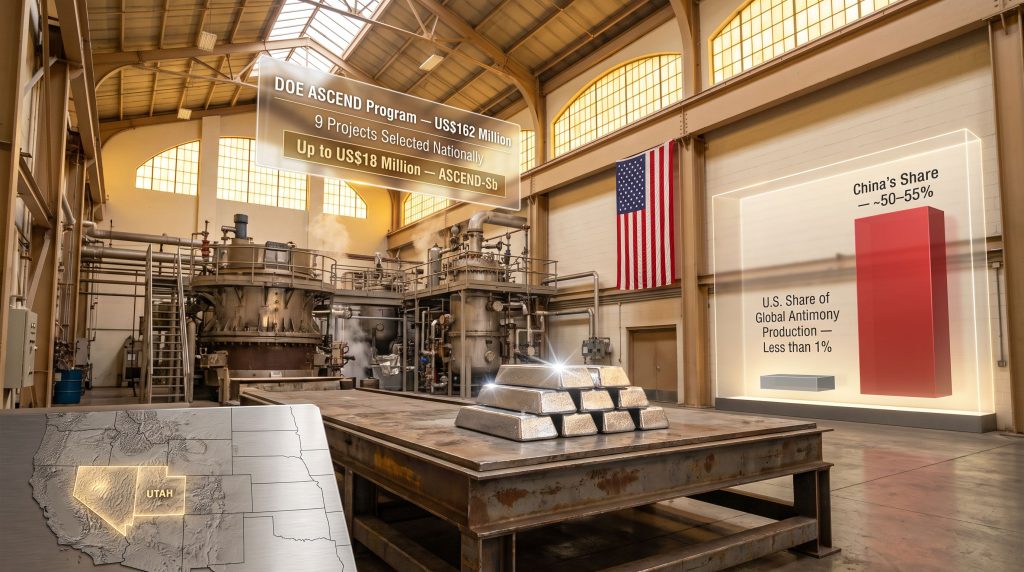
The result is stark: no primary antimony smelter has operated commercially in the United States for several decades. Furthermore, the country currently produces less than 1% of global antimony output, while China controls an estimated 50% to 55% of global refined antimony production according to U.S. Geological Survey data.
China's progressive tightening of antimony export controls from 2023 onward has compressed the timeline within which the U.S. must act. These restrictions, part of a broader pattern of leveraging critical mineral dominance as a geopolitical instrument, sent antimony prices to multi-year highs and triggered urgent reassessments across defence supply chain planners.
Understanding the ASCEND Programme: Structure, Mechanics, and Strategic Intent
The Department of Energy's ASCEND initiative, formally titled Advancing Smelting Capacity for Expansion and National Dominance, represents one of the most targeted federal interventions in domestic mineral processing in recent memory. The programme allocates US$162 million across nine nationally selected projects, with its announcement arriving on August 18, 2026.
Critically, ASCEND does not fund exploration or mine development. It targets the processing bottleneck specifically, focusing capital where the U.S. is most exposed: the transformation of raw ore into refined, usable metal. This deliberate policy choice reflects growing federal recognition that processing sovereignty — not just geological discovery — determines strategic independence. Indeed, the critical minerals executive order signed earlier laid much of the groundwork for this approach.
The selection and award process follows a structured sequence:
- Technical application review assessing engineering feasibility, domestic integration potential, and strategic mineral classification
- Competitive national shortlisting based on merit and alignment with defence and energy priorities
- Negotiation phase where selected applicants and the DOE work through scope, terms, and conditions
- Binding award finalisation contingent on successful negotiation outcomes
⚠️ Investor Caution: Selection for ASCEND negotiations is a meaningful validation of technical and strategic merit, but it does not constitute a confirmed financial commitment. A binding award only follows after the negotiation phase concludes successfully.
The minerals targeted under ASCEND extend beyond antimony to include tungsten, rare earth elements, and other defence-critical materials where domestic processing capacity is either absent or severely insufficient.
The ASCEND-Sb Project and the American Tungsten DOE Antimony Funding Story
ASX-listed American Tungsten and Antimony's U.S. subsidiary, Trigg Minerals, has been selected by the DOE for a potential financial award of up to US$18 million under the ASCEND programme. The DOE has invited Trigg to begin negotiating the scope and terms of the ASCEND-Sb project, described as Advanced Smelting Capacity for Expansion and National Dominance in Antimony.
The American Tungsten DOE antimony funding development positions this as one of nine nationally selected projects and represents the first formal step in what the company describes as a broader ambition to establish a mine-to-metal American antimony supply chain. In addition, the strategic antimony financing secured by other domestic producers illustrates the broader momentum building across the sector.
What the $18 Million Could Fund
| Potential Use of Funds | Strategic Rationale |
|---|---|
| Engineering and feasibility studies | Validates technical pathway before full capital commitment |
| Equipment procurement for refinery upgrades | Accelerates timeline at existing Del Sol facility |
| Environmental permitting and compliance work | Addresses regulatory prerequisites for commercial operation |
| Workforce development programmes | Rebuilds technical human capital lost during decades of inactivity |
What the $18 Million Does Not Represent
- A confirmed or disbursed financial commitment from the federal government
- The total capital required to bring a commercial antimony smelter to full production
- Guaranteed regulatory clearance or production timeline confirmation
- Any form of government backing or strategic project designation beyond selection for negotiation
The Del Sol Refinery: Brownfield Advantage in a Greenfield-Dominated Landscape
One of the more strategically significant elements of the company's approach is its acquisition of the Del Sol refinery, which provides existing physical infrastructure that can be repurposed for antimony processing rather than constructed from scratch.
This brownfield strategy carries meaningful advantages over greenfield development:
| Development Approach | Capital Intensity | Timeline to Production | Regulatory Risk |
|---|---|---|---|
| Greenfield smelter construction | Very High | 5 to 10 years | High |
| Brownfield refinery acquisition and upgrade | Moderate | 2 to 4 years | Moderate |
| Allied nation import substitution | Low | Immediate | Low (interim only) |
| Joint venture with domestic processor | Moderate | 2 to 5 years | Low to Moderate |
The brownfield model compresses both the capital requirement and the development timeline — two factors that DOE evaluators are likely to weigh heavily when assessing projects that can demonstrate near-term operational readiness rather than decade-long development horizons.
From a federal programme design perspective, funding a refinery upgrade that could reach operational status within two to four years is a fundamentally different risk profile than funding a greenfield smelter that may not produce commercial metal for a decade.
The next major ASX story will hit our subscribers first
The Dual-Mineral Portfolio: Why Tungsten and Antimony Are Strategic Companions
The concurrent advancement of both antimony and tungsten projects across Utah and Nevada reflects a deliberate portfolio construction philosophy rather than opportunistic diversification. Both minerals share a set of characteristics that make them natural companions within a federal funding strategy:
- Both are formally designated U.S. critical minerals with established defence applications
- Both have supply chains heavily concentrated in China and Russia, creating analogous geopolitical exposure
- Both require specialised processing infrastructure currently unavailable at commercial scale domestically
- Both are located within established western U.S. mining jurisdictions with existing regulatory frameworks and experienced workforces
Tungsten's applications in hardened munitions, cutting tools, and high-temperature aerospace components mirror antimony's defence criticality in a different technical domain. Consequently, advancing both simultaneously allows the company to leverage shared infrastructure investments, regulatory relationships, and federal engagement across two separate but strategically aligned mineral categories. This mirrors the broader model of strategic minerals for defense that other industry participants have successfully pursued.
Mapping the Federal Policy Architecture Behind ASCEND
The ASCEND programme operates within a layered federal policy environment that has intensified significantly since 2022. Understanding this architecture helps contextualise why the programme exists and why it focuses specifically on processing rather than extraction.
| Policy Instrument | Primary Focus | Relevance to Antimony Processing |
|---|---|---|
| Defense Production Act Title III | Defence-critical material supply | Direct, antimony is defence-classified |
| DOE Critical Materials Office programmes | Smelting and refining capacity | Direct, ASCEND sits within this office |
| National Defense Authorization Act frameworks | Broad strategic mineral mandates | Direct, informs critical mineral lists |
| Inflation Reduction Act | Domestic clean energy supply chains | Indirect, processing infrastructure overlap |
| Executive Orders on Critical Mineral Supply Chains | Strategic prioritisation | Direct, antimony listed as priority mineral |
The U.S. approach to critical mineral supply chain resilience has moved through identifiable phases. The awareness phase that preceded 2020 produced recognition of dependency but limited policy response. Legislative mobilisation between 2020 and 2023 created the funding frameworks. The current deployment phase is translating policy intent into project-level capital allocation. The ASCEND selection represents a concrete output of this deployment phase.
According to the Critical Materials Institute, addressing processing bottlenecks rather than simply expanding mining operations is now widely recognised as the more effective lever for achieving genuine supply chain sovereignty.
Frequently Asked Questions: American Tungsten DOE Antimony Funding
Has the $18 million award been confirmed for the ASCEND-Sb project?
No. The US$18 million figure represents the maximum potential award currently under negotiation between Trigg Minerals and the DOE. A formal binding commitment requires the successful conclusion of scope and terms negotiations.
Why does the U.S. have no domestic antimony smelters currently operating?
Decades of low commodity prices, environmental compliance costs, and competition from state-subsidised foreign producers eliminated the economic case for domestic smelting. No primary antimony smelter has operated commercially in the U.S. for several decades, and rebuilding that capacity requires deliberate federal intervention to bridge the gap between market economics and strategic necessity.
What states are involved in the project portfolio?
The antimony and tungsten project portfolio is located across Utah and Nevada, both established western U.S. mining jurisdictions with existing mineral development infrastructure, regulatory frameworks, and experienced technical workforces.
What is the significance of a mine-to-metal supply chain for national security?
A mine-to-metal supply chain eliminates foreign processing dependency at every stage, from raw ore extraction through to refined metal. This means that even if export controls or geopolitical disruptions cut off foreign supply, domestic production can continue uninterrupted. It is the only model that provides genuine strategic independence rather than partial de-risking.
Are additional federal funding programmes being pursued?
Reporting indicates that applications are pending across additional U.S. government funding mechanisms tied to critical minerals development and defence supply chain resilience, though specific programme details and award amounts remain subject to government review processes.
Disclaimer: This article is intended for informational purposes only and does not constitute financial advice. Forward-looking statements, project timelines, and potential funding figures referenced herein are subject to negotiation outcomes, regulatory processes, and other material uncertainties. Investors should conduct their own due diligence before making investment decisions.
Want to Stay Ahead of the Next Major Critical Mineral Discovery?
Discovery Alert's proprietary Discovery IQ model delivers real-time alerts on significant ASX mineral discoveries — including critical minerals like antimony and tungsten — instantly translating complex geological data into actionable investment insights for both short-term traders and long-term investors. Explore how historic mineral discoveries have generated substantial returns on Discovery Alert's dedicated discoveries page, and begin your 14-day free trial today to position yourself ahead of the broader market.