August 20, 2026
The Hidden Arithmetic of South Africa's Coal Export Infrastructure
South Africa's coal logistics chain is often discussed in terms of terminal capacity or commodity pricing, yet the most consequential variable is far less visible to outside observers: the cumulative effect of rail frequency on mine-level export economics. A single additional train per week on a feeder corridor can represent millions of rands in annual logistics savings, yet this granular operational reality rarely surfaces in headline financial reporting. Understanding how Exxaro Grootegeluk rail shipments to Richards Bay have evolved over recent years requires looking beyond volume statistics and into the structural mechanics of how coal moves from the Waterberg coalfield to the seaborne market.
When big ASX news breaks, our subscribers know first
The Waterberg's Unusual Position in South Africa's Coal Export Architecture
Why Feeder-Line Dependency Changes Everything
The Waterberg coalfield in Limpopo province holds some of South Africa's most substantial thermal and semi-soft coking coal reserves, yet its geographic distance from the primary export corridor creates a logistics architecture that is fundamentally different from Mpumalanga-based operations.
Grootegeluk, operated by Exxaro and among the largest single open-cut coal mines on the African continent, connects to the broader Transnet Freight Rail network via a feeder line passing through Thabazimbi before joining the main corridor toward Richards Bay. This multi-leg dependency has a compounding effect that is easy to underestimate:
- Any degradation in TFR system-wide throughput hits Waterberg producers earlier and harder than mines situated directly on the main Ermelo-Richards Bay coal line
- Conversely, genuine improvements in TFR capacity utilisation tend to yield proportionally larger operational benefits for Grootegeluk than for better-positioned operations
- The feeder architecture also limits flexibility during disruptions, since there are fewer alternative routing options available compared to the more densely networked Mpumalanga corridor
The Richards Bay Coal Terminal (RBCT) remains South Africa's dominant coal export gateway by volume, with Durban functioning as a secondary overflow channel during periods of either terminal congestion or rail disruption. Furthermore, the broader resource export challenges observed globally provide useful context for understanding the structural pressures affecting Grootegeluk's logistics model. For Grootegeluk, RBCT is not simply a preferred destination but an operational necessity around which its entire logistics model is built.
A lesser-appreciated aspect of the Waterberg's coal geology is the multi-product nature of Grootegeluk's output. The mine produces both thermal coal grades and semi-soft coking coal from the same deposit, meaning export mix flexibility is an additional lever management can pull when navigating logistics constraints. This dual-product capability provides a degree of commercial resilience that single-grade thermal operations simply do not have.
Rail Performance Data: Reading Between the Tonnage Figures
TFR's Delivery Trajectory to Richards Bay Coal Terminal
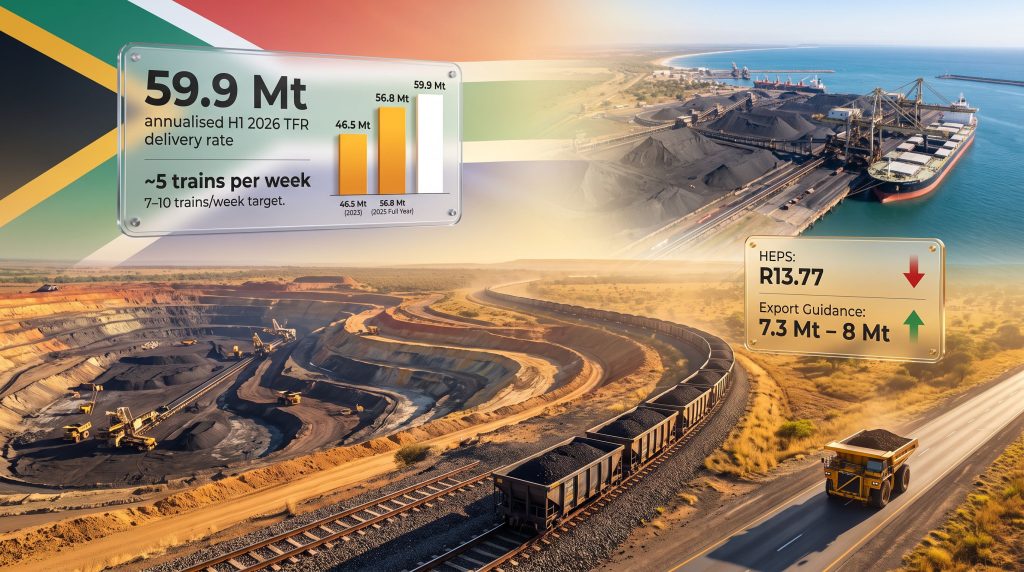
Understanding where Exxaro Grootegeluk rail shipments to Richards Bay stand today requires placing current figures within a multi-year context. TFR's coal delivery performance has moved through a notable deterioration and partial recovery cycle:
| Period | Annualised TFR Delivery to RBCT | Directional Movement |
|---|---|---|
| 2022 | ~50.4 Mt | Baseline reference |
| 2023 | ~46.5 Mt | Trough – approximately 8% decline |
| 2025 Full Year | ~56.8 Mt | Recovery phase underway |
| H1 2026 (annualised) | ~59.9 Mt | Approximately 5% above 2025 full year |
The annualised H1 2026 figure of 59.9Mt is significant not because it represents a return to pre-crisis norms, but because the trajectory is moving in the right direction while remaining well below RBCT's design throughput capacity. The terminal was originally engineered to handle significantly higher annual volumes, meaning the gap between current delivery rates and peak potential remains wide.
What Train Frequency Reveals That Tonnage Data Conceals
Aggregate tonnage figures can obscure the granular operational reality at the mine level. For Grootegeluk specifically, the train frequency metric is arguably more informative than total export volumes because it captures the regularity and predictability of logistics flow rather than just cumulative throughput. In addition, monitoring the latest metallurgical coal price update alongside these frequency metrics provides a fuller picture of Exxaro's commercial position.
- In 2023, Grootegeluk averaged approximately 4.3 trains per week on the Richards Bay corridor
- A period of further deterioration saw this drop to roughly 3 trains per week
- By mid-2026, frequency had recovered to approximately 5 trains per week
- Exxaro's stated operational target remains 7 to 10 trains per week
The gap between the current rate of 5 trains per week and the target range of 7 to 10 is analytically important. At present performance, Exxaro is operating at roughly 50-70% of its desired rail run-rate. The improvement from 3 to 5 trains per week represents a frequency gain of approximately 67% in mathematical terms, yet management has been candid that this recovery originates from a genuinely low base rather than representing a return to structural adequacy.
Industry Context: In the South African coal sector, the difference between 5 trains per week and 10 trains per week on a single corridor is not simply a doubling of volume. It changes the entire cost calculus of the operation, determining whether road transport functions as an emergency supplement or a permanent structural cost burden. This distinction has direct implications for mine-level profitability.
The Multi-Modal Logistics Trap and Its Cost Implications
When Road Haulage Becomes a Structural Dependency
When TFR cannot absorb sufficient volumes, mining companies activate road transport as an alternative export channel. In theory, this is a contingency measure. In practice, when rail underperforms for extended periods, road haulage transitions from temporary supplement to embedded cost structure, with significant margin consequences. The coal supply challenges shaping the broader sector in 2025 have made this transition particularly costly for operations reliant on feeder-line infrastructure.
Exxaro has maintained multi-modal logistics operations throughout the recovery period, and the economics of this approach are highly sensitive to diesel pricing. In H1 2026:
- Diesel prices increased 21% during the period
- A concurrent approximately 15% improvement in coal prices provided the commercial buffer that made road-based coal movement economically viable
- Without the coal price recovery, management indicated that dispatching coal via road at those diesel rates would not have been financially defensible
This creates a precarious dependence that is worth flagging for investors. Exxaro's logistics cost base during road-supplemented periods is effectively held together by coal price support. The moment coal prices soften while diesel remains elevated, the multi-modal model compresses margins rapidly.
| Scenario | Rail Frequency | Primary Mode | Margin Position |
|---|---|---|---|
| 2023 trough | ~4.3 trains/week | Rail with heavy road supplement | High cost pressure |
| H1 2026 current | ~5 trains/week | Rail primary, road secondary | Moderate – coal price offset required |
| Target state | 7-10 trains/week | Rail dominant | Low road dependency, improved operating leverage |
The target state is not merely aspirational. Achieving 7 to 10 trains per week would materially reduce Exxaro's exposure to diesel price volatility and improve the operating leverage that coal price movements translate into at the bottom line. Exxaro has also been exploring alternative export routes via Maputo as part of its contingency planning while TFR performance continues to recover.
Disaggregating Exxaro's H1 2026 Financial Results
Why the Headline Numbers Misrepresent Coal Operational Performance
Exxaro's H1 2026 results present a classic case where headline metrics and operational reality point in opposite directions. The financial summary shows:
- Headline earnings per share fell 20% to R13.77 (from R17.24 in the prior period)
- Headline earnings declined 22% to R3.22 billion
- Interim dividend reduced 17% to R7 per share
- Revenue grew 7%, though rand strength against the US dollar suppressed what would otherwise have been a larger gain
The surface-level reading suggests broad operational deterioration. The more accurate interpretation is considerably more nuanced. The primary drivers of the earnings decline were weaker equity-accounted contributions from two associate investments:
- Sishen Iron Ore Company (SIOC) – a historically significant earnings contributor that delivered weaker returns in the period
- Black Mountain – the zinc and lead operation in the Northern Cape, which underperformed relative to prior period contributions
Exxaro's coal business, measured by export volumes, rail frequency improvements, and revenue trajectory, actually demonstrated genuine operational progress. Coal exports grew 15% to 3.9Mt in H1 2026, supported by the improved TFR performance and continued multi-modal logistics deployment. The company maintained its full-year export guidance of 7.3Mt to 8Mt, a signal of management confidence that the rail improvement will be sustained through the second half.
Investor Framing: The H1 2026 results reward investors who can disaggregate portfolio-level exposure from core operational performance. Exxaro's coal business improved. Its investment portfolio did not. Conflating these two narratives produces a materially inaccurate picture of the company's operational trajectory.
Beyond Coal: Exxaro's Commodity Diversification in Practice
Manganese as the Primary Diversification Vehicle
Exxaro's transition away from pure-play coal dependency is progressing along a manganese-first pathway, with copper held as a longer-term and more conditional addition to the portfolio. However, understanding the broader relationship between commodity prices and mining performance remains essential context for evaluating these diversification moves.
Key manganese developments from H1 2026 include:
- The company recorded its first earnings contribution from manganese assets acquired in February 2026, marking a genuine portfolio milestone
- On a 100% production basis, manganese output grew 11% during the period
- An in-principle agreement has been reached regarding the acquisition of a 51% interest in Mokala, a manganese operation within the Kalahari Manganese Field in South Africa's Northern Cape
- The Mokala transaction is currently being formalised into a binding legal agreement and remains subject to completion
The Kalahari Manganese Field is geologically significant on a global scale, hosting the world's largest known manganese ore deposit. Exxaro's existing controlling stake in Tshipi Borwa, one of the more substantial producers within the field, combined with the pending Mokala acquisition, would position the company as a meaningful manganese platform rather than a minor participant.
Copper Strategy: Disciplined Optionality
Exxaro's approach to copper acquisition is deliberately measured. The company has publicly signalled interest in copper as a long-term energy transition metal exposure, consistent with industry-wide recognition of copper's role in electrification infrastructure. However, management has adopted a clear value threshold:
- Copper will not be pursued as an acquisition target at any price
- If a copper opportunity meeting Exxaro's criteria does not emerge, the company will direct capital toward expanding its manganese platform instead
- This positions copper as genuine optionality rather than a committed strategic objective
| Commodity | Current Status | Strategic Posture |
|---|---|---|
| Thermal/semi-soft coal | Core – Grootegeluk dominant | Optimise and maintain logistics |
| Manganese | Active – Tshipi Borwa + Mokala pending | Scale through disciplined acquisition |
| Copper | Exploratory – no transaction concluded | Opportunistic, price-disciplined fallback |
| Iron ore/base metals | Associate exposure only | Passive – no expansion indicated |
The next major ASX story will hit our subscribers first
RBCT Throughput and Systemic Sector Implications
Grootegeluk as a Proxy for Broader Waterberg Coal Sector Health
The experience of Exxaro Grootegeluk rail shipments to Richards Bay is not an isolated operational story. It functions as a representative data point for the broader condition of South Africa's Waterberg coal export chain, which encompasses multiple producers across the coalfield sharing the same TFR feeder architecture. Consequently, the mining industry trends shaping logistics investment decisions will prove critical to whether TFR can close the gap between current throughput and RBCT's rated capacity.
RBCT is designed as one of the highest-capacity dedicated coal export terminals globally. The gap between its rated capacity and TFR's current annualised delivery rate of approximately 59.9Mt reflects a logistics system operating materially below its engineered potential. Every tonne that TFR fails to deliver by rail either exits via costlier road transport, delays export commitments, or is not moved at all.
For the South African fiscus, the implications extend beyond individual company earnings. Coal export royalties, corporate taxes, and logistics employment are all tied to the throughput performance of this corridor. A TFR that delivers at 59.9Mt annualised rather than, say, 80Mt or beyond, represents a structural tax on export revenue at the national level.
Exxaro's decision to maintain full-year export guidance of 7.3Mt to 8Mt for 2026 is a meaningful signal. It suggests management believes the current rail improvement trajectory has sufficient momentum to hold through H2 2026, even accounting for the seasonal and operational variability that typically affects second-half performance. The RBCT congestion dynamics that have periodically complicated throughput planning remain an active consideration for Exxaro's logistics team.
FAQ: Exxaro Grootegeluk Rail Shipments to Richards Bay
How much have Exxaro Grootegeluk rail shipments to Richards Bay improved?
Train frequency on the Grootegeluk-Richards Bay corridor rose from roughly 3 trains per week to approximately 5 trains per week during H1 2026, representing a frequency improvement of around 50% against a low base. Total coal exports grew 15% to 3.9Mt in the first half.
What is Exxaro's target train frequency for Grootegeluk?
Management has stated a target of between 7 and 10 trains per week. Current performance at approximately 5 trains per week sits at roughly 50-70% of that target range.
What did TFR deliver to Richards Bay Coal Terminal in H1 2026?
Transnet Freight Rail delivered 30.95Mt to RBCT in the six months to June 2026, equivalent to an annualised rate of approximately 59.9Mt, which represents a 5% improvement over TFR's 56.8Mt full-year performance in 2025.
Why did Exxaro's headline earnings fall despite improving coal operations?
The 22% decline in headline earnings to R3.22 billion was primarily driven by weaker equity-accounted contributions from associate investments, specifically Sishen Iron Ore Company and Black Mountain, rather than deterioration in coal operational performance.
Why does Exxaro continue using road transport if rail is improving?
The gap between the current 5 trains per week and the 7-10 train target means rail cannot yet absorb all of Exxaro's desired export volumes. Road haulage supplements the shortfall, though with diesel prices rising 21% in H1 2026, this approach required the concurrent coal price improvement of approximately 15% to remain economically viable.
What is the Mokala manganese acquisition?
Mokala is a manganese mine within South Africa's Kalahari Manganese Field in the Northern Cape. Exxaro has reached an in-principle agreement to acquire a 51% interest in the operation, which would complement its existing controlling stake in Tshipi Borwa. The transaction is being formalised into a binding agreement.
This article contains forward-looking statements and financial projections based on publicly available disclosures and industry data. Past performance of rail throughput, commodity prices, and earnings metrics does not guarantee future results. Readers should conduct independent due diligence before making any investment decisions based on the information presented here.
Want to Stay Ahead of the Next Major ASX Mineral Discovery?
Discovery Alert's proprietary Discovery IQ model delivers real-time alerts on significant ASX mineral discoveries, turning complex resource data into clear, actionable investment insights — explore historic discoveries and their returns to understand the scale of opportunity, then start your 14-day free trial at Discovery Alert to position yourself ahead of the broader market.