August 20, 2026
The Battery Materials Race Is Reshaping Where Graphite Gets Mined
The global transition toward electrified transport and grid-scale energy storage has quietly elevated flake graphite to one of the most strategically sensitive materials in modern supply chains. Unlike lithium or cobalt, which tend to dominate headlines, graphite actually accounts for the largest proportion by weight of any single material inside a lithium-ion battery anode. Yet for years, the overwhelming majority of processed battery-grade graphite has originated from a single country, leaving North American manufacturers exposed to concentration risk that procurement teams and policymakers are now urgently trying to address.
This structural vulnerability has redirected capital and exploration activity toward jurisdictions capable of delivering domestically sourced, long-life graphite projects. Canada, with its established mining regulatory framework, skilled workforce, and existing critical minerals infrastructure, has emerged as one of the most credible alternatives. Within that context, the Abasca Loki graphite PEA represents a materially significant development, not simply for the company involved, but for the broader narrative around North American supply chain resilience.
When big ASX news breaks, our subscribers know first
Understanding What a PEA Actually Signals to the Market
Before examining the Loki project's specific economics, it is worth understanding what a preliminary economic assessment means within the hierarchy of mining study work. The PEA sits at the earliest stage of formal economic evaluation, sitting below a prefeasibility study and well below a bankable feasibility study. It is designed to test whether a project is economically plausible under reasonable assumptions, and to identify the parameters that require further technical validation.
Critically, PEAs incorporate both indicated and inferred mineral resources. Under NI 43-101, Canada's national standard for public disclosure of scientific and technical information about mineral projects, inferred resources carry a higher degree of geological uncertainty and are not suitable for use in economic evaluations at the prefeasibility or feasibility stage. This means investors should treat PEA-stage economics as directionally informative rather than definitively predictive. Furthermore, understanding the feasibility study process helps investors contextualise where PEA-stage metrics sit within a project's broader development journey.
Important Disclaimer: All economic figures derived from a PEA, including NPV, IRR, and capital cost estimates, are preliminary in nature and subject to material revision as additional geological, metallurgical, and engineering data becomes available. This article does not constitute financial advice.
That said, a well-constructed PEA from a credible engineering firm does serve several important commercial functions. It provides the technical scaffolding needed to initiate conversations with potential offtake partners and strategic financing counterparties. It also establishes a documented baseline for project economics that can be interrogated through sensitivity analysis.
The Loki Deposit: Geology, Scale, and Strategic Location
Location and Infrastructure Advantages
The Loki flake graphite deposit is situated approximately 15 kilometres south of the Key Lake mill complex in northern Saskatchewan. This proximity to existing mining infrastructure is more than geographic convenience. Northern Saskatchewan has hosted uranium mining operations for decades, which means the region benefits from established road access, power connectivity considerations, and a regulatory environment with institutional familiarity with large-scale open-pit operations.
For a greenfield graphite project, the ability to leverage existing regional infrastructure can meaningfully reduce both the capital complexity and the timeline associated with early-stage development. While Loki would still require dedicated processing facilities, the baseline conditions in the region compare favourably to more remote graphite development locations in parts of Africa and northern Canada where infrastructure must be constructed almost entirely from scratch.
Resource Estimate and Geological Evolution
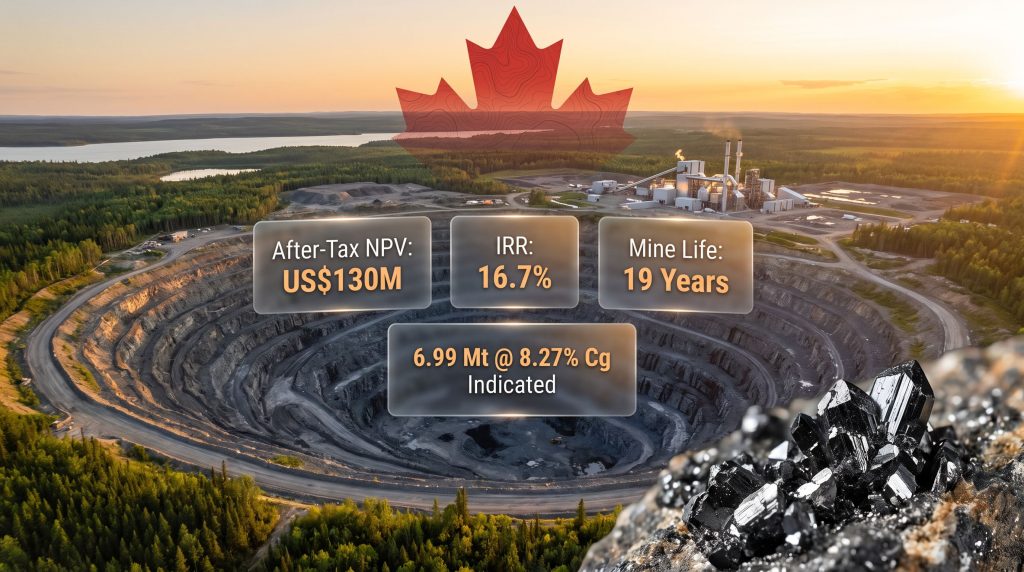
The resource estimate underpinning the Abasca Loki graphite PEA reflects a substantial expansion from earlier work. The current estimate, prepared by Understood Mineral Resources Inc. under NI 43-101 standards, comprises 6.99 million tonnes (Mt) indicated at 8.27% total graphitic carbon (Cg) and 15.83 Mt inferred at 6.93% Cg.
What makes this estimate particularly notable is the trajectory that produced it. Drilling campaigns conducted across 2025 and 2026 extended the deposit's strike length from approximately 500 metres to roughly 1,400 metres, nearly tripling the known lateral extent of mineralisation. A meaningful portion of what was previously classified as inferred resource has been upgraded to indicated status, reflecting improved geological confidence across the deposit's core zones.
The project also carries exploration upside through the adjacent Thor zone, which has not yet been fully delineated. In graphite deposit evaluation, the distinction between flake size categories matters considerably. Large and jumbo flake graphite, which commands price premiums over fine flake material, is particularly sought after for battery anode, expandable graphite, and specialty industrial applications. The Loki resource's grade profile warrants close attention as metallurgical test work advances.
Industry Context: An 8.27% Cg grade for indicated resources is considered competitive within the global flake graphite development pipeline. For reference, many African deposits operate at grades between 5% and 12% Cg, while higher-grade deposits above 10% Cg are less common and typically attract premium valuations.
Breaking Down the Abasca Loki PEA: Key Economics and Operational Parameters
Mine Plan Architecture and Production Profile
The PEA, prepared by Tetra Tech Canada Inc., a globally recognised mining engineering consultancy, envisions a conventional open-pit operation processing material at a rate of 2,750 tonnes per day. The operational parameters are summarised below:
| Parameter | PEA Estimate |
|---|---|
| Mining Method | Open-pit |
| Processing Rate | 2,750 tonnes per day |
| Mine Life | 19 years |
| Annual Graphite Concentrate Production | ~66,500 tonnes |
| Concentrate Grade | ~95% |
| Life-of-Mine Payable Graphite | ~1.2 million tonnes |
A 2,750 t/d throughput rate positions Loki as a mid-scale operation by global graphite standards, large enough to be economically meaningful but not so large as to create an unmanageable capital construction burden. The selection of this throughput rate likely reflects a deliberate balance between maximising resource recovery and keeping initial capital requirements within a range that institutional project finance lenders can absorb.
The 19-year mine life is a strategically important characteristic. Graphite prices, like most commodity prices, move through cycles driven by demand growth from battery manufacturers, shifts in anode chemistry preferences, and supply additions from new projects. A nearly two-decade operational window means Loki would be exposed to multiple complete price cycles, which tends to smooth long-run economics but also introduces uncertainty in any single-period pricing assumption.
Financial Returns at Base Case Pricing
| Financial Metric | Value |
|---|---|
| After-Tax NPV | US$130 million |
| Internal Rate of Return | 16.7% |
| Cumulative After-Tax Free Cash Flow | US$662 million |
| Base Case Graphite Price | US$1,450 per tonne |
| Initial Capital Expenditure | US$216 million |
| Payback Period | 4.7 years |
The base case graphite concentrate price of US$1,450 per tonne is a critical input that deserves scrutiny. Flake graphite pricing is notoriously difficult to benchmark because it is not traded on an exchange like copper or gold. Prices are negotiated bilaterally between producers and offtakers, and they vary significantly based on flake size, carbon purity, and the downstream application. Large flake, high-purity concentrate suitable for battery materials processing has historically commanded higher prices than standard industrial grade material.
Current market conditions for natural flake graphite have been under pressure, partly due to oversupply from Chinese producers and weaker near-term electric vehicle demand growth relative to earlier forecasts. Investors evaluating the Loki PEA should model scenarios both above and below the US$1,450/t base case assumption to understand the project's sensitivity to price movements.
Investor Note: A 16.7% after-tax IRR at base case pricing is generally considered adequate for a junior mining project seeking institutional debt and equity financing, though lenders typically apply conservative price decks that may reduce headline IRR figures in formal project finance assessments.
The US$216 million initial capital estimate and a 4.7-year payback period are relatively attractive metrics for a project of this scale. Projects with payback periods under five years at conservative pricing assumptions tend to attract stronger interest from infrastructure-focused investors and strategic industrial partners who prioritise capital recovery speed.
How Loki Compares to the Global Graphite Development Pipeline
Benchmarking Against Peer Projects
| Comparison Metric | Loki (Abasca Resources) | Typical Junior Graphite PEA Range |
|---|---|---|
| Mine Life | 19 years | 10 to 25 years |
| Annual Production | ~66,500 t/y concentrate | 20,000 to 100,000 t/y |
| After-Tax NPV | US$130 million | US$50M to US$500M+ |
| IRR | 16.7% | 12% to 25% |
| Initial Capex | US$216 million | US$100M to US$400M |
| Payback Period | 4.7 years | 4 to 8 years |
Across these metrics, Loki sits comfortably within the range of credible junior graphite development projects globally. Its Canadian jurisdiction offers advantages that are less easily quantified in a PEA but are increasingly valued by downstream battery manufacturers and automotive original equipment manufacturers seeking to satisfy domestic content requirements embedded in North American trade and investment frameworks.
Saskatchewan's regulatory clarity, established mining permitting processes, and provincial government focus on critical minerals strategy create a more predictable operating environment than many competing jurisdictions. This jurisdictional premium is something sophisticated investors and offtake counterparties typically assign qualitatively rather than numerically when evaluating project pipelines.
What Comes Next: The Path Toward Prefeasibility
Technical Work Required Before PFS
The transition from PEA to prefeasibility study involves closing a series of technical data gaps that the PEA itself identifies. For Loki, this work programme is expected to include:
- Infill drilling programs to convert inferred resources to indicated classification across additional deposit sections
- Expanded metallurgical test work to confirm concentrate grade achievability and flake size distribution across different ore zones
- Geotechnical and hydrogeological studies to inform pit design parameters
- Environmental baseline data collection to support permitting applications under Saskatchewan's regulatory framework
- Infrastructure and logistics studies to refine capital cost estimates for processing facilities, power supply, and site access
Each of these work streams involves both time and capital expenditure. For a TSX-V listed junior developer, managing cash runway while advancing this technical programme is a central operational and financial challenge. Furthermore, cut-off grade economics will play a meaningful role in shaping how the resource model evolves as infill data is incorporated into the prefeasibility study.
Financing and Offtake Positioning
The completion of the Abasca Loki graphite PEA positions the company to engage more substantively with potential financing partners and offtake counterparties. In the current critical minerals investment environment, offtake discussions are increasingly being initiated at the PEA stage rather than waiting for feasibility, as downstream battery manufacturers and automotive supply chains seek to secure future material flows earlier in the development cycle.
Strategic equity partnerships, where an industrial end-user or major mining company takes a direct equity stake in a junior developer's project in exchange for offtake rights, have become increasingly common across the critical minerals sector. The economics and jurisdiction of the Loki project make it a plausible candidate for this type of arrangement, though no such agreements have been confirmed at this stage.
The next major ASX story will hit our subscribers first
Frequently Asked Questions: Abasca Loki Graphite PEA
What is the Abasca Loki graphite PEA?
The Loki PEA is an independent preliminary economic assessment completed by Tetra Tech Canada Inc. under NI 43-101 standards, evaluating the economic potential of the Loki flake graphite deposit in northern Saskatchewan. It outlines a proposed 19-year open-pit mining operation with an after-tax NPV of US$130 million and a 16.7% IRR.
Where is the Loki graphite deposit located?
The Loki deposit is situated approximately 15 kilometres south of the Key Lake mill in northern Saskatchewan, Canada, a region with established mining infrastructure and regulatory familiarity with large-scale open-pit operations.
What is the projected annual production from the Loki project?
The PEA envisions annual production of approximately 66,500 tonnes of graphite concentrate at a grade of around 95% over a 19-year mine life, totalling approximately 1.2 million tonnes of payable graphite over the life of the operation.
What is the initial capital cost for the Loki project?
The PEA estimates an initial capital expenditure of US$216 million, with a projected payback period of approximately 4.7 years at a base case graphite price assumption of US$1,450 per tonne.
What are the next steps for Abasca Resources following the PEA?
The company intends to pursue the technical data required for a prefeasibility study, alongside advancing permitting processes and engaging with potential strategic financing and offtake partners.
What graphite resource supports the Loki PEA?
The PEA is underpinned by an updated mineral resource estimate of 6.99 Mt indicated at 8.27% Cg and 15.83 Mt inferred at 6.93% Cg, prepared under NI 43-101 standards by Understood Mineral Resources Inc.
Key Takeaways for Investors and Supply Chain Observers
The Abasca Loki graphite PEA delivers a set of economic parameters that place the project credibly within the upper tier of junior graphite developments in Canada. The combination of a long mine life, competitive capital intensity, and a sub-five-year payback period at base case pricing provides a foundation for more advanced technical and commercial conversations.
Several factors warrant continued monitoring as the project advances:
- The trajectory of natural flake graphite pricing, particularly for battery-grade material, which remains subject to near-term market headwinds from Chinese supply
- The conversion of inferred resources to indicated status through infill drilling, which will directly influence the PFS resource model
- Metallurgical results confirming flake size distribution and downstream processing suitability for battery anode applications
- The pace of offtake and financing discussions in the context of broader North American critical minerals supply chain investment activity
- Permitting timelines under Saskatchewan's regulatory framework, which will ultimately govern the project's development schedule
For those tracking the evolution of North American battery materials supply chains, the Loki project represents exactly the type of long-life, jurisdiction-stable graphite development that the market is seeking. Whether it transitions from a promising PEA to a shovel-ready operation will depend on the technical, commercial, and market factors that unfold over the next several years.
This article is intended for informational purposes only and does not constitute financial or investment advice. The economic figures referenced are derived from a preliminary economic assessment and are subject to material revision. Readers should conduct their own due diligence before making any investment decisions.
Want To Spot The Next Major Mineral Discovery Before The Market Does?
Discovery Alert's proprietary Discovery IQ model scans ASX announcements in real time, instantly identifying high-potential mineral discoveries across more than 30 commodities and turning complex data into actionable investment insights — explore how historic discoveries have delivered extraordinary returns, then begin your 14-day free trial at Discovery Alert to position yourself ahead of the market.