August 25, 2026
Why the Athabasca Basin Remains the World's Most Consequential Uranium Address
Uranium exploration has a geography problem. Despite the element being present across dozens of countries and geological settings, the economics of uranium mining are overwhelmingly concentrated in a single region of northern Saskatchewan, Canada. The Athabasca Basin accounts for a disproportionate share of the world's highest-grade uranium production, and the geological reasons for this are deeply structural rather than coincidental.
The Basin's architecture is defined by a critical boundary called the unconformity, a contact zone between ancient Proterozoic basement rocks and overlying Athabasca sandstone deposited roughly 1.7 billion years ago. Uranium-bearing fluids migrating through permeable sandstone layers become chemically reduced when they encounter the graphitic, fault-altered basement rocks below. This reduction triggers uranium precipitation, concentrating the metal into veins and pods at or near the contact zone. Over geological timescales, this process creates deposit grades that are orders of magnitude higher than anything found in sedimentary basins elsewhere.
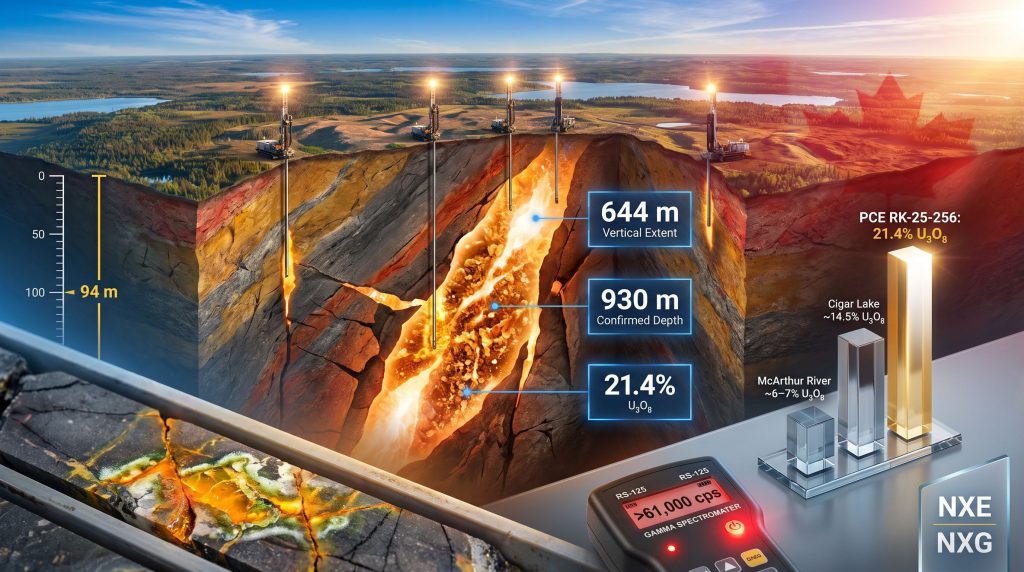
At mines like McArthur River, grades average approximately 6 to 7% U₃O₈. At Cigar Lake, the figure approaches 14.5% U₃O₈. The global average mine grade sits below 0.1% U₃O₈. This comparison alone explains why the Basin commands so much attention from exploration capital, and why the NexGen Patterson Corridor East uranium discovery is generating significant interest across the global uranium investment community. Furthermore, those tracking uranium market volatility will recognise why high-grade Basin assets attract disproportionate capital flows during periods of price uncertainty.
When big ASX news breaks, our subscribers know first
What Is Patterson Corridor East and How Does It Relate to Arrow?
Located within NexGen Energy's Rook I Project area in Saskatchewan's Athabasca Basin, the Patterson Corridor East discovery sits approximately 3.5 kilometres east of the flagship Arrow deposit. Understanding the distinction between the two is important for investors assessing NexGen's total resource potential.
Arrow is a defined, NI 43-101 compliant resource with a completed Feasibility Study. It is positioned to become one of the largest, lowest-cost uranium mines globally upon production, with a resource-average grade of approximately 3.1% U₃O₈. PCE, by contrast, is a separate and independent mineralised system discovered in early 2024 that shares Arrow's geological heritage but has not yet undergone a formal mineral resource estimate.
The geological connection between the two systems lies in their shared basement-hosted vein-type architecture, the same unconformity-associated structural setting, and overlapping hydrothermal alteration signatures. Proximity to Arrow lends PCE geological credibility, but these are distinct mineral systems with independent resource potential. PCE is not an extension of Arrow; it is a separate discovery that happens to sit within the same land package.
From Discovery to High-Grade Confirmation: PCE's Geological Timeline
Drilling at PCE commenced in March 2024, and early drill core quickly revealed vein-hosted uranium mineralisation hosted in basement rock with structural similarities to Arrow. The pace of delineation has been rapid by industry standards, with systematic step-out and infill drilling progressively expanding the known mineralised footprint.
The most significant confirmed assay results from the discovery and delineation phase include:
| Drill Hole | Interval | Grade | Significance |
|---|---|---|---|
| RK-25-232 | 15.0 m | 15.9% U₃O₈ (incl. 0.5 m at 68.8% U₃O₈) | Strongest discovery-phase assay result |
| RK-25-256 | 5.5 m | 21.4% U₃O₈ (incl. 0.5 m at 74.8% U₃O₈) | Ultra-high-grade core confirmed December 2025 |
| RK-24-222 | 17.0 m | 3.85% U₃O₈ | Early benchmark establishing high-grade subdomain reference |
For context, uranium grades exceeding 20% U₃O₈ are extraordinarily rare at any stage of the exploration or production cycle globally. PCE's confirmed assay intervals sit alongside Cigar Lake as among the highest-grade uranium intersections recorded anywhere in recorded mining history.
Decoding the 2026 Summer Drill Program: Scale, Progress, and Key Metrics
The 2026 summer drilling campaign at PCE recommenced on May 28, 2026, with a total planned meterage of 42,000 metres. As of the latest results release, 20,138.7 metres have been completed, representing approximately 48% of the planned program. Eleven holes drilled across the summer campaign total 7,425.2 metres, and a fifth drill rig has now been added to accelerate delineation across multiple vectors simultaneously.
The addition of a fifth rig is operationally significant. In uranium exploration, deploying more rigs simultaneously allows teams to test depth extensions, lateral strike expansions, and internal continuity within a single campaign window. Sequential drilling, by contrast, introduces delays that can push material discoveries back by years. The five-rig configuration reflects management's assessment that PCE's scale justifies an aggressive, parallel drilling approach.
The headline metric from the 2026 campaign so far is the expansion of the high-grade subdomain's vertical extent to 644 metres, following a 94-metre downward extension confirmed by hole RK-26-293. This represents a 17% increase in vertical depth within a single campaign update. High-grade uranium mineralisation has now been confirmed at depths reaching 930 metres below surface.
One detail that is not widely appreciated by general investors: PCE's high-grade subdomain sits approximately 70 metres shallower than the Arrow A2 High-Grade Zone. In underground mining economics, shallower ore is typically cheaper to access. All else being equal, this depth advantage could translate into meaningfully lower development costs if PCE progresses toward a future resource estimate and prefeasibility scenario.
Breaking Down the 2026 Campaign's Most Significant Drill Holes
RK-26-293: Opening the Deep Frontier
Designed specifically to test whether high-grade mineralisation continued below the previously known vertical limits of PCE, hole RK-26-293 returned cumulative 4.7 metres of greater than 10,000 cps, including 0.1 metres of off-scale readings exceeding 61,000 cps at a downhole depth of 930 metres. The hole was accompanied by strong and broad hydrothermal alteration, which geologists interpret as evidence that the mineralising system remains active below the current confirmed extent.
This is a critical geological signal. Broad alteration halos surrounding high-grade intersections typically indicate that the hydrothermal plumbing system responsible for uranium deposition was large and long-lived. Systems with extensive alteration aureoles have historically shown a greater propensity for additional mineralised shoots both laterally and at depth.
RK-26-290c1: The Best Hole Drilled at PCE Since Discovery
This hole was designed as a down-plunge test but simultaneously served to cross-cut the full width of the known mineralised footprint, providing critical geometry and continuity data. The results were exceptional. The hole intersected multiple stacked uranium veins across a 40-metre interval of the high-grade subdomain, returning:
- Cumulative 19.5 metres of greater than 10,000 cps
- 12.9 metres of greater than 10,000 cps surrounding
- 5.2 metres of off-scale readings exceeding 61,000 cps
This makes RK-26-290c1 the single best hole drilled at PCE based on cumulative off-scale readings since discovery commenced. Critically, the hole confirmed repeating, mineralisation-controlling structural disruptions across the cross-section of the system. These repeating structures, likely fault or fold-related ore controls, are what geologists look for when building confidence that high-grade mineralisation is not isolated but rather systematic and predictable within a structural framework.
RK-26-294: Confirming Internal Continuity
Located 27 metres along strike from the early benchmark hole RK-24-222 (which returned 17.0 metres at 3.85% U₃O₈), hole RK-26-294 returned cumulative 6.9 metres of greater than 10,000 cps, including 3.1 metres of off-scale greater than 61,000 cps. It ranks as the third-best hole at PCE based on cumulative off-scale readings.
Together with RK-26-290c1, this hole demonstrates that intense high-grade mineralisation is not limited to individual pierce points but is spatially connected across the structural domain. Continuity of this kind is a prerequisite for any future mineral resource estimation, making this result a material step in the maturation of PCE as a defined resource.
RK-26-296: Up-Dip Expansion at Shallower Depths
Targeting the shallowest portion of the PCE system, hole RK-26-296 returned cumulative 3.5 metres of greater than 10,000 cps, including 0.4 metres of off-scale greater than 61,000 cps, and expanded the up-dip high-grade subdomain by 50 metres along strike. This demonstrates that the system remains open for growth not only at depth but also laterally at shallower elevations, an important consideration for future development scenario planning.
PCE's Current Footprint: A Structural and Spatial Summary
| Parameter | Current Measurement |
|---|---|
| Strike Extent (current focus area) | ~210 m |
| Total Mineralised Footprint (strike) | ~620 m |
| Total Mineralised Footprint (vertical) | ~700 m |
| High-Grade Subdomain Vertical Extent | 644 m |
| Maximum Confirmed Depth | 930 m |
| Depth vs. Arrow A2 HG Zone | ~70 m shallower |
| 2026 Program Planned Meterage | 42,000 m |
| Completed as of Latest Release | 20,138.7 m (~48%) |
Crucially, mineralisation remains open below the entire high-grade subdomain, a direction that NexGen's exploration team identifies as offering the most significant potential for resource growth. A parallel trend within PCE has also been identified and is scheduled for testing in the remainder of the 2026 program. If this parallel trend yields significant mineralisation, it could expand PCE's footprint in a direction entirely separate from the current high-grade subdomain.
NexGen's Vice President of Exploration, Jason Craven, noted that growth of the high-grade subdomain continues to outpace expectations, with mineralisation remaining open across most tested directions. He identified the confirmation of clear connectivity between intense high-grade intersections as a material advancement in understanding the true scale of this discovery.
The next major ASX story will hit our subscribers first
How PCE's Grades Compare to Global Uranium Benchmarks
| Deposit / Mine | Country | Approximate Grade |
|---|---|---|
| McArthur River | Canada (Saskatchewan) | ~6-7% U₃O₈ |
| Cigar Lake | Canada (Saskatchewan) | ~14.5% U₃O₈ |
| Arrow (Rook I) | Canada (Saskatchewan) | ~3.1% U₃O₈ (resource average) |
| PCE — RK-25-232 | Canada (Saskatchewan) | 15.9% U₃O₈ over 15.0 m |
| PCE — RK-25-256 | Canada (Saskatchewan) | 21.4% U₃O₈ over 5.5 m |
| Global Average Mine Grade | Worldwide | Below 0.1% U₃O₈ |
Technical note for investors: Counts per second (cps) readings, generated by a handheld Radiation Solutions RS-125 gamma spectrometer during drilling, are a real-time proxy for radioactivity in drill core. They are a preliminary indicator only and are not directly equivalent to formal U₃O₈ grade assays. Off-scale readings exceeding 61,000 cps indicate extremely high radioactive intensity, typically associated with very high uranium concentrations, but confirmed grades require independent laboratory assay from an accredited facility such as the Saskatchewan Research Council (SRC) Geoanalytical Laboratory. All 2026 PCE drill samples are being submitted continuously to SRC as drilling progresses.
Exploration Methodology: How NexGen Is Advancing PCE Systematically
The technical approach driving PCE's rapid delineation is worth understanding in detail, as it differs from how many exploration companies manage early-stage discoveries. Investors who are already familiar with interpreting drill results will appreciate the rigour embedded in NexGen's approach.
The five-rig program is structured around three simultaneous objectives:
- Depth extension – Testing downward continuation of known high-grade mineralisation
- Lateral strike expansion – Probing both up-dip and along-strike limits of the mineralised system
- Internal continuity confirmation – Placing infill holes to verify grade distribution and spatial connectivity within the high-grade subdomain
Down-plunge test holes such as RK-26-290c1 serve a dual function. They probe depth while simultaneously cross-cutting the known mineralised footprint at oblique angles, generating cross-sectional geometry data that would otherwise require multiple dedicated holes. This is an efficient approach to extracting maximum geological information per metre drilled.
Hydrothermal alteration mapping has become increasingly important as the program matures. The strong, broad alteration halos documented around high-grade intersections are being used to refine the overall mineralisation model and identify vectors toward potentially undiscovered mineralised shoots. In the Athabasca Basin geological context, alteration intensity and spatial distribution are among the most reliable indicators of proximity to high-grade uranium.
It is also worth noting that all reported widths are downhole intervals. Understanding the distinction between true width vs apparent width is essential when evaluating any drill programme at this stage of discovery. All technical disclosure is reviewed and approved by Jason Craven (P.Geo.), NexGen's VP Exploration, serving as a Qualified Person under National Instrument 43-101, Canada's standard for scientific and technical disclosure in the mining sector.
PCE Within NexGen's Broader Strategic Context
Running a major construction program and an active discovery delineation campaign simultaneously is operationally demanding. NexGen is progressing Rook I toward production while simultaneously advancing PCE through its 2026 drilling campaign, a dual-track strategy that requires both operational capacity and financial discipline.
Rook I, anchored by the Arrow deposit and supported by a completed NI 43-101 Feasibility Study, is positioned as one of the largest and lowest-cost uranium projects globally. NexGen's asset portfolio demonstrates how PCE functions as an incremental growth asset within the same land package, with the potential to materially expand NexGen's total uranium resource base if the current discovery trajectory continues.
CEO Leigh Curyer has described the addition of the fifth drill rig at PCE as a direct response to the quality of results being generated, framing the simultaneous advancement of Rook I construction and PCE exploration as part of NexGen's broader mission to expand its profile as a global uranium fuel supplier.
NexGen is listed on the TSX, NYSE, and ASX under ticker symbols NXE, NXE, and NXG respectively, providing access to Canadian, American, and Australian institutional and retail investors across three major capital markets. Consequently, those considering uranium investment strategies may find NexGen's multi-exchange listing a practical entry point for portfolio exposure.
Key Risks and Investor Considerations
The NexGen Patterson Corridor East uranium discovery represents one of the most compelling exploration-stage uranium stories globally, but investors should be clear-eyed about the risks involved at this stage of development.
- Preliminary data only: All cps readings from gamma spectrometry are preliminary indicators. Confirmed U₃O₈ grades from independent laboratory assay are required for any resource estimation, and the full 2026 drill program assay results are still pending
- True thickness is unknown: All reported widths are downhole intervals. True thicknesses cannot be determined until geological modelling and resource estimation are completed, which requires significantly more data than currently exists
- No formal resource estimate: PCE has not undergone a formal NI 43-101 compliant mineral resource estimate. It remains an exploration-stage discovery without a defined resource
- Uranium price sensitivity: Any future development economics at PCE will be materially affected by long-term uranium spot and contract prices, which are subject to significant volatility
- Regulatory and permitting requirements: Development in the Athabasca Basin requires engagement with provincial and federal regulators, alongside formal First Nations consultation processes that can be lengthy and complex
- NI 43-101 vs. SEC standards: Canadian mineral reporting standards differ from US SEC requirements. Investors operating under US regulatory frameworks should be aware of these differences when interpreting technical disclosures
This article is for informational purposes only and does not constitute financial or investment advice. Exploration-stage mineral projects carry significant risk, and past drill results do not guarantee future resource definition or economic viability. Readers should conduct their own due diligence and consult a qualified financial adviser before making investment decisions.
FAQ: NexGen Patterson Corridor East Uranium Discovery
What is Patterson Corridor East (PCE)?
PCE is a high-grade uranium discovery located approximately 3.5 kilometres east of NexGen Energy's Arrow deposit within the Rook I Project area in Saskatchewan's Athabasca Basin. First identified through drilling in March 2024, it has rapidly emerged as one of the highest-grade uranium intersections recorded globally during an active discovery phase.
How large is the PCE mineralised system?
Based on results available as of the 2026 summer program update, the total mineralised footprint spans approximately 620 metres along strike and 700 metres vertically. The high-grade subdomain within this system now extends 644 metres vertically, with confirmed mineralisation reaching 930 metres depth.
What do cps readings mean in uranium drilling?
Counts per second (cps) are measurements from a handheld gamma spectrometer indicating the radioactivity intensity of drill core. Readings above 10,000 cps are classified as high-grade and readings above 61,000 cps are considered off-scale. Both are strong preliminary indicators of high uranium concentration, pending formal laboratory assay confirmation.
What are the best drill results at PCE to date?
The strongest confirmed assay results include 15.0 metres at 15.9% U₃O₈ from hole RK-25-232 and 5.5 metres at 21.4% U₃O₈ from hole RK-25-256. In spectrometer terms, hole RK-26-290c1 is the best hole drilled at PCE to date, returning 5.2 metres of off-scale readings within a 40-metre high-grade interval.
Is PCE the same as the Arrow deposit?
No. PCE and Arrow are separate mineralised systems within the same Rook I Project land package. Arrow is NexGen's flagship defined resource, currently in active construction. PCE is a distinct and newer discovery approximately 3.5 kilometres to the east, with its own independent resource potential and no formal resource estimate yet completed.
How much drilling remains in the 2026 PCE program?
As of the latest results release, approximately 20,138.7 metres have been completed of the planned 42,000-metre 2026 program, leaving roughly 21,800 metres still to be drilled. A fifth rig has been added to accelerate completion and test additional targets including a parallel trend identified within the PCE system.
Want to Track the Next Major Uranium Discovery the Moment It Hits the ASX?
Discovery Alert's proprietary Discovery IQ model delivers real-time alerts on significant ASX mineral discoveries — including high-grade uranium opportunities — transforming complex exploration data into actionable insights the moment announcements are made. Explore why historic mineral discoveries have generated extraordinary returns on Discovery Alert's dedicated discoveries page, and begin your 14-day free trial today to position yourself ahead of the broader market.