August 25, 2026
Why Niobium Grade Matters More Than Tonnage in 2026
The global critical minerals conversation has largely centred on lithium, cobalt, and rare earths over the past decade. Yet a quieter, arguably more strategically concentrated metal has been attracting serious exploration capital with considerably less fanfare. Niobium, a refractory metal with unique metallurgical properties, underpins some of the most structurally important materials in modern industrial economies, and its supply chain remains one of the most geographically concentrated of any commodity on Earth. Understanding why that concentration matters, and what it means for exploration projects attempting to challenge it, is essential context for evaluating what Encounter Resources niobium at Emily and Green actually represents.
When big ASX news breaks, our subscribers know first
Niobium's Industrial Role and Why Supply Concentration Creates Strategic Risk
Niobium's most established application is in high-strength low-alloy steel, where additions as small as 0.03% to 0.05% by weight can increase tensile strength by up to 30% while reducing overall steel mass. This makes it indispensable for automotive lightweighting, pipeline construction, and structural engineering. Beyond steel, niobium-based superalloys are critical components in jet engine turbines and gas turbines, where extreme heat resistance is non-negotiable.
More recently, niobium pentoxide has attracted interest as an anode material in lithium-ion battery architectures, with some research suggesting it can enable faster charging rates than conventional graphite anodes. Furthermore, the critical minerals demand surge across advanced economies has only sharpened focus on metals with this kind of dual-use industrial profile.
How Concentrated Is the Niobium Supply Chain?
The critical vulnerability in this supply picture is geographic. Brazil, primarily through the Araxá deposit in Minas Gerais operated by Companhia Brasileira de Metalurgia e Mineração (CBMM), accounts for approximately 90% of global niobium production. This level of concentration exceeds even the supply risk profiles of lithium or cobalt, both of which have attracted far more policy attention.
Australia, the United States, and the European Union have each identified niobium on their respective critical minerals lists, reflecting growing concern about single-source dependency for a metal embedded in strategic industrial infrastructure.
"Supply concentration in niobium is structurally different from most battery metals. Because niobium is not traded on any commodity exchange, pricing is negotiated bilaterally between producers and steelmakers, which means new entrants cannot simply sell into a spot market. Securing offtake commitments before production is a practical necessity, not a strategic preference."
This bilateral pricing dynamic is one of the lesser-understood features of the niobium market. Unlike iron ore or copper, there is no London Metal Exchange contract for niobium ferroniobium or niobium pentoxide. Prices are set through long-term supply agreements, which creates significant barriers to entry for new producers but also means that a well-positioned development project with demonstrated grade quality can command premium pricing from buyers seeking supply chain diversification.
What Defines Commercial Viability in Niobium Exploration
Before examining the specifics of the Aileron Project, it is worth establishing the technical benchmarks against which niobium drilling results are evaluated. Grade thresholds matter enormously in this commodity because processing costs are relatively fixed regardless of ore grade, making high-grade deposits disproportionately more valuable.
Industry practice generally treats grades above 1.0% Nb₂O₅ as economically meaningful for open-pit scenarios, with grades above 1.5% Nb₂O₅ considered high-grade in a global development context. The Niobec mine in Quebec, operated by Magris Resources, has been profitable at grades around 0.45% Nb₂O₅, but it benefits from an underground operation with decades of infrastructure investment and proximity to established logistics networks.
What Else Drives Project Economics Beyond Grade?
Three additional factors beyond grade drive project economics:
- Mineralisation continuity: Thick, laterally consistent ore bodies require fewer development metres per tonne of ore and simplify mine planning.
- Proximity to surface: Shallow mineralisation enables open-pit extraction, which is significantly cheaper per tonne than underground methods. Strip ratio, the ratio of waste to ore, directly determines open-pit economics.
- Geological host type: Carbonatite-hosted niobium, the geological setting present at Aileron, is globally preferred for large-scale production because carbonatites typically host mineralisation in geometrically coherent, weathered-to-surface bodies that respond well to conventional flotation and hydrometallurgical processing.
It is also worth noting that niobium mineralogy within carbonatites is typically dominated by pyrochlore, a niobium oxide mineral that generally achieves reasonable metallurgical recovery through standard processing routes. This distinguishes carbonatite-hosted niobium from some other geological settings where complex mineralogy significantly elevates processing costs and technical risk. Understanding cut-off grade economics is, consequently, essential when evaluating how much of a carbonatite system is genuinely exploitable.
The Aileron Project: Geological Setting and System Architecture
The Aileron Project sits within the West Arunta region of Western Australia, a geological province that has emerged as a significant focus for critical minerals exploration. The West Arunta is characterised by Proterozoic basement geology with a history of carbonatite and alkaline intrusive activity, making it prospective for the same geological processes that host the world's largest niobium deposits.
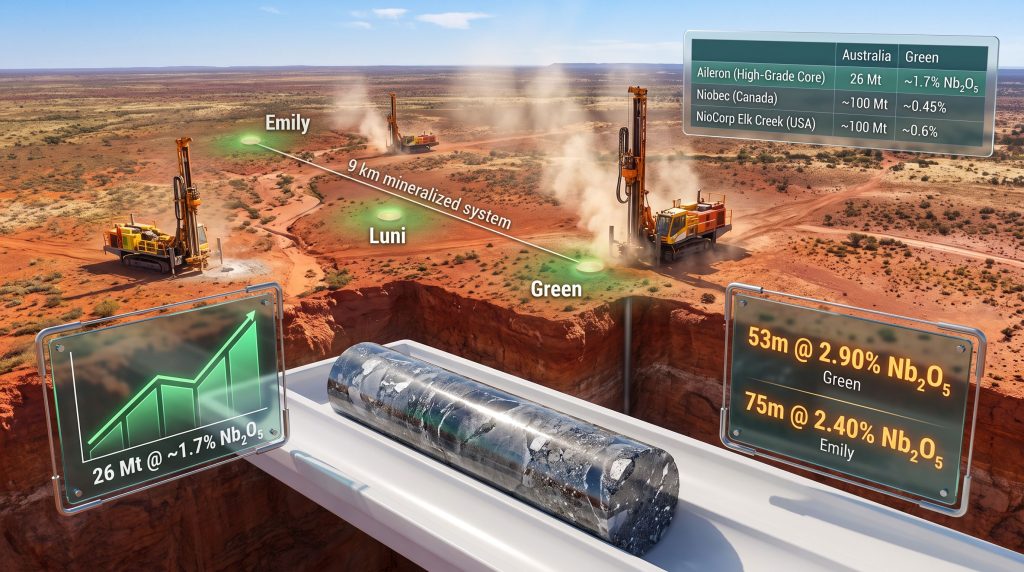
The Aileron mineralised corridor spans approximately 9 kilometres, encompassing three principal deposits: Emily, Luni, and Green. Each sits within a carbonatite-related geological system, and all three contribute to what is now a substantial combined resource inventory.
| Deposit | Resource Classification | Tonnage | Grade (Nb₂O₅) | Development Status |
|---|---|---|---|---|
| Emily | Inferred | 3.5 Mt (high-grade core) within 14 Mt | 1.9% within 0.93% | Active drilling; diamond drilling commenced |
| Green | Inferred | 12.1 Mt | 1.63% | Infill drilling; starter-pit areas identified |
| Aileron Total (High-Grade Core) | Inferred | ~26 Mt | ~1.7% | Resource definition ongoing |
| Aileron Total (Broad Envelope) | Inferred | 120 Mt | 0.77% | Above 0.25% Nb₂O₅ cut-off |
The distinction between the high-grade core and the broader resource envelope is architecturally important. In practice, a deposit developer would sequence mining to exploit the high-grade core first, generating early cash flows and building operational infrastructure before expanding into lower-grade material. The fact that Aileron hosts 26 Mt at approximately 1.7% Nb₂O₅ within a much larger 120 Mt system provides both a high-value starter scenario and long-term optionality.
Dissecting the Drilling Results: Emily and Green Intercepts in Context
Emily Deposit: Near-Surface Grades and the Significance of Open-Depth Aircore Results
Recent aircore drilling at Emily has returned a series of intercepts that reinforce both the grade quality and the unresolved depth potential of the deposit. Properly interpreting drill results from this programme is critical to understanding the full significance of the findings. Key results include:
- 13m at 3.20% Nb₂O₅, representing grade approximately 68% above the Emily high-grade core average
- 15m at 2.40% Nb₂O₅, demonstrating near-surface high-grade continuity
- 27m at 1.0% Nb₂O₅, contributing to the broader mineralised envelope that supports bulk tonnage scenarios
The pattern across multiple Emily aircore holes is technically telling. When shallow drilling programmes consistently terminate within mineralisation rather than passing through it into unmineralised rock below, it signals that the ore system extends beyond the drill depth. Aircore drilling is generally limited to depths of 100 to 150 metres depending on ground conditions, so repeated open-depth results create a strong technical rationale for diamond drilling to quantify exactly how far the system continues downward.
It is also worth understanding true vs apparent widths when evaluating these intercepts, as the reported widths from aircore programmes may differ from true mineralisation thickness depending on drill angle relative to the ore body geometry.
"When aircore holes end in mineralisation across multiple drill fences, the geological interpretation shifts from a shallow, bounded ore body to a potentially open-ended system. This fundamentally changes the resource expansion narrative and justifies the transition to more expensive but deeper diamond drilling methods."
Diamond drilling has now commenced at Emily specifically to test this depth extent. The results from this programme will be among the most important technical data points for the next mineral resource estimate update, as they will determine whether Emily's high-grade inventory can be materially expanded beyond its current dimensions.
Green Deposit: Exceptional Intercepts and the Starter-Pit Case
While Emily's depth extension story is compelling, it is the Green deposit that has delivered the most immediately striking drilling results. According to Encounter Resources' recent announcement, recent infill drilling at Green has returned:
- 53m at 2.90% Nb₂O₅: among the highest-grade intercepts recorded across the entire Aileron system to date
- 75m at 2.40% Nb₂O₅: thick, continuous mineralisation from shallow depth
Both intercepts ended in mineralisation, meaning depth potential at Green also remains open. However, the more immediate significance of these results lies in their grade relative to the resource average and their geometry relative to surface.
The Green deposit hosts 12.1 Mt at 1.63% Nb₂O₅ as the current resource estimate. Intercepts running at 2.40% to 2.90% Nb₂O₅ over 53 to 75 metre widths are materially above that average, suggesting that selective mining of the highest-grade portions could generate significantly better economics than the whole-of-deposit average implies. This is the essence of what mining engineers describe as a starter-pit opportunity.
A starter pit is a near-surface, high-grade, geometrically favourable portion of a deposit that can be brought into production at relatively low capital cost. Its strategic importance is considerable: it allows a company to generate early cash flow from the richest ore while larger project infrastructure is developed, reducing the financing quantum required to reach first production and lowering the risk profile for potential debt or equity partners.
How Aileron Compares Against Global Niobium Development Projects
| Project / Operation | Country | Total Resource | Grade (Nb₂O₅) | Stage |
|---|---|---|---|---|
| Aileron (high-grade core) | Australia | ~26 Mt | ~1.7% | Exploration / Resource Definition |
| Aileron (broad envelope) | Australia | 120 Mt | 0.77% | Exploration |
| NioCorp Elk Creek | USA | ~100 Mt | ~0.6% | Feasibility |
| Niobec (Magris Resources) | Canada | ~100 Mt | ~0.45% | Production |
| CBMM Araxá | Brazil | Multi-billion tonnes | ~2.5% | Production (dominant global supplier) |
Aileron's high-grade core compares favourably against development-stage projects outside Brazil. NioCorp's Elk Creek project in Nebraska, which has progressed to feasibility study stage, carries a grade profile roughly one-third of Aileron's high-grade inventory. Niobec in Canada, the only significant niobium producer outside Brazil, operates profitably at grades below 0.5% Nb₂O₅ using underground methods, which underscores the economic potential of a near-surface deposit running at multiples of that grade.
The comparison with CBMM's Araxá operation is instructive in terms of what the global benchmark looks like: a multi-billion tonne carbonatite system at approximately 2.5% Nb₂O₅ that has supplied the majority of global niobium for decades. Aileron cannot match that scale at current resource definition, but its grade profile and carbonatite geology place it in the same geological family as the world's premier niobium production district.
The next major ASX story will hit our subscribers first
Three Rigs Running: What Operational Scale Signals About Project Maturity
Running three drill rigs simultaneously is a meaningful capital allocation signal for an ASX-listed explorer with a market capitalisation in the range of approximately $125.9 million. It indicates a management team with sufficient conviction in the geological system to commit sustained drilling expenditure across multiple deposit targets simultaneously, rather than sequencing rigs through individual targets conservatively.
The programme architecture reflects a dual-track strategy. Infill drilling at Green is building resource confidence, progressively converting the geological picture from broadly defined mineralisation to drill-hole density sufficient for JORC Indicated classification. Simultaneously, depth extension drilling at Emily is pursuing resource expansion, attempting to grow the high-grade inventory ahead of the next mineral resource estimate update.
The JORC classification pathway matters considerably for project financing. Resources classified as Inferred cannot be included in bankable feasibility studies or used to support debt financing from major lenders. Upgrading Inferred resources to Indicated status, which requires closer drill spacing and greater geological confidence, is therefore not merely a technical milestone but a prerequisite for accessing the institutional financing that a project of Aileron's scale will ultimately require. In addition, a definitive feasibility study cannot be progressed until sufficient resources carry the requisite classification confidence.
Management has indicated that a strong pipeline of results is expected to continue through 2026 and into 2027 as the programme advances. This positions the next mineral resource estimate update as a potential re-rating event for the project, particularly if diamond drilling at Emily returns results that materially expand the high-grade inventory at depth.
Key Risk Factors Investors Should Understand
No analysis of an exploration-stage project is complete without a clear-eyed assessment of the risks that could affect the development trajectory. For Aileron, these fall into several distinct categories.
Technical and Geological Risks:
- Diamond drilling at Emily may reveal grade or width deterioration below the aircore depth limit, constraining rather than expanding the high-grade resource
- Metallurgical test work has not yet been publicly reported as complete; niobium recovery rates from carbonatite systems can vary considerably depending on mineralogy and weathering profile
- Not all Inferred resources convert to Indicated classification at equivalent grade when drill spacing tightens, creating resource downgrade risk during confidence upgrades
- Systematic testing of the full 9 kilometre mineralised corridor is required before the system-wide grade picture can be considered reliably defined
Project Development and Market Risks:
- The West Arunta region is geographically remote, and infrastructure requirements for a project of Aileron's scale will represent a material component of development capital
- Niobium's bilateral pricing structure means that revenue assumptions in any feasibility study depend entirely on the ability to negotiate offtake agreements, which in turn depend on the quality and confidence of the resource estimate
- The junior mining financing environment remains challenging, particularly for projects that have not yet reached the scoping study phase
This article is for informational purposes only and does not constitute financial advice. Readers should conduct independent due diligence and consult a licensed financial adviser before making any investment decisions. Exploration-stage projects carry significant technical and commercial risks, and past drilling results do not guarantee future outcomes or commercial development.
Frequently Asked Questions: Encounter Resources Niobium at Emily and Green
What is the current resource estimate for the Emily deposit?
Emily hosts an Inferred resource of approximately 3.5 Mt at 1.9% Nb₂O₅ within a broader envelope of 14 Mt at 0.93% Nb₂O₅, above a 0.25% Nb₂O₅ cut-off.
Why are the Green deposit intercepts considered exceptional?
Intercepts of 53m at 2.90% Nb₂O₅ and 75m at 2.40% Nb₂O₅ are materially above Green's average resource grade of 1.63% Nb₂O₅, and their shallow, thick geometry aligns with criteria for low-cost open-pit starter mining scenarios.
What is diamond drilling testing at Emily that aircore cannot?
Aircore drilling is depth-limited to roughly 100 to 150 metres. Because multiple Emily aircore holes ended within mineralisation rather than exiting it, diamond drilling is needed to determine how far the high-grade ore system continues below that depth threshold.
How large is the total Aileron niobium system?
The Emily, Luni, and Green deposits span a mineralised corridor of approximately 9 kilometres. Total Aileron resources stand at 120 Mt at 0.77% Nb₂O₅ above a 0.25% cut-off, with a high-grade core of approximately 26 Mt at around 1.7% Nb₂O₅.
Why does niobium not trade on a commodity exchange?
Unlike most base and battery metals, niobium is priced through bilateral supply agreements between producers and industrial consumers, primarily steelmakers. This structure reflects the highly concentrated supply base and the long-term nature of procurement relationships in the steel industry.
Near-Term Catalysts and the Development Path Ahead
The sequencing of upcoming milestones will be critical in determining how the market assesses Aileron's development trajectory over the next 12 to 18 months. Furthermore, several key catalysts deserve close attention:
- Diamond drilling results from Emily depth extensions: These will either confirm or constrain the resource expansion thesis at Emily and directly inform the next MRE update.
- Continued infill assay results from Green: Further definition of starter-pit geometry and grade continuity will sharpen the economic case for prioritising Green in the development sequence.
- Next mineral resource estimate update: An upgrade in resource scale or classification from Inferred to Indicated would represent a meaningful de-risking event and could attract broader institutional attention.
- Metallurgical test work results: Establishing processing viability and niobium recovery rates is a prerequisite for any credible scoping study.
- Broader corridor exploration: Systematic testing of the full 9 kilometre Emily-Luni-Green system could reveal additional mineralised zones that further expand the resource base.
The strategic development question of whether to prioritise Green's starter-pit potential or pursue Emily's depth extension first — or run both in parallel as the three-rig programme currently suggests — will likely be answered by the relative grade and geometry outcomes from the next round of drill results. Either pathway represents a logical progression from resource definition toward the scoping study threshold that would mark Aileron's transition into genuine development territory.
For those tracking Encounter Resources niobium at Emily and Green, the analytical focus should remain on three numbers above all others: the grade outcome from Emily diamond drilling, the resource classification upgrade percentage in the next MRE, and the strip ratio implied by Green's emerging starter-pit geometry. As Encounter Resources continues to expand the Emily high-grade zone, these three data points will ultimately determine whether Aileron competes seriously on the global niobium development stage.
Want to Be First When the Next Major Critical Minerals Discovery Hits the ASX?
Discovery Alert's proprietary Discovery IQ model scans ASX announcements in real time, instantly identifying significant mineral discoveries across niobium, rare earths, and over 30 other commodities — turning complex exploration data into actionable investment insights before the broader market catches on. Explore historic discoveries and their remarkable returns, then start your 14-day free trial to position yourself ahead of the next major find.