June 24, 2026
The Geology Behind Botswana's Most Underrated Critical Metals Corridor
Few geological settings on Earth concentrate copper, nickel, and platinum group elements within a single magmatic sulphide system the way southern Africa's ancient cratons do. While the world's attention has gravitated toward lithium brine operations in South America and laterite nickel deposits in Indonesia, a quieter but equally compelling story has been building across Botswana's interior. The Kalahari Copper Belt and its associated magmatic sulphide systems represent a fundamentally different class of polymetallic deposit, one where the ore deposit formation, processing chemistry, and commodity mix align with the full spectrum of critical minerals demand.
Within this context, the NexMetals Selkirk Project Botswana stands out as one of the more technically nuanced redevelopment stories in the region, combining a past-producing open-pit pedigree with a commodity profile that spans battery metals, electrification infrastructure, and hydrogen economy catalysts.
When big ASX news breaks, our subscribers know first
Botswana as a Mining Jurisdiction: Structural Advantages That Matter
Understanding why Botswana attracts junior and mid-tier developers requires looking beyond commodity prices to the underlying governance framework. Botswana consistently ranks among Africa's top mining jurisdictions for regulatory transparency, investor protection, and political stability. Its Mines and Minerals Act provides a structured licensing framework, and the country's track record with large-scale mining operations such as Jwaneng and Orapa gives institutional confidence that is genuinely difficult to manufacture.
For magmatic nickel deposits specifically, Botswana's geological setting offers something particularly valuable: the preservation of Proterozoic-age intrusive complexes that host copper-nickel-PGE mineralisation in geometries that are broadly amenable to open-pit extraction. These are fundamentally different from the laterite-hosted nickel deposits that dominate southeast Asian supply chains. Magmatic sulphide deposits typically yield higher-grade nickel with superior metallurgical response characteristics, making them more attractive as feedstock for battery-grade nickel sulphate production.
Selkirk Within NexMetals' Two-Asset Development Framework
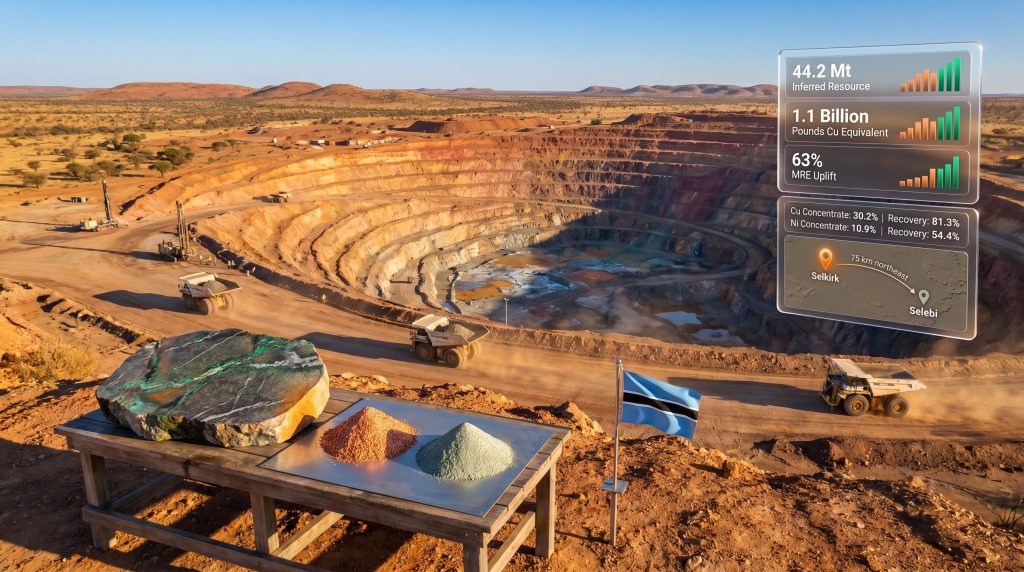
The NexMetals Selkirk Project Botswana sits 75 kilometres northeast of the company's primary Selebi Project, which is itself a former BCL underground mine targeting higher-grade copper and nickel mineralisation. The two assets are operationally and geologically distinct, but they function as complementary development priorities rather than competing capital allocation decisions.
A critical structural milestone was achieved when NexMetals secured unencumbered title to the Selkirk asset following a US$25 million milestone payment to the BCL Liquidator under the terms of the Asset Purchase Agreement. This title clarity is more significant than it might initially appear. In junior mining, encumbered or disputed title represents one of the most persistent sources of financing friction. The removal of that uncertainty at Selkirk provides a clean legal foundation for future project-level financing, joint venture negotiations, or divestiture.
Past-producing status delivers a set of technical advantages that greenfield explorers simply cannot replicate: existing drill data archives, established haulage corridors, historical metallurgical test records, and known mineralisation geometry. These inherited advantages compress the early-stage development timeline considerably.
Dissecting the Updated Mineral Resource Estimate
The revised Mineral Resource Estimate for the NexMetals Selkirk Project Botswana, prepared by The MSA Group, represents a substantive recalibration of the asset's economic standing. The headline figures are summarised below:
| Metric | Selkirk Data |
|---|---|
| Total Mineralized Envelope | Over 200 million tonnes |
| Inferred Resource Estimate | 44.2 million tonnes |
| Nickel Grade | 0.24% Ni |
| Copper Grade | 0.30% Cu |
| Palladium Grade | 0.55 g/t Pd |
| Platinum Grade | 0.12 g/t Pt |
| Indicated Cu Equivalent | Over 1.1 billion pounds |
| MRE Uplift vs. Prior Estimate | 63% increase in contained copper equivalent |
Several methodological changes drove this 63% uplift in contained copper equivalent metal. The MSA Group expanded the assay coverage to explicitly account for previously underreported by-product metals including cobalt, silver, and gold. Critically, revised mine planning parameters incorporating a reduced strip ratio improved the economic geometry of the resource envelope, meaning more mineralised material now sits within viable mining boundaries. This is a technically important distinction: a resource upgrade driven by improved mining economics rather than just additional drilling carries meaningful implications for project feasibility.
Understanding the Grade-Tonnage Trade-Off at Selkirk
Selkirk operates within a bulk tonnage, lower-grade open-pit framework. At 0.24% nickel and 0.30% copper, the deposit sits below the grade thresholds of high-value underground operations. However, this framing misses the economic logic of large-scale sulphide systems. When palladium at 0.55 g/t is factored alongside cobalt, gold, and silver credits, the multi-payable commodity basket transforms the project's net smelter return calculation substantially.
Analogous bulk sulphide open-pit operations in southern Africa have demonstrated that grade-tonnage trade-offs can be economically sound when processing costs are contained, strip ratios are favourable, and concentrate chemistry supports high payability. Selkirk's revised strip ratio improvement directly addresses the cost side of this equation.
The Metallurgical Breakthrough That Repositions Selkirk
Perhaps the most commercially significant development at the NexMetals Selkirk Project Botswana is not the resource upgrade itself, but the metallurgical test work underpinning it. Historically, Selkirk was assessed under a single bulk concentrate model, a processing approach that consolidates copper and nickel into one product stream. The commercial disadvantage of this approach is well understood in the industry: bulk concentrates attract lower smelter payability terms and limit the range of eligible offtake counterparties, since many smelters are configured specifically for either copper or nickel feed.
Locked-cycle metallurgical test results have now confirmed the production of two distinct, market-ready concentrate products:
- Copper Concentrate: achieving a grade of 30.2% Cu with a recovery rate of 81.3%
- Nickel Concentrate: achieving a grade of 10.9% Ni with a recovery rate of 54.4%
These are commercially meaningful specifications. A copper concentrate grading above 30% copper sits comfortably within the acceptable range for major smelting facilities globally. The nickel concentrate grade of 10.9% is similarly viable for nickel processing pathways relevant to battery materials. Furthermore, these improved metallurgical results represent a genuine commercial repositioning for the project.
By-Product Credits: The Hidden Economic Layer
The confirmation of payable credits across palladium, platinum, gold, silver, and cobalt fundamentally restructures the project's revenue model. Each of these metals occupies a distinct demand environment:
- Palladium retains critical roles in catalytic converter applications and is increasingly relevant to hydrogen fuel cell technologies
- Platinum is a key catalyst in hydrogen electrolysis, positioning Selkirk's PGE credits within the emerging green hydrogen supply chain
- Cobalt is a recognised battery cathode material, connecting Selkirk's production profile to lithium-ion energy storage demand
- Silver and gold provide additional revenue diversity with established liquid commodity markets
The shift from a single bulk concentrate to two separate, high-specification product streams is not a processing technicality. It is a commercial repositioning that materially expands the universe of potential offtake partners and can drive meaningfully higher net smelter return values across the project's life.
Drilling the Flexure Zone: Where Resource Growth Potential Concentrates
The ongoing 30,000-metre surface drilling program at the NexMetals Selkirk Project Botswana is targeting a structural feature known as the Flexure Zone, a geological target where mineralisation geometry is expected to thicken as the controlling structure changes orientation. This is a well-established targeting concept in magmatic sulphide exploration: inflection points in the host structure frequently correspond to zones of sulphide accumulation and grade enrichment.
An early drilling intersection of 11.15 metres of massive sulphides in drill hole SMD-26-212-W1 validates the structural targeting rationale. Massive sulphide mineralisation represents the highest-grade endmember within magmatic sulphide systems, characterised by near-solid sulphide mineral content rather than the disseminated or net-textured textures typical of lower-grade zones. Assay results from this intersection remain pending.
The Resource Conversion Pathway
The distinction between the 44.2 million tonne Inferred Resource and the broader 200+ million tonne mineralised footprint represents the central exploration opportunity. Converting material from inferred to higher confidence classifications requires systematic drilling at defined spacing intervals. The logical development sequence follows these stages:
- Complete the 30,000-metre surface drilling program
- Receive, validate, and integrate pending assay results from the Flexure Zone
- Commission an updated Mineral Resource Estimate incorporating new drilling and metallurgical inputs
- Progress toward a Preliminary Economic Assessment or Pre-Feasibility Study
Each stage in this sequence not only de-risks the project technically but also increases the asset's financing attractiveness, since lenders and strategic partners require higher resource confidence classifications before committing capital. Consequently, advancing through the feasibility study process remains a key priority for the NexMetals development timeline.
The next major ASX story will hit our subscribers first
Financing Architecture: What the US EXIM Bank Letter of Interest Actually Means
NexMetals has received a non-binding Letter of Interest from the U.S. Export-Import Bank indicating potential financing of up to US$150 million with a proposed repayment tenure of 15 years. It is important for investors to understand precisely what this instrument represents and what it does not.
A Letter of Interest is an early-stage expression of conditional willingness to consider financing. It is not a loan commitment, a term sheet, or a binding financial agreement. Conversion to a formal financing facility requires completion of feasibility-stage economics, satisfaction of due diligence requirements, and formal credit approval processes. The gap between a non-binding LoI and a signed financing agreement can span years and multiple study milestones.
That said, US EXIM financing engagement is not trivial. The institution typically extends such expressions of interest where projects align with American critical minerals supply chain policy objectives. The engagement signals institutional credibility and provides a meaningful anchor for the broader financing conversation.
For context, Selebi underground development is projected to require sub-US$500 million in capital, and Selkirk's open-pit configuration may offer a lower initial capital intensity pathway. Alternative financing structures including joint ventures, strategic partnerships, and project-level debt remain on the table.
Strategic Development Scenarios for the Selkirk Asset
| Scenario | Description | Key Conditions Required |
|---|---|---|
| Standalone Development | NexMetals advances Selkirk independently through feasibility into production | Binding project finance secured; PFS confirms positive economics |
| Joint Venture Partnership | Strategic partner acquires a project-level interest | Partner brings capital, offtake expertise, or operational capability |
| Asset Sale or Divestiture | Selkirk sold outright to a larger operator | Maximises near-term capital return; reduces development burden |
Each pathway carries a different risk-return profile. The standalone route preserves full economic upside but demands the most capital and execution capability. A joint venture can bring strategic depth, particularly if the partner has established smelter relationships or regional operational experience. Divestiture optimises liquidity but sacrifices long-term value participation.
Frequently Asked Questions: NexMetals Selkirk Project Botswana
What commodities does the Selkirk Project produce?
Selkirk targets copper, nickel, cobalt, palladium, platinum, gold, and silver. The metallurgical programme has confirmed two primary market-ready concentrate products alongside multiple payable by-product credit streams.
What is the current resource size at Selkirk?
The Inferred Resource stands at 44.2 million tonnes within a broader mineralised footprint exceeding 200 million tonnes. The updated MRE reflects a 63% uplift in contained copper equivalent relative to the prior estimate.
How does Selkirk differ from the Selebi Project?
Selkirk is an open-pit, bulk tonnage operation. Selebi is a higher-grade underground asset. The two projects are geographically proximate but operationally distinct, with complementary rather than competing development timelines.
Has NexMetals secured financing for Selkirk?
A non-binding Letter of Interest from U.S. EXIM Bank for up to US$150 million has been received. Binding financing commitments remain subject to feasibility study completion and formal due diligence processes.
What are the key upcoming catalysts for the project?
Assay results from the 30,000-metre Flexure Zone drilling programme represent the nearest-term technical catalyst. Pending assay confirmation from the 11.15-metre massive sulphide intersection in SMD-26-212-W1 is closely watched by the market.
Key Takeaways: Selkirk's Technical and Strategic Position
- Resource Scale: A 200+ million tonne mineralised system anchored by a confirmed 44.2 Mt Inferred Resource and over 1.1 billion pounds Cu equivalent in Indicated classification
- Metallurgical Maturity: Locked-cycle tests validate separate copper (30.2% Cu, 81.3% recovery) and nickel (10.9% Ni, 54.4% recovery) concentrate streams, expanding offtake optionality
- Multi-Commodity Revenue: Payable credits confirmed across palladium, platinum, cobalt, gold, and silver, aligning Selkirk with battery, electrification, and hydrogen demand themes simultaneously
- Exploration Momentum: Active 30,000-metre Flexure Zone drilling programme with massive sulphide intersections pending assay confirmation
- Financing Visibility: Non-binding U.S. EXIM Bank LoI of up to US$150 million over a 15-year tenure provides an institutional financing reference point
- Title Security: Unencumbered ownership following a US$25 million BCL Liquidator payment eliminates a key legal risk factor
- Jurisdictional Strength: Botswana's transparent regulatory environment and established mining code support long-term project credibility
This article contains forward-looking statements, projections, and analysis based on publicly available information. It does not constitute financial advice. Investors should conduct their own due diligence before making any investment decisions. Non-binding financing instruments such as Letters of Interest carry no guarantee of conversion to formal commitments.
Want to Catch the Next Major ASX Mineral Discovery Before the Market Does?
Discovery Alert's proprietary Discovery IQ model delivers real-time alerts on significant ASX mineral discoveries across copper, nickel, PGEs, and beyond, instantly translating complex geological data into actionable investment insights for traders and long-term investors alike. Explore Discovery Alert's dedicated discoveries page to see how historic finds have generated substantial returns, then begin your 14-day free trial to position yourself ahead of the next major discovery.