June 24, 2026
The Race to Rewire the World Runs Through Zambia's Copperbelt
Every electric vehicle rolling off a production line, every data centre humming with AI workloads, and every kilometre of upgraded power transmission grid shares one common dependency: copper. The red metal is not merely useful in the energy transition — it is foundational to it. Yet global mining output has struggled to keep pace with a demand curve that analysts increasingly describe as structurally, not cyclically, elevated. Against this backdrop, one of Africa's most consequential copper assets is at the centre of a multi-billion-dollar capital mobilisation effort, and the Vedanta Zambia copper mines stake sale sits squarely at the heart of it.
The Vedanta Zambia copper mines stake sale is not a simple divestiture story. It is a carefully engineered financing architecture designed to simultaneously access three distinct pools of global capital, fund one of Africa's most ambitious underground mining expansions, and position a Zambian copper operation as a critical node in the Western world's supply chain strategy. Furthermore, understanding the copper supply crunch provides essential context for why this transaction is attracting such intense global attention.
When big ASX news breaks, our subscribers know first
Understanding KCM: The Asset at the Centre of the Transaction
Konkola Copper Mines, known universally in mining circles as KCM, sits within Zambia's Copperbelt — one of the planet's most geologically privileged copper-bearing regions. The Copperbelt straddles the border between Zambia and the Democratic Republic of Congo and hosts some of the highest-grade copper deposits on Earth. What distinguishes KCM from many of its regional peers is not just the grade of the ore, but the depth and continuity of the mineralisation, particularly at the Konkola orebody.
The Konkola orebody is notable for its exceptionally high copper grades relative to global averages. While most large-scale open-pit copper mines globally operate on ore grades of around 0.5% to 0.8% copper, the Konkola orebody has historically yielded grades in the range of 3% to 4% — figures that place it among the richest undeveloped deep copper resources in the world. This geological quality is a core reason why institutional capital continues to pursue KCM despite its complex ownership history.
Vedanta Resources, the UK-headquartered natural resources conglomerate controlled by Indian billionaire Anil Agarwal, holds an 80% controlling interest in KCM through its U.S.-domiciled subsidiary, CopperTech Metals Inc. Zambia's state mining vehicle, ZCCM-IH, retains the remaining 20% and is not part of any equity being offered to external investors.
How Vedanta Reclaimed KCM
The path to the current financing push was far from straightforward. Vedanta and the Zambian government were locked in a protracted legal and commercial dispute over alleged underinvestment at KCM that resulted in the Zambian government placing the mine under provisional liquidation in 2019. The resolution reached in 2023 and formalised through 2024 restored Vedanta's 80% stake, paving the way for the capital-raising strategy now underway.
That history matters for investors. Years of operational uncertainty, reduced capital expenditure, and management disruption left KCM producing well below its geological potential. The current investment case is partly a recovery story — rehabilitating infrastructure and workforce capacity — and partly a growth story anchored in the Konkola Deep underground development project. According to Vedanta's mining technology profile, the scale of rehabilitation required underscores both the challenge and the opportunity embedded in the asset.
The Three-Track Capital Architecture
What separates the Vedanta Zambia copper mines stake sale from a conventional mining transaction is its structural complexity. Rather than pursuing a single funding route, Vedanta has engineered three parallel capital tracks, each targeting a different investor category and risk profile. In addition, the copper demand drivers underpinning this strategy reflect forces that are unlikely to reverse in the near term.
Track One: The CopperTech NYSE Listing
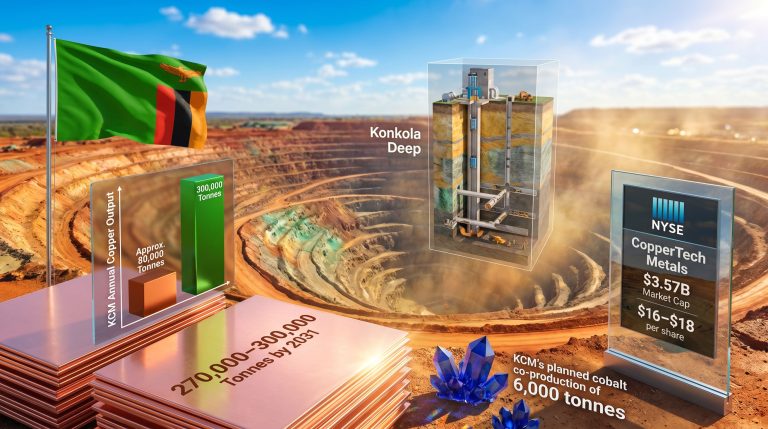
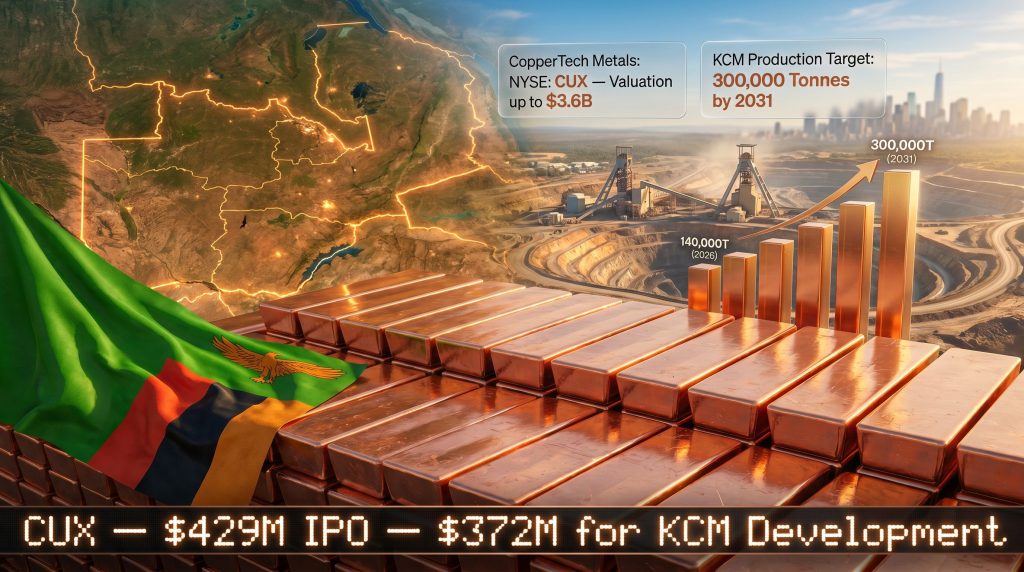
Vedanta established CopperTech Metals Inc. as a U.S.-domiciled holding entity specifically to access American institutional capital markets. CopperTech has filed to list on the New York Stock Exchange under the ticker symbol CUX, with an anticipated valuation of up to $3.6 billion at debut.
The IPO involves the sale of 11.8% of CopperTech, representing approximately 23.5 million shares, with gross proceeds potentially reaching $429 million. Of that total, $372 million is designated directly for KCM development in Zambia, primarily the completion of the Konkola Deep underground project. Financial advisors Barclays and Citigroup are managing the transaction. Bloomberg has reported on the scale of this windfall, highlighting investor interest in the listing.
The decision to domicile the holding vehicle in the United States, rather than London or a traditional offshore jurisdiction, is strategically deliberate. A U.S. corporate structure opens access to American institutional fund flows and positions CopperTech to qualify for U.S. government-aligned financing programmes — an increasingly important consideration as Washington accelerates efforts to build critical mineral supply chains outside Chinese-controlled channels. CopperTech has described its Zambian operations in its NYSE prospectus as among the few positioned to meaningfully contribute to U.S. copper demand.
Track Two: The Direct Stake Sale in KCM
Running in parallel to the IPO process, Vedanta is in active negotiations to sell more than 30% of KCM directly to strategic investors, targeting approximately $1.2 billion in proceeds.
The leading candidate is International Resources Holding (IRH), a subsidiary of UAE-based International Holding Company (IHC), one of the Gulf's largest diversified conglomerates. IRH previously tabled a proposal to acquire a 51% majority stake for over $1 billion, a bid that was not consummated. Negotiations have since been restructured around a smaller equity position, though the financial ambition of the transaction remains substantial.
Glencore plc is also identified as a potential participant. The Swiss-headquartered commodity trading and mining giant already operates extensively in the Copperbelt through its DRC assets, and a Zambian footprint via KCM would create meaningful operational and logistical synergies. Glencore's interest, if confirmed, would represent a significant institutional endorsement of KCM's production potential.
Potential Strategic Partners: Comparative Overview
| Potential Investor | Origin | Strategic Motivation | Stake Interest |
|---|---|---|---|
| International Resources Holding (IRH) | UAE | Sovereign resource diversification, energy transition portfolio | 30%+ (revised from 51%) |
| Glencore plc | Switzerland/UK | Copperbelt expansion, trading volume, operational synergy | Undisclosed |
| Other Long-Duration Global Investors | Various | Critical minerals exposure, ESG-aligned copper allocation | Undisclosed |
Track Three: U.S. Government-Aligned Financing
The U.S. corporate structure of CopperTech also opens a third financing channel: access to American development finance instruments and government-backed lending programmes designed to support critical mineral supply chain diversification. While no specific programme commitments have been publicly confirmed, the structural positioning of CopperTech within the U.S. regulatory and corporate environment reflects a deliberate attempt to qualify for such instruments as they become available.
"This three-track approach is rare in African mining finance. By spreading capital-raising risk across a public equity market, a strategic bilateral sale, and potential government-aligned lending, Vedanta is hedging both execution and valuation risk simultaneously."
Where the Capital Goes: The Konkola Deep Project
The destination for funds raised across all three tracks is consistent: the Konkola Deep underground mining development. This project is the operational centrepiece of KCM's growth ambition and arguably one of the most technically demanding copper mining undertakings currently active on the African continent.
Konkola Deep involves accessing ore at significant depth, requiring substantial shaft infrastructure, hoisting capacity, dewatering systems, and underground ventilation engineering. Historically, the Konkola orebody has required one of the world's largest mine dewatering operations — pumping millions of litres of water per hour to keep underground workings accessible. This technical complexity is part of why the asset was chronically underfunded during the dispute period.
KCM Production Trajectory and Capital Deployment
| Funding Source | Estimated Proceeds | Primary Use |
|---|---|---|
| CopperTech NYSE IPO (11.8% stake) | Up to $429M | KCM development, primarily Konkola Deep |
| Direct Stake Sale (30%+ of KCM) | ~$1.2B | Operations rehabilitation, debt, social obligations |
| U.S. Government-Aligned Financing | To be determined | Infrastructure and production scale-up |
| Total Target Capital | ~$1.5B+ | Full KCM revitalisation and expansion |
The investment roadmap targets annual copper production growth from approximately 140,000 tonnes in 2026 toward 270,000 tonnes upon Konkola Deep completion, with a longer-term ambition of 300,000 tonnes annually by 2031. Achieving this trajectory would transform KCM into one of Africa's most significant individual copper producers.
Zambia's Copper Macro: The Numbers Behind the Investment Case
The Vedanta Zambia copper mines stake sale is unfolding against a national production backdrop that strengthens the investment thesis considerably. Zambia is Africa's second-largest copper producer, and the metal remains one of the country's primary export revenue generators.
In the most recent full reporting year, Zambia achieved a record national copper output of 890,000 tonnes. Refined copper export data from the Zambia Statistics Agency confirms that cumulative refined copper export volumes for January to February 2026 reached 155,300 tonnes, compared to 140,000 tonnes for the same period in 2025 — a 10.9% year-on-year increase that signals genuine production momentum across the sector.
Why Copper Demand Is Structurally Different This Cycle
Several converging demand forces distinguish the current copper cycle from historical commodity upswings:
-
Artificial intelligence infrastructure: Modern hyperscale data centres require copper-intensive power delivery, cooling systems, and networking infrastructure. The AI buildout underway across North America, Europe, and Asia represents a new and sustained demand category that did not exist in previous copper cycles.
-
Electric vehicle adoption: Each battery electric vehicle contains roughly three to four times the copper content of a conventional internal combustion engine vehicle, across wiring harnesses, motors, charging systems, and power electronics.
-
Power grid modernisation: Transmission and distribution infrastructure across developed and developing markets is being rebuilt to handle bidirectional power flows from distributed renewable generation — a process that is fundamentally copper-intensive.
-
Industrial electrification and heat pump deployment: The decarbonisation of heating and industrial processes creates incremental copper demand across millions of installation points globally.
"Commodity analysts increasingly characterise this demand profile as structural rather than cyclical, meaning that supply gaps, once formed, are unlikely to self-correct through normal price-driven investment responses within a short timeframe."
Risk Factors Investors Cannot Ignore
Despite the compelling investment narrative, the Vedanta Zambia copper mines stake sale carries a meaningful risk profile that any serious analysis must address.
Execution and Deal Completion Risk
The previous IRH negotiation for a 51% stake did not reach completion. That precedent introduces genuine uncertainty about whether the current restructured discussions will conclude differently. The simultaneous pursuit of an IPO and a direct stake sale also creates potential conflicts around valuation sequencing, governance rights, and dilution mechanics.
Sovereign and Regulatory Risk
Zambia has publicly stated its intention to increase domestic control and economic benefit from its mining sector without resorting to coercive nationalisation. However, the government's broader ambitions to capture more mineral revenue through royalty structures, local content requirements, and export levies remain live policy considerations. The broader mining geopolitics shaping African mineral governance add another layer of complexity that investors must carefully evaluate.
Operational Rehabilitation Risk
Years of underinvestment during the ownership dispute left KCM's infrastructure, workforce capability, and community relations in a deteriorated state. The technical demands of the Konkola Deep project, combined with legacy rehabilitation obligations, create execution risk that goes beyond standard mining project development.
Geopolitical Positioning Risk
Vedanta's explicit framing of KCM as a supplier aligned with U.S. copper demand introduces geopolitical dimensions that could complicate future relationships with Chinese-affiliated buyers, trading partners, or offtake counterparties. As the contest between Western and Chinese capital for African critical mineral assets intensifies, operators who explicitly align with one bloc may encounter friction when engaging the other.
The next major ASX story will hit our subscribers first
A Financing Template With Broader Implications
The structural innovation embedded in the CopperTech NYSE listing merits attention beyond KCM itself. Routing an African copper mining asset through a U.S.-domiciled holding vehicle to access American equity markets and government-aligned financing represents a financing architecture that other African mineral producers could replicate. Furthermore, those exploring copper investment strategies will find the CopperTech model particularly instructive as a framework for accessing Western institutional capital.
Lithium producers in Zimbabwe, cobalt operators in the DRC, and manganese miners in South Africa all face the same fundamental challenge: their assets are geological world-class, but their access to deep, patient capital is constrained by jurisdiction risk, currency exposure, and the limited depth of regional capital markets. The copper funding partnerships emerging across the sector suggest this model of structured co-investment is gaining broader traction.
Zambia's pragmatic endorsement of Vedanta's $1.5 billion investment commitment reflects a government that has concluded private capital, structured appropriately, serves national economic interests better than state-led alternatives alone. How that balance evolves as production scales toward 300,000 tonnes annually will be one of the more instructive case studies in African resource governance over the next decade.
Disclaimer: This article is intended for informational purposes only and does not constitute financial or investment advice. All figures, projections, and transaction details referenced are drawn from publicly available sources and should be independently verified. Mining investments involve substantial risks including commodity price volatility, sovereign risk, and operational uncertainty. Past production or financial performance does not guarantee future results.
Want to Identify the Next Major Copper Discovery Before the Market Does?
Discovery Alert's proprietary Discovery IQ model scans ASX announcements in real time, instantly converting complex mineral data across 30+ commodities into clear, actionable investment insights — explore the historic returns major mineral discoveries have generated and begin your 14-day free trial at Discovery Alert to position yourself ahead of the next significant copper find.