
August 5, 2026
The Scale Problem That Only a Merger Can Solve
Electricity grids were not built for the age of artificial intelligence. Designed across decades to serve predictable residential and industrial loads, the infrastructure underpinning the United States power system now faces a demand profile it was never engineered to absorb. Hyperscale computing facilities, AI training clusters, and the sprawling data centre corridors of the U.S. Southeast are drawing power at a scale that is rewriting the economics of utility ownership. In this context, size is no longer just an advantage. It is a prerequisite.
That structural reality sits at the heart of the proposed NextEra Dominion merger, announced on May 18, 2026, a transaction that would forge the largest regulated electric utility on earth and fundamentally alter the competitive architecture of American energy infrastructure.
When big ASX news breaks, our subscribers know first
How Big Would the Combined NextEra-Dominion Entity Actually Be?
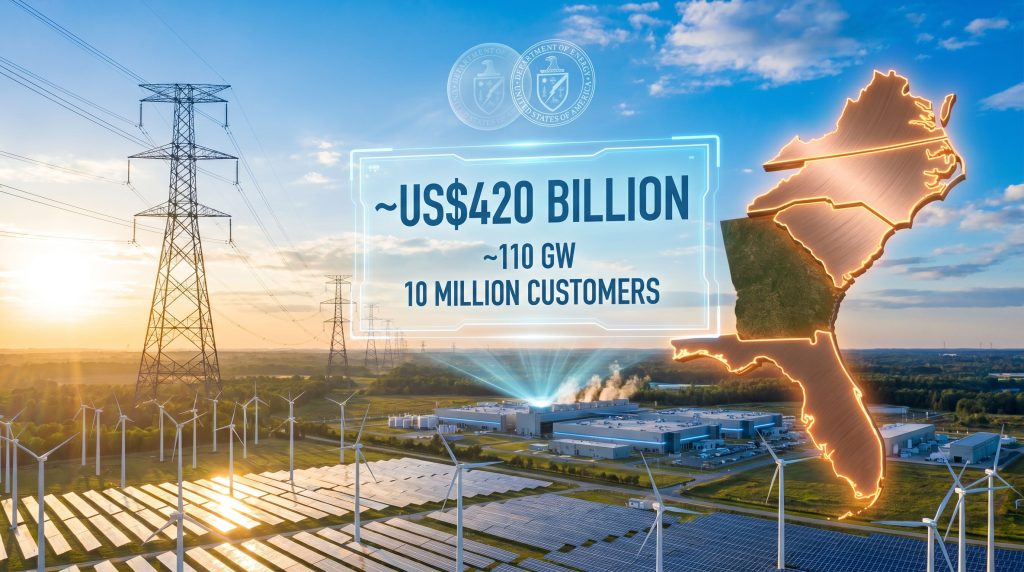
The numbers alone are enough to recalibrate expectations of what a utility company can look like. The combined enterprise value of the merged entity is projected at approximately US$420 billion, with Dominion's standalone valuation entering the deal at roughly US$67 billion. That figure places the combined company not merely at the top of the energy sector, but in the same tier as the world's most recognised industrial conglomerates.
| Metric | Combined Entity (Projected) |
|---|---|
| Enterprise Value | ~US$420 billion |
| Dominion Valuation | ~US$67 billion |
| Generation Capacity | ~110 GW (pipeline potentially exceeding 130 GW) |
| Customer Accounts Served | ~10 million |
| Regulated Business Share | More than 80% |
| Geographic Footprint | Florida, Virginia, North Carolina, South Carolina |
The generation portfolio at closing would stand at approximately 110 GW, with a development pipeline that could push the combined capacity beyond 130 GW. Across that footprint, the merged entity would serve roughly 10 million customer accounts spanning four states, with a regulated revenue base exceeding 80% of total operations.
To contextualise this deal historically, the consolidation events that genuinely remade industries share certain characteristics. Vodafone's acquisition of Mannesmann restructured global telecommunications. The Exxon-Mobil combination redrew the map of international oil. The NextEra Dominion merger is positioned to achieve something analogous for regulated electricity in the United States, concentrating generation capacity, transmission relationships, and regulatory leverage within a single entity of unprecedented scale.
What Are the Structural Terms of the NextEra-Dominion Deal?
Transaction Architecture: An All-Stock Exchange with a Cash Component
The deal is structured as an all-stock transaction, which carries specific implications for how capital is managed across the combined organisation. The core mechanics include:
- A fixed exchange ratio of 0.8138 NextEra shares issued for every single Dominion share held
- A one-time cash distribution of US$360 million, paid proportionally across all outstanding Dominion shares at closing
- US$2.25 billion in proposed customer bill credits for Dominion customers across Virginia, North Carolina, and South Carolina, distributed over two years following deal closure
- The announcement date of May 18, 2026, with a closing window of 12 to 18 months from announcement
Why an All-Stock Structure? Strategic Financing Rationale
The decision to structure the transaction primarily in stock rather than cash is a deliberate capital management strategy. Key reasons include:
- Preserving NextEra's balance sheet liquidity for deployment into generation capacity and grid infrastructure investment
- Aligning long-term incentives between shareholders of both legacy companies, who now hold equity in the same combined enterprise
- Avoiding the immediate debt load that a cash-heavy acquisition would create, particularly important given the sustained capital expenditure requirements of an entity building toward a 130+ GW pipeline
This structure is particularly well-suited to utilities, where multi-decade infrastructure investment cycles demand financial flexibility rather than short-term capital efficiency. Furthermore, as Reuters has reported, the deal represents one of the most ambitious financing structures ever attempted in the U.S. utility sector.
What Is Driving This Merger? The AI and Data Centre Power Demand Catalyst
Electricity Demand Growth as the Structural Trigger
The underlying force propelling this deal is not purely financial engineering. It is physics. Data centre electricity consumption worldwide reached approximately 415 TWh in 2024, a volume roughly equivalent to the entire annual power consumption of the United Kingdom. Independent analysts project that figure will double by 2030, driven by AI workload expansion, cloud infrastructure buildout, and the electrification of industrial processes.
Data centre electricity demand reaching 415 TWh in 2024 is not simply a benchmark. It represents a structural shift in what utilities must be capable of delivering, redefining the minimum viable scale for a credible power infrastructure operator. (Source: International Energy Agency, World Energy Investment Report 2024)
The convergence of these trends creates a set of very specific pressures on utility operators:
- Hyperscale load growth: Technology operators requiring guaranteed, large-scale power supply agreements need counterparties capable of delivering at that scale
- Grid interconnection backlogs: Utilities with existing regulatory relationships and transmission assets can accelerate connection timelines in ways that smaller operators cannot
- Capital intensity: Constructing new generation capacity to serve AI-driven demand requires the financing capacity that only the largest players can access at commercially viable rates
Why Scale Matters in a High-Demand Environment
A combined 110 GW generation portfolio provides qualitatively different negotiating leverage than any smaller operator can achieve. Industrial and technology customers seeking long-term power purchase agreements at scale need counterparties who can credibly guarantee delivery over multi-decade horizons. The merged entity's 80%+ regulated revenue base provides the earnings stability to underwrite those commitments while simultaneously funding long-duration infrastructure projects.
Geographic positioning compounds this advantage. The U.S. Southeast, spanning Florida, Virginia, North Carolina, and South Carolina, has emerged as one of the most active data centre development corridors in the country. A combined utility with regulatory presence and transmission infrastructure across all four states occupies exactly the right footprint for the demand growth that is already materialising. In addition, CNBC's analysis highlights how the merger is explicitly designed to capture the AI and data centre-driven surge in electricity demand across this region.
Consequently, renewable energy solutions will play a central role in how the combined entity meets this unprecedented demand growth, particularly across its Southeast footprint.
What Regulatory Hurdles Must the NextEra-Dominion Merger Clear?
Multi-Layered Approval Architecture
Few transactions in U.S. utility history have required approval from as many independent regulatory bodies simultaneously. The NextEra Dominion merger must navigate the following:
| Regulatory Body | Jurisdiction |
|---|---|
| Federal Energy Regulatory Commission (FERC) | Federal wholesale power markets |
| Nuclear Regulatory Commission (NRC) | Nuclear asset transfer approvals |
| Virginia State Corporation Commission | State utility regulation |
| North Carolina Utilities Commission | State utility regulation |
| South Carolina Public Service Commission | State utility regulation |
| Shareholder votes (both companies) | Corporate governance requirement |
Each of these bodies applies its own evidentiary standards, public interest tests, and procedural timelines. The interaction between federal and state-level review processes is not sequential but overlapping, meaning the companies must simultaneously manage multiple regulatory relationships with different information requirements and political sensitivities.
Estimated Timeline to Closing
The companies have indicated a target closing window of 12 to 18 months from the May 2026 announcement, placing the expected completion date somewhere between mid-2027 and late 2027. State-level commissions will pay particular attention to rate impact modelling, service reliability commitments, and whether the proposed US$2.25 billion customer credit package represents genuine consumer protection or a temporary concession designed to smooth regulatory approval.
What Are the Key Antitrust and Consumer Protection Concerns?
Three interconnected concerns are likely to define the most contested elements of the regulatory process:
- Rate pressure risk: Critics of large-scale utility consolidation argue that bill credits distributed over two years do not structurally prevent rate increases once the combined entity begins recovering infrastructure costs through regulated tariffs
- Market concentration: The merged entity's geographic dominance across the U.S. Southeast raises legitimate questions about whether large industrial customers retain any meaningful competitive alternatives for power supply
- Long-run cost recovery dynamics: Regulated utilities recover capital expenditure through approved rate mechanisms. A company building toward a 130+ GW pipeline will generate sustained infrastructure investment, and the cost recovery implications for customers extend well beyond the two-year credit window
If the merged entity deploys capital at the scale its development pipeline implies, the cost recovery mechanisms embedded in state utility regulation could translate into sustained upward rate pressure beyond the initial credit window, a dynamic regulators in Virginia and the Carolinas are expected to scrutinise closely.
What Does the Merger Mean for Dominion Energy Customers?
Bill Credits, Rate Trajectories, and Service Commitments
For the approximately 10 million customer accounts that will sit within the combined entity's service territory, the near-term picture is shaped primarily by the US$2.25 billion in proposed bill credits. These would be distributed across Virginia, North Carolina, and South Carolina over two years following deal closure.
The competing arguments on long-term rate outcomes break down as follows:
- Proponents argue that the combined entity's superior access to capital markets will lower the weighted average cost of capital for new generation investment, ultimately moderating the rate increases associated with infrastructure buildout
- Critics contend that the elimination of a major independent utility competitor reduces the regulatory pressure that historically constrains rate-setting, and that customers will face accelerated cost pass-throughs once the credit period expires
Neither position is provably correct at this stage. The answer will ultimately depend on the specific rate covenants that state commissions extract as conditions of approval, and on how aggressively the merged entity pursues infrastructure deployment in the years immediately following closing.
The next major ASX story will hit our subscribers first
How Does the NextEra-Dominion Merger Fit Into the Broader U.S. Energy Transition?
Renewable Energy Buildout Capacity at Unprecedented Scale
NextEra holds the distinction of being the world's largest generator of wind and solar energy ahead of this transaction. Adding Dominion's regulated asset base to that foundation creates a platform with capabilities that extend well beyond what either company could achieve independently. The energy transition and security implications of a combined entity at this scale are therefore considerable, reshaping how the U.S. approaches long-term grid decarbonisation.
- Accelerated renewable deployment across the U.S. Southeast, where solar resource quality and available land make large-scale clean energy development commercially attractive
- Integrated transmission and distribution infrastructure that can support grid modernisation at the scale required to accommodate intermittent renewable generation
- Combined regulatory relationships across multiple high-growth states, reducing the time and cost associated with obtaining permits, interconnection agreements, and rate approvals for new clean energy assets
The Tension Between Scale and Decarbonisation Pace
A less commonly discussed dimension of this merger involves the structural tension between regulatory stability and transition speed. Heavily regulated combined entities tend to move through decision-making cycles more deliberately than purely merchant operators. Capital allocation decisions require regulatory engagement, rate filings, and public interest reviews that add time to deployment timelines.
However, this dynamic cuts both ways. The guaranteed cost recovery mechanisms available to regulated utilities de-risk large-scale clean energy projects in ways that merchant developers cannot replicate. A wind or solar project developed by a regulated utility with approved cost recovery is fundamentally less exposed to wholesale power price volatility than the same project developed on a merchant basis. For long-duration infrastructure with capital costs measured in billions, that risk reduction materially improves project economics and financing terms.
The decarbonisation benefits associated with deploying capital at this scale are substantial, particularly when the combined entity's pipeline is directed toward low-carbon generation assets. Furthermore, critical minerals demand will inevitably rise as the merged entity accelerates its clean energy buildout, given the material requirements of large-scale wind, solar, and battery storage deployment.
The 80%+ regulated revenue model of the combined entity therefore functions as both a constraint on pace and a structural enabler of scale. Whether the net effect accelerates or moderates the transition will depend heavily on how state commissions in Virginia, North Carolina, South Carolina, and Florida engage with the entity's clean energy investment programmes in the years following closing. Green energy design principles will consequently become central to how the merged company plans and executes its generation infrastructure across this expanded footprint.
Frequently Asked Questions: NextEra Dominion Merger
What is the NextEra Dominion merger?
NextEra Energy and Dominion Energy announced on May 18, 2026 a proposed all-stock merger that would create the world's largest regulated electric utility, with a combined enterprise value of approximately US$420 billion and a generation portfolio of around 110 GW.
How many customers would the merged utility serve?
The combined entity would serve approximately 10 million customer accounts across Florida, Virginia, North Carolina, and South Carolina.
What is the share exchange ratio in the deal?
Dominion shareholders would receive 0.8138 NextEra shares for each Dominion share held, plus a proportional share of a one-time US$360 million cash distribution.
When is the NextEra Dominion merger expected to close?
The companies have indicated a closing window of 12 to 18 months from announcement, subject to shareholder votes and approvals from FERC, the NRC, and state utility commissions in Virginia, North Carolina, and South Carolina.
Will Dominion customers see lower electricity bills?
The companies have proposed US$2.25 billion in bill credits for Dominion customers in Virginia, North Carolina, and South Carolina, to be distributed over two years after closing. Long-term rate impacts remain subject to regulatory review and ongoing infrastructure investment decisions.
Why is the merger happening now?
The primary structural driver is the surge in electricity demand from AI infrastructure and data centre expansion, which requires capital scale and generation capacity that only a combined entity of this size could efficiently deliver.
Key Takeaways: The Strategic Significance of the NextEra-Dominion Combination
- The merger represents the most consequential consolidation in U.S. utility history by enterprise value, at approximately US$420 billion
- The deal is fundamentally a response to structural electricity demand growth, with data centre power consumption already at 415 TWh annually and projected to double by 2030
- Regulatory approval across five separate bodies makes this one of the most complex utility transactions ever attempted in the United States
- The 80%+ regulated revenue model provides earnings stability but introduces sustained rate scrutiny risk for customers across four states
- A combined generation pipeline of 130+ GW positions the merged entity as the dominant force in U.S. clean energy infrastructure deployment for the decade ahead
- The all-stock transaction structure preserves balance sheet flexibility for the capital deployment the combined entity's pipeline demands
This article contains forward-looking statements and projections based on information available at the time of writing. The NextEra Dominion merger remains subject to regulatory approval and shareholder votes. Actual outcomes, timelines, and financial metrics may differ materially from projections. Nothing in this article constitutes financial or investment advice.
Want To Capitalise On The Critical Minerals Driving The Clean Energy Revolution?
As the NextEra-Dominion merger accelerates demand for wind, solar, and battery storage infrastructure, the critical minerals underpinning that buildout — lithium, copper, rare earths, and beyond — are increasingly in focus for investors seeking early-mover advantage. Discovery Alert's proprietary Discovery IQ model delivers real-time alerts on significant ASX mineral discoveries, instantly transforming complex geological data into actionable opportunities — explore historic discoveries and their remarkable returns, then begin your 14-day free trial at Discovery Alert to position yourself ahead of the market.