
July 28, 2026
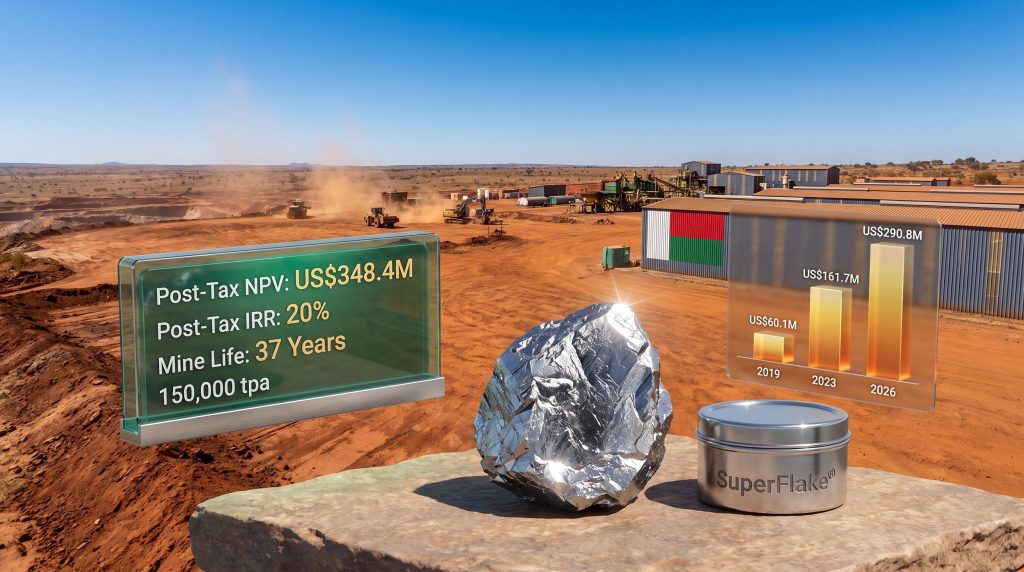
The Graphite Supply Chain Is Being Rebuilt From the Ground Up
For most of the past decade, the global graphite industry operated under a quiet assumption: China would continue to dominate every stage of the supply chain, from mining through to anode material production, and the rest of the world would simply buy what it needed. That assumption is now under serious pressure. Battery manufacturers, automakers, and policymakers across North America, Europe, and Japan are actively searching for credible non-Chinese graphite supply, and the list of projects capable of delivering at scale is remarkably short.
Against that backdrop, the updated NextSource Molo graphite mine feasibility study, released in late July 2026, arrives at a pivotal moment. It does not tell a simple story of improving economics. Instead, it presents something more complex and arguably more instructive: a world-class deposit navigating a difficult cost and pricing environment while demonstrating that the underlying asset quality and strategic positioning remain intact.
When big ASX news breaks, our subscribers know first
How the Molo Project Has Transformed Across Three Studies
From a Modest Start to a Globally Significant Operation
The evolution of the Molo graphite mine in southern Madagascar can be understood as three distinct chapters, each shaped by different market conditions and development ambitions. The global graphite shortage has, furthermore, added urgency to finding credible non-Chinese sources of supply.
The original 2019 feasibility study envisioned a relatively conservative two-phase operation, with Phase 1 targeting 17,000 tonnes per year of graphite concentrate and a Phase 2 expansion to 45,000 tonnes per year, underpinned by a mine life of 30 years and capital costs of US$60.1 million. At that scale, the pre-tax NPV at an 8% discount rate was estimated at US$237.1 million, with a pre-tax IRR of 43.1%.
By 2023, the development vision had expanded dramatically. A new expansion study targeting 150,000 tonnes per year was released, with capital costs rising to US$161.7 million and a pre-tax NPV of US$424.1 million, delivering a pre-tax IRR of 31.1% over a 25-year mine life. The shift reflected a surge in EV battery demand signals and the emergence of a binding offtake relationship with Mitsubishi Chemical Group.
The 2026 updated feasibility study retains the 150,000-tonne-per-year production target but recalibrates virtually every other financial variable:
| Study Year | Planned Annual Output | Mine Life | CAPEX | Post-Tax NPV (8%) | Post-Tax IRR |
|---|---|---|---|---|---|
| 2019 Feasibility Study | 17,000–45,000 tpa | 30 years | US$60.1M | US$237.1M (pre-tax) | 43.1% (pre-tax) |
| 2023 Expansion Study | 150,000 tpa | 25 years | US$161.7M | ~US$370M (est.) | 29% |
| 2026 Updated Study | 150,000 tpa (staged) | 37 years | US$290.8M | US$348.4M | 20% |
Why the 2026 Update Is a Structural Recalibration, Not a Retreat
It would be a misreading of the data to interpret the 2026 update as a deterioration in the project's foundations. Three specific forces drove the financial revision, none of which reflect a change in the deposit's quality or extractability.
- Capital cost inflation: Total CAPEX rose 79% to US$290.8 million compared to the 2023 study, consistent with broad-based construction cost escalation across African mining jurisdictions since 2022.
- Graphite price compression: The assumed concentrate price fell from US$1,191 per tonne to US$1,138 per tonne, a decline of approximately 4.4%, reflecting near-term market softness driven in part by Chinese synthetic graphite oversupply.
- Extended mine life as a partial offset: The 37-year mine life, up from 25 years, adds twelve additional years of production value to the asset, which partially compensates for the compressed near-term return metrics.
The deposit itself has not changed. What has changed is the cost of building the mine and the near-term price of the product it will produce. Long-duration asset value and strategic positioning remain the structural pillars of the investment thesis.
The 2026 Feasibility Study Economics: A Detailed Breakdown
Post-Tax Financial Model at an 8% Discount Rate
The 2026 updated feasibility study for the NextSource Molo graphite mine reports the following headline figures:
- Post-tax NPV (8% discount rate): US$348.4 million
- Post-tax IRR: 20%
- Total CAPEX: US$290.8 million
- Mine life: 37 years
- Planned peak production: 150,000 tonnes per year of graphite concentrate
- Assumed graphite concentrate price: US$1,138 per tonne
One dimension of the updated study that deserves particular investor attention is the expansion architecture. Rather than committing to a single large-scale capital build, the plan stages growth across modular processing units:
- Existing Phase 1 capacity: 17,000 tonnes per year, currently operational since 2023.
- Stage 1 expansion: Addition of processing modules to reach an intermediate production level, reducing early-stage financing burden and accelerating cash generation.
- Stage 2 expansion: Three additional 50,000-tonne-per-year processing modules brought online in sequence, achieving the full 150,000-tonne-per-year target.
This modular approach was deliberately designed to reduce operating risk, lower financing costs per phase, and allow the project to respond dynamically to changes in graphite market demand. The staged model was developed in direct alignment with the company's binding offtake agreement with Mitsubishi Chemical Group, which will source purified and spheronized graphite produced at a planned Battery Anode Facility in the United Arab Emirates.
How 2026 Returns Compare to the 2023 Study
| Economic Metric | 2023 Study | 2026 Update | Change |
|---|---|---|---|
| Post-Tax NPV (8%) | ~US$370M (est.) | US$348.4M | ~6% lower |
| Post-Tax IRR | 29% | 20% | -9 percentage points |
| CAPEX | US$161.7M | US$290.8M | +79% |
| Graphite Price Assumption | US$1,191/t | US$1,138/t | -4.4% |
| Mine Life | 25 years | 37 years | +12 years |
The Molo Deposit: Geological Quality and Resource Scale
What the Ground Actually Contains
Understanding why Molo attracts strategic interest requires examining the geological reality beneath the economics. The deposit is among the largest known flake graphite accumulations in the world, with a resource base that extends well beyond what most junior miners can claim:
- Proven and probable reserves: 82.5 million tonnes of ore
- Average grade: 6.27% graphitic carbon
- Contained graphite: approximately 5.1 million tonnes
- Location: approximately 900 kilometres south of Antananarivo, Madagascar
The grade of 6.27% graphitic carbon is worth contextualising. In the broader graphite exploration universe, deposits grading above 5% graphitic carbon are considered high quality for large-tonnage operations. Molo's resource combines size and grade in a way that supports long mine-life economics and stable processing costs over decades.
SuperFlake: Product Quality as a Competitive Differentiator
One underappreciated dimension of the Molo story is NextSource's proprietary SuperFlake branded graphite concentrate. This is not simply a marketing label. SuperFlake designates a product with a specific flake size distribution and purity profile that is particularly suited to downstream processing into battery-grade spherical purified graphite for lithium-ion anodes.
In the graphite supply chain, flake size matters enormously. Large-flake graphite commands premium pricing because it can be processed into larger spherical graphite particles, which are preferred in certain high-performance battery chemistries due to their superior charging characteristics. The ability to brand and differentiate concentrate output gives Molo a pricing positioning advantage that purely commodity-grade operations do not possess.
Why Non-Chinese Graphite Supply Is Structurally Undervalued
The Concentration Problem in Global Graphite Processing
China currently controls an estimated 60 to 80 percent of global graphite processing capacity, according to industry analyses of the critical minerals demand landscape. This concentration is not limited to mining; it extends through purification, spheronisation, and coating processes required to convert raw concentrate into battery-grade anode material.
For battery manufacturers and automakers attempting to qualify non-Chinese supply chains, the challenge is not simply finding a mine. It is finding a mine that is already producing, has a credible expansion pathway, has secured downstream processing arrangements, and has an established product identity. Molo satisfies all four criteria in ways that most graphite development projects simply cannot match.
The Legislative Tailwind for Ex-China Sourcing
Western battery supply chain frameworks, including the US Inflation Reduction Act and the EU Critical Raw Materials Act, have established structural incentives for sourcing critical minerals outside of Chinese jurisdiction. These regulatory frameworks create potential commercial advantages for producers like Molo that operate outside Chinese supply chains, though it is important to note that Molo has not been confirmed as a specifically designated or officially supported project under any of these programmes.
The broader policy environment rewards supply diversification, but investors should evaluate Molo on the basis of its confirmed commercial arrangements — namely the Mitsubishi Chemical offtake agreement — rather than anticipated policy benefits. The wider battery metals investment landscape suggests, however, that regulatory tailwinds are increasingly translating into tangible procurement decisions.
The Mitsubishi Chemical Offtake: What It Signals to the Market
The existence of a binding offtake agreement with Mitsubishi Chemical Group is one of the most materially significant de-risking factors in the Molo investment case. Its implications extend beyond simple revenue certainty:
- It validates the product quality of SuperFlake graphite for battery anode applications at industrial scale.
- It anchors the planned UAE Battery Anode Facility as a downstream value-capture mechanism, extending Molo's value chain from a mine in Madagascar to a processing facility in the Gulf.
- It creates a credible commercial relationship with a major Japanese industrial conglomerate, which carries its own due diligence implications for project quality.
- It provides a partial revenue floor that reduces the project's exposure to spot graphite price volatility.
The vertical integration concept embedded in the Molo-to-UAE supply chain is notably ambitious. If successfully executed, it would transform NextSource from a concentrate producer into a vertically integrated anode material supplier, capturing significantly more value per tonne of graphite mined. The mineral processing challenges involved in this transition are, consequently, not trivial and should be monitored closely by investors.
The next major ASX story will hit our subscribers first
Key Risks Investors Must Evaluate
The CAPEX-to-Market Cap Gap
The most immediate financial risk in the 2026 updated study is the relationship between the project's capital requirements and the company's current market position. NextSource shares were trading at approximately 30 Canadian cents at the time of the announcement, implying a market capitalisation of roughly C$73.3 million. The total CAPEX required for the staged expansion is US$290.8 million.
The gap between a ~C$73M market capitalisation and a US$290.8M capital requirement is the central financing execution risk in this investment thesis. The staged approach reduces the per-phase burden, but the total commitment is still substantial relative to the company's current valuation.
The staged expansion architecture directly addresses this challenge by allowing each phase to be financed incrementally, with early production revenue potentially contributing to subsequent phase funding. However, the precise debt-to-equity structure of the financing plan has not been fully disclosed, and investors should monitor progress on binding financing commitments as a key near-term catalyst.
Graphite Price Sensitivity and Synthetic Competition
The feasibility model assumes a graphite concentrate price of US$1,138 per tonne, which already reflects a market under pressure from Chinese synthetic graphite competition. Synthetic graphite, produced from petroleum coke through energy-intensive processes, has been increasingly adopted by battery manufacturers in certain cell chemistries as a substitute for natural flake graphite.
A further 10% decline in the assumed price would compress the post-tax IRR materially below the 20% threshold cited in the study. Investors should model sensitivity scenarios at US$950 to US$1,050 per tonne to stress-test the project's returns under continued price weakness.
Madagascar Jurisdictional Considerations
Operating in southern Madagascar, approximately 900 kilometres from the capital, introduces a distinct risk profile:
- Madagascar has experienced periods of political instability that have historically affected foreign investment sentiment.
- Remote location logistics add complexity and cost to both construction and ongoing operations.
- Community relations and environmental permitting remain ongoing operational requirements in an ecologically sensitive region.
How Molo Ranks Among Global Graphite Development Projects
| Project | Country | Stage | Planned Output | Key Differentiator |
|---|---|---|---|---|
| Molo (NextSource) | Madagascar | Operating + Expansion FS | 150,000 tpa | SuperFlake brand; Mitsubishi offtake |
| Balama (Syrah Resources) | Mozambique | Operating | ~350,000 tpa | Largest ex-China producer |
| Epanko (Volt Resources) | Tanzania | Development | ~240,000 tpa | Long-life resource |
| Lindi Jumbo (Evolution Energy) | Tanzania | Development | ~80,000 tpa | High-purity flake |
| Mason Graphite | Canada | Development | ~50,000 tpa | North American supply focus |
Note: Table metrics are approximate and for comparative context only. Readers should independently verify current project statuses and production figures.
Molo's distinction within this peer group is its already-operational status. The mine entered production in 2023 at 17,000 tonnes per year, providing real-world operational data that validates the expansion feasibility assumptions and demonstrates the team's ability to execute in a challenging jurisdiction. This is a material distinction from projects still working through permitting, construction, or pre-feasibility stages.
Three Scenarios for the Long-Term Investment Thesis
Bull Case: Supply Chain Realignment Drives Premium Pricing
If Western battery manufacturers accelerate non-Chinese graphite procurement under ongoing regulatory pressure, and graphite concentrate prices recover toward US$1,300 to US$1,400 per tonne, the project's economics improve substantially. Under this scenario, staged financing proceeds efficiently, Stage 1 expansion reaches production by 2027 to 2028, and the post-tax NPV potentially exceeds US$400 million with an IRR recovering toward 25%.
Base Case: Measured Execution at Current Price Assumptions
Graphite prices stabilise near US$1,138 per tonne, the Mitsubishi offtake provides a partial revenue floor, and financing is secured through a combination of project debt and equity raises. The post-tax NPV of approximately US$348.4 million is realised over the 37-year mine life, with a 20% post-tax IRR maintained throughout the expansion sequence.
Bear Case: Prolonged Price Weakness and Capital Market Constraints
Graphite prices decline further toward US$900 to US$1,000 per tonne under sustained Chinese synthetic graphite competition, financing for Stage 1 expansion is delayed beyond 2027, and construction costs escalate further above the US$290.8 million base estimate. Under this scenario, the post-tax NPV compresses below US$250 million and the project timeline extends materially.
Key Milestones to Monitor
- Binding financing commitments for Stage 1 expansion
- Construction progress updates for the UAE Battery Anode Facility
- Graphite concentrate spot price trajectory
- Additional offtake agreements beyond the existing Mitsubishi arrangement
- Madagascar regulatory, permitting, and community relations updates
- NextSource share price and market capitalisation relative to CAPEX requirements
Frequently Asked Questions
What is the post-tax NPV reported in the 2026 Molo feasibility study?
The 2026 updated feasibility study reports a post-tax NPV of US$348.4 million, discounted at 8%, based on a graphite concentrate price assumption of US$1,138 per tonne. The Molo Graphite Expansion Feasibility Study provides the full technical underpinning for these projections.
Why did capital costs increase so significantly between 2023 and 2026?
The 79% increase in CAPEX to US$290.8 million reflects broad-based construction and materials cost inflation across African mining projects since 2022, combined with the expanded scope of the modular processing design targeting 150,000 tonnes per year.
What makes SuperFlake graphite different from standard graphite concentrate?
SuperFlake is NextSource's proprietary branded concentrate, designed around a specific flake size distribution and purity profile optimised for battery anode applications. Large-flake graphite commands premium pricing because of its suitability for producing higher-performance spherical graphite for lithium-ion cells.
How large is the Molo graphite resource?
Molo hosts proven and probable reserves of 82.5 million tonnes grading 6.27% graphitic carbon, containing approximately 5.1 million tonnes of graphite, making it one of the largest known flake graphite deposits globally.
What is the Mitsubishi Chemical offtake agreement?
NextSource holds a binding offtake agreement with Mitsubishi Chemical Group for purified and spheronized graphite, which will be processed at a planned Battery Anode Facility in the United Arab Emirates. This arrangement de-risks a portion of Molo's planned production revenue and validates the product's suitability for battery anode applications. Furthermore, China's battery recycling outlook underscores why Japanese and Western manufacturers are actively seeking diversified anode material supply.
A Long-Duration Asset in a Structurally Important Commodity
The 2026 NextSource Molo graphite mine feasibility study presents an investment case defined by tension: lower near-term returns against a backdrop of inflation and price pressure, balanced by a longer asset life, a modular development architecture, and a strategic position in a commodity that sits at the core of the global energy transition.
The economics have weakened in comparison to the 2023 study. That is factually accurate and investors should not minimise it. The post-tax IRR has fallen from 29% to 20%, and the capital requirement has grown by nearly US$130 million in three years. These are material changes that reflect a more challenging operating environment rather than improved project quality.
What has not changed is the scale of the underlying resource, the quality of the SuperFlake product, or the strategic significance of operating one of the world's most advanced ex-China graphite projects with a binding offtake from a major Japanese industrial group. Whether those structural advantages translate into shareholder returns will ultimately depend on financing execution, graphite price recovery, and the pace at which Western battery supply chains genuinely diversify away from Chinese dependency. For independent context on the project's infrastructure and energy arrangements, the Molo mine's renewable energy setup provides a useful reference point on the operation's sustainability credentials.
This article is intended for informational purposes only and does not constitute financial advice. Feasibility study projections involve assumptions about future commodity prices, capital costs, and operating conditions that may differ materially from actual outcomes. Investors should conduct independent due diligence before making investment decisions.
Want to Stay Ahead of the Next Major Mineral Discovery?
Discovery Alert's proprietary Discovery IQ model scans ASX announcements in real time, instantly identifying significant mineral discoveries across graphite, battery metals, and over 30 other commodities — transforming complex data into actionable investment insights before the broader market reacts. Start your 14-day free trial today, or explore Discovery Alert's dedicated discoveries page to see how historic finds have generated exceptional returns for early-positioned investors.