
July 28, 2026
The Structural Gap in Conventional Retirement Planning That Most Investors Never Address
Every retirement account structure reflects an assumption about the future. The standard 401(k) or brokerage IRA assumes that equities will appreciate, that bonds will hedge against equity drawdowns, and that the financial institutions holding those assets will remain solvent. For most of the past four decades, those assumptions held well enough that few investors questioned them.
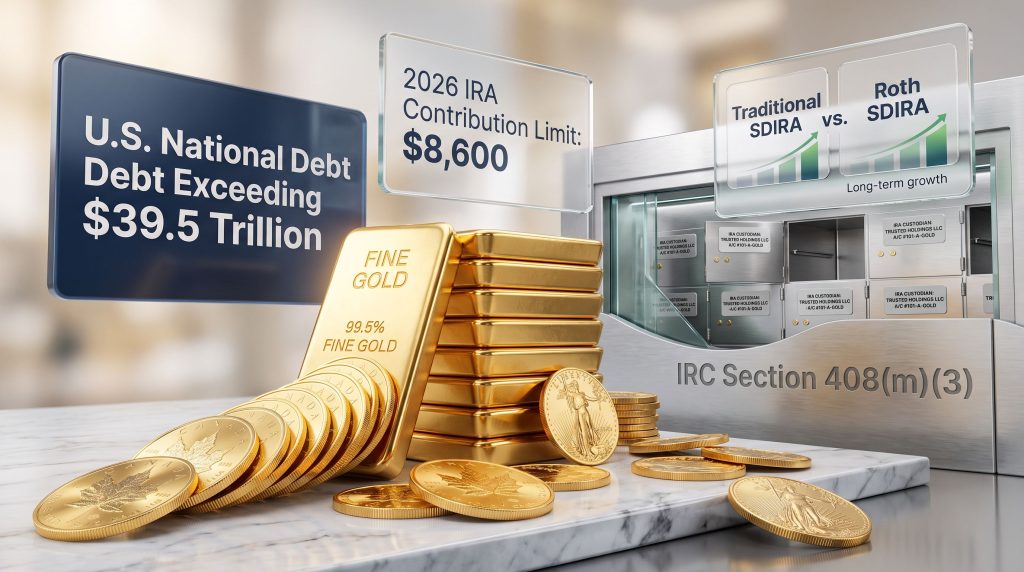
However, fiscal and monetary conditions have shifted in ways that make those assumptions worth examining more carefully. U.S. national debt has surpassed $39.5 trillion, and annual interest obligations on that debt now exceed $1 trillion according to U.S. Treasury Fiscal Data. When interest payments alone consume a figure of that magnitude, the systemic exposure embedded in paper-based retirement portfolios deserves serious attention.
A self-directed IRA for precious metals offers a structurally different approach: the same tax-advantaged retirement framework, applied to a physical monetary asset with no counterparty dependency and no issuer risk. This guide covers exactly how it works, which metals qualify, what the rules require, and what mistakes can cost you the entire account.
When big ASX news breaks, our subscribers know first
What a Self-Directed IRA Actually Is, and How It Differs From What You Already Have
The Legal Architecture: Internal Revenue Code Section 408
A self-directed IRA (SDIRA) is an individual retirement account established under Internal Revenue Code Section 408 that extends the permissible asset universe well beyond the stocks, bonds, and mutual funds accessible through conventional brokerages [IRS Publication 590-A]. Eligible alternative assets include physical real estate, private equity, tax liens, and critically for this discussion, physical gold, silver, platinum, and palladium held to IRS purity standards.
The distinction is not in the tax treatment. A Traditional SDIRA functions identically to a Traditional IRA in terms of contribution deductibility, tax-deferred growth, and distribution taxation. A Roth SDIRA mirrors the Roth IRA in every structural sense. What changes is the range of assets the account can hold, and who bears responsibility for investment decisions.
In a standard brokerage IRA, the custodian both holds assets and determines what assets are available for selection. In an SDIRA, the account holder directs the investments while a qualified custodian handles custody, compliance, and reporting. The same engine powers a different vehicle.
Why Physical Ownership Matters for Precious Metals Investors Specifically
Paper exposure to gold, such as ETF shares or futures contracts, can legally sit inside any standard IRA. Physical metal cannot, unless the account is structured as a self-directed IRA with a qualified custodian arranging storage at an IRS-approved depository.
This distinction matters more than it might initially appear. When comparing physical vs ETF gold, a gold ETF is a financial instrument whose value depends on the issuer's solvency, custody arrangements, and fund mechanics. Physical gold, by contrast, carries no counterparty risk. Its value does not depend on any institution remaining operational or solvent. For investors whose core reason for holding gold is precisely its independence from the financial system, ETF exposure and physical ownership are not equivalent.
Traditional SDIRA vs. Roth SDIRA: Which Structure Works Better for Physical Metals?
The choice between a Traditional and Roth SDIRA involves a set of trade-offs that interact meaningfully with the long-term appreciation potential of physical metals.
| Feature | Traditional SDIRA | Roth SDIRA |
|---|---|---|
| Contribution tax treatment | Pre-tax (may be deductible) | After-tax (no deduction) |
| Growth taxation | Tax-deferred | Tax-free |
| Distribution taxation | Ordinary income tax applies | Qualified distributions tax-free |
| RMD requirement | Yes, begins at age 73 (SECURE 2.0 Act) | No RMD during account holder's lifetime |
| Best suited for | Investors expecting lower tax rate in retirement | Investors with long time horizons and growth expectations |
For investors who believe gold will appreciate substantially over a multi-decade holding period, the Roth SDIRA offers a particularly compelling structural advantage: all of that appreciation occurs within a tax-free wrapper. There is no capital gains event when metals rise in value, and qualified distributions in retirement carry no tax liability at all [IRS Publication 590-A].
The Traditional SDIRA suits investors who expect their tax rate to be lower in retirement than it is today, since contributions may be deductible now and distributions are taxed at ordinary income rates later.
Both structures defer the capital gains that would otherwise be triggered if you held physical metal outside a retirement account. That compounding advantage is substantial over time.
IRS Purity Requirements: Which Precious Metals Qualify for SDIRA Holding?
Statutory Minimums Under IRC Section 408(m)(3)
The IRS establishes precise purity thresholds for metals held inside an SDIRA. These are statutory minimums, not guidelines, and they apply to every product regardless of brand or format [IRC Section 408(m)(3)]:
- Gold: Minimum 99.5% purity
- Silver: Minimum 99.9% purity
- Platinum: Minimum 99.95% purity
- Palladium: Minimum 99.95% purity
Products that meet these standards include the Canadian Gold Maple Leaf (99.99% pure gold), the U.S. Silver Eagle (99.9% fine silver), and LBMA-approved gold bars meeting the 99.5% standard [U.S. Mint].
The American Gold Eagle Exception
American Gold Eagles occupy a unique position. At 22-karat, their gold content is only 91.67%, placing them well below the 99.5% statutory threshold. Despite this, Congress explicitly authorised them for IRA holding through a carve-out written directly into IRC Section 408(m)(3)(A) [IRC Section 408(m)(3)(A)]. This is a congressional legislative decision, not an interpretive workaround or a compliance grey area. American Gold Eagles are fully IRA-eligible.
What Makes a Product Ineligible: The Collectibles Prohibition
Collectible and numismatic coins are explicitly disqualified under IRC Section 408(m)(2) [IRC Section 408(m)(2)]. The prohibition targets items whose market value is driven by rarity, condition, or historical significance rather than metal content. A useful practical test: if a coin's price trades materially above its melt value, it likely does not qualify for IRA holding.
| Product | Metal | Purity | IRA Eligible? | Notes |
|---|---|---|---|---|
| American Gold Eagle | Gold | 91.67% | Yes | Statutory exception under IRC 408(m)(3)(A) |
| Canadian Gold Maple Leaf | Gold | 99.99% | Yes | Exceeds minimum threshold |
| LBMA-Approved Gold Bar | Gold | 99.5%+ | Yes | Standard bullion format |
| U.S. Silver Eagle | Silver | 99.9% | Yes | Meets minimum threshold |
| Numismatic/Collectible Coins | Various | Varies | No | Prohibited under IRC Section 408(m)(2) |
| Pre-1933 Gold Coins | Gold | Varies | No | Classified as collectibles |
How to Open a Self-Directed IRA for Precious Metals: A Step-by-Step Process
Step 1: Selecting a Qualified SDIRA Custodian
Not every IRA custodian is authorised to hold alternative assets, and not every alternative asset custodian specialises in precious metals. You need a custodian specifically approved by the IRS to custody physical metals and coordinate storage at an approved depository. For a comprehensive overview of specialist custodians, IRA Financial's guidance provides useful context on what to look for.
Key considerations when evaluating custodians include:
- Whether they are explicitly approved to handle precious metals IRAs
- Their fee structure, including setup fees, annual maintenance charges, storage costs, and transaction fees
- Their depository relationships and whether allocated storage is available
- Their track record and responsiveness to client inquiries
SDIRA custodians do not provide investment advice. Their role is compliance and custody, not portfolio guidance.
Step 2: Funding the Account
Three distinct pathways exist for placing capital into an SDIRA:
- New cash contributions: Subject to 2026 annual limits of $7,500 for individuals under age 50, or $8,600 for individuals aged 50 and older, including a $1,100 catch-up contribution that increased in 2026 [IRS IR-2025-111; Notice 2025-67]. These limits apply across all IRA accounts combined.
- Direct IRA-to-IRA transfer: A custodian-to-custodian movement of existing IRA assets. No contribution limits apply, and there is no tax event.
- Rollover from a 401(k) or eligible plan: Governed by rollover rules and not counted against annual contribution caps. This pathway allows substantially larger capital deployment than new contributions alone.
Steps 3 and 4: Purchasing Metals and Arranging Custody
| Step | Action | Who Executes It |
|---|---|---|
| 1 | Open SDIRA with qualified custodian | Account holder and custodian |
| 2 | Fund via contribution, transfer, or rollover | Account holder initiates |
| 3 | Direct custodian to purchase approved metals | Account holder instructs |
| 4 | Custodian arranges depository storage | Custodian and depository |
Once the account is funded, you instruct the custodian on which specific metals to purchase. The custodian executes the purchase through an authorised dealer and arranges delivery to an IRS-approved depository. Metals are allocated to your account and held in your name. You do not take personal possession of the metal at any point in this process.
Allocated vs. Commingled Storage: A Distinction That Matters
When metals arrive at an IRS-approved depository, they can be held in two configurations. Allocated storage means specific, identified bars or coins are assigned to your account and held separately from assets belonging to other clients. Commingled storage pools metals with those of other account holders, with your interest recorded as a proportional claim.
Allocated storage provides the clearest legal title and the most direct relationship between your account and specific physical assets. For investors whose primary reason for holding physical metal is to eliminate counterparty exposure, allocated storage is the more logically consistent choice, though it typically carries higher fees. Furthermore, Directed IRA's specialist framework outlines how allocated arrangements are structured in practice.
The next major ASX story will hit our subscribers first
The Home Storage Myth: What the Tax Court Actually Ruled
One of the most aggressively marketed claims in the precious metals industry is that a self-directed IRA can legally store gold at the account holder's home through an LLC or trust structure. This claim is incorrect, and the legal record says so clearly.
In McNulty v. Commissioner, 157 T.C. No. 10 (2021), the United States Tax Court ruled that personal possession of gold held within a self-directed IRA constitutes a taxable distribution, regardless of the LLC or trust structure used to facilitate it. The court treated the entire account value as distributed in the year of the violation, making the full balance subject to ordinary income tax plus a 10% early distribution penalty for account holders under age 59½.
IRS rules require that metals held in an SDIRA remain in the custody of a qualified trustee at an IRS-approved depository [IRS Publication 590-A; IRC Section 408(m)]. When personal possession occurs, the IRS treats the metal as having been distributed from the account, triggering a tax event on the full account value.
The structures marketed as workarounds, sometimes called checkbook IRAs or LLC IRAs, do not change this fundamental requirement. The regulatory logic is straightforward: the tax-advantaged status of an IRA is contingent on the assets remaining under qualified custody. Personal possession ends that arrangement, and the IRS treats the consequences accordingly.
Required Minimum Distributions and the Fractional Metal Problem
SECURE 2.0 Act Age Thresholds
Under the SECURE 2.0 Act of 2022, Traditional SDIRA holders must begin taking Required Minimum Distributions (RMDs) at age 73. Individuals born in 1960 or later face an RMD start age of 75 [SECURE 2.0 Act, Section 107; IRS Publication 590-B].
Why Physical Metals Create RMD Complexity
The RMD calculation is straightforward for a cash or securities account. For a precious metals SDIRA, a structural challenge arises: the IRS calculates your required distribution based on total account value, but physical metal cannot be subdivided to match an exact dollar amount. A gold bar is not divisible into fractions equal to your annual distribution requirement.
Two compliant approaches exist:
- Liquidation approach: Selling a portion of held metal to generate cash equal to the calculated RMD amount. This is administratively clean but involves selling physical metal.
- In-kind distribution: Receiving physical metal directly. The distribution is taxable at the metal's fair market value on the distribution date, even when no cash changes hands.
Both approaches require coordination with the custodian and depository. RMD logistics should be factored into custodian selection before the account is opened, not addressed reactively once distributions become mandatory.
The Roth SDIRA Structural Advantage
Roth SDIRAs carry no RMD obligation during the original account holder's lifetime [IRS Publication 590-B]. For investors with extended time horizons who anticipate significant metal appreciation, this structural difference compounds meaningfully. The full value of the account, including all appreciation, can remain in a tax-free wrapper for the account holder's entire lifetime.
Prohibited Transactions: The Rules That Can Terminate Your Entire Account
The expanded asset flexibility of an SDIRA comes with strict boundaries on how those assets can be used. The IRS prohibits any transaction that allows the account holder to derive personal benefit from IRA-held assets before retirement [IRC Section 4975; IRS Publication 590-A].
Prohibited actions include:
- Purchasing IRA-held metals for personal use
- Selling personally owned metals into your own SDIRA
- Using IRA-held metal as collateral for any personal obligation
- Storing IRA metal at a personal residence or business premises
Critical warning: A prohibited transaction does not result in a partial penalty. Under IRS rules, the entire IRA is treated as fully distributed as of January 1 of the year the violation occurred. The complete account value becomes taxable income, and the 10% early distribution penalty applies if the account holder is under age 59½. This is account termination, not a fine.
When evaluating whether a specific action constitutes a prohibited transaction, consult a qualified tax professional before executing it. The consequences of getting it wrong are irreversible.
How a Precious Metals SDIRA Fits Into Modern Portfolio Strategy
The 60/40 Breakdown and What It Means for Retirement Savers
The conventional 60% equities and 40% bonds portfolio rested on a well-established assumption: that bonds and equities move inversely, providing natural portfolio hedging. That correlation broke down during the 2022 rate shock, when both asset classes declined simultaneously, delivering losses in the equity allocation and the supposed hedge at the same time.
In a fiscal-dominance environment, where government spending drives persistent inflation rather than temporary supply disruptions, the relationship between gold and bonds becomes structurally more important to understand. The Incrementum In Gold We Trust 2026 report identifies this dynamic as a key driver of gold's structural repricing, noting that investors are increasingly seeking assets that are genuinely non-correlated rather than historically correlated.
Central Bank Behaviour as a Structural Signal
Central bank gold demand has continued for more than 20 consecutive months as institutions worldwide have reduced dollar-denominated reserve exposure. This sustained institutional accumulation reflects a structural reassessment of reserve asset composition, not tactical short-term positioning. For individual investors evaluating long-term allocation decisions, this behaviour pattern provides relevant context.
Gold was trading near $4,074 per ounce as of late July 2026 [GoldSilver.com price charts], a level that reflects a repricing driven by structural forces rather than a speculative episode. With the FOMC meeting scheduled for July 28–29 and June PCE data arriving July 30, monetary policy expectations continue to shape real yield calculations, which remain the primary mechanical driver of gold's long-term price trajectory.
The Dual Advantage: Physical Ownership Inside a Tax-Efficient Wrapper
A self-directed IRA for precious metals resolves a tension that otherwise forces investors to choose between two desirable characteristics. Holding physical metal outside a retirement account provides genuine physical ownership but generates capital gains tax events on appreciation. Holding paper gold inside a standard IRA provides tax efficiency but removes the counterparty-free characteristics that make physical ownership strategically distinct.
Furthermore, understanding how gold in inflationary periods performs helps investors appreciate the strategic value of this structure. Physical metal, allocated to the account holder's name, held at an IRS-approved depository, compounds within a tax-deferred or tax-free wrapper. The asset class's core attributes and the retirement account's tax advantages operate together rather than in opposition.
Frequently Asked Questions About Self-Directed IRAs for Precious Metals
What is the difference between a gold IRA and a self-directed IRA?
A gold IRA is a self-directed IRA specifically holding physical precious metals. All gold IRAs are SDIRAs, but an SDIRA can also hold other alternative assets. The terms are sometimes used interchangeably in the context of precious metals investing.
Can I transfer an existing 401(k) into a precious metals SDIRA without penalty?
Yes. A direct rollover from a 401(k) to a self-directed IRA is a non-taxable event when executed correctly. The rollover does not count against annual contribution limits, allowing substantially larger capital deployment than new contributions alone.
What happens to SDIRA metals if the custodian goes out of business?
Because metals are held at a separate IRS-approved depository and allocated to your account specifically, a custodian's insolvency does not affect title to the physical metal. The assets are yours, not the custodian's. Transition to a new custodian is required, however, but the underlying metal remains intact.
Are there income limits that restrict who can open a precious metals SDIRA?
There are no income limits for a Traditional SDIRA. Roth IRA contributions are subject to income phase-out thresholds, though high-income earners can access the Roth SDIRA structure through a rollover conversion rather than direct contribution.
How are distributions from a precious metals SDIRA taxed compared to physical metal held outside an IRA?
Distributions from a Traditional SDIRA are taxed as ordinary income. Physical metal held outside an IRA and sold after more than one year is taxed as a collectible, subject to a maximum federal rate of 28% under the IRS collectibles rule, which is higher than the standard long-term capital gains rate. The SDIRA distribution treatment may be higher or lower depending on the account holder's income bracket in retirement.
What is the difference between allocated and unallocated storage?
Allocated storage means specific, identifiable bars or coins belong to your account exclusively. Unallocated storage, in contrast, records a proportional claim against a pooled inventory. Allocated storage provides clearer title and greater independence from the depository's own balance sheet.
Can I add platinum or palladium to a precious metals SDIRA?
Yes. Both platinum and palladium qualify under IRC Section 408(m)(3) provided they meet the 99.95% minimum purity threshold. SDIRA accounts are not limited to gold and silver.
Key Regulatory and Legal References
| Source | Relevance |
|---|---|
| IRS Publication 590-A | Contribution rules and SDIRA eligibility |
| IRS Publication 590-B | Distribution rules and RMD requirements |
| IRC Section 408(m)(3) | Purity standards and qualifying metals |
| IRC Section 408(m)(2) | Collectibles prohibition |
| IRC Section 4975 | Prohibited transaction definitions |
| IRS IR-2025-111 / Notice 2025-67 | 2026 contribution limits |
| SECURE 2.0 Act, Section 107 | RMD age threshold changes |
| McNulty v. Commissioner, 157 T.C. No. 10 (2021) | Home storage prohibition precedent |
| U.S. Mint, American Eagle Coin Program | Coin specification and IRA eligibility |
| U.S. Treasury Fiscal Data | National debt and interest payment figures |
| Incrementum AG, In Gold We Trust 2026 | Gold market structural analysis |
The Decision Framework: Is a Precious Metals SDIRA Right for You?
Who Benefits Most From This Structure?
A self-directed IRA for precious metals is most valuable for investors who:
- Want physical gold or silver ownership rather than paper proxy exposure
- Have existing IRA or 401(k) balances eligible for rollover into a new structure
- Hold a long time horizon that allows tax-free Roth compounding to work in their favour
- Are specifically concerned about systemic financial risk and want a non-correlated monetary asset within their retirement framework
- Understand that physical ownership and tax efficiency are not mutually exclusive
Cost-Benefit Considerations
SDIRA fees are higher than those of a standard brokerage IRA. Custodial setup fees, annual maintenance charges, transaction costs, and depository storage fees all apply. For smaller account balances, these fees can represent a meaningful drag on returns.
The relevant comparison is not SDIRA fees against brokerage IRA fees in isolation. It is the total cost of custodial and storage fees weighed against the tax compounding benefit of holding an appreciating monetary asset inside a tax-advantaged wrapper rather than outside one.
Three Questions to Evaluate Before Opening an Account
- Do I want genuine physical metal ownership, or is paper exposure to gold sufficient for my strategy?
- Do I have existing retirement account balances that can be rolled over, allowing meaningful capital deployment beyond annual contribution limits?
- Does my investment time horizon justify the Roth structure's tax-free compounding advantage, or does the Traditional structure better match my expected tax position in retirement?
Answering these questions honestly, preferably with input from a qualified financial adviser, provides the decision framework for evaluating whether a self-directed IRA for precious metals belongs in your retirement planning architecture. Consequently, understanding gold's role as a gold safe haven asset will further inform that evaluation.
This article is for informational and educational purposes only and does not constitute financial, tax, or investment advice. Precious metals investing involves risk, including the potential for partial or total loss of capital. Readers should consult a qualified financial adviser and tax professional before making any investment or retirement planning decisions. All figures and regulatory references are based on information available as of the date of publication and may be subject to change.
Ready to Discover the Next Major ASX Mineral Find Before the Broader Market?
While structuring tax-efficient retirement portfolios is one path to long-term wealth, another is positioning early in transformative mineral discoveries — and Discovery Alert's proprietary Discovery IQ model delivers real-time ASX discovery alerts straight to subscribers, turning complex geological announcements across 30+ commodities into clear, actionable opportunities. Explore historic discoveries and their extraordinary returns to understand what early positioning can mean, then start a 14-day free trial at Discovery Alert to secure your edge the moment the next major find is announced.