July 27, 2026
When Growth Becomes a Trap: The Economics Behind European Battery Manufacturer Distress
There is a counterintuitive reality at the heart of the global clean energy transition: a market can expand rapidly while simultaneously destroying the financial viability of the companies operating within it. This dynamic has played out with painful clarity across European battery manufacturing, where rising deployment volumes have coincided with accelerating price compression, thinning margins, and mounting corporate stress. Varta AG's Varta self-administered insolvency filing in July 2026 is perhaps the most prominent illustration of this paradox to emerge from Germany's industrial heartland.
Understanding why one of Europe's most recognised battery brands arrived at a Stuttgart District Court filing requires looking beyond headlines and examining the structural forces that have reshaped competitive dynamics across the entire sector. Furthermore, the story connects to broader shifts in the battery raw materials market that have fundamentally altered the economics of European battery production.
When big ASX news breaks, our subscribers know first
Why Varta Filed for Insolvency: A Multi-Variable Financial Deterioration
The Structural Financing Gap Explained
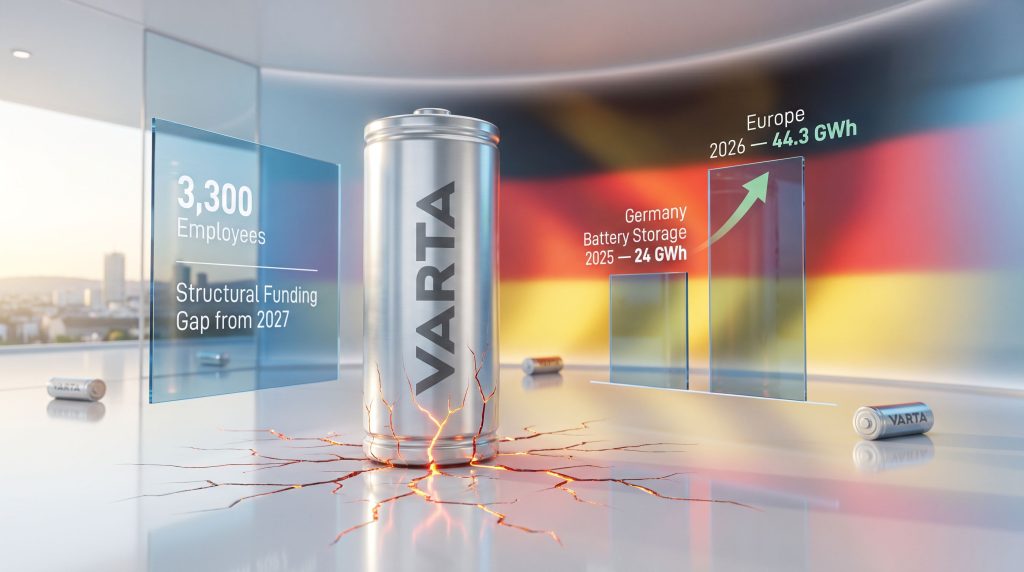
Varta's insolvency filing was not triggered by a single corporate misstep. Instead, it reflects the convergence of several compounding pressures that eroded the group's financial position over time, ultimately producing a projected structural funding shortfall anticipated from 2027 onward.
The key factors Varta identified as driving this outcome include:
- Significantly deteriorating market conditions across core product segments
- Softening consumer and industrial demand, reducing revenue visibility
- Adverse foreign exchange movements affecting cost competitiveness
- The termination of a major customer supply relationship with Apple, which had sourced miniature batteries from Varta for its audio products, removing a stable and sizeable revenue stream
- A complex internal corporate architecture that impeded conventional debt restructuring efforts outside of a formal legal framework
The Varta situation illustrates a recurring challenge for mid-sized European industrial manufacturers: when revenue concentration is high, the loss of a single anchor customer can accelerate a financial deterioration that was already underway due to structural market forces.
According to Reuters reporting on the insolvency filing, the proceedings were initiated proactively rather than as a response to an immediate liquidity crisis. The projected funding gap was identified as emerging from 2027, not as an immediate issue. Management chose to initiate formal proceedings proactively rather than waiting for the gap to become critical. This is precisely the scenario that Germany's Eigenverwaltung mechanism was designed to address.
Understanding Germany's Self-Administration Insolvency Framework
How Eigenverwaltung Differs from Conventional Proceedings
Germany's insolvency law provides a distinct restructuring pathway that differs fundamentally from the liquidation-oriented procedures many observers associate with the word insolvency. Under the Eigenverwaltung framework, a company's existing management team retains full operational authority and decision-making control throughout the restructuring process. No external administrator displaces leadership. Instead, a court-appointed supervisor, known as a Sachwalter, monitors proceedings independently to protect creditor interests.
The Stuttgart District Court appointed Tobias Wahl of the firm Anchor as provisional Sachwalter for the Varta proceedings.
The table below illustrates the key structural differences between the two approaches:
| Feature | Self-Administration (Eigenverwaltung) | Conventional Insolvency |
|---|---|---|
| Management control | Retained by existing leadership | Transferred to external administrator |
| Court oversight mechanism | Sachwalter (supervisor) | Insolvency administrator |
| Primary objective | Restructuring and continuity | Asset realisation and creditor repayment |
| Operational continuity | High | Variable, may include wind-down |
| Speed to restructuring | Can be faster when creditors cooperate | Typically slower, more adversarial |
This distinction matters enormously for employees, customers, and partners. A self-administered proceeding is fundamentally a restructuring tool rather than a closure mechanism. Varta confirmed that production, service delivery, customer support, and partner relationships would continue to operate under the applicable insolvency rules.
Which Varta Entities Are Included and Excluded
The Scope of the Filing
The insolvency applications filed with the Stuttgart District Court cover four legal entities:
- Varta AG – the parent holding company
- Varta Microbattery GmbH – the core battery manufacturing subsidiary
- Varta Micro Production GmbH – the production operations entity
- Varta Storage GmbH – the solar storage and energy management systems business
Critically, Varta Consumer Batteries — the division responsible for household batteries and power banks — is explicitly excluded from the proceedings. As noted in reporting from MarketScreener, Varta describes this unit as legally and financially separate from the entities under court supervision, and its operations are expected to continue without disruption.
This separation has meaningful implications. Consumer Batteries represents a more stable, lower-margin but higher-volume business that generates consistent cash flows. Its exclusion suggests Varta's management and advisers identified it as a separable asset worth protecting from the restructuring process.
Varta Storage GmbH: The Solar Storage Business Under Proceedings
Operations, Products, and the Uncertainty Ahead
Varta Storage, which develops and manufactures residential and commercial solar storage systems alongside energy management platforms, is headquartered with manufacturing operations in Nördlingen, near Augsburg, in Bavaria. Its inclusion within the insolvency proceedings introduces meaningful uncertainty for the European solar storage market.
Varta has confirmed that customer support and service operations will continue under insolvency rules. However, the medium-term trajectory of the business depends entirely on how the restructuring resolves. Key considerations for those with an interest in Varta Storage include:
- Existing system owners face uncertainty about the long-term continuity of warranty obligations and firmware support
- Channel partners and solar installers face potential supply disruption if the business unit is ultimately sold or restructured in ways that alter its product roadmap
- Competing storage manufacturers may benefit from channel partner defections during the period of uncertainty
The inclusion of Varta Storage in the proceedings raises a question that runs deeper than one company's finances: how does the European residential storage market develop sustainable supply chains when mid-tier manufacturers face structural cost disadvantages against Asian competitors?
The Broader Competitive Forces Destroying European Battery Manufacturer Margins
A Structural Problem That Predates Varta's Filing
Varta's crisis does not exist in isolation. European battery manufacturers have faced intensifying structural pressures for several years, driven by a combination of factors that individually would be manageable but collectively have proven highly damaging.
Chinese competition and vertical integration: Chinese battery manufacturers benefit from deeply vertically integrated supply chains, ranging from raw material processing through cell manufacturing to system assembly. Advances in Chinese battery recycling have further strengthened this advantage by closing the loop on material costs. This integration compresses costs at every stage and enables pricing that European manufacturers with more fragmented supply chains structurally cannot match.
Currency volatility: European manufacturers whose input costs are partially denominated in foreign currencies while competing in euro-denominated end markets face an asymmetric exposure. Currency movements that would be manageable for a large diversified manufacturer can be existential for a mid-sized specialist producer.
Demand softness in consumer electronics: The miniature battery segment, where Varta's Microbattery division has historically been a market leader, has faced structural demand headwinds from changes in consumer device architectures and design trends.
Price deflation outpacing volume growth: Perhaps the most underappreciated dynamic is the divergence between deployment volumes and per-unit economics. Germany added approximately 6.57 GWh of battery storage capacity in 2025, representing an 8% year-on-year increase, bringing total installed capacity to approximately 24 GWh, according to the Battery Charts data platform published by the Institute for Power Electronics and Electrical Drives (ISEA) at RWTH Aachen University.
Europe's total energy storage capacity additions are projected to reach approximately 44.3 GWh in 2026, representing more than 60% year-on-year growth, according to InfoLink Consulting (July 2026). Continued battery storage expansion across the continent has driven impressive volume figures, yet manufacturers have seen per-unit revenues compressed by competitive pricing dynamics at a pace that volume gains have not compensated for.
The clean energy transition's growth trajectory benefits system integrators, project developers, and end users far more than it benefits incumbent component manufacturers caught between Asian cost leaders and European cost structures.
The next major ASX story will hit our subscribers first
Scenario Analysis: Three Possible Outcomes for Varta
Mapping the Restructuring Pathways
The Varta self-administered insolvency proceedings could resolve in several distinct ways. Analysts and industry observers generally consider three scenarios plausible, each with materially different implications for the company's workforce, partners, and the broader German battery sector.
Scenario 1: Successful Recapitalisation and Continuation
Under this outcome, management negotiates revised financing arrangements with creditors under court supervision, potentially alongside a strategic capital injection. The group emerges as a leaner entity with a reduced cost base and renegotiated obligations. Conditions required include creditor cooperation, a credible forward revenue model, and possibly the identification of a strategic partner willing to inject capital in exchange for equity or preferred positioning.
Scenario 2: Partial Breakup Through Asset Sales
Individual business units, particularly Varta Storage and Varta Microbattery, are sold separately to strategic or financial acquirers. The parent company Varta AG is restructured or wound down. Consumer Batteries continues independently. This scenario is considered plausible if unified recapitalisation negotiations stall, particularly given the structural diversity of the affected entities.
Strategic buyers from Asia, North America, or within the European energy sector could find individual units attractive at distressed valuations. In this context, Europe's critical minerals supply chain challenges may influence which acquirers view the assets as strategically attractive.
Scenario 3: Orderly Liquidation
If neither creditor consensus nor a buyer emerges for viable business units, an orderly wind-down of the included entities becomes the default outcome. Assets are realised to repay creditors in legal priority order. This scenario would represent a significant reduction in Germany's domestic battery manufacturing capacity and would create immediate questions about supply continuity for existing storage system customers.
Most restructuring practitioners consider full liquidation the least likely outcome in a self-administered proceeding, given that the mechanism is explicitly oriented toward business continuity. However, it cannot be excluded.
Workforce Protections and the Human Dimension
What German Law Provides for Varta's 3,300 Employees
Varta currently employs approximately 3,300 people across its operations. Varta confirmed that wages and salaries will continue to be paid during the insolvency proceedings. Under German law, employees in self-administered insolvency proceedings are afforded meaningful protections:
- The Bundesagentur für Arbeit (Federal Employment Agency) administers insolvency wage guarantees covering up to three months of outstanding salary obligations
- Existing employment contracts remain in force during the proceedings unless specifically altered through a restructuring plan
- Works councils retain their consultation rights throughout the process
The ultimate employment outcomes will depend on which restructuring scenario materialises. A successful recapitalisation preserves the greatest number of roles. An asset sale creates uncertainty depending on which acquirer assumes which entity. Liquidation would result in the most significant workforce impact. Furthermore, the outcome will have considerable implications for UK EV battery production and the broader European battery ecosystem.
Frequently Asked Questions: Varta Insolvency Explained
Is Varta Going Out of Business?
Not immediately. The Varta self-administered insolvency filing is a restructuring mechanism under German law, not a declaration of closure. Management retains operational control and the company intends to continue trading throughout the proceedings.
Will Varta Storage Products Still Be Supported?
Varta has confirmed that customer and partner support will continue under insolvency rules. Long-term service and warranty obligations depend on the outcome of the restructuring process.
Is Varta Consumer Batteries Affected?
No. Varta Consumer Batteries is legally and financially separate from the entities included in the insolvency filing and is not part of the proceedings.
What Is a Sachwalter?
A Sachwalter is a court-appointed supervisor who monitors a self-administered insolvency proceeding independently without replacing the company's management. Tobias Wahl of Anchor has been appointed to this role by the Stuttgart District Court.
Key Facts at a Glance
| Category | Detail |
|---|---|
| Filing type | Self-administered insolvency (Eigenverwaltung) |
| Filing court | Stuttgart District Court, Germany |
| Entities covered | Varta AG, Varta Microbattery GmbH, Varta Micro Production GmbH, Varta Storage GmbH |
| Entities excluded | Varta Consumer Batteries |
| Court-appointed supervisor | Tobias Wahl, Anchor, Stuttgart |
| Employee count | Approximately 3,300 |
| Primary causes | Structural funding gap from 2027, demand weakness, FX headwinds, loss of Apple contract, complex corporate structure |
| Operational status | Continuing – production, deliveries, and support ongoing |
| Restructuring outlook | Uncertain – recapitalisation, partial sale, or liquidation all remain possible |
Disclaimer: This article contains forward-looking statements and scenario projections based on publicly available information. These do not constitute financial advice. Restructuring outcomes are inherently uncertain and subject to creditor negotiations, court processes, and market conditions beyond any party's direct control. Readers with direct financial exposure to Varta AG or its subsidiaries should seek independent professional advice.
Want to Stay Ahead of the Next Major Mineral Discovery on the ASX?
While European battery manufacturers face mounting structural pressures, the materials powering the clean energy transition continue to drive significant discovery activity on the ASX — and Discovery Alert's proprietary Discovery IQ model delivers real-time alerts the moment significant mineral discoveries are announced, turning complex data across 30-plus commodities into clear, actionable insights. Explore how historic discoveries have generated substantial returns on Discovery Alert's dedicated discoveries page, and begin your 14-day free trial today to position yourself ahead of the broader market.