July 27, 2026
The Rough Diamond Market at an Inflection Point
For most of the twentieth century, the rough diamond market operated under a model of deliberate supply control. A single dominant producer managed global inventory flows, adjusted output to support pricing, and cultivated an aspirational consumer narrative that sustained demand across economic cycles. That architecture has now fractured. Anglo American diamond prices sink 32%, and the simultaneous arrival of synthetic substitution, prolonged demand weakness in the world's second-largest luxury consumer market, and geopolitical instability across key consuming regions has created a convergence of pressures that no single lever of supply management can resolve. The result is a structural reconfiguration, not a cyclical correction.
Understanding the magnitude of what is happening requires more than reading a headline price decline. It requires unpacking the mechanics of how rough diamond pricing is reported, why inventory composition distorts realised revenue figures, and what the divergence between benchmark indices and consolidated prices actually reveals about the decisions producers are making in real time.
When big ASX news breaks, our subscribers know first
The Three Structural Forces Compressing Natural Diamond Values
The natural diamond market in 2026 is not navigating a single headwind. It is contending with three structurally distinct forces that are compounding one another in ways that make near-term recovery projections increasingly difficult to defend.
Synthetic substitution is the most frequently cited pressure, but its true impact is often mischaracterised. Lab-grown diamonds are not uniformly displacing natural stones. They are systematically capturing the lower end of the natural diamond market, specifically the price-sensitive categories where visual characteristics are comparable and consumers lack strong provenance motivations. This segment, historically a volume driver for rough diamond producers, is experiencing what analysts describe as structural demand leakage.
Demand contraction in China represents the second major pressure. Chinese consumers became a critical growth engine for global diamond jewellery consumption during the 2010s, but the post-pandemic recovery in Chinese luxury spending has significantly underperformed industry expectations. A combination of consumer caution, shifting luxury preferences toward domestic brands, and broader macroeconomic uncertainty has suppressed diamond jewellery demand in a market that producers had long assumed would drive the next sustained upcycle.
Geopolitical and macroeconomic uncertainty constitutes the third force. Conflict in the Middle East and broader global economic fragility have elevated consumer risk aversion in key purchasing markets, compressing discretionary spending on high-ticket items including diamond jewellery. Furthermore, geopolitical mining risks across multiple regions are amplifying supply chain complexity and adding further downward pressure on sentiment.
These three forces are not operating in sequence. They are operating simultaneously, which is what distinguishes the current period from prior diamond market downturns.
What the H1 2026 De Beers Numbers Actually Reveal
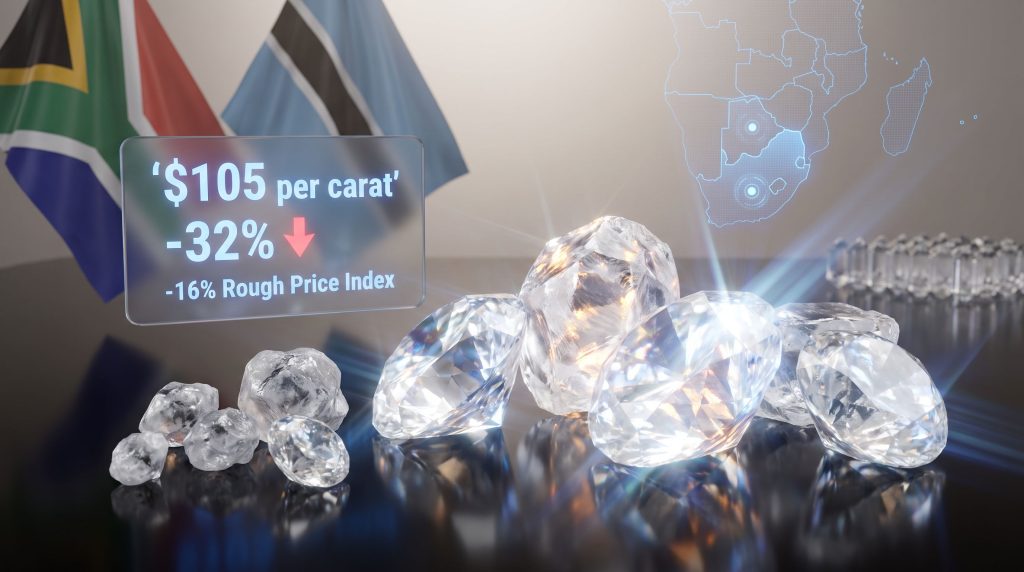
Anglo American's production report for the first half of 2026 disclosed that Anglo American diamond prices sink 32% on a consolidated average realised basis, with the per-carat realised price falling to $105. That figure demands careful interpretation, because it bundles two conceptually distinct phenomena into a single headline number.
The first component is the underlying rough diamond price environment. The average rough diamond price index declined by 16% during the period, reflecting the demand pressures outlined above. This is the market-level price signal.
The second component is what the industry calls sales mix composition. During H1 2026, De Beers sold a higher proportion of lower-value goods relative to prior periods. Lower-value goods, which include smaller stones and lower-clarity categories, carry materially lower per-carat realisations than gem-quality or higher-specification rough diamonds. When a producer's sales mix shifts toward these goods, the consolidated realised price falls further than the benchmark index decline would suggest.
Layered on top of this was De Beers' deliberate decision to begin reducing its rough diamond inventory, which carried a book value of approximately $2 billion. Offloading stockpiled inventory, particularly under prevailing market conditions, typically requires pricing concessions. This introduced a third layer of discount into the consolidated realised price figure.
| Metric | H1 2026 Result | Primary Driver |
|---|---|---|
| Consolidated average realised price | $105 per carat | Sales mix shift + inventory clearance |
| Average rough diamond price index decline | -16% | Macro uncertainty + geopolitical risk |
| Overall consolidated price decline | -32% | Lower-value goods proportion + discounted inventory |
| Full-year production guidance | 21-26 million carats | Expected at lower end of range |
The gap between the 16% benchmark decline and the 32% consolidated drop is not noise. It is a precise signal about the operational decisions being made inside De Beers, and it reveals that the headline revenue deterioration is being amplified by internal choices, not just external market forces. Understanding these commodity price impacts is essential for anyone assessing the investment case for natural diamond assets.
Venetia, Orapa, and Jwaneng: Reading the Operational Signals
Anglo American announced on 13 July 2026 the suspension of production at the Venetia mine in South Africa. Venetia is not a peripheral operation. It is one of South Africa's most significant diamond-producing assets, and its suspension represents a meaningful statement about the economics of continued output at current price levels.
Anglo stated that production at other operations would be increased to compensate for Venetia's absence, leaving overall output targets nominally unchanged. However, the full-year picture is further complicated by scheduled maintenance at two of De Beers' major Botswana operations: Orapa and Jwaneng, both slated for the second half of 2026.
| Operation | Status | Full-Year Production Impact |
|---|---|---|
| Venetia (South Africa) | Suspended | Offset by other operations |
| Orapa (Botswana) | H2 scheduled maintenance | Reduces full-year run-rate |
| Jwaneng (Botswana) | H2 scheduled maintenance | Reduces full-year run-rate |
| Overall guidance range | 21-26 million carats | Tracking toward lower bound |
Orapa and Jwaneng are not interchangeable operations. Jwaneng in particular is widely regarded as one of the highest-value diamond mines in the world by revenue per carat, producing a meaningfully higher proportion of gem-quality stones than most peer operations. Maintenance-driven production reductions at Jwaneng do not simply compress volume; they disproportionately affect the value composition of what reaches the market.
The convergence of Venetia's suspension and Botswana maintenance scheduling in H2 2026 signals that Anglo American is actively prioritising margin preservation over volume defence, a structurally different posture than traditional rough diamond supply management.
Anglo has also reserved the right to make further supply adjustments, indicating it will continue monitoring rough diamond trading conditions to align output with prevailing demand. This flexible production stance, while commercially rational, introduces additional uncertainty for sightholders and the broader midstream pipeline.
The De Beers Divestiture: Sovereign Complexity and Deal Architecture
Anglo American's effort to divest its 85% stake in De Beers is among the most structurally consequential mining M&A activity currently in motion across the global mining sector. According to Botswana's minister for state president, defence and security, Moeti Mohwasa, Anglo has identified the Global Diamond Consortium as its preferred buyer, a group understood to be led by former De Beers managing director Gareth Penny.
The transaction, however, is not straightforward. Botswana holds a 15% stake in De Beers and retains preemptive rights over any sale of Anglo's shareholding. This is not a passive minority position. Botswana's diamond revenues, channelled primarily through Debswana, the joint venture that operates Orapa and Jwaneng, represent a critical component of the national fiscal framework. Any ownership transition that materially alters Botswana's influence over De Beers' commercial strategy or production decisions carries significant sovereign risk dimensions that the Botswana government is likely to protect vigorously.
Three plausible ownership scenarios have emerged from the deal dynamics:
- Full consortium acquisition with Botswana retaining its existing 15% position and the Global Diamond Consortium acquiring Anglo's 85% stake.
- Botswana exercises preemptive rights, acquiring a materially larger stake and potentially becoming a co-majority shareholder alongside a reduced consortium interest.
- A tripartite hybrid structure, in which the consortium acquires a partial position, Botswana expands its stake through negotiation, and ownership is redistributed across three principal parties.
The preemptive rights mechanism introduces genuine timeline uncertainty. Deal conclusion is not expected to be imminent, and the structural complexity of aligning Anglo's divestiture ambitions with Botswana's sovereign interests adds layers of negotiation that could extend well beyond initial market expectations. In addition, industry consolidation trends across the broader mining sector suggest that complex multi-party transactions of this nature are becoming increasingly common. For a deeper examination of this transaction's background, Anglo American's De Beers divestment provides comprehensive context on the deal's evolution.
Lab-Grown Diamonds and the Bifurcation of Natural Diamond Demand
The synthetic diamond sector has evolved from a niche curiosity to a market-reshaping force in less than a decade. The economics of lab-grown diamond production have improved dramatically through advances in Chemical Vapour Deposition (CVD) and High Pressure High Temperature (HPHT) manufacturing techniques, driving production costs down at a pace that has consistently outpaced industry forecasts.
The competitive threat is not uniform across the natural diamond market. It is concentrated in specific segments:
- Lower-value rough categories (smaller stones, lower colour and clarity grades) face direct substitution risk, as synthetic alternatives offer visually comparable characteristics at a fraction of the price.
- Mid-market jewellery is experiencing accelerating consumer preference shifts toward lab-grown stones, particularly among younger demographics who place lower value on geological provenance.
- High-value natural diamonds (large, high-quality gem stones) have demonstrated relative pricing resilience, supported by genuine scarcity, collector and investment demand, and provenance narratives that synthetic production cannot replicate.
Anglo American's CEO Duncan Wanblad acknowledged in commentary accompanying the H1 2026 results that synthetic lab-grown diamonds continued to affect demand for lower-value natural diamonds, adding pressure in price-sensitive categories, while noting that stronger pricing for higher-value goods provided some support to the overall average price index. This bifurcation is likely to intensify as synthetic production costs continue to decline, not moderate.
The long-term strategic question for natural diamond producers is whether the premiumisation thesis for higher-value stones can generate sufficient revenue density to offset structural volume losses at the lower end of the market. That question remains unresolved.
The next major ASX story will hit our subscribers first
China, Consumer Sentiment, and the Recovery Timeline Problem
China's trajectory as a diamond demand driver carries outsized importance for the global rough diamond market's recovery prospects. During the 2010s, Chinese consumer appetite for diamond jewellery, particularly bridal and gifting categories, contributed meaningfully to sustained rough diamond demand growth. Industry participants had anticipated that post-pandemic normalisation would reignite this demand.
That expectation has not been met. Chinese consumer sentiment has remained subdued, shaped by property market weakness, youth unemployment concerns, and a broader recalibration of luxury spending priorities. Diamond jewellery, which lacks the resale liquidity of gold and the cultural inheritance of jade, has not benefited from the luxury recovery to the same degree as some other premium categories.
By contrast, Indian consumer demand for diamond jewellery has shown greater relative resilience, supported by strong cultural associations with diamond gifting in bridal contexts and a growing middle-class consumer base. However, India's rough diamond import volumes are also sensitive to cutting and polishing sector economics, which are themselves under pressure from compressed margins and inventory overhang in the midstream pipeline.
What Three Years of Consecutive Impairments Signal for the Broader Industry
The H1 2026 price deterioration does not exist in isolation. It represents the third consecutive phase of significant value deterioration for De Beers under Anglo American's ownership:
- 2023: The first major write-down cycle as post-pandemic demand normalisation accelerated faster than supply could adjust.
- 2024: A second impairment phase as Chinese consumer demand failed to recover and midstream pipeline inventory built to elevated levels.
- 2026: A third deterioration phase compounded by Venetia's suspension, Botswana maintenance scheduling, and sales mix degradation amplifying the headline price decline.
This sequential deterioration pattern carries implications beyond De Beers. When the world's largest rough diamond producer systematically curtails output, adjusts its preferred buyer network, and clears inventory at discounted prices simultaneously, it typically signals that the broader industry is approaching a supply rationalisation inflection point. Smaller producers operating higher-cost, lower-quality assets face existential pressure at current price levels.
The marginal cost of production for artisanal and small-scale mining operations in several African jurisdictions now exceeds prevailing rough diamond prices in certain size and quality categories. Consequently, management red flags are becoming increasingly apparent across smaller operators who lack the financial resilience to weather a prolonged pricing trough.
Investors and industry participants should treat the current environment as a structural repricing of natural diamond assets rather than a temporary dislocation. The distinction matters for capital allocation, mine life extension decisions, and long-term revenue modelling. This article does not constitute financial advice.
Frequently Asked Questions
Why did Anglo American diamond prices fall 32% in H1 2026?
The 32% decline in consolidated average realised price to $105 per carat reflected three compounding factors: a 16% decline in the average rough diamond price index driven by geopolitical uncertainty and macroeconomic headwinds, a deliberate shift in sales mix toward a higher proportion of lower-value goods, and discounted offloading of inventory from a $2 billion stockpile that De Beers began reducing during the period.
What is the difference between the 32% price drop and the 16% rough price index decline?
The 16% figure represents the decline in the underlying rough diamond price benchmark, reflecting broader market conditions. The 32% consolidated drop is larger because it also incorporates the effect of selling a greater proportion of lower-value stones and clearing discounted inventory, factors that compound the headline revenue impact well beyond what market pricing alone would produce.
What is happening with the De Beers sale to the Global Diamond Consortium?
Anglo American has identified the Global Diamond Consortium as its preferred buyer for its 85% stake in De Beers. However, Botswana, which holds a 15% stake and retains preemptive rights over any sale, has significant leverage to negotiate an expanded ownership position or extend the transaction timeline, meaning deal conclusion is unlikely to be imminent. The Times has reported extensively on Anglo American's motivation to close this chapter following significant accumulated losses.
How are lab-grown diamonds affecting natural diamond prices?
Synthetic diamonds are exerting sustained downward pressure on the lower-value segment of the natural diamond market by offering visually comparable characteristics at substantially lower price points. Higher-value natural diamonds have demonstrated greater pricing resilience due to genuine geological scarcity, but the lower-value category faces structural substitution risk that shows no sign of reversing.
Will diamond production volumes fall further in 2026?
Full-year production guidance remains at 21 to 26 million carats, but Anglo has indicated outcomes will likely track toward the lower end of that range, reflecting the Venetia suspension and scheduled maintenance at Orapa and Jwaneng in the second half of the year.
Key Takeaways
- 32% consolidated price decline to $105 per carat in H1 2026 reflects market deterioration amplified by deliberate inventory management and sales mix composition
- 16% rough price index decline driven by geopolitical instability, macroeconomic headwinds, and sustained weakness in Chinese consumer demand
- Lab-grown diamond competition is structurally eroding the lower-value natural diamond segment with no credible near-term reversal in sight
- Venetia suspension combined with Botswana mine maintenance will compress H2 2026 output, with full-year production expected at the lower end of the 21-26 million carat guidance range
- De Beers divestiture to the Global Diamond Consortium remains in progress, with Botswana's preemptive rights introducing meaningful uncertainty into deal timing and final structure
- Market bifurcation between higher-value and lower-value natural diamonds is accelerating, with diverging pricing trajectories likely to define the industry's medium-term structural character
Readers seeking additional context on the global rough diamond market and De Beers' evolving commercial position can explore related industry coverage at MiningMX, which provides ongoing reporting on the African mining sector and diamond market developments.
Want to Identify the Next Major Mineral Discovery Before the Market?
While structural shifts reshape traditional commodity sectors like diamonds, Discovery Alert's proprietary Discovery IQ model scans ASX announcements in real time, instantly alerting subscribers to significant mineral discoveries across more than 30 commodities — turning complex data into actionable opportunities. Explore how historic discoveries have generated substantial returns on Discovery Alert's dedicated discoveries page, and begin your 14-day free trial today to position yourself ahead of the broader market.