August 4, 2026
When Sovereign Borrowing Evolves: The Architecture Behind Oil-Backed Refinancing
For decades, the dominant assumption in sovereign finance was straightforward: resource-rich nations borrow against their future production, and the terms of that borrowing reflect little more than commodity price expectations and country risk premiums. What the NNPC Project Gazelle refinancing reveals is something more nuanced. It demonstrates that the quality of oil-backed financing, not merely its volume, has become the defining metric by which markets now judge a sovereign borrower's trajectory.
Nigeria's approval of a $4.5 billion refinancing of its flagship Project Gazelle facility, unlocking approximately $3 billion in fresh liquidity whilst simultaneously reducing the volume of crude committed to debt service, reframes what sovereign liability management can look like in practice. This is not simply a story about borrowing more money. It is a story about borrowing smarter, and what that distinction means for Africa's largest oil producer.
When big ASX news breaks, our subscribers know first
Understanding Pre-Export Financing: The Instrument at the Centre of Project Gazelle
Before unpacking the mechanics of the refinancing, it is worth understanding the instrument itself. A pre-export financing facility, commonly abbreviated as PXF, allows a sovereign oil producer to borrow against the anticipated value of crude it has not yet exported. The lender essentially takes a forward claim over future production proceeds as collateral, removing the need for traditional balance-sheet guarantees or fixed asset pledges.
This structure has several defining features that set it apart from conventional sovereign debt:
- The credit quality of the borrower is only partly relevant; the production profile of the pledged crude is the primary underwriting variable
- Lenders model forward output curves, pipeline capacity, geopolitical risk, and historical theft rates to determine how many barrels per day must be committed to ensure repayment
- The ratio of pledged barrels to total capital raised, often called collateral efficiency, is the clearest technical measure of deal quality
- Accordion disbursement mechanisms allow borrowers to draw capital in pre-agreed tranches, reducing early-stage interest drag
A critical but underappreciated feature of these structures is that lenders bear production risk, not just credit risk. If output falls below the pledged threshold, repayment timelines can compress, creating fiscal stress even when commodity prices are supportive.
The distinction between issuing new oil-backed debt and refinancing existing crude-backed obligations is equally important. Refinancing replaces an outstanding liability with a new one, ideally on superior terms. Gross sovereign debt may not increase materially, but the cost, tenor, and collateral commitment attached to that debt can change substantially.
Project Gazelle Origins: Nigeria's 2023 Liquidity Crisis Response
The Macroeconomic Conditions That Made Project Gazelle Necessary
By mid-2023, Nigeria was navigating one of its most acute foreign exchange crises in recent memory. External reserves had been depleted by sustained defence of an artificially managed naira, dollar shortages were cascading through the import-dependent economy, and conventional sovereign bond issuance had become prohibitively expensive given elevated global interest rates. Furthermore, Nigeria's credit risk profile at the time compounded these pressures considerably.
Against that backdrop, NNPC's crude production capacity emerged as the most credible credit enhancement mechanism available. The result was Project Gazelle, structured through Afreximbank as lead arranger and representing one of the largest oil-backed financing transactions ever executed by a Nigerian state entity. In the context of current crude oil market dynamics, understanding such instruments becomes increasingly important for analysts tracking sovereign energy finance.
Original Project Gazelle: Core Parameters
| Deal Parameter | Original Project Gazelle (2023) |
|---|---|
| Facility Size | $3.3 billion |
| Arranging Bank | Afreximbank |
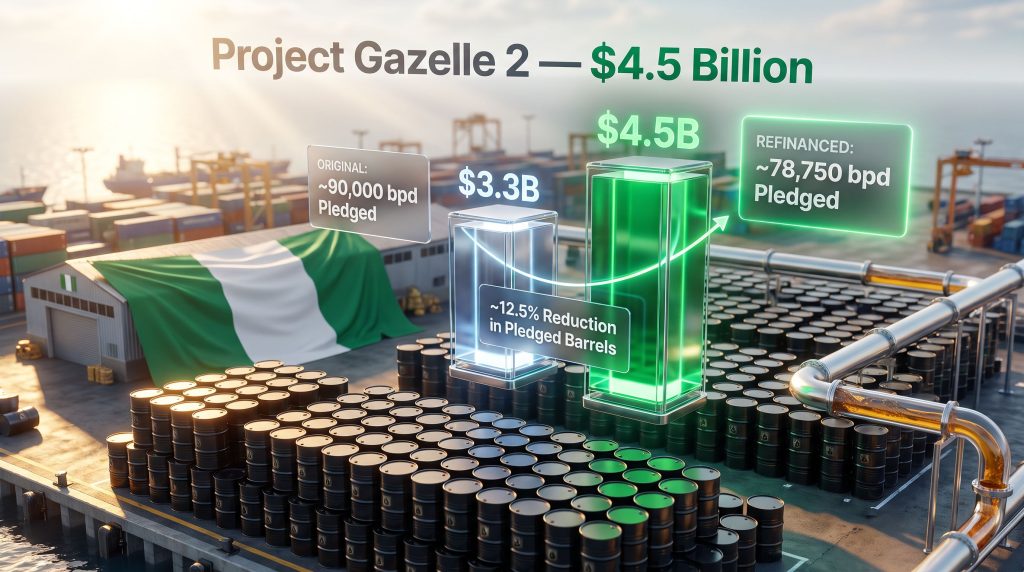
| Pledged Crude Volume | ~90,000 bpd |
| Launch Date | August 2023 |
| Accordion Tranche (June 2024) | $925 million |
| Cumulative Funded Amount (mid-2024) | ~$3.175 billion |
The accordion disbursement of $925 million drawn in June 2024 is a detail frequently overlooked in media coverage. It explains why figures cited across different publications vary between $3 billion, $3.3 billion, and $3.4 billion. The $3.3 billion figure represents the headline syndicated commitment, whilst the $3.175 billion figure reflects the actual funded position by mid-2024, after accounting for phased disbursements. Each number is technically accurate depending on the reference point being used.
The accordion feature itself is a structuring tool designed to benefit the borrower. By pre-committing lender capital without triggering immediate drawdown, Nigeria could access funds on demand without renegotiating terms, whilst paying interest only on drawn balances.
Project Gazelle 2: Anatomy of the $4.5 Billion Refinancing
National Economic Council Approval and Its Significance
Nigeria's National Economic Council approved the NNPC Project Gazelle refinancing, providing the multi-stakeholder governmental endorsement that international lenders require before committing capital at this scale. NEC functions as the primary coordinating body for major sovereign financial decisions, and its approval signals alignment across federal executive, state-level, and sectoral interests. For international banks evaluating counterparty risk, NEC sign-off materially reduces the probability of mid-facility political interference.
Project Gazelle 2: Core Deal Parameters
| Deal Parameter | Project Gazelle 2 (2026) |
|---|---|
| New Facility Size | $4.5 billion |
| Fresh Liquidity Unlocked | ~$3 billion |
| Outstanding Balance Refinanced | ~$1.5 billion |
| Pledged Crude Volume | ~78,750 bpd |
| Crude Freed for Federation Sales | ~11,250 bpd |
| Reduction in Pledged Barrels | ~12.5% |
| Facility Size Increase vs. 2023 | ~36% |
How the Refinancing Mechanics Work: Step-by-Step
- Establish residual liability: The outstanding unpaid balance on the original 2023 facility, approximately $1.5 billion, serves as the starting point for the new transaction
- Negotiate improved terms: NNPC and its lender syndicate agree on a larger total commitment of $4.5 billion, incorporating improved pricing, tenor, and collateral ratios
- Retire the existing obligation: Proceeds from the new facility are used to extinguish the remaining 2023 balance, removing the original covenants
- Unlock net new capital: After retiring the old debt, approximately $3 billion becomes available for deployment against fiscal priorities
- Recalibrate collateral: Pledged crude falls from roughly 90,000 bpd to approximately 78,750 bpd, liberating 11,250 bpd for independent federation sales
- Deploy proceeds strategically: Fresh capital is directed toward foreign exchange reserve support, infrastructure obligations, and broader fiscal stabilisation
The simultaneous increase in total facility size by 36% and reduction in pledged barrel volume by 12.5% is the most analytically significant feature of this transaction. These two movements are typically inversely correlated in crude-backed structures. Achieving both at once is only possible when lender confidence in forward production has materially improved.
Why Refinancing Rather Than New Debt Issuance?
Liability Quality Over Debt Volume
Nigeria's strategic choice to refinance an existing obligation rather than negotiate a wholly new oil-backed facility reflects a deliberate philosophy shift in public liability management. The distinction between debt volume expansion and liability quality improvement is subtle but consequential. Moreover, it aligns with a broader pattern emerging across Africa's resource and energy sectors as producers reassess how they structure long-term obligations.
Issuing new debt increases gross obligations and adds to the forward crude commitment required to service an expanded balance sheet. Refinancing on better terms can achieve the same capital-raising objective whilst simultaneously reducing the per-dollar collateral burden and lowering the ongoing cost of servicing existing liabilities.
The following comparison illustrates why the refinancing approach was strategically preferred:
| Instrument | Key Advantage | Key Risk |
|---|---|---|
| Eurobond issuance | No crude collateral required | High coupon rates; sentiment-dependent |
| IMF/World Bank concessional loans | Lower interest rates | Policy conditionality requirements |
| Oil-backed pre-export financing | Leverages existing production assets | Commits future crude to repayment |
| Domestic debt issuance | Avoids foreign exchange exposure | Crowds out private sector credit |
| Refinancing existing PXF facility | Improves terms without expanding gross debt | Requires lender confidence in production outlook |
In the current environment, improving but still fragile macroeconomic conditions made the refinancing route most viable. Nigeria's recovering crude production and demonstrated reform momentum gave lenders sufficient confidence to increase facility size without demanding proportionally more collateral.
The 11,250 bpd Liberation: Translating Barrels Into Fiscal Impact
Revenue Implications Across Crude Price Scenarios
The release of approximately 11,250 barrels per day from debt service obligations carries tangible fiscal consequences. These volumes flow directly into federation accounts rather than being absorbed by loan repayment mechanics, expanding the distributable pool available to federal, state, and local governments. Consequently, the revenue implications extend well beyond headline figures.
| Brent Crude Price (USD/bbl) | Estimated Annual Revenue from 11,250 bpd |
|---|---|
| $70/bbl | ~$287.6 million per year |
| $80/bbl | ~$328.7 million per year |
| $90/bbl | ~$369.8 million per year |
Note: Revenue projections are indicative estimates based on daily volume multiplied by assumed crude price across a 365-day production year. Actual realised values will vary based on oil quality differentials, shipping costs, production continuity, and prevailing spot prices. These figures should not be treated as guaranteed revenue forecasts.
Beyond the headline numbers, the transmission mechanism to foreign exchange stability matters. When federation accounts receive higher crude sales proceeds in dollars, the government's capacity to supply foreign exchange through official channels improves. This reduces pressure on the parallel market, supports naira stability, and contributes to the reserve accumulation cycle that underpins Nigeria's sovereign credit ratings. It is also worth noting that oil price movements influenced by broader policy shifts can materially alter these revenue projections in either direction.
Foreign Exchange Reserve Transmission
The $3 billion in fresh liquidity, if deployed with reserve augmentation as a priority objective, could meaningfully supplement Nigeria's external buffers. Reserve adequacy is typically measured by months of import cover, and improvements in this metric directly influence the terms available on future sovereign borrowing. Each dollar added to reserves compounds into lower financing costs on subsequent transactions, creating a virtuous cycle that the Project Gazelle 2 structure is partly designed to initiate.
The next major ASX story will hit our subscribers first
Project Gazelle 2 Within Nigeria's Broader Reform Agenda
Reading Lender Behaviour as a Confidence Signal
There is an underappreciated dimension to how oil-backed financing transactions should be interpreted. Because lenders conduct rigorous internal modelling of forward production curves, discount rates, operational risk, and country-level geopolitical variables before committing capital, the terms they accept function as a de facto market assessment of Nigeria's production trajectory. Indeed, the geopolitical landscape shaping metals and mining decisions globally also informs how lenders price sovereign energy risk.
The willingness of the international banking community to support a facility 36% larger than its 2023 predecessor, on a reduced collateral commitment, is not a commercial decision taken lightly. It reflects an institutional view that Nigeria's crude output is on a credible recovery path, that recent efforts to combat oil theft and pipeline vandalism have produced measurable results, and that the structural reforms introduced since mid-2023 have improved the operating environment sufficiently to justify increased exposure.
Nigeria's Competitive Position in African Energy Finance
Multiple African oil producers are simultaneously seeking crude-backed capital, creating genuine competitive pressure on deal terms across the continent. Nigeria's scale advantage as Africa's largest oil producer provides structural leverage that smaller producers cannot replicate. The sheer volume of exportable crude available as collateral, combined with the sovereign weight of NNPC as counterparty, gives Nigerian negotiators a fundamentally stronger position at the lender table.
This competitive dynamic also explains why improving deal quality, rather than simply securing capital at any price, has become a strategic imperative. Countries that demonstrate sophisticated liability management attract progressively better terms, whilst those that repeatedly accept unfavourable structures find their negotiating position eroding over time.
Risks and Structural Critiques of Oil-Backed Sovereign Borrowing
The Core Criticism: Forward Production as Collateral
The primary critique of crude-backed financing is straightforward: it mortgages sovereign resources that have not yet been produced against obligations that exist today. If production falls short of pledged volumes due to theft, infrastructure failure, vandalism, or adverse geological developments, repayment timelines compress regardless of the prevailing oil price environment.
There is also a transparency concern that institutional investors and civil society organisations consistently raise. Oil-backed facilities are typically less publicly visible than traded sovereign bonds, making independent assessment of a country's total contingent crude liabilities genuinely difficult. Unlike Eurobonds, which require prospectus disclosure and are priced continuously in secondary markets, PXF facilities operate within syndicated loan markets where terms are not systematically published.
Debt Sustainability in Context
It is important to distinguish between gross sovereign debt levels, which may not increase substantially under a refinancing structure, and the embedded contingent liability represented by pledged future production. The 78,750 bpd commitment under Project Gazelle 2 still represents a meaningful portion of Nigeria's exportable crude, and any sustained production shortfall below this threshold would create repayment pressure independent of fiscal policy settings.
The counterargument, which carries considerable analytical weight in this specific case, is that refinancing on genuinely improved terms reduces the risk profile of the original 2023 obligation rather than compounding it. The net release of 11,250 bpd from collateral obligations provides a tangible margin of safety that the original structure lacked. Furthermore, the broader context of trade dynamics and supply chain pressures globally means that securing stable, long-term financing terms is increasingly valuable for oil-dependent sovereigns.
Whether oil-backed borrowing ultimately serves or burdens a sovereign borrower depends almost entirely on two variables: the trajectory of domestic production and the quality of governance over oil revenues. Project Gazelle 2 improves Nigeria's position on both measures relative to 2023, but the structural risks inherent to crude-backed financing do not disappear simply because the terms have improved.
Frequently Asked Questions: NNPC Project Gazelle Refinancing
What is Project Gazelle?
Project Gazelle is NNPC's crude-oil-backed pre-export financing facility, originally launched in August 2023 with Afreximbank as lead arranger. It raised $3.3 billion through a syndicated structure backed by future crude export proceeds, providing Nigeria with immediate foreign exchange liquidity during an acute dollar shortage.
What is Project Gazelle 2?
Project Gazelle 2 is the $4.5 billion refinancing of the original facility, approved by Nigeria's National Economic Council. It retires the remaining approximately $1.5 billion balance from the 2023 structure whilst unlocking roughly $3 billion in fresh capital and reducing the daily crude commitment from approximately 90,000 bpd to 78,750 bpd.
Why Did Nigeria Choose to Refinance Rather Than Issue New Debt?
Refinancing allows Nigeria to improve the terms of an existing obligation, reducing cost, extending tenor, and freeing pledged collateral, without materially increasing gross sovereign debt. It reflects a deliberate strategy of liability quality improvement rather than debt volume expansion.
How Much Crude Oil Is Freed by the Refinancing?
Approximately 11,250 barrels per day are released from debt service obligations and returned to the federation for independent sale, generating additional distributable revenue for federal, state, and local governments.
What Does the Deal Signal to International Investors?
Lenders' willingness to increase the facility from $3.3 billion to $4.5 billion on improved terms signals growing institutional confidence in Nigeria's crude production recovery and the effectiveness of recent fiscal and energy sector reforms. However, it is equally worth noting that sovereign credit ratings agencies will monitor whether these improved terms translate into durable fiscal outcomes.
What Are the Main Risks?
The primary risks include production shortfalls that could impair repayment, limited transparency compared to public bond markets, and the forward commitment of sovereign crude resources to current obligations. Refinancing on better terms mitigates but does not eliminate these structural risks.
Key Takeaways: What Project Gazelle 2 Signals for Nigeria's Economic Direction
The NNPC Project Gazelle refinancing is most accurately understood as a multi-dimensional policy instrument rather than a single financial transaction. It simultaneously functions as a liquidity event, a liability quality upgrade, and a sovereign credit signal to international capital markets.
The three measurable outcomes are:
- $3 billion in net new liquidity available for fiscal deployment
- 11,250 bpd returned to federation sales, generating between $288 million and $370 million in additional annual revenue depending on crude price
- Improved financing terms on a reduced collateral commitment, expanding Nigeria's fiscal flexibility without proportionally expanding its gross debt position
What makes the transaction analytically distinctive is the direction of all three metrics simultaneously. In a 2023 environment defined by crisis-driven borrowing, Nigeria accessed capital at whatever terms the market would accept. In 2026, the same sovereign is accessing more capital, on better terms, with fewer barrels pledged as collateral. That directional shift, more than any individual figure, is the clearest evidence of how much Nigeria's relationship with international energy finance has evolved across a three-year period.
The structural challenges remain real. Production reliability, governance of oil revenues, and the inherent opacity of crude-backed lending markets will determine whether this refinancing delivers its intended fiscal benefits. However, Project Gazelle 2 demonstrates that when reform momentum is genuine and production recovery is credible, the architecture of sovereign oil-backed finance can be reengineered, not merely renewed.
Disclaimer: This article contains forward-looking revenue estimates and analytical projections that are inherently subject to uncertainty. Crude price assumptions, production volumes, and fiscal outcomes may differ materially from figures presented. Nothing in this article constitutes financial or investment advice.
Want to Spot the Next Major ASX Mineral Discovery Before the Broader Market Does?
Discovery Alert's proprietary Discovery IQ model scans ASX announcements in real time, delivering instant alerts on significant mineral discoveries and turning complex data into actionable opportunities for traders and investors alike — explore historic discoveries and their returns to understand what early positioning can mean, then begin your 14-day free trial at Discovery Alert to secure your market-leading edge.