
July 29, 2026
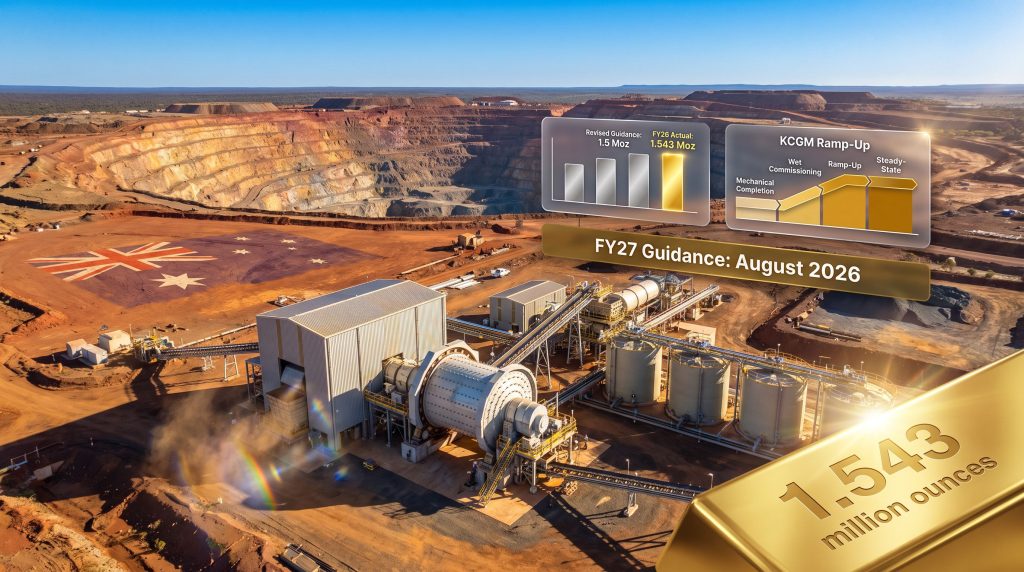
When a Mine Expands, Guidance Must Wait
Large-scale gold mining operates on a paradox that investors often underestimate: the moment a company completes its most ambitious capital project is frequently the moment its forward visibility becomes most uncertain. Northern Star delays FY27 guidance as KCGM commissioning begins, and this decision sits at the heart of a transitional window where throughput rates, metallurgical recovery, and equipment availability are all simultaneously in flux.
It is precisely during this window that committing to annual production forecasts carries the highest risk of being wrong in ways that damage management credibility and market trust.
This dynamic reflects a deliberate philosophy at Northern Star Resources (ASX: NST): that forecast accuracy is worth more to long-term shareholders than the optics of providing timely guidance on an arbitrary calendar schedule. The deferral of FY27 production guidance until August 2026 is, consequently, a studied choice rather than an oversight.
When big ASX news breaks, our subscribers know first
The Strategic Logic Behind Delaying Annual Guidance
Why Forward Guidance Timing Matters in Large-Scale Gold Mining
In the Australian gold sector, annual production guidance is treated as a binding commitment by the market. When major producers like Northern Star issue ounce targets and all-in sustaining cost ranges, analysts build discounted cash flow models around those numbers, institutional investors calibrate position sizing accordingly, and retail shareholders anchor their expectations to them.
The consequences of a guidance miss are asymmetric. Beating guidance by a modest margin rarely produces proportional share price gains, but missing guidance, even by a small percentage, can trigger significant re-ratings. This asymmetry creates a powerful incentive for management teams to be conservative and data-driven when circumstances are genuinely uncertain.
Furthermore, the gold price impact on miners compounds these risks, as volatile pricing environments make production forecast misses even more consequential for equity valuations.
The Risk of Premature Forecasting During Capital Project Transitions
The commissioning phase of a major processing expansion is one of the most operationally complex periods in a mine's lifecycle. New equipment must be integrated with existing circuits, reagent dosing calibrated, and operators trained on systems they have never run at scale before. During this period, throughput rates can vary dramatically week to week as engineering teams identify and resolve bottlenecks.
Issuing production guidance before a facility has demonstrated stable throughput, recovery rates, and plant availability introduces material forecast risk. This is not a theoretical concern. Across the global gold industry, numerous producers have faced guidance cuts within months of commissioning new processing infrastructure, simply because ramp-up curves proved slower or more unpredictable than modelled.
How KCGM's Commissioning Phase Changes Northern Star's Production Calculus
For Northern Star, the KCGM expansion is not a peripheral project. It is the single most consequential operational development in the company's near-term production outlook. Given the scale of throughput uplift the expansion is designed to deliver, even modest variations in ramp-up pace translate into material differences in annual gold output.
Deferring FY27 guidance until early commissioning data is available is therefore not conservatism for its own sake. It is a rational response to genuine operational uncertainty. Moreover, definitive feasibility studies completed prior to the expansion already highlighted the complexity of translating design assumptions into real-world throughput performance.
What Is the KCGM Mill Expansion and Why Is It Central to NST's Growth Story?
Understanding the Fimiston Processing Hub: Scale, Capacity, and Infrastructure
The Kalgoorlie Consolidated Gold Mines operation, located in the heart of Western Australia's Goldfields region, is one of the most recognisable names in Australian gold mining. The Fimiston Open Pit, commonly known as the Super Pit, has been producing gold since the late 1980s and represents one of the largest gold mines in the southern hemisphere.
The Fimiston processing hub sits at the centre of KCGM's value chain, converting ore extracted from the Super Pit into refined gold. Expanding this hub's processing capacity is therefore a direct lever on Northern Star's total production volume, making the current expansion project one of the most closely watched capital initiatives on the ASX.
The Expanded Flowsheet: What New Equipment Has Been Commissioned
According to Northern Star's recent commissioning update, the KCGM mill expansion incorporates a substantial suite of new processing infrastructure, each component serving a specific role in the upgraded circuit:
- A new primary crusher designed to handle significantly increased ore volumes entering the processing circuit
- A 5.8MW semi-autogenous (SAG) mill, which uses a combination of ore and steel balls to grind material to the particle size required for effective leaching
- A pebble crusher positioned downstream of the SAG mill to recycle coarse material that passes through without adequate grinding, improving overall circuit efficiency
- Additional leaching and adsorption tanks to increase the volume of slurry that can be processed for gold extraction at any given time
The SAG mill deserves particular attention. At 5.8 megawatts, it represents a meaningful addition to the processing circuit's grinding capacity. In mineral processing engineering, SAG mills are often the primary throughput constraint in gold circuits. Adding a new SAG mill effectively unlocks a step-change in the volume of ore that can move through the circuit each day.
From Construction to Commissioning: What the Transition Phase Involves
Understanding what commissioning actually involves helps contextualise why production guidance cannot be responsibly issued mid-ramp-up. The table below outlines the typical phases a processing plant expansion moves through before full, guidance-quality operational data is available:
| Commissioning Phase | Key Milestones | Typical Duration |
|---|---|---|
| Mechanical Completion | Equipment installed and tested dry | Weeks to months |
| Wet Commissioning | First ore introduced through the circuit | 1 to 3 months |
| Ramp-Up | Throughput scaling progressively toward nameplate capacity | 3 to 12 months |
| Steady-State Operations | Sustained performance data available for forecasting | Post-ramp-up |
Each phase carries its own failure modes. Mechanical completion can be delayed by supply chain issues or installation errors. Wet commissioning reveals unforeseen interactions between new and existing equipment. Ramp-up is where metallurgical performance often diverges from design assumptions, particularly when ore hardness or mineralogy varies from what was modelled in feasibility studies.
Why KCGM Is the Cornerstone of Northern Star's Long-Term Production Profile
Beyond the immediate commissioning period, the KCGM expansion underpins Northern Star's ambition to grow its annual production base over the medium term. The Super Pit still contains substantial ore reserves at depth, and the underground mining programme at KCGM continues to expand its resource base. A higher-capacity processing facility directly translates this geological endowment into additional gold ounces per year.
For investors focused on production growth rather than simply current-year output, the expansion represents the transition from a period of heavy capital expenditure to one of production leverage, where sunk infrastructure costs begin generating increasing returns as throughput scales.
How Did Northern Star Perform in FY26? A Production Reality Check
FY26 Gold Sales: What the Numbers Actually Reveal
Northern Star recorded 1.543 million ounces of gold sold during FY26. To properly contextualise this figure, it must be read against two separate benchmarks:
- The original guidance range of 1.7 to 1.85 million ounces, which the FY26 result fell short of
- The revised downward guidance of 1.5 million ounces, which the FY26 result exceeded
This dual-benchmark reality is one of the more nuanced aspects of evaluating mining company performance. A result that appears disappointing against the original target can simultaneously represent an operational achievement relative to revised expectations.
What Caused the Original Guidance Miss?
Mid-year guidance resets in large-scale gold mining typically stem from a combination of factors: geotechnical issues affecting mining rates, lower-than-expected ore grades, processing plant availability shortfalls, or weather-related disruptions to open-cut operations. Historical guidance cuts at the Super Pit have demonstrated how quickly operational complexity can translate into forecast revisions at this scale.
In KCGM's case, the sheer complexity of managing an active expansion programme concurrently with ongoing production operations introduces additional variables. Circuit tie-ins, planned shutdowns for new equipment installation, and temporary diversions of ore flow can all temporarily suppress throughput during construction periods.
The Significance of Beating Revised Guidance in a Volatile Production Environment
In capital-intensive gold mining, delivering above a revised guidance target during a period when a major expansion is simultaneously underway signals that management has stabilised operations after an acknowledged disruption. It is a credibility marker, not a concession.
Exceeding the revised 1.5 million ounce guidance threshold, even modestly, indicates that the operational headwinds which prompted the mid-year reset were contained rather than compounding. However, the broader gold sector challenges facing Australian producers mean that managing expectations carefully remains essential to maintaining institutional confidence.
What Does Prudent Guidance Management Look Like for an ASX Gold Major?
The Case for Data-Driven Forecasting Over Calendar-Driven Commitments
There is an implicit pressure in Australian equity markets for large-cap companies to maintain a predictable rhythm of guidance communication. Annual results, investor days, and quarterly activity reports all create natural windows where the market expects forward-looking numbers. Deviating from this rhythm attracts scrutiny.
However, the most respected gold producers globally have established a precedent for decoupling guidance timing from the calendar when operational circumstances genuinely warrant it. A guidance range issued before a major processing plant has demonstrated stability is not actually a forecast — it is a guess dressed in the language of precision.
Three Operational Variables Northern Star Must Assess Before Committing to FY27 Numbers
Northern Star has indicated it will evaluate three critical operational indicators before finalising its FY27 production outlook:
- Initial throughput rates from the expanded KCGM mill circuit, which determine how many tonnes of ore can be processed per unit of time and form the foundation of any ounce production model
- Metallurgical recovery performance across the new leaching and adsorption infrastructure, which governs what percentage of the gold contained in processed ore is actually captured as a saleable product
- Plant availability metrics, representing the proportion of scheduled operating time during which the expanded facility runs without unplanned downtime — a figure that can vary significantly during ramp-up as new mechanical systems bed in
Each of these variables feeds directly into the gold production equation. Throughput multiplied by feed grade multiplied by recovery equals ounces produced. If any of the three inputs is uncertain, the output range widens to the point where guidance becomes meaningless.
How Peer Gold Producers Handle Major Expansion Commissioning Periods
Across the global gold industry, the most operationally transparent producers typically adopt a similar approach: providing qualitative commissioning updates and early-stage throughput data rather than committing to full-year numerical guidance until ramp-up trajectories are established. For context, the Gruyere production outlook in Western Australia illustrates how even well-established operations manage forecast communication carefully during operational transitions.
When Will Northern Star Release FY27 Guidance? A Timeline Breakdown
August 2026 Full-Year Results: The Guidance Catalyst Event
Northern Star has confirmed that FY27 production guidance will be released alongside its FY2026 full-year financial results in August 2026. This disclosure event will serve as a multi-dimensional information release for investors, encompassing:
- A consolidated view of FY26 financial performance, including revenue, costs, and free cash flow generation
- Early commissioning data from the KCGM expansion, providing the first publicly available throughput and recovery metrics from the upgraded circuit
- An initial FY27 production and cost framework that will anchor market expectations for the year ahead
Why Medium-Term Guidance Has Been Pushed Beyond the 2026 Calendar Year
Beyond FY27 annual guidance, Northern Star has indicated that medium-term production guidance covering multiple forward years will not be issued during the 2026 calendar year. This is a more significant deferral than the annual guidance delay, as medium-term guidance typically anchors analyst valuation models and longer-horizon institutional investment theses.
The reasoning is consistent: until the KCGM expansion has demonstrated sustained throughput at or near nameplate capacity, modelling multi-year production trajectories with sufficient precision to be meaningful is not possible.
What Investors Should Watch for in the August Results Release
Pay close attention to the KCGM mill throughput rates disclosed in the August 2026 results. Even early-stage figures will signal whether the expanded circuit is tracking toward design capacity. The gap between actual early throughput and nameplate design capacity, and the rate at which that gap is closing, will be the most important forward indicator for Northern Star's production growth thesis.
Secondary indicators worth monitoring include reported gold recovery rates from the new leaching circuit and any commentary on unplanned downtime events during the commissioning period.
The next major ASX story will hit our subscribers first
The Broader Significance of KCGM for Australia's Gold Sector
KCGM's Position Within the Western Australian Goldfields Ecosystem
KCGM does not operate in isolation. The Kalgoorlie goldfields represent one of the most concentrated clusters of gold mining activity anywhere in the world, with multiple producers operating in close geographic proximity and sharing regional infrastructure such as transport corridors, power networks, and labour markets.
The Goldfields region has historically demonstrated that large-scale processing expansions at anchor operations like KCGM tend to attract additional investment and exploration activity in surrounding areas, as improved regional processing economics encourage the development of satellite ore sources.
Capital Discipline vs. Growth Ambition: How Northern Star Is Balancing Both
Northern Star's approach to the KCGM expansion and its guidance communications reflects a deliberate tension between growth ambition and capital discipline. The expansion itself represents a substantial long-term bet on production volume growth. The guidance deferral, however, reflects an equally deliberate commitment to not letting that ambition translate into premature financial commitments that could undermine credibility if ramp-up proves slower than modelled.
This balance is increasingly valued by institutional investors in the resources sector, where the historical pattern of over-promising during expansion phases and subsequently disappointing on delivery has eroded confidence in many producers.
FAQ: Northern Star FY27 Guidance Delay and KCGM Commissioning
Why Has Northern Star Delayed Its FY27 Guidance?
Northern Star has chosen to defer FY27 production guidance until its August 2026 full-year results announcement, citing the need to incorporate early operational data from the newly commissioned KCGM mill expansion before committing to a full-year production and cost outlook.
What Is the KCGM Mill Expansion?
The KCGM expansion refers to the upgrade of the Fimiston processing hub at the Kalgoorlie Consolidated Gold Mines operation, incorporating new crushing, grinding, and leaching infrastructure designed to significantly increase annual gold processing capacity.
How Much Gold Did Northern Star Sell in FY26?
Northern Star sold 1.543 million ounces of gold in FY26, below its original guidance range of 1.7 to 1.85 million ounces but above its revised guidance of 1.5 million ounces.
When Will Medium-Term Guidance Be Provided?
Northern Star has indicated that medium-term production guidance will not be issued during the 2026 calendar year, with timing dependent on how commissioning and ramp-up data evolve at KCGM.
What Are the Key Metrics Investors Should Watch During KCGM's Ramp-Up?
The three critical operational indicators are mill throughput rates, metallurgical recovery performance, and plant availability. All three must demonstrate stability before reliable multi-year guidance can be responsibly issued.
Key Takeaways: What the KCGM Commissioning Decision Tells Us About Northern Star's Strategy
| Strategic Signal | Interpretation |
|---|---|
| FY27 guidance deferred to August 2026 | Management prioritising forecast accuracy over calendar optics |
| Medium-term guidance withheld in 2026 | Ramp-up trajectory still being established across key metrics |
| FY26 beat revised guidance of 1.5Moz | Operational stabilisation achieved despite original guidance miss |
| KCGM commissioning underway | Transition from growth capex to production leverage phase |
| New 5.8MW SAG mill and leaching tanks online | Foundation for multi-year processing volume uplift established |
Disclaimer: This article is intended for informational purposes only and does not constitute financial advice. All production figures, guidance ranges, and timelines referenced are drawn from publicly available disclosures. Readers should conduct their own due diligence and consult a licensed financial adviser before making investment decisions. Forward-looking statements and commissioning timelines are subject to operational, geological, and market uncertainties.
Want to Identify the Next Major ASX Gold Discovery Before the Market Does?
While Northern Star's KCGM expansion demonstrates the transformative production potential unlocked by major mining projects, Discovery Alert's proprietary Discovery IQ model scans ASX announcements in real time to instantly notify subscribers of significant new mineral discoveries — visit the Discovery Alert discoveries page to see how historic finds have generated exceptional returns, and begin your 14-day free trial today to position yourself ahead of the broader market.