
June 8, 2026
The Geology Behind the Numbers: Why Intrusion-Related Gold Systems Are Rewriting Australian Mining's Next Chapter
For most of the past century, Australia's gold mining narrative has been anchored to the structurally hosted lode systems of the Yilgarn Craton, particularly the Kalgoorlie goldfields of Western Australia. These orogenic deposits, formed through deep crustal fluid migration along fault structures, defined the architectural template for how major Australian gold mines were discovered, developed, and valued. The emergence of a fundamentally different deposit style in the Pilbara region has challenged that orthodoxy, and the financial consequences of that challenge are now being formally quantified in Northern Star Hemi mineral resources and ore reserves for the first time.
Intrusion-related gold systems like Hemi are genetically distinct from the Yilgarn's orogenic deposits. Gold mineralisation is spatially associated with granitic intrusions rather than fault-controlled fluid pathways, producing broader, more geometrically regular mineralised envelopes that often sit at or near the surface. That geometric regularity is not merely a geological curiosity. It translates directly into lower strip ratios, more predictable mine planning, and reduced upfront capital intensity — attributes that reshape the economics of a project before a single metre of ore is processed.
When big ASX news breaks, our subscribers know first
Northern Star Hemi Mineral Resources and Ore Reserves: The Numbers That Redefined the Group Inventory
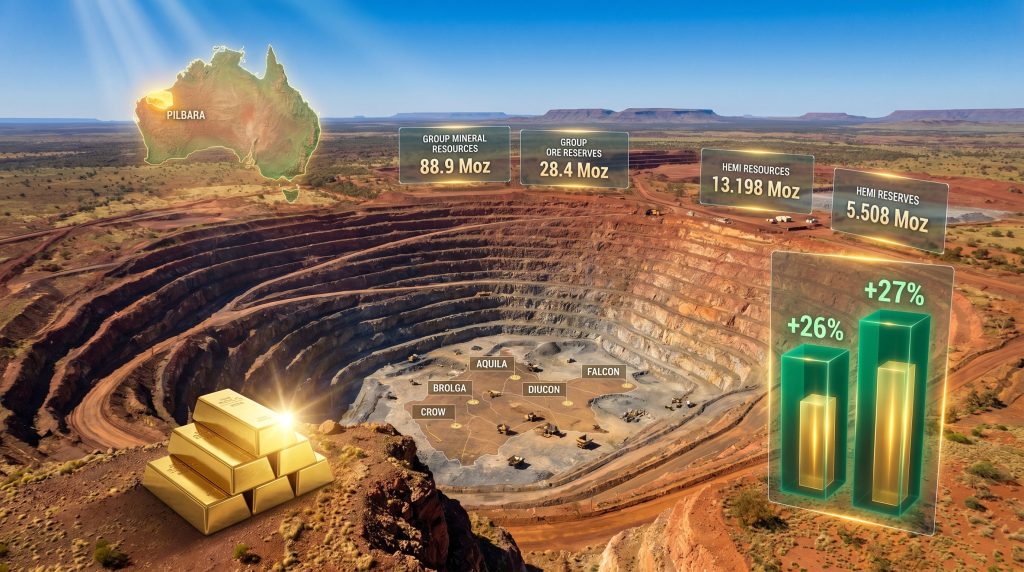
The release of Northern Star's (ASX: NST) updated resource and reserve statement as at 31 March 2026 represents a structural shift in how the company's asset base is measured. The incorporation of Hemi's figures into the group inventory for the first time produced a 26% increase in group mineral resources and a 27% increase in group ore reserves — an uplift scale that is genuinely rare in Australian gold mining when attributable to a single asset addition. Furthermore, this disclosure has significant implications for gold mining equities across the sector.
Group-Level Metrics at a Glance
| Metric | Figure (31 March 2026) | Year-on-Year Change |
|---|---|---|
| Group Mineral Resources | 88.9 Moz | +26% |
| Group Ore Reserves | 28.4 Moz | +27% |
| Hemi Mineral Resources | 13.198 Moz | First disclosure |
| Hemi Ore Reserves | 5.508 Moz | First disclosure |
Hemi's 13.198 million ounce mineral resource now represents approximately 14.8% of Northern Star's total group resource base, while the 5.508 Moz ore reserve accounts for roughly 19.4% of the group's total reserve inventory. The proportional weight of a single project driving nearly a fifth of the company's entire reserve base illustrates just how consequential this first disclosure is from a valuation perspective.
The transition from a project being resource-defined to reserve-defined is one of the most significant re-rating events in the lifecycle of a mining asset. It signals that economic justification, technical confidence, and modifying factor assessments have all cleared the threshold required for public commitment under the JORC Code.
What the JORC Code Actually Requires Before a Reserve Can Be Declared
Understanding why a first-time ore reserve disclosure carries such weight requires a brief explanation of the regulatory framework governing Australian mineral reporting. Under the Joint Ore Reserves Committee (JORC) Code, a mineral resource and an ore reserve are not interchangeable terms. They occupy distinct positions on a confidence and economic justification spectrum.
A mineral resource is an estimation of mineralised material with reasonable prospects for eventual economic extraction. It is categorised as Inferred, Indicated, or Measured based on the density and reliability of geological data. An ore reserve, however, must satisfy a higher and more rigorous standard:
- It must be derived from Indicated or Measured resources only, meaning Inferred material cannot be directly converted.
- It must incorporate modifying factors including mining, metallurgical, infrastructure, economic, marketing, legal, environmental, social, and governmental considerations.
- It must demonstrate that extraction is technically and economically viable under the reporting conditions.
The declaration of 5.508 Moz of ore reserves at Hemi confirms that Northern Star has progressed geotechnical studies, pit optimisation work, metallurgical test programs, and financial modelling to a level where the company is prepared to formally state that this volume of gold is economically extractable. That is a material elevation in technical and commercial confidence. In addition, interpreting drill results from the ongoing infill programmes has been critical in building the data density needed to support these declarations.
The Six Deposits of the Hemi System: Architecture, Grade, and Development Logic
Deposit Breakdown and Structural Roles
| Deposit | Role in the Hemi System |
|---|---|
| Aquila | Primary high-grade resource contributor |
| Brolga | Near-surface open pit target |
| Crow | Satellite deposit with regional upside |
| Diucon | Early-stage delineation zone |
| Eagle | Established resource with reserve conversion |
| Falcon | Exploration-stage with resource growth potential |
The multi-deposit architecture of Hemi is strategically important and somewhat underappreciated in mainstream analysis. Rather than a single ore body requiring a single production decision, the Hemi system offers phased development optionality. Northern Star can sequence pit development to prioritise deposits with the highest grade, lowest strip ratio, or most favourable metallurgical characteristics, while deferring more capital-intensive or lower-confidence zones to later production stages.
This sequencing flexibility is a significant risk management tool. In gold mining, project economics are highly sensitive to the order in which ore is processed. Higher-grade early ore generates stronger early cash flows, which can be recycled into subsequent development phases, reducing reliance on external capital markets during construction.
How Hemi's Reported Figures Have Evolved
It is worth contextualising the current figures against earlier disclosures. Northern Star's April 2025 ASX announcements referenced a global Hemi mineral resource of approximately 13.6 Moz and a probable ore reserve of around 6.0 Moz. The figures as at 31 March 2026 reflect 13.198 Moz in mineral resources and 5.508 Moz in ore reserves, representing a modest reduction between periods.
This reduction is not a signal of asset deterioration. In mining reporting, resource and reserve figures move in response to several routine factors:
- Depletion from any early works or pre-strip activities that consume previously reported inventory.
- Revised cut-off grade assumptions reflecting updated cost estimates or commodity price inputs.
- Model updates following infill or sterilisation drilling that refines the geological interpretation.
- Reclassification of material between confidence categories as additional data refines understanding.
The overall quantum of gold in the ground at Hemi remains one of the largest undeveloped concentrations in Australian gold mining. The direction of travel over successive reporting periods is expected to reflect resource growth from ongoing exploration rather than depletion at this pre-production stage.
Reserve Conversion Ratio: What 42% Tells Investors About Future Upside
Understanding the Conversion Metric
| Metric | Value |
|---|---|
| Hemi Mineral Resources | 13.198 Moz |
| Hemi Ore Reserves | 5.508 Moz |
| Reserve-to-Resource Conversion Ratio | ~41.7% |
A reserve conversion ratio of approximately 42% at first disclosure is consistent with early-stage open pit projects where a material proportion of the total resource sits in the Inferred category, which is ineligible for direct reserve conversion under JORC. For context, mature producing mines with well-drilled resource bases often achieve conversion ratios of 60–70%, while greenfield or early-study projects frequently sit below 50% at initial reserve declaration.
The 42% conversion ratio at Hemi is not a weakness in the asset. It is a direct reflection of where the project sits in its technical study lifecycle, and it implies that substantial incremental reserve conversion is achievable as infill drilling upgrades Inferred resources to the Indicated category required for reserve status.
This distinction matters significantly for investors constructing net asset value models. The current reserve base provides the foundation for initial production planning, but the gap between 13.198 Moz in resources and 5.508 Moz in reserves represents a substantial volume of material with the potential to be converted as the project matures through feasibility study stages.
Pilbara Infrastructure and Regulatory Complexity: The Factors That Don't Appear in Resource Tables
What Operating in the Pilbara Actually Requires
The Pilbara region of Western Australia is geologically prospective but operationally distinct from the established Kalgoorlie gold corridor where Northern Star has decades of infrastructure investment. Developing Hemi requires addressing several infrastructure and regulatory dimensions that are not visible in resource and reserve tables:
- Power supply: The Pilbara lacks the established grid connections available near Kalgoorlie, requiring dedicated power generation solutions. Renewable energy integration with battery storage or gas generation is being considered by multiple Pilbara developers.
- Water access: Western Australia's water licensing framework in the Pilbara involves complex assessments, particularly given the region's arid climate and competing demands from existing iron ore operations.
- Transport and logistics: Road and port access for a future Hemi operation would likely leverage existing Pilbara logistics infrastructure, but purpose-built solutions may be required depending on the final mine design.
- Cultural heritage: Western Australia's Aboriginal Cultural Heritage Act 2021 introduced a significantly more rigorous framework for heritage assessment and consultation than previously existed, and Pilbara projects operate within one of Australia's most heritage-significant regions.
These factors influence project timeline and capital cost estimates. They are being worked through as part of Northern Star's pre-feasibility and environmental study programmes, and their resolution will be critical milestones ahead of any final investment decision.
The next major ASX story will hit our subscribers first
Hemi's Position in the Australian Gold Development Landscape
Contextualising the Scale of the Asset
| Benchmark | Hemi's Position |
|---|---|
| Mineral Resource Size | 13.198 Moz, upper tier of undeveloped Australian gold assets |
| Deposit Style | Intrusion-related, near-surface, lower strip ratio than deep orogenic systems |
| Development Stage | Pre-feasibility to definitive feasibility study transition |
| Reserve Conversion Maturity | ~42%, early stage with significant upside potential |
Most Tier 1 Australian gold mining operations are supported by resource bases ranging from 5 to 15 Moz. Hemi sits firmly at the upper boundary of that range, in the same tier as the asset bases that underpin mines like the Super Pit at Kalgoorlie and Newcrest's Cadia complex in New South Wales. The scale of Hemi is not an incremental addition to Australia's gold pipeline — it is one of the most significant undeveloped gold concentrations the country has seen in a generation.
The original Hemi discovery by De Grey Mining in 2020 fundamentally changed exploration targeting across the Pilbara. Consequently, other companies pivoted exploration programmes toward Hemi-style intrusion-related targets across their Pilbara tenements — a clear indicator of how significantly the discovery reset geological thinking in the region. Gold M&A activity accelerated notably following the discovery, ultimately culminating in Northern Star's acquisition of De Grey Mining, which brought this asset into one of Australia's largest gold producer portfolios.
Production Timeline, Underground Optionality, and Long-Term Cash Flow Implications
The Path from Reserve to Production
The formalisation of Northern Star Hemi mineral resources and ore reserves is a necessary precondition for advancing toward a definitive feasibility study, which is the final technical gate before a Final Investment Decision (FID) can be made. The pathway from current position to first production involves several sequential milestones:
- Completion of a Definitive Feasibility Study with bankable-grade cost and schedule estimates.
- Environmental and heritage approval processes under Western Australian and Commonwealth frameworks.
- Final Investment Decision by the Northern Star board, requiring alignment of project economics with corporate capital allocation priorities.
- Construction and commissioning, typically a three to four year process for a mine of Hemi's scale.
Based on current study timelines, first production at Hemi is broadly anticipated in the mid-2030s, allowing Northern Star's existing KCGM and Pogo operations to continue generating the cash flows that fund Hemi's development capital requirements.
Underground and Regional Upside: The Inventory Beyond Current Reserves
The current reserve base reflects open pit economics. However, Northern Star has identified meaningful underground gold potential beneath the open pit envelopes at multiple Hemi deposits. Underground resources in intrusion-related systems can extend at depth following the same geological controls as surface mineralisation, potentially adding decades to mine life beyond the open pit phase.
Regional tenements surrounding the core Hemi deposits add another layer of optionality. The geological corridor hosting the six named Hemi deposits is extensive, and systematic regional exploration has the potential to deliver new resource additions without requiring the discovery of an entirely new geological system. Northern Star's Hemi development project page provides further technical context on the scope of this exploration pipeline.
What Northern Star's Expanded Inventory Means for Its Standing Among Global Gold Producers
Scale Comparison: Where 88.9 Moz Positions Northern Star
With 88.9 Moz in group mineral resources and 28.4 Moz in group ore reserves, Northern Star's inventory now places it in direct comparison with global mid-tier to major gold producers. For reference, globally recognised mid-tier gold companies typically operate on reserve bases of 10–25 Moz, while major producers like Newmont and Barrick operate with reserve bases exceeding 80–90 Moz and 75 Moz respectively.
The addition of Hemi's reserve base moves Northern Star meaningfully along that spectrum. For institutional investors who benchmark gold equity allocations against inventory scale and mine life visibility, the expanded reserve base provides a material argument for re-rating the company's long-term valuation profile. Furthermore, Northern Star's resources and reserves overview provides the complete group-level inventory breakdown for investors seeking additional detail.
The significance of reserve scale in gold equity valuation lies in its relationship to mine life. Longer mine lives support lower capital intensity per ounce over time and provide greater scope for operational optimisation, cost reduction, and throughput expansion decisions that compound value over decades.
Overall, the formalisation of Northern Star Hemi mineral resources and ore reserves marks a decisive step in the asset's journey from exploration discovery to globally significant gold development project — one that will continue to shape the Australian gold sector's outlook for years to come.
Disclaimer: This article contains forward-looking statements and analysis based on publicly available information. It does not constitute financial advice. Past performance of mining projects and resource estimates are not indicative of future results. Mineral resource and ore reserve estimates are subject to ongoing revision as new geological, technical, and economic information becomes available. Readers should conduct their own due diligence before making investment decisions.
For ongoing coverage of Northern Star Hemi mineral resources and ore reserves updates, and broader Australian gold sector developments, visit australianminingreview.com.au.
Want to Be First When the Next Hemi-Scale Discovery Hits the ASX?
Discovery Alert's proprietary Discovery IQ model scans ASX announcements in real time, delivering instant alerts on significant mineral discoveries — the kind that can reshape company valuations overnight, just as De Grey Mining's original Hemi discovery did in 2020. Explore historic discoveries and their returns to understand the scale of opportunity, then begin your 14-day free trial to ensure you're positioned ahead of the broader market when the next major find is announced.