July 22, 2026
When Reliable Producers Become the Backbone of Global Energy Security
The global oil market has always rewarded reliability, but that premium has rarely been as visible as it is today. Across decades of petroleum history, the producers that consistently delivered predictable volumes attracted long-term buyers, anchored pricing benchmarks, and shaped the geopolitical calculus of importing nations. That dynamic has never mattered more than in the current environment, where shipping chokepoints face sustained disruption, Middle Eastern export logistics remain deeply uncertain, and European energy planners are actively searching for supply sources that will not evaporate overnight.
Against that backdrop, the Norwegian Continental Shelf has quietly reasserted itself as one of the most operationally dependable production zones in the world. When Norway oil output beats forecasts, it does more than generate a single month's positive data point. It reinforces a structural narrative about the North Sea's capacity to outperform conservative decline projections, and it arrives at a moment when the global supply picture is far more fragile than headline production statistics might suggest.
When big ASX news breaks, our subscribers know first
Norway's June 2026 Production: The Numbers Behind the Headline
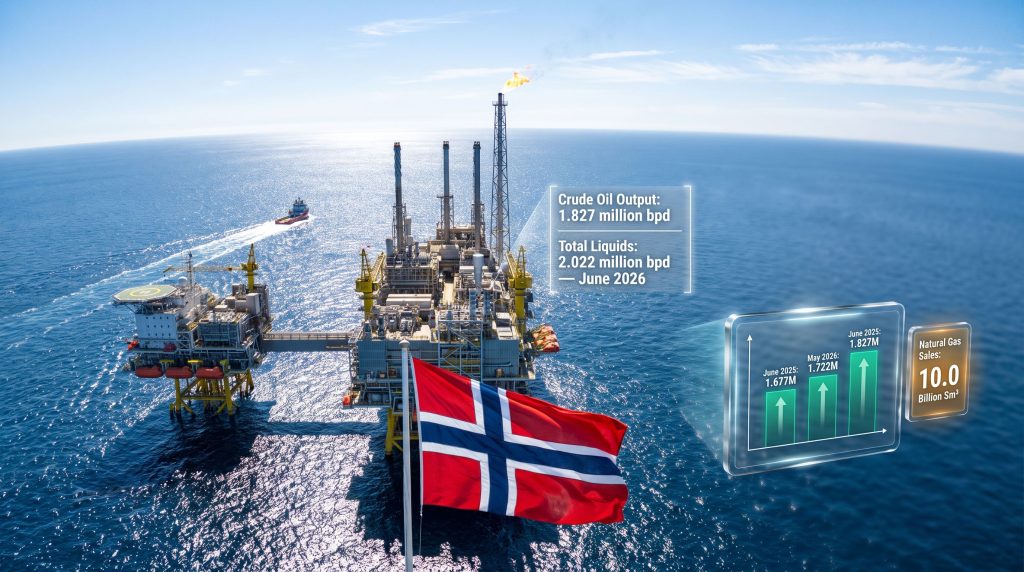
Preliminary figures published by the Norwegian Offshore Directorate (SODIR) on 22 July 2026 confirmed that Norwegian crude oil production averaged 1.827 million barrels per day (bpd) in June, surpassing the agency's official forecast and representing a year-on-year increase of approximately 150,000 bpd from the 1.677 million bpd recorded in June 2025. That translates to a year-on-year gain of roughly 8.9%, a figure that carries significant weight in a mature producing basin that many analysts have long modelled as being in structural decline.
Including natural gas liquids (NGL) and condensate, total liquids output climbed to 2.022 million bpd in June, up from 1.909 million bpd in May. Natural gas sales also recovered meaningfully after seasonal maintenance, reaching 10.0 billion standard cubic metres (Sm³) compared to 9.4 billion Sm³ the previous month.
| Production Metric | June 2026 | May 2026 | June 2025 | Year-on-Year Change |
|---|---|---|---|---|
| Crude Oil (bpd) | 1.827 million | ~1.714 million | 1.677 million | +~150,000 bpd (+8.9%) |
| Total Liquids (bpd) | 2.022 million | 1.909 million | N/A | +113,000 bpd (MoM) |
| Natural Gas Sales (Sm³) | 10.0 billion | 9.4 billion | N/A | +0.6 billion Sm³ (MoM) |
What makes this data particularly significant is its context. The June rebound reflects fields returning from scheduled seasonal maintenance, a pattern that creates predictable but often underestimated upside in the months following planned downtime. For European crude buyers managing inventory positions, the timing of this recovery matters as much as the volume itself. Furthermore, understanding the broader LNG supply outlook helps contextualise why Norwegian gas volumes are drawing increasing attention from European energy planners.
A Pattern of Outperformance: Norway's 2026 Forecast Record
May 2026 Already Signalled the Trend
June's upside surprise did not emerge in isolation. May 2026 had already demonstrated the same dynamic, with Norwegian crude oil output averaging 1.722 million bpd against an official SODIR forecast of approximately 1.607 million bpd, representing a deviation of +7.2%. Total liquids in May came in at 1.909 million bpd against a forecast of approximately 1.855 million bpd, a positive deviation of +2.9%. Year-to-date production through May 2026 reached 102.6 million standard cubic metres of oil equivalent, running approximately 4% ahead of the same period in 2025.
| Metric | May 2026 Actual | May 2026 Forecast | Deviation |
|---|---|---|---|
| Crude Oil Output | 1.722 million bpd | ~1.607 million bpd | +7.2% |
| Total Liquids | 1.909 million bpd | ~1.855 million bpd | +2.9% |
| Year-to-Date (Jan–May) | 102.6 million scm o.e. | N/A | +4% vs 2025 |
When consecutive months both exceed official projections by meaningful margins, it is no longer statistically reasonable to attribute the divergence to random variation. Instead, it points to a structural feature of how SODIR constructs its decline-curve models and how actual field performance compares to those conservative assumptions.
Why Official Models Tend to Underestimate Norwegian Fields
SODIR's forecast methodology is deliberately conservative, anchoring projections to established decline trajectories for individual fields rather than incorporating real-time operational improvements. This approach has merit from a regulatory standpoint, where underestimating output is generally preferable to overstating it. However, it means that when operators invest in production optimisation, improve injection well performance, or commission new subsea tiebacks that lift recovery rates on existing reservoirs, actual output routinely exceeds the modelled baseline.
The phenomenon is particularly pronounced at large, technically sophisticated fields where operators have both the capital and incentive to push recovery factors higher than original development plans assumed. In mature offshore basins, enhanced oil recovery (EOR) techniques, including water flooding optimisation, polymer injection, and improved artificial lift systems, can meaningfully extend plateau production without the need for entirely new discoveries.
The repeated pattern of positive forecast deviations across 2026 suggests that Norwegian Continental Shelf operators have achieved a level of production optimisation that official decline-curve modelling has not yet fully captured. For energy planners, this represents a structural upside risk to supply projections through at least 2027.
The Anchor Fields: Johan Sverdrup, Troll, and Johan Castberg
Understanding why Norway oil output beats forecasts repeatedly in 2026 requires examining the specific assets driving the outperformance. Three fields in particular underpin the Continental Shelf's above-projected performance:
- Johan Sverdrup is Norway's largest producing field, operated by Equinor, and has consistently delivered above its initial production targets since reaching full capacity. The field benefits from a highly efficient subsea template design and some of the lowest per-barrel production costs in the North Sea, making it economically viable to pursue aggressive uptime optimisation.
- Troll remains one of the world's largest gas and oil fields in operation and has been producing for over three decades. Continuous reinvestment in compression capacity and subsea infrastructure has sustained production levels that simple decline curves would not predict.
- Johan Castberg, located in the Barents Sea and brought into production in late 2024, is still in its ramp-up phase. Fields in early production phases typically track above long-term decline models because operators prioritise maximising plateau output before natural reservoir depletion accelerates.
The collective operational uptime across these three assets, combined with improved maintenance scheduling that minimises unplanned shutdowns, directly explains the gap between SODIR forecasts and actual June 2026 production. According to official Norwegian production forecasts, these fields are expected to remain central to the country's output profile for several years to come.
Norway in the Non-OPEC Landscape: Bucking Structural Decline
How the North Sea Compares to Peer Basins
Most mature offshore basins globally, including the UK Continental Shelf, the US Gulf of Mexico's legacy fields, and older West African producing regions, exhibit the declining production profiles that textbook petroleum engineering predicts. Norway's ability to sustain and even grow output in this environment reflects a combination of factors that are rarely replicated elsewhere:
- Sustained capital investment by major operators across field life cycles
- A regulatory framework that encourages long-term field development planning
- High technical standards for offshore infrastructure maintenance
- Access to one of the world's deepest pools of petroleum engineering expertise
- A fiscal regime that historically incentivised reinvestment rather than capital extraction
The result is a producing basin that routinely surprises to the upside during what should theoretically be years of declining output. SODIR's own longer-term projections indicate that Norwegian production should maintain a plateau through approximately 2027 before entering a gradual decline toward 2030. If the current pace of outperformance continues, that plateau phase may prove longer than current official projections suggest, though this remains speculative and no formal upward revision to the outlook has yet been issued.
The Strait of Hormuz Factor: Why Norwegian Reliability Has Acquired a New Premium
Tanker Traffic and the Geopolitical Supply Squeeze
The broader significance of June's Norwegian production beat cannot be understood without accounting for what is simultaneously happening at the opposite end of the global supply chain. Vessel-tracking data cited by Reuters from Kpler has shown tanker traffic through the Strait of Hormuz remaining close to the severely depressed levels recorded at the height of the recent conflict period in the Persian Gulf. On certain recent trading days, data showed near-zero sailings by Very Large Crude Carriers (VLCCs) and LNG tankers through the waterway.
The Strait of Hormuz handles a disproportionate share of global crude and LNG flows. When tanker traffic through this chokepoint drops toward crisis levels, the global supply balance tightens in ways that production statistics alone cannot fully capture. Vessel availability, cargo insurance costs, and buyer risk appetite all shift dramatically.
This context reframes what might otherwise appear to be a routine monthly production update from a North Sea regulator. Every additional barrel that Norway delivers above forecast is a barrel that European refiners do not need to source from a region where logistical risk is currently elevated and cargo delivery timelines are uncertain. The crude oil price trends emerging from this environment illustrate just how sensitively markets are responding to reliable supply alternatives.
OPEC+ Quotas and the Translation Problem
OPEC+ is scheduled to increase collective production targets by 188,000 bpd in August 2026. Under normal market conditions, a quota increase of this magnitude would apply meaningful downward pressure to Brent prices. However, the persistent disruption to Persian Gulf shipping logistics raises a critical question that markets are actively debating: can higher OPEC+ quotas actually translate into additional barrels reaching consuming nations when the primary export route faces ongoing physical and geopolitical constraints?
The answer, for now, appears to be only partially. OPEC's market influence has historically shaped global supply expectations, but when Gulf export logistics are impaired, paper quota increases do not automatically become physical supply additions for European or Asian buyers. This creates a structural divergence between announced OPEC+ output targets and actual delivered supply, and it is precisely this gap that makes above-forecast Norwegian production more valuable than its absolute volume would suggest. Furthermore, recent OPEC demand revisions have added another layer of complexity to how markets are pricing in future supply adequacy.
The next major ASX story will hit our subscribers first
Europe's Energy Security Architecture: Norway's Dual Role
Beyond Crude: The Gas Dimension
Norway's importance to European energy markets extends well beyond crude oil. Following the sharp curtailment of Russian pipeline gas deliveries to continental Europe, Norway has assumed the position of Europe's single largest natural gas supplier. The June 2026 gas sales figure of 10.0 billion Sm³ represents a meaningful contribution to the pipeline volumes that European storage operators and utilities depend upon to enter the winter period with adequate inventory cushions.
The combination of crude oil and natural gas exports makes Norway structurally irreplaceable within the European energy security framework in a way that no single Middle Eastern producer can match. Unlike LNG, which requires liquefaction terminals, specialist vessels, and regasification infrastructure, Norwegian pipeline gas delivers directly into the Continental European grid system with minimal additional logistics risk.
Inventory Tightness Across European Consuming Hubs
Commercial crude inventories in several major European consuming regions have been running at relatively tight levels through the first half of 2026, a condition that reflects both demand resilience and the supply disruptions affecting Middle Eastern export flows. In this environment, Norwegian barrels arriving on an above-forecast schedule provide more than just additional volume. They provide timing certainty, which for refinery operators managing turnaround schedules and blending requirements is often as valuable as the volume itself.
The ongoing trade war oil impacts have, however, introduced additional uncertainty into European import planning, making the predictability of Norwegian supply even more commercially significant for regional buyers.
Scenario Analysis: Three Pathways for European Energy Markets in H2 2026
| Scenario | Norwegian Output Trajectory | European Supply Impact | Brent Price Implication |
|---|---|---|---|
| Scenario 1: Maintenance Disruption + Hormuz Closure | Shortfall from unplanned downtime | Significant tightening | Strong upward price pressure |
| Scenario 2: Continued Outperformance Through Q3 2026 | Sustained above-forecast volumes | Partial offset to Gulf disruptions | Moderate geopolitical risk premium sustained |
| Scenario 3: Post-2027 Decline Accelerates | Output declines faster than projected | Structural supply gap emerges for Europe | Long-term upward repricing of European crude benchmarks |
Disclaimer: The scenarios above represent analytical frameworks for assessing potential market outcomes and do not constitute investment advice. Actual outcomes will depend on a wide range of variables including geopolitical developments, operational decisions by field operators, and broader macroeconomic conditions.
Of these three scenarios, Scenario 2 appears most consistent with the data currently available through June 2026. However, Scenario 3 deserves particular attention from long-term energy planners. If the current plateau phase proves shorter than SODIR projects, or if capital investment in Norwegian field development decelerates due to energy transition pressures on upstream spending, Europe could face a structural crude supply shortfall from its most reliable non-OPEC source sooner than current consensus forecasts imply.
Frequently Asked Questions: Norway Oil Output and Global Supply
What Does It Mean When Norway's Oil Output Beats Forecasts?
When Norwegian production exceeds SODIR's official projections, it indicates that offshore fields are performing above the conservative decline trajectories embedded in official modelling. In practical terms, this generates additional barrels entering European markets, contributing to inventory builds or offsetting shortfalls from other producing regions.
How Much Oil Does Norway Produce Per Day in 2026?
Norway's crude oil production averaged 1.827 million barrels per day in June 2026, with total liquids output including NGL and condensate reaching 2.022 million bpd for the same month. Detailed reporting from Reuters has further confirmed the consistency of this outperformance across recent months.
Why Is Norway Important to European Energy Security?
Norway functions as Europe's largest natural gas supplier and a significant crude oil exporter. Reliable Norwegian Continental Shelf production has become increasingly critical following the sharp reduction in Russian pipeline gas deliveries, making consistent above-forecast output a meaningful stabilising factor for continental energy markets.
What Is SODIR?
The Norwegian Offshore Directorate is the Norwegian government agency responsible for regulating and monitoring petroleum activities on the Norwegian Continental Shelf. It publishes monthly preliminary production figures that serve as the primary benchmark for measuring actual output against official projections.
What Is Norway's Long-Term Production Outlook?
Regulators currently project that Norwegian production will maintain a plateau through approximately 2027, followed by a gradual decline toward 2030. The consistent above-forecast performance observed throughout 2026 may extend the plateau phase, though no official upward revision to this outlook has been issued.
How Does the Strait of Hormuz Crisis Affect Norway's Market Position?
Persistent disruptions to tanker traffic through the Strait of Hormuz have elevated the strategic value of reliable non-Middle Eastern producers. Norway's capacity to deliver above-forecast volumes during this period directly benefits European buyers seeking to reduce exposure to Gulf supply logistics risk.
What the Production Data Tells Energy Markets Heading Into H2 2026
The recurring pattern of Norwegian Continental Shelf outperformance is not a statistical anomaly. It reflects real operational achievements by field operators, structural features of Norwegian reservoir management, and a regulatory environment that has historically supported long-term investment in North Sea assets.
For traders, energy planners, and policymakers, the key insight is not simply that Norway oil output beats forecasts in any given month. It is that the mechanism generating these positive surprises — namely the combination of world-class field operators, modern subsea infrastructure, and a conservative forecast methodology that systematically underestimates production optimisation — is likely to persist through at least the end of the current plateau phase.
In a global market where the Strait of Hormuz remains a source of acute logistical anxiety, where OPEC+ quota increases face delivery uncertainty, and where European energy security planning has been fundamentally reshaped by the withdrawal of Russian pipeline gas, the reliability premium attached to Norwegian barrels has never been more commercially and strategically relevant.
The months ahead will test whether Scenario 2 can be sustained or whether planned and unplanned maintenance events begin to compress the outperformance gap. Either way, the Norwegian Continental Shelf will remain one of the most closely watched production zones in global energy markets for the remainder of 2026 and beyond.
Want to Capitalise on the Next Major Resource Discovery Before the Broader Market?
Whilst Norwegian production reliability is reshaping global energy security, Discovery Alert's proprietary Discovery IQ model is scanning ASX announcements in real time to identify significant mineral discoveries the moment they are made public — delivering actionable insights to subscribers ahead of the market, just as historic discoveries like those by De Grey Mining and WA1 Resources demonstrated the transformative returns early-movers can capture. Begin your 14-day free trial at Discovery Alert today and position yourself at the forefront of the next major ASX mineral discovery.