July 17, 2026
The Recycling Paradox at the Heart of South Korea's Aluminium Industry
Across the global metals landscape, a quiet but consequential shift is underway. The Novelis Korea KONMA aluminium committee represents precisely this kind of structural change — industries that once treated aluminium governance as a peripheral concern are now recognising it as a strategic lever, one capable of shaping trade outcomes, decarbonisation trajectories, and supply chain resilience simultaneously. South Korea's decision to formalise this recognition through a dedicated institutional structure within its peak nonferrous metals body is a development worth examining closely.
When big ASX news breaks, our subscribers know first
Understanding KONMA and Its New Aluminium Committee
The Korea Nonferrous Metals Association, widely known as KONMA, functions as South Korea's central advocacy and coordination body for companies operating across the nonferrous metals sector. Its mandate spans copper, zinc, nickel, aluminium, and related materials, covering everything from policy representation to trade facilitation and industry development programming.
What makes 2026 notable is KONMA's decision to establish a standalone Aluminium Committee, a structure that deliberately separates aluminium governance from the broader nonferrous metals framework. This move reflects the growing recognition that aluminium's industrial, environmental, and geopolitical dimensions have become complex enough to require dedicated institutional attention rather than shared committee bandwidth.
The rationale for this separation becomes clearer when examined through the lens of aluminium's unique properties and expanding end-use profile. Unlike many industrial metals, aluminium sits at the intersection of multiple simultaneous macro forces: the global energy transition, evolving carbon border adjustment mechanisms, the electric vehicle growth supply chain buildout, and increasingly stringent sustainability reporting requirements affecting downstream manufacturers.
"The formation of a dedicated aluminium committee within an established nonferrous metals association signals a maturation of South Korea's industrial policy approach, moving from reactive sector compliance toward proactive standards-setting and regulatory co-design."
Who Chairs the Committee and Why It Matters
The selection of Choi Min-young, Director of Government Affairs at Novelis Korea, as the inaugural Chair of the KONMA Aluminium Committee carries deliberate strategic logic. Placing a government affairs specialist at the helm of a newly formed industry body, rather than a technical, commercial, or operational executive, signals clearly what the committee's primary output is intended to be: policy influence, regulatory engagement, and trade standard co-development.
This is a meaningful distinction. Technical committees typically focus on specifications, process standards, or research coordination. A committee led by a government affairs director is architecturally oriented toward shaping the external environment in which its member companies operate, influencing legislation before it is finalised, contributing to regulatory consultations, and building relationships with policymakers that translate into competitive advantage over time.
Novelis Korea's participation in this leadership role reflects the company's broader positioning within South Korea's aluminium ecosystem. Operating through its stake in the Ulsan Aluminum Ltd. joint venture, Novelis Korea is embedded in the country's downstream manufacturing infrastructure and has direct commercial exposure to the policy settings the committee will seek to influence. Furthermore, the Novelis Korea ASI recertification against the Chain of Custody Standard underscores the company's demonstrated commitment to responsible sourcing and traceability across its operations.
"Industry observers note that embedding a government affairs director within the peak industry body's leadership structure creates a channel for early regulatory intelligence and policy co-design access that operational executives rarely obtain through conventional industry engagement."
The Core Mandates: Three Pillars of Committee Activity
The KONMA Aluminium Committee has articulated three broad areas of focus that together define its operational scope.
Policy Development and Regulatory Engagement
The committee intends to develop structured policy recommendations for South Korean government bodies covering aluminium-related trade standards and environmental compliance frameworks. This includes coordinating the sector's response to evolving global trade regulations, particularly carbon border adjustment mechanisms that are beginning to reshape the economics of aluminium imports and exports across major trading blocs.
Aligning South Korea's aluminium producers and processors with international sustainability reporting requirements is also on the agenda, a priority driven by the growing number of Korean manufacturers supplying into European and North American value chains where Scope 3 emissions accountability is becoming a commercial prerequisite. In addition, the committee's work on green transition materials positions South Korea to engage proactively with international policy frameworks rather than simply adapting to them retrospectively.
Supply Chain Stability and Resilience
South Korea does not possess significant domestic bauxite or primary aluminium smelting capacity, making it structurally dependent on imported primary metal and vulnerable to commodity price cycles driven by factors entirely outside its control. The committee aims to coordinate member company strategies to reduce this exposure, improve raw material predictability for downstream manufacturers, and address vulnerabilities in upstream sourcing arrangements.
Circular Economy Acceleration
Perhaps the most commercially urgent mandate centres on advancing closed-loop recycling, particularly can-to-can recycling, as a strategic priority. The committee is focused on developing policy frameworks that incentivise high-quality aluminium scrap recovery and reuse, and on repositioning recycled aluminium as a premium industrial input rather than a secondary-grade commodity.
The Data Behind the Urgency: South Korea's Recycling Gap
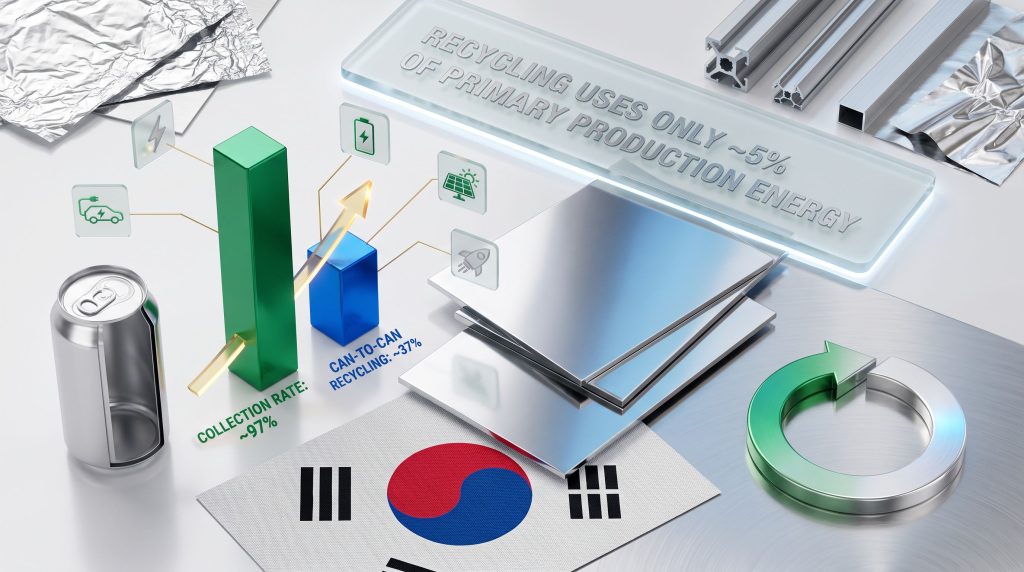
The most striking data point underpinning the committee's formation is the divergence between South Korea's aluminium can collection rate and its actual closed-loop recycling performance.
| Metric | Current Rate |
|---|---|
| Used aluminium beverage can collection rate | ~97% |
| Can-to-can closed-loop recycling rate | ~37% |
| Energy required vs. primary production | ~5% (recycling) |
On the surface, a 97% collection rate appears to represent world-class recycling performance. The reality is considerably more nuanced. Collecting a used aluminium can and returning it to equivalent-quality can stock are fundamentally different industrial processes. South Korea currently converts only around 37% of collected cans back into comparable-grade aluminium through genuine closed-loop recycling, leaving a 60-percentage-point gap between collection and quality recovery.
The balance is lost to contamination, alloy downgrading through mixed-scrap processing, and the export of scrap to overseas markets where it enters secondary material streams at lower value. Each of these pathways represents an economic and environmental loss compared to what closed-loop processing could deliver.
"Leading European aluminium markets have achieved can-to-can recycling rates in the range of 70 to 80 percent. Closing even half the gap between South Korea's current 37 percent rate and these benchmarks would represent a transformative improvement in the country's aluminium circularity profile."
This distinction between collection efficiency and recycling quality is a lesser-understood aspect of aluminium sustainability metrics that often gets obscured by headline recovery statistics. The KONMA Aluminium Committee's specific focus on improving closed-loop rates, rather than simply collection rates, reflects a sophisticated understanding of where genuine value creation and emissions reduction potential actually reside.
Why Aluminium's Physical Properties Make This Policy Work Unique
Aluminium possesses a characteristic that distinguishes it from the majority of structural and packaging materials: it can be recycled an essentially unlimited number of times without any degradation in its physical properties or performance characteristics. This is not merely a marketing claim but a metallurgical reality rooted in aluminium's atomic structure and the thermodynamics of its reprocessing.
The energy economics reinforce the strategic importance of recycling. Producing aluminium from recycled scrap requires approximately 5% of the energy consumed in primary smelting from bauxite ore through the Bayer and Hall-Heroult processes. At scale, this differential translates into dramatically lower greenhouse gas emissions per tonne of metal produced, a factor of growing commercial relevance as South Korean manufacturers face increasing pressure to reduce Scope 3 emissions across their supply chains.
For a country without meaningful primary smelting capacity, this energy arithmetic makes expanding domestic recycled aluminium supply a national resource security strategy as much as an environmental one. Every tonne of high-quality aluminium recovered through closed-loop recycling is a tonne that does not need to be imported as primary metal at LME-linked prices subject to global commodity volatility. Notably, aluminium decarbonisation investment by major global players signals that this shift is already reshaping capital allocation decisions across the wider industry.
The next major ASX story will hit our subscribers first
Sector-by-Sector Demand: Why Urgency Is Building Now
The timing of the committee's formation is not coincidental. Multiple end-use sectors critical to South Korea's industrial base are simultaneously expanding their aluminium consumption, creating a compounding demand signal that elevates supply chain governance from a background concern to a foreground priority.
| End-Use Sector | Primary Growth Driver | Key Aluminium Application |
|---|---|---|
| Electric Vehicles | Accelerating EV adoption and domestic manufacturing | Body panels, battery housings, chassis lightweighting |
| Defence | Expanding domestic procurement programs | Structural components, high-strength alloy systems |
| Aerospace | Regional aerospace manufacturing growth | High-specification sheet and extrusion products |
| Rechargeable Batteries | Battery gigafactory buildout in Korea | Cathode current collector foil (aluminium foil) |
| Energy Infrastructure | Renewable energy deployment programs | Solar panel frames, grid transmission systems |
| Construction | Green building standard requirements | Curtain wall systems, roofing, architectural cladding |
The battery connection deserves particular attention. Aluminium foil serves as the cathode current collector in lithium-ion battery cells, a role that is less frequently discussed than aluminium's structural applications in EVs but no less important. Consequently, surging battery raw materials demand is creating quality-sensitive requirements that are poorly served by downgraded scrap-sourced material, further elevating the committee's circular economy mandate.
South Korea's Position in the Northeast Asian Aluminium Governance Landscape
A broader industry governance trend provides important context for understanding why this committee structure matters beyond its immediate Korean domestic application. Across major aluminium-consuming economies, industry associations have increasingly adopted formal committee structures as mechanisms for shaping regulatory outcomes rather than simply responding to them.
European Aluminium, the industry body representing producers and downstream processors across the EU, has used its committee architecture extensively to influence the design of the Carbon Border Adjustment Mechanism and to shape sustainability certification frameworks. The Aluminum Association in North America performs a comparable function in relation to US trade policy and procurement standards.
South Korea's establishment of the KONMA Aluminium Committee positions it to participate in these international standard-setting conversations from a credible institutional base. Over time, this creates potential for the committee to serve as a regional counterpart body in bilateral trade and sustainability discussions involving Northeast Asian aluminium trade flows. The aluminium industry leaders operating across this region will increasingly look to such institutional structures to navigate evolving regulatory complexity.
Japan's aluminium industry associations offer a relevant comparative reference point. Through sustained committee-based engagement with trade ministries and environmental regulators, Japanese aluminium bodies have secured favourable regulatory treatment on scrap import classifications and maintained influence over Asia-Pacific trade norms in ways that individually operating companies could not have achieved.
Novelis Korea's Strategic Position Within the Committee
For Novelis Korea, the committee chairmanship represents more than a governance contribution. Novelis Inc., the parent organisation, operates as one of the world's largest aluminium rolling and recycling companies, with recycling embedded as a core commercial and strategic competency rather than a secondary activity. Its South Korean operations are naturally aligned with a committee whose circular economy mandate centres on exactly the capabilities Novelis has built its global business model around.
Early positioning within the committee's leadership structure provides access to regulatory intelligence before it is formalised, opportunities to contribute to standard-setting processes that govern recycled aluminium quality specifications, and a platform for shaping the procurement frameworks that will influence which companies benefit from expanded closed-loop recycling programs. Indeed, the recent opening of Novelis' $65m recycling facility in South Korea illustrates the tangible infrastructure investment underpinning this strategic commitment.
This does not represent a conflict of interest so much as the natural outcome of how industry governance structures function across mature metals markets: the companies with the most developed capabilities in a given technical area tend to contribute most meaningfully to the committees tasked with governing that area.
FAQ: Novelis Korea, KONMA, and the Aluminium Committee
What is KONMA?
The Korea Nonferrous Metals Association is South Korea's peak industry body representing companies operating across the nonferrous metals sector, including aluminium, copper, zinc, and related materials. It advocates for member interests through policy engagement, trade support, and industry development programs.
What is the KONMA Aluminium Committee?
A newly established standing committee within KONMA, created in 2026 to provide dedicated governance, policy advocacy, and strategic coordination for the Novelis Korea KONMA aluminium committee's broader industry constituency.
Who chairs the KONMA Aluminium Committee?
Choi Min-young, Director of Government Affairs at Novelis Korea, was appointed as the committee's inaugural Chair upon its establishment in 2026.
Why does South Korea's can-to-can recycling rate matter?
Despite collecting approximately 97% of used aluminium beverage cans, South Korea converts only around 37% back into equivalent-quality can stock through closed-loop recycling. The remaining material is either downcycled or exported as scrap, representing a significant loss of economic and environmental value.
How does recycled aluminium support carbon neutrality goals?
Recycling aluminium consumes approximately 5% of the energy required for primary production, substantially reducing associated greenhouse gas emissions. Expanding closed-loop recycling is therefore a high-leverage strategy for South Korean manufacturers seeking to reduce their carbon footprint across the value chain.
What is Novelis Korea's connection to the broader Novelis group?
Novelis Korea operates as part of Novelis Inc., a global leader in aluminium rolling and recycling. Its South Korean operations include participation in the Ulsan Aluminum Ltd. joint venture, supporting downstream manufacturing for automotive, packaging, and industrial customers.
This article is intended for informational purposes only and does not constitute financial or investment advice. Forecasts and projections referenced within reflect industry analysis and publicly available data, and are subject to change based on market, regulatory, and geopolitical conditions.
Want to Stay Ahead of the Next Major ASX Mineral Discovery?
Discovery Alert's proprietary Discovery IQ model scans ASX announcements in real time, transforming complex commodity data into clear, actionable insights across more than 30 minerals — so investors can act on significant discoveries the moment they emerge. Start your 14-day free trial today, or explore Discovery Alert's discoveries page to see how historic ASX mineral finds have delivered extraordinary returns.