August 5, 2026
The global nuclear fuel cycle represents a complex web of interdependent supply chains, where strategic control over enrichment capabilities determines national energy security. Furthermore, examining current uranium market volatility reveals that the concentration of enrichment capacity among a limited number of geopolitical actors creates systemic vulnerabilities that extend far beyond energy supply considerations.
Modern nuclear reactor technology requires precisely controlled uranium fuel compositions, yet achieving these specifications remains technically challenging and capital-intensive. The gap between theoretical enrichment requirements and practical industrial capacity continues to constrain advanced reactor deployment worldwide, consequently forcing nations to reassess their strategic fuel cycle policies.
Strategic Context Behind America's Nuclear Independence Push
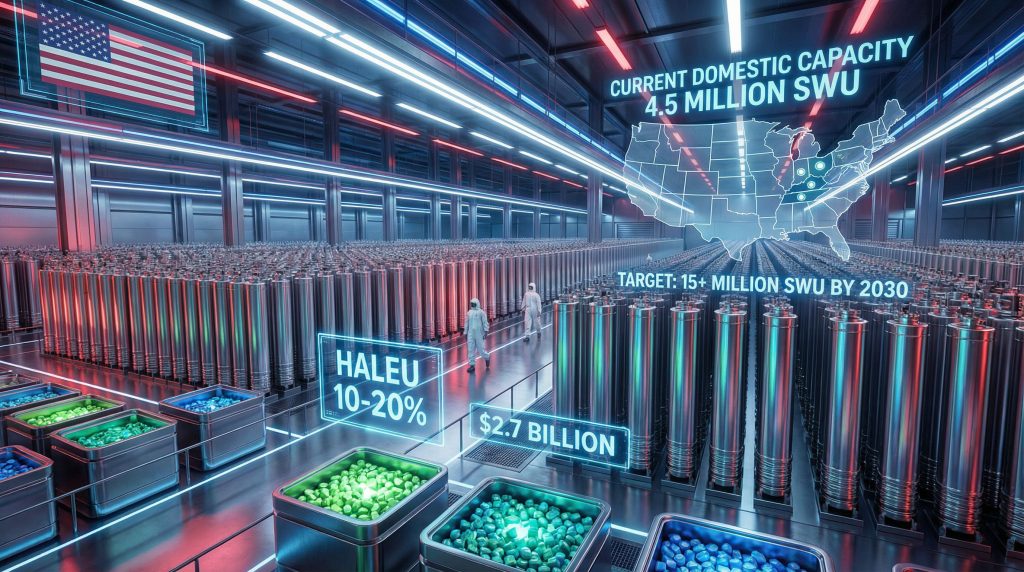
The United States currently faces an unprecedented uranium enrichment capacity deficit that has accumulated over more than a decade. Following the closure of the Paducah Gaseous Diffusion Plant in 2013, domestic enrichment capability dropped to just 4.5 million separative work units (SWU) annually, while national demand exceeds 20 million SWU for low-enriched uranium and requires an additional 10+ tonnes of high-assay low-enriched uranium (HALEU).
This strategic vulnerability prompted the Department of Energy to allocate $2.7 billion in milestone-based contracts spanning decade-long task orders, representing the most significant federal investment in domestic nuclear fuel infrastructure since the Manhattan Project era. The US uranium enrichment funding framework specifically targets three critical pathways: HALEU production acceleration, LEU capacity expansion, and next-generation enrichment technology development.
Since 2013, the Urenco USA facility at Eunice, New Mexico has served as the sole commercial enrichment operation on American soil, though it utilises European centrifuge designs manufactured in the Netherlands. This dependency on foreign technology and the absence of domestically-owned enrichment capacity highlighted the strategic risks inherent in critical nuclear infrastructure reliance.
The Department of Energy characterised this investment as a mechanism to "transition the United States away from foreign sources of uranium and diversify the nation's domestic fuel supply," indicating recognition of supply chain vulnerability as a strategic national security concern requiring immediate federal intervention.
When big ASX news breaks, our subscribers know first
The Technical Foundation of Nuclear Independence
Natural uranium contains approximately 0.7% uranium-235 (U-235), the fissile isotope capable of sustaining nuclear fission reactions necessary for energy production. Commercial nuclear reactors require significantly higher concentrations of this isotope, necessitating sophisticated enrichment processes that increase U-235 content through industrial-scale isotopic separation.
Standard light-water reactors operate on fuel containing 3.5-5% U-235 enrichment, classified as low-enriched uranium (LEU). However, next-generation advanced reactor designs and small modular reactors demand higher enrichment levels, including LEU+ at 5-10% concentrations and high-assay low-enriched uranium (HALEU) at 10-20% concentrations.
The enrichment process involves converting natural uranium into gaseous uranium hexafluoride (UF₆), which then passes through cascaded centrifuge configurations. The heavier uranium-238 isotope concentrates toward the outer edge of each centrifuge while lighter uranium-235 migrates inward, enabling isotopic separation across multiple cascade stages.
This technical foundation becomes critical for understanding the complexity differential between LEU and HALEU production. Higher enrichment levels require extended centrifuge cascade chains, tighter isotopic separation specifications, enhanced quality control monitoring systems, and fundamentally different operational parameters compared to standard reactor fuel production.
Critical Infrastructure Gaps in the US Supply Chain
Current domestic enrichment capacity represents a 78% supply gap for LEU production, with annual demand of approximately 20 million SWU against domestic capacity of 4.5 million SWU. The HALEU supply situation presents even more acute challenges, with projected annual demand of 10 tonnes against current domestic capacity of less than 1 tonne, representing a 90%+ supply deficit.
| Enrichment Type | Annual US Demand | Current Domestic Capacity | Supply Gap |
|---|---|---|---|
| LEU (3.5-5%) | ~20 million SWU | ~4.5 million SWU | 78% |
| HALEU (10-20%) | ~10 tonnes projected | <1 tonne | 90%+ |
Perhaps most critically, no commercial HALEU production capacity existed outside Russia prior to 2024, creating a complete absence of non-Russian commercial alternatives for advanced reactor fuelling. This supply monopoly concentrated geopolitical leverage in non-aligned nuclear states, directly constraining American advanced reactor commercialisation timelines.
The complexity of HALEU production extends beyond standard LEU manufacturing requirements. Higher enrichment levels necessitate fundamentally different centrifuge cascade configurations, specialised quality assurance protocols, and enhanced regulatory oversight mechanisms that distinguish HALEU facilities from conventional enrichment operations.
American Centrifuge Operating currently maintains HALEU demonstration capability at its Piketon, Ohio facility, representing the primary domestic HALEU experience base. The transition from demonstration-scale to commercial-scale production targeted at 6 tonnes annually by 2030 represents a magnitude increase in operational complexity and regulatory compliance requirements.
Strategic Allocation Across Three Critical Pathways
The Department of Energy's $2.7 billion investment divides across three distinct market segments designed to address specific supply chain vulnerabilities. HALEU production acceleration receives $1.8 billion (66.7%) of total funding, LEU capacity expansion accounts for $900 million (33.3%), while next-generation technology development receives $28 million (1%).
HALEU Production Acceleration
HALEU Production Acceleration represents the largest funding allocation. American Centrifuge Operating, a Centrus Energy subsidiary, received $900 million for expansion of its Piketon, Ohio facility. The company maintains existing HALEU demonstration capability and targets 6 tonnes annual production by 2030 under a ten-year milestone-based contract structure.
General Matter secured an equivalent $900 million award for facility development in Paducah, Kentucky, utilising federal land at the former Gaseous Diffusion Plant site. The company emerged from stealth mode in April 2025 and signed a lease agreement with the DOE in August 2025, positioning itself as a novel centrifuge technology disruptor.
LEU Capacity Expansion
LEU Capacity Expansion focuses on proven technology deployment. Orano Federal Services received $900 million to accelerate development of Project IKE, a $5 billion total investment in Oak Ridge, Tennessee. The facility will utilise European centrifuge technology to achieve 7.5 million SWU annual capacity, with commercial operations anticipated at the beginning of the next decade.
Orano CEO Nicolas Maes characterised the award as validation that the DOE recognises Orano as a proven nuclear fuel supplier, emphasising the company's established execution track record compared to emerging competitors. The substantial private capital commitment alongside federal funding demonstrates market confidence in LEU demand sustainability.
Next-Generation Technology Development
Next-Generation Technology Development targets breakthrough capabilities. Global Laser Enrichment received $28 million to advance SILEX laser enrichment technology, representing a fundamentally different methodology from centrifuge-based approaches. The technology achieved Technology Readiness Level 6 in October 2025 following large-scale demonstration completion, positioning it for commercial deployment pending regulatory approval.
SILEX technology potentially offers 40-50% energy reduction compared to centrifuge methods, representing significant operational cost advantages if successfully commercialised. The company completed its full licence application to the US Nuclear Regulatory Commission in July 2025 for planned deployment at Paducah.
Breaking Dependency on Russian Enrichment Services
Russia currently controls approximately 44% of global uranium enrichment capacity, creating strategic dependencies for Western nuclear programmes that extend beyond simple commercial relationships. The United States imports 20% of its enriched uranium from Russia, while the broader global market relies heavily on Russian Rosatom subsidiary TENEX for enrichment services.
The Russian uranium import ban necessitates rapid domestic capacity development to prevent supply disruptions across American nuclear facilities. This timeline constraint adds urgency to the milestone-based contract structure, requiring accelerated facility development and regulatory approval processes.
Beyond direct supply considerations, Russian enrichment dominance creates leverage points during geopolitical tensions. The 2022 Ukraine invasion demonstrated how energy infrastructure dependencies can become coercive diplomatic tools, emphasising the strategic importance of diversified supply chains.
The concentration of enrichment capacity among geopolitically aligned actors represents a critical vulnerability that extends far beyond commercial supply considerations, affecting national security planning and diplomatic flexibility.
Advanced reactor deployment faces particular vulnerability to Russian supply disruptions, as HALEU production remained concentrated in Russian facilities until recent capacity expansion efforts. This constraint delayed demonstration projects and commercial deployment timelines for next-generation nuclear technologies by an estimated 3-5 years.
Competitive Positioning Against China's Nuclear Expansion
China's aggressive nuclear expansion programme includes substantial enrichment capacity investments through the China National Nuclear Corporation, which operates 12 million SWU capacity with expansion plans targeting 30 million SWU by 2030. This state-directed investment model enables rapid infrastructure development without the financing constraints affecting private sector competitors.
American domestic capacity development aims to maintain technological leadership in advanced reactor deployment while preventing future market dependencies on Chinese nuclear fuel services. The competitive dynamics extend beyond commercial considerations to encompass technological sovereignty and export market positioning.
| Region | Current Capacity (Million SWU) | 2030 Target | Financing Model |
|---|---|---|---|
| United States | 4.5 | 15+ | Public-private milestone contracts |
| China | 12 | 30 | State-directed investment |
| Russia | 26 | 35 | State enterprise expansion |
| European Union | 18 | 25 | Private consortium with state support |
China's capacity expansion strategy focuses on supporting domestic reactor construction while positioning for export market penetration in developing nuclear programmes. American capacity development creates competitive alternatives for allied nations seeking diversified nuclear fuel suppliers aligned with Western security frameworks.
The next major ASX story will hit our subscribers first
Established Players Scaling Operations
American Centrifuge Operating represents the only domestically-owned commercial enrichment facility currently operational in the United States. The Piketon, Ohio facility maintains HALEU demonstration capability and targets expansion to 6 tonnes annual production by 2030 under its $900 million DOE contract.
The facility's existing HALEU experience provides operational advantages in scaling to commercial production levels. Technical challenges include transitioning from demonstration-scale batch processing to continuous commercial-scale production while maintaining the enhanced quality control standards required for higher enrichment levels.
Orano Federal Services leverages extensive international enrichment experience through its parent company's European operations. Project IKE in Oak Ridge, Tennessee represents a $5 billion total investment utilising European centrifuge technology for rapid deployment to 7.5 million SWU annual capacity.
The company's approach emphasises proven technology deployment rather than experimental development, reducing technical risk while accelerating commercial operation timelines. European centrifuge designs offer mature technology platforms with established regulatory approval pathways and operational performance data.
Orano's CEO characterised the DOE award decision as recognition of the company's status as a proven nuclear fuel supplier, distinguishing established operators from emerging technology developers in the competitive selection process.
Emerging Technology Disruptors
General Matter emerged from stealth mode in April 2025 as a uranium enrichment startup targeting cost reduction through novel centrifuge designs. The company secured $900 million in DOE funding despite minimal operational track record, indicating confidence in its proprietary technology approach.
The Paducah, Kentucky facility will reuse federal land at the former Gaseous Diffusion Plant site, providing infrastructure advantages and regulatory precedent for uranium enrichment operations. The decade-long milestone-based contract structure provides DOE risk mitigation regarding execution capability while supporting technology development.
General Matter's approach focuses on novel centrifuge designs targeting cost reduction, potentially disrupting established industry economics through manufacturing innovations and operational efficiency improvements. The company's stealth development period suggests substantial private investment in technology development prior to federal contract award.
Global Laser Enrichment represents the most technologically advanced disruption potential through SILEX laser enrichment technology licensed exclusively from Australian company Silex Systems. The technology achieved Technology Readiness Level 6 in October 2025, indicating completion of large-scale prototype demonstration.
SILEX technology offers 40-50% energy reduction compared to centrifuge methods, potentially transforming enrichment economics through operational cost advantages. The technology utilises laser isotopic separation rather than mechanical centrifuge cascades, representing a fundamental methodology shift.
The company completed its full licence application to the US Nuclear Regulatory Commission in July 2025 for commercial deployment at Paducah, positioning it for regulatory approval concurrent with facility construction timelines.
Geographic Distribution of Investment Benefits
Ohio (Piketon Region) benefits from American Centrifuge Operating's HALEU expansion, creating approximately 400+ direct jobs in high-technology nuclear fuel production. The facility's integration with existing nuclear infrastructure creates clustering effects for advanced manufacturing ecosystem development.
Regional economic impact extends beyond direct employment to encompass specialised supply chain development, engineering services, and regulatory compliance support industries. The $1.2 billion regional economic impact over a decade reflects multiplier effects throughout the regional economy.
Tennessee (Oak Ridge) receives the largest investment concentration through Orano's Project IKE, generating 1,500+ construction jobs and 800 permanent positions. The facility's integration with existing nuclear research infrastructure at Oak Ridge National Laboratory creates synergistic research and development opportunities.
The $3.2 billion total regional investment including private matching funds positions Oak Ridge as a comprehensive nuclear fuel cycle hub, combining research, development, and commercial production capabilities within a unified geographic cluster.
Kentucky (Paducah) experiences economic revitalisation through multiple projects utilising the former Gaseous Diffusion Plant site. General Matter's facility development and Global Laser Enrichment's planned deployment create approximately 600+ specialised manufacturing positions.
The reuse of existing nuclear infrastructure provides cost advantages while addressing rural economic development needs in historically nuclear-dependent communities. Federal land lease arrangements facilitate rapid project development while maintaining government oversight of sensitive nuclear technologies.
European Union's Strategic Autonomy Approach
The European Union's enrichment strategy centres on the Urenco consortium, a tri-national partnership encompassing UK, Netherlands, and German operations. Current EU capacity totals 18 million SWU with expansion targeting 25 million SWU by 2035 through coordinated member state support.
Urenco's approach emphasises technological standardisation across multiple facilities, enabling economies of scale while maintaining strategic redundancy. The consortium structure distributes geopolitical risk while maintaining unified technology platforms and operational standards.
European enrichment strategy prioritises strategic autonomy from both Russian and Chinese dependencies, aligning with broader EU objectives for critical minerals & energy security. Private consortium financing with state support provides market-driven efficiency while ensuring strategic oversight.
The EU model demonstrates alternative approaches to enrichment capacity development that balance commercial viability with strategic autonomy objectives, providing comparative context for American investment strategies.
China's State-Directed Capacity Building
China National Nuclear Corporation operates 12 million SWU capacity with aggressive expansion targeting 30 million SWU by 2030 through state-directed investment programmes. This capacity growth supports both domestic reactor construction and export market positioning.
State financing enables rapid infrastructure development without private sector financing constraints, accelerating construction timelines and technological deployment. The integrated approach combines domestic demand support with export market development strategies.
Chinese capacity expansion focuses on supporting the world's largest nuclear construction programme while creating competitive advantages in international nuclear fuel markets. State-directed investment eliminates traditional project financing risks while accelerating market penetration strategies.
The Chinese model represents a fundamentally different approach to enrichment capacity development, emphasising strategic market positioning over commercial optimisation and providing comparative context for evaluating American investment strategies.
Technical and Operational Challenges
HALEU production complexity exceeds standard LEU manufacturing requirements across multiple technical dimensions. Higher enrichment levels necessitate extended centrifuge cascade chains with tighter isotopic separation specifications, enhanced quality control monitoring systems, and different operational parameters.
Critical Technical Challenges include:
• Advanced centrifuge cascade configurations for higher enrichment levels
• Enhanced quality assurance protocols for nuclear fuel specifications
• Specialised materials handling for higher-activity uranium compounds
• Regulatory compliance for novel enrichment facility designs
• Integration of safety systems for higher-enrichment operations
Supply chain dependencies create additional operational risks, particularly for specialised centrifuge components from limited global suppliers. High-grade steel and precision manufacturing requirements constrain vendor options while increasing procurement complexity.
Skilled workforce development represents a critical bottleneck, as specialised nuclear technologies require extensive training and certification programmes. The nuclear industry's aging workforce compounds recruitment challenges while regulatory requirements limit workforce flexibility.
Regulatory approval processes for new facility designs introduce timeline uncertainties that affect project financing and commercial operation schedules. Novel technologies like SILEX laser enrichment face unprecedented regulatory review requirements that extend approval timelines.
Market and Financial Risk Factors
Advanced reactor deployment timelines remain uncertain despite substantial private and government investment in next-generation nuclear technologies. Potential delays in small modular reactor commercial deployment could reduce HALEU demand projections, affecting facility utilisation rates.
Key Market Risks include:
• Demand uncertainty for advanced reactor fuels
• Competition from alternative energy storage technologies
• Regulatory delays affecting commercial deployment timelines
• Cost escalation in nuclear infrastructure projects
• Labour shortages in specialised nuclear construction
Nuclear infrastructure projects historically exceed initial budget projections, with cost escalation averaging 30-50% above original estimates. Regulatory compliance costs may increase as safety standards evolve and environmental requirements expand.
International market competition from state-subsidised competitors creates pricing pressure that affects project economics. Chinese and Russian state-directed investment programmes enable below-market pricing that challenges commercial project viability.
Financial risk extends to potential changes in federal energy policy that could affect long-term contract stability. Political transitions may influence nuclear programme priorities and funding continuation across decade-long contract periods.
Phased Deployment Timeline
Phase 1 (2026-2028): Foundation Building
Initial development focuses on site preparation, regulatory approvals, and workforce training programmes. Existing facilities like American Centrifuge Operating's Piketon plant begin incremental capacity expansion while new facilities complete environmental reviews and construction permitting.
Regulatory approval processes for novel facility designs advance through Nuclear Regulatory Commission review procedures. Global Laser Enrichment's SILEX technology licensing represents the most complex regulatory pathway, requiring unprecedented technology review protocols.
Phase 2 (2028-2032): Capacity Ramp-Up
Commercial HALEU production commences at demonstration facilities transitioning to full-scale operations. Orano's Project IKE construction reaches completion with initial production testing and regulatory compliance verification.
Technology demonstration scaling occurs across multiple facilities, with performance validation and operational optimisation driving capacity increases. Supply chain development matures as specialised component suppliers establish domestic production capabilities.
Phase 3 (2032-2036): Full Strategic Capability
Target capacity achievement across all facilities enables domestic supply chain independence for both LEU and HALEU requirements. Export capability development positions American enrichment services as competitive alternatives for allied nations.
Advanced reactor fuel supply chain maturation supports commercial deployment of next-generation nuclear technologies. Integrated fuel cycle capabilities from mining through enrichment create comprehensive domestic nuclear fuel sovereignty.
Enabling Advanced Reactor Deployment
Domestic HALEU production removes the primary bottleneck constraining advanced reactor commercialisation across multiple technology pathways. Companies developing sodium-cooled fast reactors, high-temperature gas reactors, and molten salt reactor designs require reliable HALEU supply chains for demonstration and commercial deployment.
Advanced Reactor HALEU Requirements:
• TerraPower's Natrium reactors: 10-20% enriched uranium fuel
• X-energy's Xe-100 reactors: TRISO fuel with HALEU kernels
• Kairos Power's KP-FHR: TRISO fuel assemblies requiring HALEU
• NuScale Power's advanced SMR designs: Enhanced LEU+ fuel compositions
Fuel availability constraints previously delayed demonstration projects by an estimated 3-5 years, as reactor developers waited for HALEU production capacity to mature. Domestic production capability enables accelerated testing schedules and commercial deployment timelines.
The integration of HALEU supply chains with advanced reactor development creates positive feedback loops, where increased fuel availability drives reactor deployment while reactor demand justifies expanded fuel production capacity.
Strategic Industrial Base Strengthening
US uranium enrichment funding investment creates foundation capabilities for broader nuclear supply chain development, potentially attracting downstream manufacturing investments in fuel fabrication, reactor components, and waste management technologies.
The US production executive order demonstrates federal commitment to nuclear technology leadership, encouraging private sector investment in complementary technologies and supply chain infrastructure. Regional clustering effects concentrate expertise and create innovation ecosystems.
Industrial Base Benefits include:
• Advanced manufacturing capability development
• Specialised workforce training and certification
• Research and development infrastructure expansion
• Export market positioning for nuclear technologies
• Strategic material processing independence
Integration with national laboratory capabilities enhances research and development capacity while supporting technology transfer from government research to commercial deployment. Oak Ridge National Laboratory's proximity to Orano's facility exemplifies this strategic alignment.
Global Leadership Positioning
Successful execution positions the United States as a reliable nuclear fuel supplier for allied nations seeking alternatives to Russian and Chinese enrichment services. Export opportunities in the expanding global nuclear market create economic returns on federal investment while supporting diplomatic objectives.
American enrichment capacity development strengthens relationships with allied nuclear programmes in Europe, Asia, and emerging nuclear nations requiring diverse supply chain options. Strategic fuel supply agreements can complement broader security cooperation frameworks.
The demonstration of successful public-private partnership models for critical infrastructure development provides templates for other strategic technology investments. Milestone-based contracting approaches balance innovation support with execution accountability.
Global Market Opportunities:
• Allied nation fuel supply diversification
• Export revenue generation from excess capacity
• Technology transfer and licensing opportunities
• Strategic partnership development through fuel supply agreements
• Leadership positioning in next-generation nuclear technologies
The DOE's investment represents a strategic response to evolving uranium market strategies that prioritise supply chain security alongside commercial viability. Moreover, the US Department of Energy awarded $2.7 billion to restore American uranium enrichment capabilities, representing the largest federal commitment to nuclear fuel infrastructure since the Cold War era.
Furthermore, industry analysis suggests these investments could position the United States to capture significant market share in the global enrichment market while reducing strategic dependencies on foreign suppliers.
Disclaimer: This analysis involves projections and forecasts that depend on various economic, technological, and geopolitical factors that may change. Investment decisions should consider comprehensive risk assessments and may differ from projected outcomes. Market conditions, regulatory changes, and technological developments could affect actual results.
Looking to Capitalise on Nuclear Energy Opportunities?
Discovery Alert's proprietary Discovery IQ model delivers real-time alerts on significant uranium and nuclear energy discoveries across the ASX, instantly empowering subscribers to identify actionable opportunities ahead of the broader market. With nuclear fuel supply chains becoming increasingly strategic and domestic uranium production gaining federal support, understanding which discoveries historically generated substantial returns through Discovery Alert's dedicated discoveries page could position you advantageously for this evolving sector.