August 22, 2026
Nuclear fuel supply chains face unprecedented transformation as geopolitical tensions reshape energy security priorities worldwide. The intersection of national defense, technological innovation, and economic independence creates a complex framework where uranium enrichment capabilities become strategic assets rather than mere industrial processes. This convergence of factors drives policy decisions that fundamentally alter how nations approach nuclear energy infrastructure development.
The United States nuclear industry operates within a unique position where domestic reactor capacity exceeds enrichment capabilities, creating dependencies that extend far beyond simple commercial relationships. Understanding these dynamics requires examining both the technical complexities of uranium processing and the broader implications for energy independence in an increasingly volatile international landscape. Furthermore, recent developments in uranium market volatility have highlighted the urgent need for domestic supply chain security.
Strategic Context: Breaking Down Energy Security Dependencies
The American nuclear infrastructure presents a stark paradox: while the nation operates 94 commercial reactors generating approximately 20% of total electricity, domestic uranium enrichment capacity remains critically insufficient to support this fleet independently. This dependency emerged gradually following the closure of major enrichment facilities in the 1990s, including the Portsmouth Gaseous Diffusion Plant in Ohio, which marked the end of significant domestic enrichment operations.
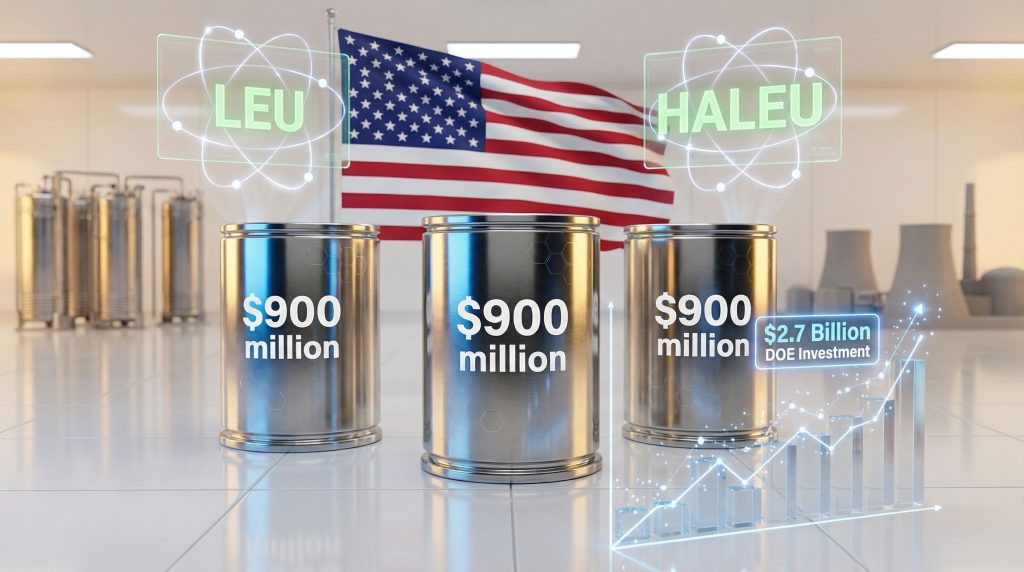
Historical data reveals that the United States previously maintained three major enrichment facilities: Portsmouth (Ohio), Paducah (Kentucky), and Oak Ridge (Tennessee). These installations utilised gaseous diffusion technology, which proved energy-intensive and economically uncompetitive compared to modern centrifuge methods developed internationally. The systematic decommissioning of these facilities created the current supply chain vulnerability that the $2.7 billion U.S. Department of Energy uranium enrichment funding initiative aims to address.
Foreign enrichment services currently supply the majority of fuel for American reactors, with Russia historically representing a significant portion of this supply through the Megatons to Megawatts program and subsequent commercial arrangements. This dependency extends beyond simple commercial transactions, encompassing technical specifications, delivery schedules, and quality assurance protocols that integrate foreign suppliers directly into domestic nuclear operations. However, the US Senate uranium ban has significantly altered these relationships.
The national security implications become apparent when considering reactor refuelling cycles, which typically occur every 18-24 months for large pressurised water reactors. Any disruption in enrichment services could potentially affect reactor operations, electricity generation, and regional power grid stability. The 10-year timeline established for capacity restoration reflects both the technical complexity of enrichment facility construction and the urgent need to establish reliable domestic alternatives.
Economic Framework Behind Nuclear Fuel Independence
Cost-benefit analysis of domestic enrichment versus imports reveals multiple economic layers extending beyond simple per-kilogram pricing comparisons. Domestic enrichment capacity requires substantial capital investment in facilities, equipment, and workforce development, but generates long-term economic benefits through job creation, technology development, and reduced exposure to international price volatility.
Investment multiplier effects across nuclear energy sectors demonstrate how enrichment capacity influences broader industry development. Domestic enrichment capabilities support uranium mining operations, fuel fabrication facilities, reactor manufacturing, and advanced nuclear technology development. These interconnected relationships create economic synergies that extend far beyond the enrichment process itself.
Market dynamics driving policy decisions include uranium price volatility, international trade restrictions, and the emerging advanced reactor market requiring specialised fuel types. The allocation of $1.8 billion specifically for HALEU production (combining American Centrifuge Operating and General Matter awards) indicates recognition that future nuclear technologies require fuel specifications unavailable through conventional enrichment services.
When big ASX news breaks, our subscribers know first
How Will This Funding Reshape America's Nuclear Fuel Supply Chain Architecture?
Low-Enriched Uranium (LEU) Production Capacity Expansion
LEU production serves as the foundation for current commercial reactor operations, requiring uranium enrichment to approximately 3-5% U-235 concentration. This specification supports the thermal neutron spectrum utilised by pressurised water reactors and boiling water reactors that comprise the majority of the American commercial fleet. The $900 million allocation to Orano Federal Services for LEU capacity expansion addresses the immediate needs of existing reactor operations while establishing infrastructure for long-term supply security.
Current domestic production gaps create multiple vulnerabilities beyond simple supply interruption. Quality assurance protocols, delivery scheduling, and technical specifications require coordination between enrichment providers and reactor operators months or years in advance. Domestic LEU capacity eliminates international coordination complexities while providing greater flexibility for operational planning and emergency supply situations.
Commercial reactor fuel supply timeline considerations encompass uranium procurement, conversion to uranium hexafluoride, enrichment processing, fuel assembly fabrication, and delivery to reactor sites. Each stage requires precise coordination and quality control measures that become significantly more manageable with domestic enrichment capabilities. The integration of domestic enrichment into existing supply chains reduces lead times and increases operational flexibility for reactor operators.
Technical specifications for LEU production demand consistent isotopic composition, chemical purity, and physical characteristics that meet strict nuclear fuel standards. Domestic production facilities must achieve these specifications while maintaining competitive costs and reliable delivery schedules. The milestone-based funding approach ensures accountability and performance standards throughout capacity development. In addition, this development addresses current US uranium market disruptions affecting commercial operations.
High-Assay Low-Enriched Uranium (HALEU) Innovation Pipeline
HALEU represents a critical enabler for advanced reactor technologies, requiring uranium enrichment between 5% and 20% U-235 concentration. This enrichment level supports reactor designs that operate at higher temperatures, achieve greater thermal efficiency, and utilise innovative coolant systems compared to current commercial reactors. The $1.8 billion combined investment in HALEU capacity through American Centrifuge Operating and General Matter establishes the United States as a global leader in advanced nuclear fuel production.
Advanced reactor technology fuel requirements vary significantly across different design approaches. High-temperature gas-cooled reactors utilise TRISO (tristructural isotropic) fuel particles that require HALEU for optimal neutron economy. Molten salt reactors operate with liquid fuel systems that demand specific HALEU formulations for criticality control and operational safety. Small modular reactors incorporate design features that benefit from HALEU's enhanced neutron efficiency and longer operational cycles.
Next-generation nuclear plant deployment scenarios depend critically on HALEU availability. Advanced reactor developers require reliable fuel supply commitments before proceeding with commercial deployment. The establishment of domestic HALEU capacity provides the supply chain foundation necessary for advanced reactor commercialisation and widespread deployment throughout the 2030s and beyond.
Strategic positioning for future energy market leadership emerges from the combination of advanced reactor technology and domestic fuel supply capabilities. Countries with both advanced reactor designs and fuel production capacity gain significant advantages in international nuclear technology markets. The dual-contractor approach creates competitive dynamics that drive innovation while ensuring supply redundancy.
Enrichment Technology Diversification Strategy
Centrifuge technology advancement pathways focus on improving separation efficiency, reducing energy consumption, and increasing operational reliability. Modern gas centrifuges achieve higher separation factors than previous gaseous diffusion methods while consuming significantly less electricity per unit of enriched uranium produced. The scaling of centrifuge technology for both LEU and HALEU production requires careful engineering optimisation for each enrichment level.
Laser enrichment innovation potential represents a transformative approach to uranium isotope separation. The $28 million award to Global Laser Enrichment supports development of technologies that could theoretically achieve higher separation efficiency and lower operational costs compared to centrifuge methods. According to industry reports, Atomic Vapour Laser Isotope Separation (AVLIS) and related techniques offer potential advantages in energy consumption and facility footprint requirements.
Competitive advantage development through technological superiority creates long-term strategic benefits beyond domestic supply security. Advanced enrichment technologies can support export opportunities, technology licensing, and international partnerships that strengthen America's position in global nuclear markets. The combination of proven centrifuge technology and innovative laser enrichment research establishes a comprehensive technology portfolio.
Technology risk assessment requires careful evaluation of both proven and experimental approaches. Centrifuge technology offers immediate deployment capability with established operational experience, while laser enrichment provides longer-term potential with higher technical risks. The funding allocation reflects this balance, with the majority supporting proven centrifuge deployment while maintaining significant investment in breakthrough technologies.
Which Companies Received DOE Task Orders and What Are Their Strategic Roles?
American Centrifuge Operating: HALEU Capacity Development
American Centrifuge Operating receives $900 million over 10 years to establish domestic HALEU enrichment capacity utilising proven centrifuge technology. The company's affiliation with Centrus Energy Corp provides operational experience through previous demonstration facility operations and technical validation of centrifuge-based HALEU production methods.
Production capacity targets require scaling existing demonstration capabilities to commercial production levels capable of supporting multiple advanced reactor deployments. The centrifuge cascade design for HALEU production demands more sophisticated engineering than LEU systems due to higher enrichment levels and stricter quality requirements. Facility expansion plans must accommodate both current advanced reactor demonstrations and future commercial deployment scenarios.
Technology deployment strategy leverages American Centrifuge's existing operational knowledge while incorporating improvements in centrifuge design, cascade optimisation, and process control systems. The milestone-based funding structure ensures performance accountability while providing flexibility for technological upgrades and capacity expansion as market demand evolves.
Market positioning advantages emerge from being among the first domestic HALEU producers in a market with limited global supply sources. This early-mover advantage could extend to international markets as other countries develop advanced reactor programs requiring HALEU fuel supplies.
General Matter: Advanced Enrichment Solutions
General Matter receives an equivalent $900 million allocation for HALEU capacity development, representing the DOE's strategic decision to establish competitive domestic production sources. The dual-contractor approach reduces single-source dependency while promoting technological innovation through competitive dynamics between enrichment providers.
Innovation approach to HALEU production scaling requires detailed analysis of General Matter's specific technological pathway and competitive differentiation strategy. The company's methodology may incorporate alternative centrifuge designs, process innovations, or facility optimisation approaches that distinguish its operations from American Centrifuge Operating's established methods.
Market differentiation strategy becomes crucial in a dual-supplier environment where both contractors target similar HALEU specifications and customer requirements. Factors such as production costs, delivery reliability, quality consistency, and customer service capabilities will determine market share distribution between the two domestic suppliers.
Competitive advantages may emerge through technological innovation, operational efficiency, or customer relationship development. The competition between domestic suppliers should drive continuous improvement and cost optimisation that benefits advanced reactor developers and ultimately American energy consumers.
Orano Federal Services: LEU Expansion Framework
Orano Federal Services receives $900 million for LEU enrichment capacity expansion, positioning the company as the primary domestic supplier for current commercial reactor fuel requirements. As a subsidiary of French nuclear giant Orano, the company brings international enrichment experience and established relationships with American reactor operators.
Existing infrastructure leverage represents a significant advantage in LEU capacity expansion. Orano's global enrichment operations provide technical knowledge, operational procedures, and supply chain relationships that can be adapted for American domestic production requirements. This experience reduces deployment risks and accelerates capacity development timelines.
Market share implications for domestic nuclear operators include pricing stability, supply reliability, and reduced dependence on international enrichment services. The establishment of significant domestic LEU capacity provides reactor operators with supply alternatives while maintaining competitive pricing through international market competition.
Supply reliability improvements address critical operational planning requirements for nuclear power plants. Domestic LEU supply reduces international shipping complexities, eliminates foreign trade restrictions, and provides greater flexibility for emergency supply situations or operational changes. Furthermore, these developments complement broader uranium investment strategies being implemented across the industry.
What Are the Long-Term Market Implications of This Investment Strategy?
Nuclear Renaissance Acceleration Factors
Advanced reactor deployment timeline acceleration depends critically on fuel supply chain availability. The establishment of domestic HALEU capacity removes a significant barrier to advanced reactor commercialisation by ensuring reliable fuel supplies for demonstration projects and early commercial deployments. This supply chain security provides investor confidence necessary for reactor development and deployment financing.
Small modular reactor fuel supply chain readiness addresses a key commercialisation requirement for SMR technologies. Many SMR designs require HALEU fuel to achieve their design performance characteristics, including longer operational cycles and enhanced safety features. Domestic HALEU availability enables SMR developers to provide firm fuel supply commitments to potential customers.
Commercial nuclear expansion economic viability improves through domestic fuel supply security and price stability. Reactor operators can develop long-term operational plans with greater certainty regarding fuel costs and availability. This planning certainty supports both new reactor construction decisions and licence extension evaluations for existing plants.
The combination of established LEU capacity and innovative HALEU production creates a comprehensive fuel supply infrastructure supporting both current and future nuclear technologies. This infrastructure foundation positions the United States to capitalise on growing global demand for clean baseload electricity generation. However, uranium spot price trends continue to influence market dynamics.
Competitive Positioning Against International Suppliers
Market share redistribution across global suppliers will occur gradually as domestic capacity becomes operational. American enrichment capacity will primarily displace imports rather than compete directly in international markets initially. However, technological advantages and operational efficiency could eventually support export opportunities to allied nations.
Price stability implications for domestic nuclear operators include reduced exposure to international uranium price volatility and currency exchange rate fluctuations. Domestic supply provides pricing predictability that supports long-term operational planning and financial forecasting for reactor operators.
International competitive dynamics may shift as American domestic capacity influences global enrichment market structure. The reduction in American import demand could affect international suppliers' capacity utilisation and pricing strategies, potentially creating opportunities for American technology exports.
Technology leadership positioning emerges through the combination of advanced centrifuge and laser enrichment development. American enrichment capabilities could become attractive for technology licensing and international partnerships, creating export opportunities beyond uranium enrichment services.
Job Creation and Economic Development Projections
Direct employment generation across enrichment facilities encompasses highly skilled technical positions including nuclear engineers, process operators, quality assurance specialists, and facility maintenance personnel. The $2.7 billion investment will create thousands of direct jobs across multiple states hosting enrichment facilities.
Indirect economic impact through supply chain development extends to uranium mining, chemical processing, transportation, construction, and professional services. Each direct enrichment job typically supports multiple indirect positions throughout the nuclear fuel cycle and broader economy.
Regional economic development in nuclear industry clusters creates concentrated expertise and infrastructure that attracts additional nuclear technology companies, research institutions, and supporting businesses. This clustering effect amplifies the economic impact of enrichment facility investments.
Workforce development requirements include specialised training programs, university partnerships, and apprenticeship opportunities that develop the technical skills necessary for enrichment facility operations. These educational investments create long-term economic benefits beyond the immediate employment opportunities.
How Does This Initiative Address Critical Energy Security Vulnerabilities?
Supply Chain Resilience Enhancement
Diversification away from single-source dependencies reduces systemic risks associated with international supply disruptions, trade disputes, or geopolitical tensions. The establishment of three separate domestic enrichment contractors creates multiple supply sources that collectively provide supply chain redundancy and operational flexibility.
Strategic reserve capacity development considerations include maintaining production capability beyond immediate market demand to address emergency situations or supply chain disruptions. Domestic enrichment capacity provides the foundation for strategic uranium reserves that could support reactor operations during international supply interruptions.
Emergency supply capability establishment requires coordination between enrichment facilities, fuel fabrication plants, and reactor operators to ensure rapid response to supply chain disruptions. Domestic capacity enables emergency protocols that would be impossible with foreign suppliers subject to international trade restrictions.
The 10-year timeline allows for systematic capacity development while addressing immediate vulnerabilities through existing supply arrangements. This transition period provides operational continuity while building long-term supply chain resilience.
Geopolitical Risk Mitigation Framework
International trade disruption preparedness addresses scenarios where political tensions, economic sanctions, or military conflicts could affect uranium enrichment imports. Domestic capacity provides supply chain independence that eliminates vulnerability to foreign policy disputes or international trade restrictions.
National defence nuclear fuel requirements encompass both commercial reactor operations supporting critical infrastructure and specialised applications requiring enriched uranium. Domestic enrichment capacity ensures availability of nuclear materials necessary for national security applications without dependence on foreign suppliers.
Allied nation supply chain cooperation opportunities emerge as domestic capacity exceeds immediate American requirements. Excess enrichment capability could support allied nations seeking to reduce their own dependencies on potentially unreliable suppliers, strengthening international partnerships while generating export revenue.
The strategic value of enrichment independence extends beyond fuel supply to encompass technological leadership, export opportunities, and diplomatic leverage in international nuclear technology discussions.
Technology Transfer and Innovation Protection
Intellectual property security in enrichment technologies becomes crucial as advanced centrifuge and laser enrichment methods represent significant competitive advantages. Domestic development and operation of enrichment facilities protects proprietary technologies from foreign intelligence gathering or technology transfer requirements.
Research and development capability preservation ensures continued American leadership in enrichment technology innovation. The combination of operational facilities and research programs creates a comprehensive technology base that supports both current operations and future technological advancement.
Export control compliance and strategic advantage maintenance require careful balance between technology protection and commercial opportunities. American enrichment capabilities must comply with nonproliferation requirements while maximising economic and strategic benefits.
The integration of proven technologies with innovative research creates a technology portfolio that supports both immediate operational requirements and long-term competitive positioning in global nuclear markets. Consequently, this Department of Energy investment represents a fundamental shift in strategic energy policy.
What Timeline and Milestones Define Success for This Program?
Phase Implementation Strategy
Years 1-3 focus on infrastructure development and capacity building, including facility construction, equipment installation, workforce recruitment, and initial operational testing. This phase establishes the foundation for production scaling while addressing regulatory requirements and safety protocols.
Years 4-7 emphasise production scaling and market integration as facilities achieve operational status and begin commercial production. This period includes capacity optimisation, quality assurance validation, and customer relationship development with reactor operators.
Years 8-10 target full operational capacity and market leadership as domestic enrichment reaches design capacity and potentially begins serving international markets. This phase includes technology upgrades, capacity expansions, and strategic planning for post-2035 operations.
The milestone-based funding structure ensures accountability and performance measurement throughout each implementation phase while providing flexibility for technological improvements and market adaptations.
Performance Metrics and Accountability Measures
Production volume targets by enrichment type establish specific deliverables for LEU and HALEU output that support both existing reactor operations and advanced reactor deployment scenarios. These metrics provide objective measures of program success and operational capability.
Cost competitiveness benchmarks against international suppliers ensure domestic production achieves pricing levels that support reactor operator economics while providing reasonable returns on investment. Price competitiveness maintains market viability and reduces dependence on government subsidies.
Supply reliability metrics for domestic reactor operators measure delivery performance, quality consistency, and customer service levels that demonstrate operational effectiveness. Reliability metrics ensure domestic capacity provides genuine supply chain improvements over foreign alternatives.
Technical performance standards encompass isotopic composition accuracy, chemical purity levels, and physical specifications that meet nuclear fuel requirements. These standards ensure domestic production achieves the quality levels necessary for safe and efficient reactor operations.
Risk Management and Contingency Planning
Technology development delays and mitigation strategies address potential technical challenges in capacity scaling, equipment performance, or operational optimisation. Contingency planning includes alternative technology pathways and schedule adjustments that maintain program objectives despite technical setbacks.
Market demand fluctuation response mechanisms provide operational flexibility for capacity adjustments based on reactor fleet changes, advanced reactor deployment rates, or international market conditions. This flexibility ensures efficient capacity utilisation across varying demand scenarios.
Regulatory compliance and safety standard maintenance encompass Nuclear Regulatory Commission licensing requirements, environmental protection protocols, and worker safety standards. Compliance management ensures operational continuity while maintaining public confidence in domestic enrichment operations.
Financial risk management addresses cost overruns, schedule delays, or market changes that could affect program viability. Risk mitigation includes performance bonds, milestone payments, and contract provisions that protect government investments while ensuring contractor accountability.
The next major ASX story will hit our subscribers first
Investment and Market Analysis: Strategic Considerations
Strategic Investment Opportunities
Nuclear energy sector growth potential extends beyond enrichment capacity to encompass reactor manufacturing, fuel fabrication, waste management, and technology development. The U.S. Department of Energy uranium enrichment funding creates investment opportunities throughout the nuclear supply chain as domestic capacity drives sector expansion.
Uranium mining and processing company implications include increased demand for domestic uranium production as enrichment capacity creates market opportunities for American uranium suppliers. This demand supports mining company development and reduces dependence on foreign uranium supplies.
Advanced reactor technology development acceleration occurs as HALEU availability removes fuel supply constraints from reactor design and deployment decisions. Technology companies, reactor developers, and component manufacturers benefit from improved commercialisation prospects for advanced nuclear technologies.
The infrastructure investment creates economic multiplier effects that extend far beyond the enrichment facilities themselves, generating opportunities for construction, engineering, manufacturing, and professional services companies supporting nuclear industry growth.
Market Risk Considerations
Technology development execution risks encompass potential delays in facility construction, equipment commissioning, or operational optimisation that could affect production timelines. These risks require careful project management and contingency planning to maintain program schedules and performance targets.
Regulatory approval timeline uncertainties may affect facility licensing, operational permits, or safety certifications required for commercial operation. Regulatory risk management requires early engagement with oversight agencies and comprehensive compliance planning throughout development phases.
International trade policy change impacts could affect market dynamics, pricing structures, or competitive positioning of domestic enrichment capacity. Policy risk assessment includes scenario planning for various trade policy environments and their effects on domestic operations.
Market demand volatility risks arise from changes in reactor operations, advanced reactor deployment rates, or international market conditions that could affect enrichment capacity utilisation. Demand risk mitigation requires flexible operational planning and diverse customer base development.
Competitive Landscape Evolution
Domestic enrichment capacity market share projections indicate gradual displacement of foreign suppliers as American facilities achieve operational status. Market share evolution depends on production costs, delivery reliability, and customer relationship development relative to international alternatives.
International supplier response strategies may include pricing adjustments, service improvements, or technology innovations designed to maintain market position despite American domestic capacity. Competitive dynamics will influence long-term market structure and pricing trends.
Innovation leadership positioning advantages emerge through advanced technology development, operational efficiency improvements, and customer service excellence that differentiate American enrichment services in both domestic and international markets.
The evolution toward domestic enrichment independence represents a fundamental shift in American nuclear energy strategy that creates both opportunities and challenges for industry participants, government policymakers, and energy consumers seeking reliable, affordable, and secure nuclear fuel supplies.
Looking to Capitalise on Nuclear Energy Investment Opportunities?
The $2.7 billion uranium enrichment initiative creates unprecedented opportunities across the nuclear supply chain, from mining companies to advanced reactor developers. Stay ahead of significant ASX mineral discoveries and nuclear sector developments with Discovery Alert's proprietary Discovery IQ model, which instantly identifies actionable investment opportunities in uranium and critical minerals before the broader market reacts.