July 22, 2026
How Nuclear Incidents Shaped Four Decades of Uranium Market Instability
Nuclear energy's strategic importance in global power generation creates unique market dynamics where psychological factors often supersede fundamental supply-demand economics. The uranium market fragility after Chernobyl exemplifies how safety perceptions can trigger sustained commodity price depressions lasting decades, establishing patterns that continue influencing contemporary market behavior.
The relationship between nuclear incidents and uranium market fragility reflects complex interactions between risk perception, policy responses, and capital allocation decisions. Unlike conventional commodity markets where supply disruptions create temporary price adjustments, uranium markets exhibit prolonged psychological scarring that fundamentally alters investment flows and production planning across entire industry cycles.
The Chernobyl Shock and Market Psychology
The April 1986 Chernobyl disaster created an immediate market disruption that persisted for nearly two decades. Uranium prices collapsed from pre-incident levels to a range between $7-10 per pound, remaining depressed until the early 2000s. This 15-year suppression period demonstrates how nuclear incidents function as psychological market shocks rather than merely technical disruptions.
The disaster's approximately 30 immediate fatalities triggered policy responses far exceeding the actuarial risk assessment. Capital systematically fled nuclear-related investments, creating sustained funding shortages for exploration, development, and reactor construction programs. This behavioral response pattern established uranium market fragility after Chernobyl as a baseline for understanding subsequent market cycles.
Fukushima's Amplified Impact on Modern Markets
The March 2011 Fukushima incident demonstrated how nuclear market fragility had intensified over time. Prices declined from $72 per pound immediately before the disaster to $49 per pound within five months, representing a 32% collapse. The decline continued systematically, reaching $22 per pound by 2017 for a total 70% price destruction.
Unlike Chernobyl's gradual impact, Fukushima created immediate global policy responses. Germany accelerated its nuclear phase-out through the Energiewende policy, Japan suspended reactor operations nationwide, and China modulated expansion plans. These policy shifts created demand destruction across multiple markets simultaneously, amplifying uranium market volatility beyond historical precedents.
When big ASX news breaks, our subscribers know first
Understanding Uranium Market Cycles: Beyond Single-Event Analysis
Uranium market cycles operate within macroeconomic frameworks where multiple variables interact to create persistent fragility independent of individual incidents. The sector's structural characteristics—long development timelines, capital intensity, and strategic government involvement—create vulnerability windows where external shocks generate outsized market consequences.
Supply Chain Concentration and Systemic Risk
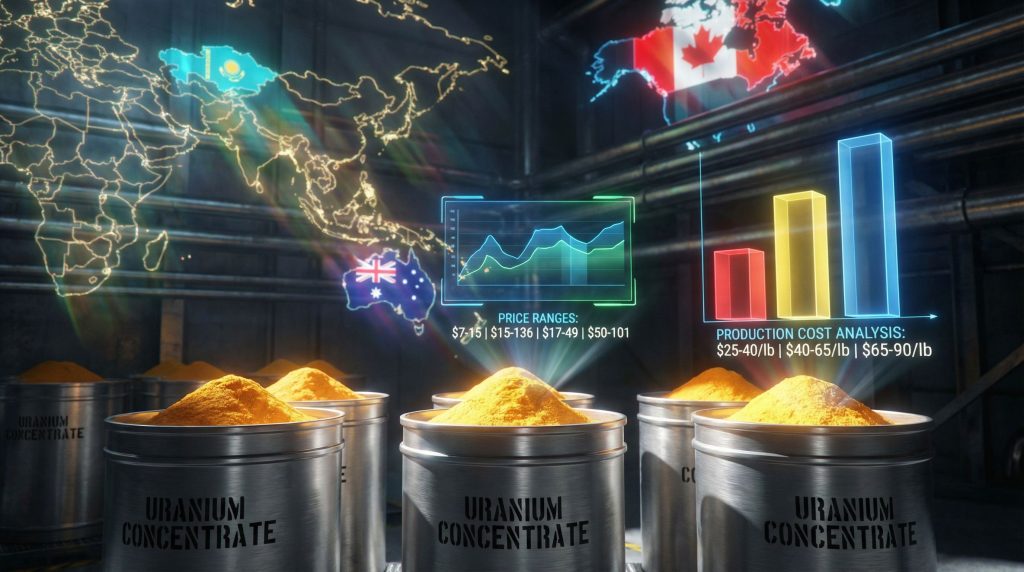
Contemporary uranium markets exhibit extreme geographic concentration, with approximately 60% of global production originating from Kazakhstan, Canada, and Australia. This concentration creates systemic vulnerability where disruptions affecting any major producer generate immediate global supply concerns.
The concentration risk extends beyond geographic factors to encompass technological and regulatory dependencies. Production facilities operate under complex licensing frameworks requiring years of regulatory approval for capacity modifications. When policy-driven demand uncertainty emerges, producers face binary choices between maintaining operations at reduced utilization or implementing costly facility shutdowns.
The Kayelekera Mine Case Study
The Kayelekera uranium mine in Malawi illustrates how incident-driven price suppression creates multi-year production gaps. The facility closed in 2014 due to sustained low prices but remained mothballed until August 2025, representing an 11-year production hiatus. The restart coincided with prices exceeding $100 per pound, demonstrating economic thresholds required to justify production resumption.
This timeline reveals uranium market fragility mechanisms: low prices eliminate marginal mine economics, operators defer maintenance investments, and years of capital underinvestment create production constraints that subsequently drive price rallies. The Kayelekera mine comeback represents a broader pattern where temporal mismatches between price signals and supply responses generate structural instability.
What Drives Long-Term Uranium Price Volatility?
Long-term uranium price volatility stems from fundamental misalignments between supply response capabilities and demand variability. The sector's capital-intensive nature means production decisions made today impact supply availability 5-10 years hence, creating temporal lags where markets cannot achieve equilibrium through normal price discovery mechanisms.
Production Cost Structure and Economic Floors
Uranium production operates within distinct cost tiers that create supply elasticity constraints:
- High-grade deposits: $25-40/lb production costs
- Medium-grade deposits: $40-65/lb production costs
- Low-grade/unconventional sources: $65-90/lb production costs
These cost tiers establish economic floors below which production becomes unviable. However, prices sufficient to incentivise low-grade source development—typically exceeding $90-100/lb—often trigger demand destruction pressure, creating a pricing band where sustainable equilibrium remains elusive.
Exploration Investment Cycles
Exploration spending exhibits asymmetric behaviour during market cycles, declining by 70-80% during price downturns while recovering slowly during upturns. This asymmetry creates lagged supply constraints: price collapses in year one eliminate exploration funding in years one-two, manifesting as production shortages in years five-ten.
The Chinese nuclear expansion beginning in the early 2000s demonstrates demand-driven cycle dynamics. Government policy commitments to nuclear capacity growth created sustained uranium demand that drove prices from the $10-20 range to $136 per pound by 2007, representing a 680% appreciation over seven years.
How Do Nuclear Markets Experience Boom-Bust Cycles?
Nuclear markets experience boom-bust cycles through inventory management mechanisms that mask fundamental supply-demand imbalances for extended periods. Utilities and governments maintain strategic inventory buffers that absorb excess supply during oversupply periods while dampening price appreciation during supply constraints.
Inventory Buffer Mechanics
Strategic stockpiles function as price stabilisation mechanisms but create delayed price signals that contribute to boom-bust dynamics. When inventory buffers exhaust rapidly, markets experience sudden corrections as buyers compete for limited available supply. This pattern creates non-linear price behaviour where gradual tightening manifests as sharp price spikes.
Policy-Driven Demand Volatility
Government nuclear policies create immediate demand shocks that reverberate through uranium markets. The post-Fukushima period illustrates this mechanism: while global nuclear capacity remained largely constant, policy responses in Germany and Japan created demand uncertainty that suppressed prices for nearly a decade.
The current cycle (2021-2026) reflects competing policy forces where energy transition initiatives support nuclear expansion while geopolitical tensions create supply security concerns. Furthermore, market tariff impact considerations add another layer of complexity as markets attempt to discount multiple scenarios simultaneously.
Why Do Modern Geopolitical Tensions Affect Uranium Supply?
Modern geopolitical tensions affect uranium supply through strategic resource competition and trade restriction mechanisms. Uranium's dual-use nature—civilian power generation and defence applications—elevates government involvement in market mechanisms beyond typical commodity oversight.
Strategic Reserve Policies and Market Intervention
Governments increasingly view uranium as a strategic resource requiring domestic supply security. Export restrictions, preferential supplier agreements, and strategic reserve accumulation create additional market complexity beyond commercial supply-demand dynamics.
Recent geopolitical developments demonstrate how quickly uranium supply chains can face disruption through trade restrictions. The industry's global nature means sanctions affecting any major producer create immediate supply concerns across international markets, amplifying uranium market fragility after Chernobyl during periods of geopolitical tension.
Technology Transfer and Supply Chain Security
Advanced nuclear technologies require specialised fuel specifications that may depend on specific supplier capabilities. As countries develop indigenous nuclear programmes, technology transfer restrictions and supply chain security requirements create additional barriers to market integration.
The geopolitical landscape increasingly influences uranium market dynamics as nations seek to secure strategic resource access whilst managing technological sovereignty concerns.
What Lessons Can Investors Draw from Historical Volatility?
Historical uranium market volatility provides several key insights for investment strategy development. The sector's cyclical nature requires understanding long-term structural trends rather than short-term price movements, while uranium's strategic importance suggests sustained long-term demand growth despite periodic volatility.
Risk Management Framework
Effective uranium investment strategies require diversification across multiple dimensions:
- Value chain exposure: Exploration, production, and fuel cycle companies
- Geographic diversification: Multiple producing regions and jurisdictions
- Timeline alignment: Matching investment horizons with commodity cycles
- Technology exposure: Conventional and advanced reactor fuel requirements
Fundamental Analysis Requirements
Uranium market analysis demands monitoring multiple variables simultaneously: reactor construction pipelines, inventory levels, production capacity utilisation, and policy developments across major consuming regions. Traditional commodity analysis frameworks require modification to account for strategic government involvement and policy volatility.
For instance, understanding the uranium market's complex dynamics requires recognising the metal's strategic role in energy transition planning and the resulting impact on long-term pricing mechanisms.
The next major ASX story will hit our subscribers first
Future Market Structure Evolution
Future uranium market structure evolution will likely reflect technology advancement and policy integration trends. Small modular reactors (SMRs) and advanced reactor designs promise improved safety profiles while creating uncertainty about future fuel specifications and demand patterns.
Emerging Supply-Demand Dynamics
The global energy transition's nuclear component suggests sustained long-term demand growth, while supply constraints from decades of underinvestment create potential for continued price volatility. Current market dynamics indicate prices may need to sustain levels above $80-90 per pound to incentivise sufficient exploration and development investment for long-term supply adequacy.
Technology Integration and Market Stability
Advanced nuclear technologies may eventually provide greater market stability through improved demand visibility and sophisticated risk management capabilities. However, the transition period creates additional uncertainty as markets discount multiple technology deployment scenarios with varying uranium demand implications.
Research into market fragility patterns demonstrates how technological advancement intersects with policy frameworks to create both opportunities and additional complexity for market participants.
The uranium market fragility after Chernobyl established behavioural patterns that continue influencing contemporary market dynamics. While technology advances and policy frameworks evolve, the sector's strategic importance ensures continued government involvement in market mechanisms, maintaining inherent volatility characteristics that distinguish uranium from conventional commodity markets.
Understanding these dynamics requires recognising that uranium market analysis extends beyond traditional supply-demand economics to encompass psychology, policy, and strategic considerations that create persistent structural fragility regardless of technological advancement or safety improvements.
This analysis is for educational purposes only and should not be considered investment advice. Uranium markets involve significant risks, and past performance does not indicate future results. Readers should conduct independent research and consult qualified professionals before making investment decisions.
Ready to Capitalise on Uranium Market Opportunities?
Discovery Alert's proprietary Discovery IQ model delivers instant notifications on significant ASX mineral discoveries, including uranium exploration breakthroughs that could benefit from the sector's structural supply constraints. Historic discoveries demonstrate exceptional return potential, and with uranium markets experiencing heightened volatility, subscribers gain crucial timing advantages to identify actionable opportunities ahead of broader market recognition.