August 25, 2026
Europe's Uranium Supply Gap Is Hiding in Plain Sight
For decades, European nations have imported the overwhelming majority of their uranium requirements from Kazakhstan, Russia, Canada, and Australia. The structural vulnerability this creates has largely been treated as an acceptable cost of doing business within the nuclear fuel cycle. Yet as energy security has climbed to the top of the European policy agenda, questions around uranium supply and demand have shifted from academic curiosity to strategic priority. Sweden's recent legislative transformation — central to the broader Sweden uranium mining law and Viken project story — offers the clearest answer yet, and the implications stretch well beyond Scandinavian borders.
Understanding what has changed, why it matters, and where the realistic development pathway leads requires unpacking both the regulatory architecture and the geology, because in this case, both tell a remarkable story.
When big ASX news breaks, our subscribers know first
What Sweden's Three-Law Restructuring Actually Changed
The legislative shift that unlocked Sweden's uranium sector was not a single reform. It was a sequenced, three-part dismantling of every meaningful legal barrier that had been constructed since 2018. Each instrument targeted a distinct layer of the prohibition framework.
| Legal Instrument | Effective Date | Core Change | Practical Impact |
|---|---|---|---|
| Environmental Code and Minerals Act | January 1, 2026 | Uranium reclassified as a concession mineral | Exploration and extraction permits now accessible under standard mining law |
| Nuclear Activities Act | July 15, 2026 | Uranium mines removed from nuclear facility classification | Municipal veto over mining operations eliminated |
| Residual Products Act | July 15, 2026 | Uranium extraction waste reclassified away from nuclear waste | Permitting process substantially streamlined |
The most operationally significant of these three changes is arguably the removal of municipal veto powers. Under the previous regulatory structure, local councils held an effective right of refusal over uranium mining operations within their jurisdictions. This single provision made commercial development nearly impossible regardless of geological or economic merit.
A project that cannot secure local political consent cannot advance through any permitting process, no matter how favourable the national regulatory environment might be. Furthermore, parliament's approval of amendments to Swedish nuclear law in November 2025 set the entire legislative sequence in motion.
What Reclassification as a Concession Mineral Actually Means
The term concession mineral carries significant weight in Swedish mining law. Under a concession system, the right to extract a mineral is granted by the state through a structured licensing process, rather than being subject to discretionary political interference at the local level. Reclassifying uranium within this framework places it alongside copper, nickel, and other strategically important metals in terms of how extraction rights are administered.
Before January 2026, uranium sat outside this framework entirely. It could not be explored for or extracted under any standard mining concession instrument, which effectively rendered Sweden's substantial uranium endowment commercially inaccessible regardless of market conditions or project economics.
The One Remaining Regulatory Threshold Worth Watching
While mine-site extraction now operates under reformed concession mineral rules without municipal consent requirements, the downstream processing of uranium ore into yellowcake concentrate may still face separate approval requirements depending on further parliamentary action.
This distinction matters for project timelines. Mine construction and ore extraction are now on a clear regulatory pathway, but developers will need to monitor whether processing facilities attract additional oversight under remaining provisions of Swedish nuclear law. This is not an insurmountable barrier, however it represents a variable that investors and project developers should track carefully.
How the 2018 Ban Was Born and What Reversed It
Sweden's 2018 uranium mining prohibition emerged from amendments to the Environmental Code at a time when the country's energy debate was heavily influenced by post-Fukushima sentiment and a political coalition that favoured renewable energy expansion over nuclear fuel cycle participation. The amendments did not merely restrict uranium mining — they effectively made it illegal by inserting prohibitions directly into environmental legislation.
Sweden's estimated uranium endowment of more than one million tonnes of uranium resources, predominantly hosted in alum black shale formations across three major deposit zones, sat untouched throughout this period. The geological reality did not change. The political calculus did.
What shifted the balance by November 2025 was a convergence of energy security concerns, rising electricity prices, and a broader European reassessment of nuclear power's role in decarbonisation. Sweden had already reversed its phase-out of nuclear electricity generation, and extending that logic to domestic uranium production became politically coherent in a way it had not been for nearly a decade.
Consequently, the parliament's November 2025 vote to repeal the ban set the legislative sequence in motion, with the Environmental Code and Minerals Act changes taking effect on January 1, 2026, and the Nuclear Activities Act and Residual Products Act amendments following on July 15, 2026.
The Viken Deposit: Scale, Geology, and Why It Stands Apart
Located in Jämtland County in central Sweden, the Viken Energy Metals Project is not simply a uranium prospect. It is a polymetallic system of genuinely unusual scale, hosted within the same alum black shale formations that define Sweden's broader uranium endowment. The Sweden uranium mining law and Viken project are now inextricably linked in the minds of European energy security analysts.
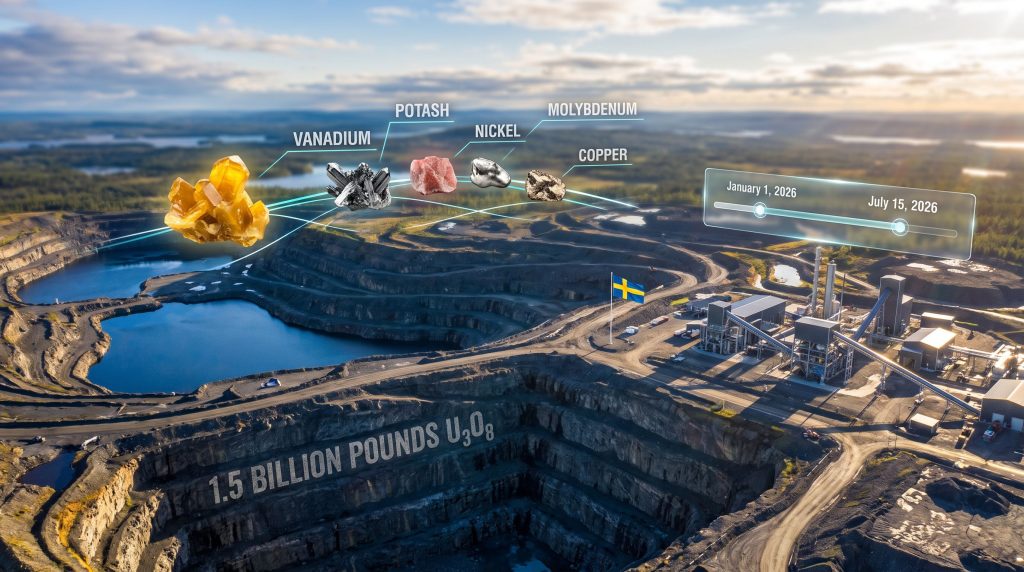
The Viken deposit contains approximately 1.5 billion pounds of inferred U₃O₈ resources alongside 176 million pounds of indicated U₃O₈, placing it among the largest undeveloped uranium deposits anywhere on the planet.
Those figures alone would make Viken noteworthy. What elevates the project's strategic profile further is the range of critical minerals that occur alongside the uranium. In addition, the Viken property's geological profile confirms the deposit's exceptional polymetallic character within the broader alum shale sequence.
The Co-Product Suite: Why Polymetallic Economics Change the Conversation
- Vanadium — used in grid-scale vanadium redox flow batteries and as a steel-hardening agent in high-strength alloy production
- Potash — a critical input to global agricultural fertiliser supply chains
- Nickel — increasingly important to battery technology and stainless steel manufacturing
- Molybdenum — a key component in high-performance alloy steel for aerospace and energy infrastructure
- Copper — foundational to electrical grid infrastructure and renewable energy systems
The economic logic of polymetallic uranium deposits is fundamentally different from single-commodity uranium projects. When vanadium and potash generate meaningful revenue streams alongside uranium, the project's financial resilience to uranium price volatility increases substantially.
A conventional uranium-only project is essentially a leveraged bet on the uranium spot price. A polymetallic operation, however, has built-in economic diversification at the mine level. Alum black shale formations, which host the Viken mineralisation, are known for this kind of multi-element enrichment.
Reading the Preliminary Economic Assessment: What the Numbers Reveal
District Metals Corp, the Canadian company advancing the Viken project, filed its Preliminary Economic Assessment technical report on the SEDAR+ system in July 2026, days after the second tranche of Swedish legislative reforms came into force. The PEA was prepared by independent consultants P&E Mining Consultants Inc, with input from METS Engineering Group Pty Ltd, and was structured in accordance with Canadian National Instrument 43-101 standards.
Where Viken Sits in the Development Lifecycle
Understanding what a PEA represents requires situating it within the broader mining development sequence.
- Scoping Study — High-level concept validation with order-of-magnitude cost estimates
- Preliminary Economic Assessment (PEA) Viken's current position — Early-stage economic modelling incorporating inferred resources
- Pre-Feasibility Study (PFS) — Detailed technical and economic modelling with tighter resource confidence requirements
- Feasibility Study (FS) — Bankable project confirmation suitable for debt financing discussions
- Permitting and Construction — Regulatory approvals and capital deployment
- Production — Operational phase
Key Production Parameters from the PEA
| Metric | Projected Figure |
|---|---|
| Mining Method | Conventional open-pit |
| Average Annual U₃O₈ Production | 3.3 million pounds (1,269 tU) |
| Projected Mine Life | 13 years |
| Indicated Mineral Resources in Mine Plan | approximately 77% |
| Inferred Mineral Resources in Mine Plan | approximately 23% |
| Primary Co-products | Vanadium and Potash |
The 77% indicated resource proportion within the mine plan is a technically meaningful figure. In the NI 43-101 framework, indicated resources carry substantially higher geological confidence than inferred resources, having been defined by tighter drill spacing and more comprehensive sampling. A mine plan with 77% indicated resource backing suggests a relatively robust geological foundation for the economic modelling, even at this early PEA stage.
It is important to note that a PEA is permitted to incorporate inferred resources, which are more geologically speculative by definition. The figures presented should be understood as indicative of potential, not as confirmed production commitments.
Viken and Häggån: Two Projects Reshaping Jämtland County
Jämtland County has quietly emerged as Sweden's primary uranium development corridor, hosting two of the country's most advanced polymetallic uranium projects within the same geological province.
| Comparison Factor | Viken Project | Häggån Deposit |
|---|---|---|
| Primary Owner | District Metals Corp (Canada) | Aura Energy (Australia) |
| Location | Jämtland County, Sweden | Jämtland County, Sweden |
| Key Minerals | U₃O₈, Vanadium, Potash | U₃O₈, Vanadium, Nickel, Molybdenum, Zinc, Potash |
| Development Stage | PEA Filed (July 2026) | Advancing post-legislative reform |
| Regulatory Status | Enabled under reformed law | Confirmed enabled under reformed law |
Aura Energy, the Australian company behind the Häggån deposit, confirmed following the July 15 legislative enactment that uranium mining will no longer be regulated as a nuclear facility and that uranium extraction will consequently no longer require explicit municipal consent. This confirmation removes ambiguity for both projects simultaneously, establishing a clear regulatory baseline for the province as a whole.
The co-occurrence of two large polymetallic systems within the same county and the same host rock formation reflects the regional geology of Jämtland's alum black shale sequence, which appears to have been a highly efficient trap for uranium, vanadium, and associated metals over geological timescales.
The next major ASX story will hit our subscribers first
Development Milestones and What Comes Next for Viken
The filing of the PEA technical report on SEDAR+ marks a formal public disclosure milestone under Canadian securities regulations. NI 43-101 requires that technical reports supporting material project disclosures be filed within 45 days, and the SEDAR+ system makes these documents publicly accessible to investors and analysts globally.
The path from PEA to production involves several major workstreams running in parallel.
- Advancing geological work to convert inferred resources to indicated status, improving mine plan confidence ahead of pre-feasibility study development
- Initiating environmental baseline studies under the reformed Minerals Act framework, which will form the foundation of future permitting applications
- Engaging with the Swedish Geological Survey (SGU) as that body assesses how the new legislative framework intersects with national resource management interests
- Monitoring whether downstream yellowcake processing attracts additional regulatory requirements under remaining nuclear legislation
What Sweden's Opening Means for European Uranium Supply
Europe currently imports virtually all of its reactor fuel requirements. The continent hosts operating nuclear capacity across France, Finland, the Czech Republic, Slovakia, and several other nations, yet produces negligible quantities of uranium domestically. This structural dependency has become increasingly visible as a strategic vulnerability — a concern directly relevant to Europe's critical minerals supply chain planning.
Furthermore, understanding the broader uranium supply challenges facing the continent makes Sweden's legislative shift all the more significant. Sweden's estimated one million-plus tonne uranium endowment, if even partially developed, would represent a meaningful contribution to European domestic uranium supply.
An annual production figure of 3.3 million pounds of U₃O₈ from Viken alone, sustained over a 13-year mine life, would supply a portion of European reactor requirements that currently must be sourced from outside the continent. The broader uranium market dynamics at play further reinforce why projects of this scale attract serious institutional attention.
Beyond uranium, the vanadium co-production from projects like Viken and Häggån touches a separate critical minerals supply chain. Vanadium is a key material for vanadium redox flow batteries, increasingly deployed for grid-scale energy storage. European supply of vanadium is similarly import-dependent, meaning these polymetallic Swedish projects could contribute to multiple strategic mineral supply objectives simultaneously. Indeed, global uranium reserves data underscores how rare deposits of Viken's scale truly are.
The intersection of uranium supply security, critical minerals strategy, and reformed domestic regulatory frameworks makes Sweden's Jämtland County one of the more consequential emerging resource provinces in the European context, even at this early stage of development.
Disclaimer: This article is intended for informational purposes only and does not constitute financial advice. Preliminary Economic Assessments represent early-stage project evaluations and should not be interpreted as confirmed production or financial outcomes. Investors should conduct independent due diligence and consult qualified financial advisers before making investment decisions related to any mining or resource company.
Frequently Asked Questions: Sweden Uranium Mining Law and the Viken Project
Is uranium mining now fully legal in Sweden?
Yes, as of July 15, 2026, all three legislative changes required to enable uranium mining have come into force. Uranium is now classified as a concession mineral, mines are no longer classified as nuclear facilities, and extraction waste is no longer classified as nuclear waste. The primary remaining variable relates to downstream processing into yellowcake concentrate.
Does the Viken project have all the permits it needs to begin mining?
No. Having a reformed regulatory framework in place is distinct from holding the operational permits required to begin construction and mining. Viken remains at the PEA stage of development and will need to advance through pre-feasibility and feasibility studies before entering the formal permitting process.
What is the difference between a PEA and a feasibility study?
A PEA is an early-stage economic assessment that can incorporate geologically speculative inferred resources and is not suitable as the basis for project financing. A feasibility study represents the final and most rigorous level of economic analysis, drawing exclusively on measured and indicated resources, and is typically required before debt financing can be secured for mine construction.
Why was uranium mining banned in Sweden in the first place?
The 2018 ban was introduced through amendments to Sweden's Environmental Code during a period when nuclear energy faced significant political headwinds in the country. Post-Fukushima sentiment, combined with a governing coalition that prioritised renewable expansion, created the political conditions for the prohibition.
How large is the Viken deposit compared to other global uranium projects?
With approximately 1.5 billion pounds of inferred U₃O₈ resources, Viken ranks among the largest undeveloped uranium deposits in the world by resource size. Most uranium deposits in active development or production globally are considerably smaller in total resource terms.
What other minerals does the Viken deposit contain besides uranium?
The Viken PEA identifies vanadium and potash as primary co-products. The broader Jämtland alum black shale province also hosts nickel, molybdenum, zinc, and copper in associated deposits.
What is the significance of removing the municipal veto for uranium mining?
The municipal veto was arguably the most effective practical barrier to uranium mining development in Sweden, because it gave local governments an effective right of refusal that could not be overridden through national regulatory processes. Its removal aligns uranium with the standard concession mineral framework, where extraction rights are administered at the national rather than municipal level.
When could the Viken project potentially begin production?
No confirmed production timeline has been announced. Moving from the current PEA stage through pre-feasibility study, feasibility study, environmental permitting, and construction typically requires a minimum of several years under favourable conditions. The reformed regulatory environment — central to the Sweden uranium mining law and Viken project narrative — removes legal barriers but does not compress the technical and financial development requirements.
Want to Track the Next Major Uranium Discovery Before the Broader Market Does?
Discovery Alert's proprietary Discovery IQ model delivers real-time alerts on significant ASX mineral discoveries — including uranium and critical minerals — transforming complex data into actionable investment insights the moment they are announced; explore historic discoveries and their returns to understand the potential at stake, then begin your 14-day free trial at Discovery Alert to position yourself ahead of the market.