August 25, 2026
The Hidden Cost of Sovereign Risk: What African Uranium Investors Rarely Price In
Resource investors frequently debate grade, infrastructure, and metallurgy when evaluating uranium development projects. What receives far less rigorous attention is the compounding cost of sovereign risk — specifically, the capital destruction that occurs when a host government terminates a mining licence mid-development, triggering years of legal paralysis and sunk cost accumulation. The Atomic Eagle Madaouela Mining Convention Niger uranium dispute offers one of the most instructive case studies in how that risk eventually resolves, and what it truly costs both sides when it does.
The Madaouela story is not simply a corporate transaction. It is a window into the mechanics of African uranium development, the structural tensions between foreign capital and sovereign resource ambitions, and the institutional frameworks that attempt to bridge those tensions when they fracture. Furthermore, understanding this dispute illuminates the broader uranium investment outlook for those considering exposure to African uranium jurisdictions.
When big ASX news breaks, our subscribers know first
Niger's Tim Mersoi Basin: Geological Significance and Structural Tension
Few sedimentary basins on Earth carry the uranium endowment of Niger's Tim Mersoi Basin. According to the World Nuclear Association, Niger holds approximately 450,000 tonnes of identified uranium resources — roughly 992 million pounds — making it one of the most prospective uranium geographies in the world. Commercial extraction at the Arlit mining district began in 1971, and Niger has since produced in excess of 150,000 tonnes (approximately 330 million pounds) of uranium, supplying nuclear utilities across Europe, North America, and Asia for over five decades.
That production legacy is both Niger's greatest economic asset and the source of persistent tension. The basin hosts a cluster of significant operations and development projects including:
- The SOMAIR operation, a long-running producer
- The historic COMINAK mine
- Global Atomic's Dasa Project
- The large-scale Imouraren deposit
- The Madaouela project, now held through Atomic Eagle's MAMICO vehicle
The density of prospective assets in a single jurisdiction creates concentrated exposure for foreign operators. When sovereign attitudes shift — as they have with notable intensity across the Sahel since the early 2020s — the consequences are felt simultaneously across multiple projects and operators. Niger's concurrent dispute with major operator Orano illustrates that the Madaouela resolution does not represent a wholesale normalisation of the country's investment climate. However, developers monitoring uranium market volatility will recognise these tensions as a recurring structural feature rather than an isolated event.
"A critical but underappreciated dynamic in Niger's uranium sector is the historical asymmetry between the economic returns captured by foreign operators and those flowing to the state. This asymmetry has shaped Nigerien mining policy for decades and is a structural driver of the periodic renegotiations that characterise the basin's investment history."
What Made Madaouela Worth Fighting Over
Understanding why both GoviEx Uranium and subsequently Atomic Eagle pursued Madaouela through an international arbitration process requires examining the asset's technical fundamentals in detail.
| Metric | Madaouela |
|---|---|
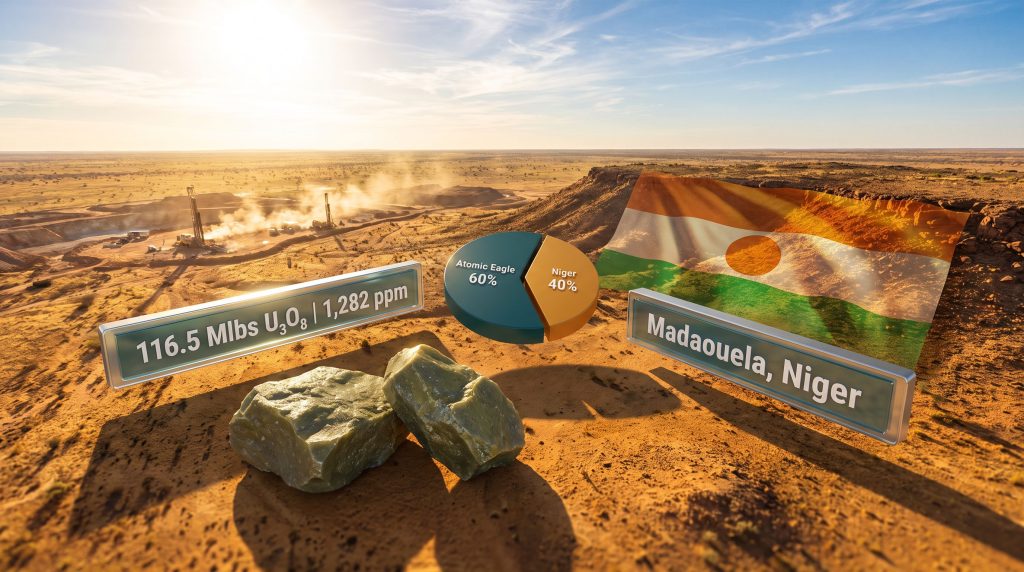
| Total Resource | 116.5 million lbs U₃O₈ |
| Grade | 1,282 ppm uranium oxide |
| Historical Drilling | ~600,000 metres |
| Prior Capital Invested | ~US$160 million |
| Reporting Standard | NI 43-101 (foreign estimate) |
| JORC Conversion Target | Q4 2026 |
| Exploitation Permit Term | 10 years, renewable for successive 5-year periods |
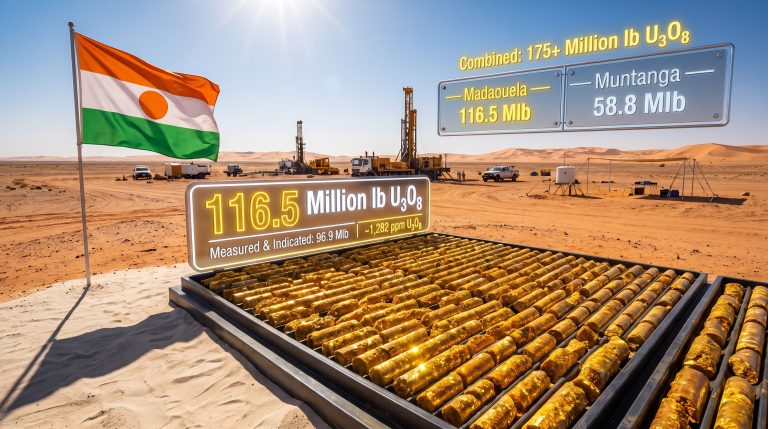
The grade figure of 1,282 ppm is where Madaouela's case becomes particularly compelling. For context, the grade profile at Atomic Eagle's flagship Zambian asset, Muntanga, sits at 309 ppm — meaning Madaouela's uranium concentration is approximately four times higher. In uranium development economics, grade is a primary lever for operating cost competitiveness. Higher-grade deposits require less ore processing to yield equivalent uranium output, which compresses both operating expenditure and waste volumes.
The approximately 600,000 metres of historical drilling conducted by predecessor GoviEx Uranium represents a technical dataset of substantial depth. That campaign, which consumed roughly US$160 million in prior capital, generated the geological confidence underpinning the current resource estimate. For Atomic Eagle's incoming management, the existence of this dataset was not incidental — it materially reduced the capital and time required to advance Madaouela toward feasibility-stage work under new ownership.
Why Grade Matters More Than Most Investors Realise
The uranium sector has a nuanced relationship with resource grade that is often misunderstood by generalist investors. Unlike copper or gold, where mineralogy and recovery methods vary widely, uranium processing from sedimentary-hosted deposits follows broadly similar hydrometallurgical pathways. This means grade translates relatively directly into operating cost efficiency.
A deposit grading at 1,282 ppm will, in most processing configurations, generate significantly lower reagent consumption, energy costs, and tailings volumes per pound of uranium produced compared with a deposit at 300 to 400 ppm. This cost advantage is especially relevant when considering uranium market trends and the long-term contract pricing that typically governs project economics. Utilities signing multi-year offtake agreements want visibility on producer cost floors, making higher-grade assets more bankable in structured financing discussions.
How the Madaouela Dispute Escalated and Then Resolved
The sequence of events leading to the August 2026 Mining Convention reflects a pattern seen across Sahel mining jurisdictions — escalating sovereign action followed by a negotiated commercial settlement that replaces litigation with a restructured partnership.
Key timeline milestones:
- July 2024 — Niger's government revokes the Madaouela exploitation permit from GoviEx Uranium, citing insufficient project advancement relative to original licence terms.
- Post-revocation — GoviEx initiates proceedings before the International Centre for Settlement of Investment Disputes (ICSID), the principal multilateral forum for investor-state arbitration.
- January 2025 — Arbitration proceedings are suspended by mutual consent, creating a bilateral negotiation window.
- November 2025 — GoviEx Uranium and Tombador Iron complete a corporate merger, forming Atomic Eagle Limited (ASX: AEU | OTCQX: AEUXF).
- August 2026 — Atomic Eagle announces the executed Mining Convention with the Republic of Niger, resolving the Atomic Eagle Madaouela Mining Convention Niger uranium dispute.
- Within 7 days of signing — Formal withdrawal of ICSID arbitration proceedings.
The corporate restructuring that produced Atomic Eagle appears to have been a decisive factor in breaking the negotiating deadlock. New management brought a fresh commercial posture to discussions with Niger's Ministry of Mines, and the absence of the historical dispute's emotional and institutional baggage likely facilitated more productive engagement. Consequently, this dynamic — where M&A activity creates conditions for dispute resolution that the original parties could not achieve — is more common in African mining than is widely recognised.
Anatomy of the Mining Convention: Terms, Protections, and What They Mean in Practice
The Atomic Eagle Madaouela Mining Convention establishes a multi-layered commercial framework. Understanding its architecture requires examining not just the headline economics, but the structural protections embedded within it.
Ownership and Control Architecture
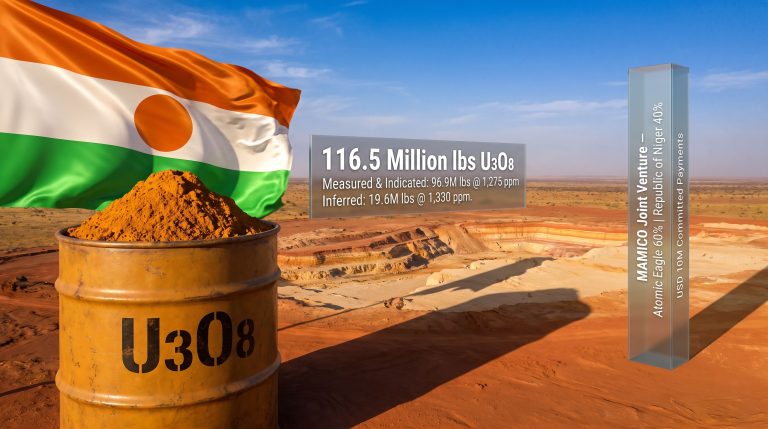
The project vehicle, Madaouela Mining Company SA (MAMICO), is structured with the following interests:
| Shareholder | Interest | Nature |
|---|---|---|
| Atomic Eagle | 60% | Operational control |
| Republic of Niger | 15% | Free carried interest |
| Republic of Niger | 25% | Contributing interest |
| Total Niger State | 40% | Combined stake |
The distinction between Niger's two categories of interest is commercially significant. The 15% free carried interest requires no capital contribution from the state — it is granted by right. The 25% contributing interest obligates Niger to fund its proportional share of future equity contributions to project development, or face dilution under an agreed formula. This structure creates a meaningful alignment of incentives: the state benefits from project advancement but bears cost risk on its contributing tranche if it declines to participate in funding rounds.
Financial Obligations and the US$40 Million Credit Mechanism
The convention's financial terms are structured across three distinct components, and conflating them leads to misinterpretation:
- US$5 million payable within 30 days of the exploitation permit being formally issued
- US$5 million payable upon commencement of construction activities
- US$40 million credit applied against Niger's future equity contributions to MAMICO
The US$40 million figure requires careful reading. It is explicitly not an upfront cash payment by Atomic Eagle. Rather, it functions as a deferred equity offset — meaning Niger's 25% contributing stake will be partly funded through this credit mechanism rather than requiring fresh state capital at the point of project financing. The structure effectively monetises the historical value of Niger's resource endowment within the partnership framework, while limiting Atomic Eagle's immediate cash outlay to the US$10 million in direct payments.
"This credit-offset mechanism is a sophisticated financing instrument increasingly seen in African resource conventions. It allows resource-rich but capital-constrained governments to maintain meaningful equity participation in projects without requiring upfront Treasury disbursements, which are politically and fiscally difficult to justify."
Investor Protection Provisions
The Mining Convention incorporates a suite of legal safeguards that are standard in well-structured African mining conventions but critical to understand individually:
- Legal, fiscal, and regulatory stabilisation clauses protect the agreed commercial framework against future legislative changes that might otherwise alter the economics of the project mid-development
- ICSID arbitration access is preserved under the new convention, maintaining international dispute resolution rights for both parties
- Offshore banking permissions are granted, subject to applicable repatriation requirements
- Exploitation permit term of 10 years, renewable for successive five-year periods for the life of the mine
Stabilisation clauses are among the most technically valuable provisions in any African mining convention. Their legal enforceability has been tested in multiple ICSID proceedings, and while not absolute, they provide a meaningful deterrent against arbitrary regulatory change and a basis for compensation claims if such changes occur.
The 90-Day Deemed-Approval Mechanism for Offtake
The convention's offtake framework introduces a provision that deserves specific attention from investors evaluating Madaouela's commercial viability.
All MAMICO uranium sales contracts require government approval. However, the convention includes a 90-day deemed-approval mechanism: if Niger's government fails to formally respond to an offtake submission within 90 days, approval is automatically considered granted. This provision directly addresses one of the most common operational risks in state-partnership mining structures — government inaction as an implicit veto on commercial transactions.
Additional offtake parameters include:
- The government retains the right to purchase and market production up to its proportional shareholding in MAMICO
- In defined circumstances, pre-emption rights or requisition of up to 50% of mine output may be exercised
- Combined government production rights are capped at 50% and cannot interfere with binding offtake contracts already executed by MAMICO
Atomic Eagle's Dual-Project Strategy: Muntanga as the Primary Engine
The Madaouela Mining Convention represents a material expansion of Atomic Eagle's asset base, but the company has been explicit that its Zambian flagship, the Muntanga Uranium Project, remains its primary near-term development focus. In addition, those refining their uranium investment strategies should note how Atomic Eagle's dual-jurisdiction approach balances grade and geopolitical risk across its portfolio.
| Asset | Country | Resource | Grade | Development Status |
|---|---|---|---|---|
| Muntanga | Zambia | 58.8 Mlbs U₃O₈ | 309 ppm | Primary focus; drilling through 2026; feasibility from 2027 |
| Madaouela | Niger | 116.5 Mlbs U₃O₈ | 1,282 ppm | JORC conversion Q4 2026; development pathway assessment ongoing |
Muntanga's district-scale footprint spans 1,136 square kilometres across four mining licences and two exploration licences, covering a 146-kilometre strike length adjacent to Lake Kariba. The project's infrastructure position is a material advantage: sealed road access to Lusaka and established export routing through Namibia's Port of Walvis Bay reduce the capital intensity of logistics relative to more remote African uranium projects.
Atomic Eagle's stated sequencing — Muntanga feasibility work from 2027, Madaouela JORC conversion in Q4 2026, with parallel evaluation of development pathways and strategic partnerships for the Niger asset — reflects a disciplined capital allocation approach. Furthermore, running two advanced uranium projects simultaneously would strain the balance sheet of any development-stage company. The convention's structure, with deferred cash payments tied to permit issuance and construction commencement rather than signing, is consistent with this financial discipline.
The next major ASX story will hit our subscribers first
The JORC Conversion: More Than an Administrative Exercise
The Madaouela resource is currently reported as a foreign estimate prepared under Canada's National Instrument 43-101 (NI 43-101) framework. For Atomic Eagle, as an ASX-listed entity operating under Australian regulatory requirements, this creates a meaningful disclosure gap: the resource cannot be formally recognised under ASX Listing Rules until it has been independently assessed and classified under the JORC Code (the Joint Ore Reserves Committee's Australasian Code for Reporting of Mineral Resources and Ore Reserves).
The JORC conversion process targeted for Q4 2026 involves several distinct technical steps:
- Independent competent person review of all historical drilling data and geological interpretations
- Validation of sampling, assay, and density datasets against JORC transparency requirements
- Assessment of geological confidence sufficient to support Measured, Indicated, and Inferred classification
- Review of any changes in mineralogical interpretation or resource model assumptions
Investors considering exposure to global uranium reserves across multiple jurisdictions should note that a JORC reclassification is not a rubber-stamp process. Independent review may identify data quality issues, confidence limitations, or geological interpretation differences that result in changes to the reported resource tonnage, grade, or classification. Consequently, the outcome of the conversion process for Madaouela cannot be assumed to replicate the existing NI 43-101 estimate. For a broader perspective on how assets like Madaouela fit within the evolving landscape, Mining Weekly's coverage of the Atomic Eagle Madaouela Mining Convention Niger uranium dispute provides useful additional context.
This article is intended for informational purposes only and does not constitute financial advice. Statements regarding forward-looking timelines, resource estimates, and project development outcomes involve material uncertainty. Readers should conduct independent due diligence and consult a qualified financial adviser before making investment decisions. Mineral resource estimates reported as foreign estimates have not been verified under the JORC Code and may be subject to change upon independent review.
Want to Track the Next Major Uranium Discovery Before the Market Does?
Discovery Alert's proprietary Discovery IQ model scans ASX announcements in real time, instantly identifying significant mineral discoveries — including uranium — and delivering actionable alerts to subscribers ahead of the broader market. Explore Discovery Alert's dedicated discoveries page to understand how historic ASX mineral finds have generated substantial returns, and begin your 14-day free trial today to position yourself at the forefront of the next major discovery.