August 24, 2026
The Geological Foundations That Make Niger's Arlit Basin a Tier-One Uranium Address
Few geological corridors on earth carry the same density of proven uranium mineralisation as the Arlit basin in northern Niger. Formed within the Tim Mersoï sedimentary basin of the Agadez Region, this stretch of the Sahara has been the foundation of France's nuclear energy supply chain for decades, hosting some of the most consistently mineralised sandstone-hosted uranium deposits outside of Canada's Athabasca Basin. Understanding why the Atomic Eagle Madaouela uranium project commands serious investor attention requires starting here, with the geology itself, because the rock is ultimately what separates credible uranium development stories from speculative ones.
Sandstone-hosted uranium deposits of the type found at Madaouela form through a fundamentally different process than the high-grade unconformity deposits of Saskatchewan. Uranium-bearing fluids migrate through permeable sandstone formations and precipitate uranium minerals when chemical conditions shift, typically at redox boundaries where oxidising fluids meet reducing environments. The result is a style of mineralisation that tends to be laterally extensive and geometrically predictable, lending itself to systematic drilling programs and bulk tonnage development. This geological consistency is a core reason why the Arlit corridor has attracted over half a century of sustained investment.
When big ASX news breaks, our subscribers know first
Inside the Atomic Eagle Madaouela Uranium Project: Scale, Grade, and What the Numbers Actually Mean
Decoding the 116.5 Million Pound Resource
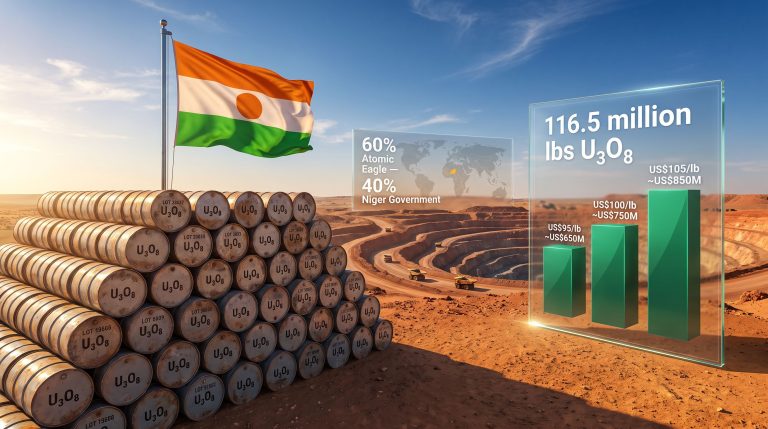
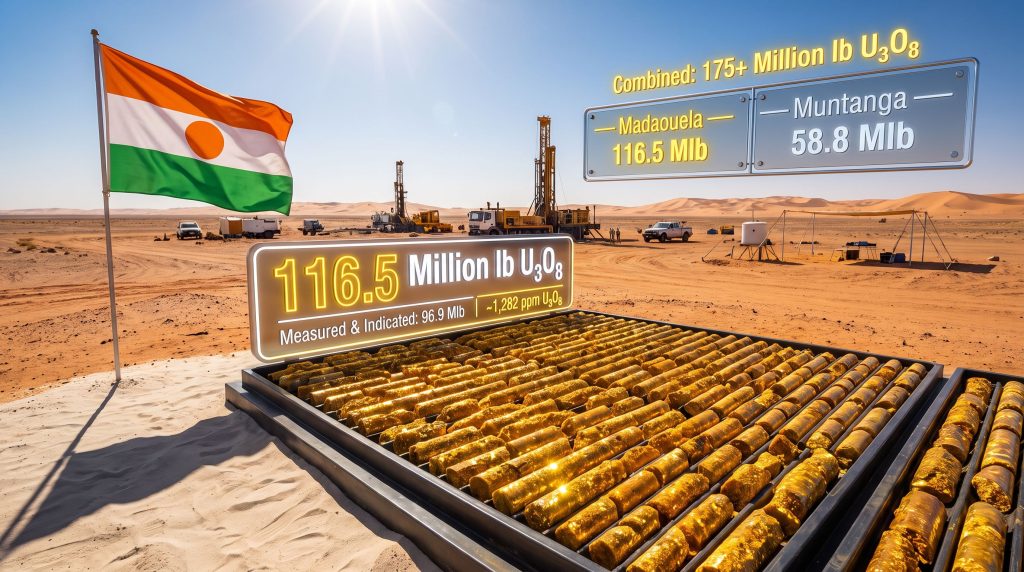
The Atomic Eagle Madaouela uranium project hosts a total mineral resource of 116.5 million pounds of U₃O₈ based on a foreign resource estimate, spanning approximately 41.21 million tonnes at an average grade of ~1,282 parts per million U₃O₈. The breakdown between confidence categories is significant: 96.9 million pounds sits in the measured and indicated categories, with only 19.6 million pounds classified as inferred. That ratio, where roughly 83% of the resource resides in higher-confidence categories, reflects the depth and density of historical investigation across the project area.
To contextualise the grade, it helps to understand where 1,282 ppm sits within the global uranium deposit spectrum. Athabasca Basin unconformity deposits routinely exceed 10,000 ppm and can reach above 100,000 ppm in exceptional cases, but these are geological anomalies. The global average grade for operating uranium mines is considerably lower. By the standards of sandstone-hosted deposits globally, including those across the broader Sahel and in Kazakhstan's prolific in-situ recovery operations, a grade approaching 1,300 ppm is commercially competitive, particularly when paired with resource scale that exceeds 100 million pounds. For further context on how this fits within the broader landscape, the tier-one deposit guide provides a useful framework for comparison.
Key Project Metrics at a Glance
| Parameter | Detail |
|---|---|
| Location | Near Arlit, Niger (Agadez Region) |
| Project Area | ~122.9 km² |
| Total Resource (Foreign Estimate) | 116.5 million lb U₃O₈ |
| Measured and Indicated | 96.9 million lb U₃O₈ |
| Inferred | 19.6 million lb U₃O₈ |
| Total Tonnage | ~41.21 Mt |
| Average Grade | ~1,282 ppm U₃O₈ |
| Historical Drilling | ~600,000 metres |
| Historical Investment | ~US$160 million |
| JORC Update Target | 2026 |
The 600,000 metres of historical drilling that underpin this resource is not a trivial number. For comparison, many advanced junior uranium projects globally are considered well-drilled at 50,000 to 100,000 metres. Six hundred thousand metres represents one of the most comprehensively drilled uranium land packages in Africa, and this exploration density is a direct consequence of the sustained investment made by GoviEx, which committed approximately US$160 million to the project before the ownership dispute arose. That capital has not been lost — it has been converted into technical knowledge that now forms the foundation for Atomic Eagle's resource verification and JORC conversion program.
The Ownership Structure and Commercial Terms: What Atomic Eagle Actually Secured
Equity Architecture and Operational Control
Under the terms of the new Mining Convention, Atomic Eagle holds a 60% equity interest with full operational control of the Madaouela project. The remaining 40% is retained by the Niger state, structured as a 15% free-carried interest alongside a 25% contributing interest. This distinction matters enormously for project economics.
A free-carried interest means the state participates in project economics without contributing proportionally to development capital up to a defined point. A contributing interest, by contrast, requires the state to fund its proportional share of costs once triggered. The practical effect is that Atomic Eagle bears a larger share of early-stage capital burden, but retains the majority equity position and all operational decision-making authority. For a junior developer, operational control in a joint venture structure is not merely symbolic: it governs drilling schedules, contractor selection, environmental management, and ultimately the pace of the project's development timeline.
Financial Obligations and the US$40 Million Credit Mechanism
The financial commitments embedded in the Mining Convention are structured to reduce Atomic Eagle's upfront cash exposure:
- A first payment of US$5 million is payable upon issuance of the exploitation permit
- A second payment of US$5 million falls due at the commencement of construction
- A US$40 million credit mechanism is applied against the government's equity contributions, effectively recognising the historical capital already invested in the project
- A new exploitation permit has been granted to Madaouela Mining Company, the Niger-registered subsidiary
This staged payment structure is a commercially astute design for a junior company. Rather than requiring a large lump-sum entry payment, the obligations are tied to project milestones, aligning cash outflows with capital events that should themselves be financed through project-level funding mechanisms.
Legal Protections: Why the Governance Framework Matters for Bankability
The Mining Convention includes legal and tax stabilisation provisions alongside access to ICSID arbitration as a dispute resolution backstop. These are not boilerplate inclusions. In the context of Niger's recent regulatory history, where a permit was withdrawn outside the procedures prescribed by the national mining code, the explicit stabilisation of legal and tax terms represents a materially stronger governance position than what existed under the prior arrangement.
For project finance lenders and offtake counterparties evaluating Madaouela, the presence of ICSID access and stabilisation provisions is a prerequisite for bankability, not merely a comfort measure. Sovereign risk is ultimately priced, and governance frameworks like these directly affect the cost and availability of project financing.
The convention also provides clarification on uranium offtake arrangements, an often underappreciated commercial element. In the uranium market, long-term utility offtake agreements are the primary mechanism through which mine development gets financed. Without contractual clarity on the right to market and sell uranium production, securing term offtake commitments from nuclear utilities becomes legally complicated. This clarification is therefore commercially foundational.
How the Madaouela Dispute Unfolded: A Regulatory and Geopolitical Timeline
From Coup to Convention
The sequence of events that culminated in the new Mining Convention spans three years and traverses military transition, international arbitration, and structured diplomatic negotiation:
| Date | Event |
|---|---|
| July 2023 | Military coup in Niger; President Mohamed Bazoum removed from power |
| July 2024 | Niger government informs GoviEx that its Madaouela mining permit rights are no longer valid |
| Late 2024 | GoviEx disputes the withdrawal, citing procedural non-compliance with Niger's mining code |
| December 2024 | ICSID arbitration proceedings formally initiated by GoviEx against Niger |
| February 18, 2025 | GoviEx and Niger sign a Letter of Intent establishing a negotiation roadmap; ICSID arbitration temporarily suspended |
| 2025 | GoviEx becomes part of Atomic Eagle via transaction with ASX-listed Tombador Iron, which is subsequently renamed Atomic Eagle |
| 2026 | New Mining Convention agreed; 60/40 ownership structure confirmed; exploitation permit issued |
The Procedural Argument That Created Negotiating Leverage
Niger's mining code prescribes specific procedural conditions that must be satisfied before a mining permit can be lawfully withdrawn. GoviEx's central legal argument was that the July 2024 withdrawal failed to comply with these conditions, rendering the withdrawal procedurally deficient under Nigerien law. This was not merely a diplomatic objection: it formed the basis of the ICSID arbitration filing in December 2024.
The ICSID filing created meaningful negotiating leverage. International arbitration proceedings against a sovereign state carry reputational and financial costs, and the February 2025 Letter of Intent — which suspended proceedings while negotiations continued — represented the Niger government's acknowledgment that a negotiated resolution served both parties' interests better than protracted legal conflict. The pathway from LOI to full Mining Convention, completed in 2026, is the outcome of that structured engagement. Further detail on these technical and legal discussions can be found via reporting on the negotiations.
The Corporate Transformation: Tombador Iron to Atomic Eagle
The 2025 transaction through which GoviEx's assets were consolidated under ASX-listed Tombador Iron, subsequently renamed Atomic Eagle, reflects a deliberate strategic repositioning. The renaming itself signals unambiguously that the company's identity and market proposition are now anchored in uranium, with the Madaouela and Muntanga projects forming the twin pillars of a uranium-focused portfolio.
Dual-Portfolio Strategy: Madaouela vs. Muntanga
Comparing Atomic Eagle's Two Uranium Assets
| Metric | Madaouela (Niger) | Muntanga (Zambia) |
|---|---|---|
| Resource Size | 116.5 million lb U₃O₈ | 58.8 million lb U₃O₈ |
| Resource Standard | Foreign Estimate (JORC update pending) | JORC Compliant |
| Development Stage | Resource verification and optimisation | Flagship development asset |
| Strategic Role | Scale and portfolio optionality | Primary development focus |
| Jurisdiction | Niger (post-coup stabilisation phase) | Zambia |
The combined resource inventory across both projects now exceeds 175 million pounds of U₃O₈, a portfolio scale that positions Atomic Eagle meaningfully within the junior uranium developer peer group. Muntanga retains flagship status despite being the smaller asset, a deliberate sequencing decision that reflects the jurisdictional risk premium currently assigned to Niger-based assets. As Niger's regulatory environment stabilises and the JORC conversion at Madaouela advances, this weighting may evolve. Understanding global uranium reserves helps contextualise just how significant a combined inventory of this scale can be.
Portfolio Logic: Maintaining Muntanga as the primary development focus while Madaouela undergoes JORC verification is strategically sound. It allows Atomic Eagle to demonstrate development capability in a lower-risk jurisdiction while preserving the optionality value of a much larger resource base in Niger.
The JORC Conversion Process: What Investors Need to Understand
Foreign Estimate vs. JORC-Compliant Mineral Resource
For ASX-listed companies, the distinction between a foreign resource estimate and a JORC-compliant mineral resource is a matter of disclosure standards, not simply nomenclature. Foreign estimates are not subject to the same competent person requirements, classification criteria, and quality assurance protocols that govern JORC reporting. They can provide directionally useful guidance on resource scale, but they cannot be relied upon with the same degree of confidence for project economics, feasibility studies, or project financing discussions.
Atomic Eagle's ongoing resource verification and technical optimisation program is designed to convert the 116.5 million pound foreign estimate into a JORC-compliant mineral resource, with delivery targeted for 2026. Furthermore, interpreting drill results from the historical 600,000-metre database will be central to this conversion process. The program involves:
- Database compilation and validation of the 600,000-metre historical drill program
- Geological modelling to establish mineralisation domains consistent with JORC classification criteria
- Grade estimation using modern geostatistical methods applied to historical assay data
- Competent person review and sign-off in accordance with the 2012 JORC Code
The outcome of this process carries both upside and downside potential. On the positive side, the density of historical drilling suggests the geological model is well-constrained, which typically supports resource confidence rather than undermining it. On the downside, JORC conversion can reveal issues with data quality, geological continuity assumptions, or classification boundaries that result in a revised resource estimate differing from the foreign estimate. Investors should treat the 116.5 million pound figure as directionally indicative rather than definitively confirmed.
The next major ASX story will hit our subscribers first
Uranium Market Context: Where Madaouela Sits in the Global Supply Picture
The Structural Supply-Demand Backdrop
Niger was historically a top-five global uranium producer, with the Arlit basin supplying French nuclear utilities for decades through Orano-operated mines. The post-coup period disrupted this output and created uncertainty about Niger's role in the Western uranium supply chain. However, the uranium market dynamics in play today suggest the structural case for large-scale African production remains compelling.
Against this backdrop, the market faces a structural challenge: global reactor demand continues to expand, driven by existing fleet operations, life extensions, and new build programs across Asia and Europe, while near-term mine supply growth remains constrained by long project development lead times and the legacy effects of the post-Fukushima price collapse on exploration investment. Consequently, uranium market volatility has become an increasingly important consideration for developers and investors alike.
The uranium spot market has recovered significantly from its post-2011 lows, and long-term contract prices — which is the mechanism through which mines actually get financed and built — have followed. For a project of Madaouela's scale, the ability to negotiate substantial long-term utility offtake agreements is a realistic ambition, provided the governance framework and resource confidence are sufficient to satisfy utility procurement requirements.
Scenario Analysis: Pathways Forward for Madaouela
| Scenario | Key Conditions | Likely Timeline |
|---|---|---|
| Base Case | JORC resource confirmed 2026, feasibility initiated 2027, construction financing by 2028-2029 | Production potential late 2020s |
| Upside Case | Strong uranium prices accelerate offtake negotiations, strategic partner or major producer interest emerges | Development timeline compressed by 12-18 months |
| Downside Case | JORC conversion reveals resource degradation, or jurisdictional complications delay permitting beyond 2027 | Production timeline pushed into early 2030s |
Disclaimer: The above scenarios represent analytical projections for illustrative purposes only and should not be interpreted as forecasts or investment advice. Uranium project development timelines are subject to extensive variables including commodity prices, financing markets, regulatory processes, and operational factors beyond the company's control.
What the Madaouela Resolution Signals for African Mining Investment
ICSID Arbitration as a Dispute Resolution Model
The Madaouela resolution offers a case study in how international arbitration mechanisms function in practice within frontier mining jurisdictions. The filing of ICSID proceedings in December 2024 was not the end point: it was the mechanism that created conditions for a negotiated outcome. The subsequent LOI and convention pathway demonstrates that the threat of sustained international arbitration, with its reputational and financial costs for the host state, can be an effective lever for junior companies operating in politically transitional environments, provided the underlying legal position is defensible.
For other junior uranium developers with assets in Francophone West Africa, the Madaouela precedent is instructive. It suggests that rigorous adherence to procedural requirements under national mining codes, combined with willingness to pursue international arbitration when those procedures are violated, can ultimately deliver commercially viable resolutions even in post-coup regulatory environments.
Re-Rating Catalysts for Atomic Eagle
Investors evaluating the Atomic Eagle Madaouela uranium project as a component of the company's overall investment thesis should monitor several key developments:
- Delivery of the JORC-compliant mineral resource update, expected in 2026
- Progress on uranium offtake agreement discussions with nuclear utilities
- Uranium spot and long-term contract price trajectory through the current market cycle
- Advancement of the Muntanga flagship project through feasibility and permitting stages
- Further stabilisation of Niger's investment regulatory environment
The combination of a 175-million-pound-plus combined resource inventory across two African jurisdictions, a restored governance framework at Madaouela, and a JORC-compliant flagship project in Zambia creates a multi-dimensional value proposition for a company that did not exist in its current form before 2025.
This article is intended for informational purposes only and does not constitute financial or investment advice. Investing in junior mining and exploration companies involves significant risk, including total loss of capital. Readers should conduct their own due diligence and consult a licensed financial adviser before making investment decisions.
Want to Catch the Next Major Uranium Discovery Before the Market Does?
Discovery Alert's proprietary Discovery IQ model scans ASX announcements in real time, instantly identifying significant mineral discoveries across uranium and more than 30 other commodities — translating complex data into actionable insights for investors at every level. Explore how historic discoveries have generated exceptional returns on the Discovery Alert discoveries page, and start your 14-day free trial today to position yourself ahead of the broader market.