August 24, 2026

The Quiet Revolution in Uranium Project Finance: Why Advanced Assets Are Rewriting the Rules
Most investors tracking the uranium sector focus on spot price movements and reactor pipeline growth. Fewer examine the structural scarcity problem unfolding quietly beneath those headline numbers. The world's reactor fleet is expanding, but the pipeline of construction-ready uranium projects capable of feeding it has not kept pace. Decades of underinvestment following the Fukushima disaster compressed exploration budgets globally, and the long lead times inherent in uranium project development mean that assets with completed drilling programmes, existing feasibility studies, and defined resource bases now occupy an increasingly rare and strategically valuable position in the global nuclear fuel supply chain.
It is within this context that the return of the Madawela uranium project in Niger to Atomic Eagle's portfolio deserves serious analytical attention. This is not simply a corporate transaction. It represents a case study in how advanced-stage uranium assets are being repositioned, renegotiated, and repriced as the uranium market deficit tightens.
When big ASX news breaks, our subscribers know first
Niger's Place in the Global Uranium Endowment
To understand why the Madawela uranium project in Niger matters, one must first appreciate the geology and geopolitics of the Arlit and Agadez mining corridor in northern Niger. This region hosts some of the most significant uranium mineralisation on the African continent, with French nuclear group Orano operating long-established mines that have supplied European reactors for decades. According to the World Nuclear Association, Niger has historically ranked among the top five global uranium producers by volume, and the broader Aïr Mountains geological province continues to host unexplored and underdeveloped resources beyond the French-aligned assets.
What makes this region particularly compelling from a supply security standpoint is the diversity of interests already present. Chinese state-linked entities hold positions in the corridor, independent Western developers have pursued assets, and African institutional capital has been deployed into the sector. This convergence of competing strategic interests is itself a signal of how highly the region's uranium endowment is regarded by those with the deepest insight into long-term fuel cycle economics. Furthermore, understanding global uranium reserves helps contextualise just how strategically positioned this corridor truly is.
From GoviEx to Atomic Eagle: Understanding the Asset's History
The Madawela project, also referred to historically as Madaouela, did not arrive in Atomic Eagle's hands without a significant and turbulent backstory. The asset was developed over many years by GoviEx Uranium Inc., a TSX Venture Exchange-listed Canadian company that committed approximately US$160 million in historical expenditure and completed over 600,000 metres of drilling across the project area. That level of investment produced a substantial technical database that would prove critical to the speed with which Atomic Eagle was later able to re-engage the Niger government.
In 2024, Niger's government revoked the project's exploitation permit, triggering international arbitration proceedings under GoviEx. When Atomic Eagle completed its reverse takeover of GoviEx in November 2025, it inherited not only the Mutanga uranium project in Zambia, which was the primary acquisition target, but also the disputed Niger asset and its associated arbitration proceedings.
The Strategic Decision to Negotiate Rather Than Litigate
The decision to pursue a negotiated resolution rather than continue with international arbitration reflects a sophisticated understanding of the real costs of mining disputes in frontier jurisdictions. Arbitration proceedings in resource-rich African nations can extend over many years, consume substantial management bandwidth, and generate outcomes that are difficult to enforce even when judgements are favourable.
Atomic Eagle's leadership made initial contact with Niger's Minister of Mines at the Future Minerals Forum in Saudi Arabia in January 2026. From that opening conversation, a negotiating framework was established that produced a new mining convention, a new Niger-incorporated corporate entity, and a formalised ownership structure within approximately seven months. For context, comparable framework negotiations in other African jurisdictions have historically taken several years to conclude. The pace of resolution in Niger was, by any reasonable standard, exceptional.
"Negotiated mining conventions with stabilisation clauses, arbitration access, and defined operational control provisions are increasingly preferred by project financiers over assets with unresolved sovereign disputes, regardless of the technical quality of the underlying resource."
The Architecture of the New Mining Convention
The governance structure underpinning Atomic Eagle's return to Madawela is defined by three interlocking legal documents: the corporate constitution of the newly incorporated Niger entity, the mining convention itself, and a shareholders agreement between the two equity parties. All three documents must be internally consistent to be enforceable, and inconsistencies between such documents have historically been a primary source of mining disputes in African jurisdictions.
The key commercial and governance terms of the new mining convention are summarised below:
| Term | Detail |
|---|---|
| Atomic Eagle Equity Stake | 60% |
| Niger Government Stake | 40% (15% free carry + up to 25% contributory) |
| Upfront Payment to Government | US$5 million (within one month of signing) |
| Second Payment Trigger | US$5 million at commencement of construction |
| Government Carry Facility | Up to US$40 million toward government's equity contribution |
| Dilution Mechanism | Government's 25% contributory interest dilutes if capital not contributed |
| Operational Control | Atomic Eagle retains full authority over all budgets and work programmes |
| Off-take Rights | Unfettered rights over 60% equity share; pre-emption applies to government's 40% |
| Dispute Resolution | International arbitration access confirmed |
| Study Update Window | Two years from signing |
Critically, Atomic Eagle retains complete operational control over all budgets and work programmes without requiring unanimous shareholder consent. This is an explicit provision across all three governance documents, meaning the government's equity stake does not translate into operational veto rights. For investors evaluating governance risk in African mining assets, this distinction carries significant weight.
Decoding the Off-Take Provisions
One of the most technically complex aspects of Niger's mining law relates to government off-take rights. Niger's statutory framework contains three distinct sets of government rights over project output that, when read together without clarification, could theoretically direct up to 90% of production to the state. This ambiguity had the potential to fundamentally undermine the project's commercial attractiveness to utilities and strategic buyers.
The new mining convention resolves this ambiguity directly. Atomic Eagle holds unfettered commercial off-take rights over its 60% equity share of production. For the government's 40% share, any proposed off-take agreement must be presented to the government for review, but the government can only exercise pre-emption rights by stepping into the agreement on identical commercial terms. This means that arm's-length, market-priced, long-duration off-take agreements covering up to 100% of total project production are structurally achievable, a material improvement over the pre-convention legal uncertainty. In addition, the broader context of spot versus term pricing makes these off-take provisions all the more commercially significant.
Resource Scale and Grade: The Numbers That Matter
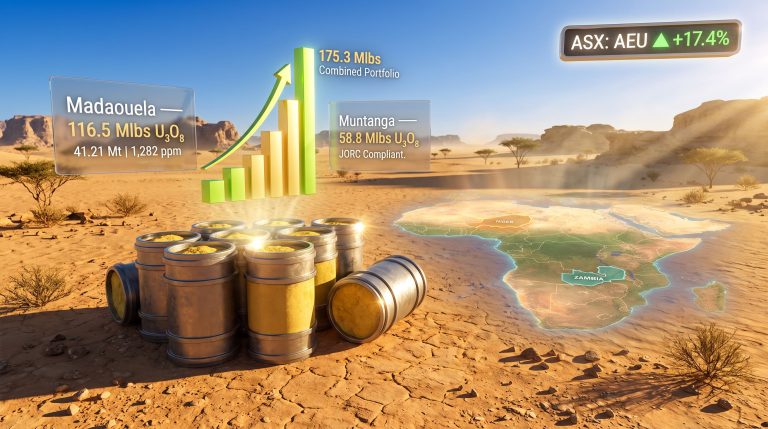
The scale of the Madawela resource places it in a category that very few undeveloped uranium projects globally can match. The project holds a total resource of 116.5 million pounds of U₃O₈ at a grade of 1,282 parts per million, with 96 million pounds classified as measured and indicated resources and approximately 20 million pounds in the inferred category.
The comparison to Atomic Eagle's Zambian asset, the Mutanga project, is instructive:
| Metric | Madawela (Niger) | Mutanga (Zambia) |
|---|---|---|
| Total Resource | 116.5 million lbs U₃O₈ | ~60 million lbs U₃O₈ |
| Grade | 1,282 ppm U₃O₈ | Approximately one-quarter of Madawela's grade |
| Historical Expenditure | US$160 million | Ongoing |
| Drilling Database | 600,000 metres | Expanding |
| Resource Standard | NI 43-101 (JORC conversion planned H2 2026) | JORC |
| Price Assumption at Resource Estimate | US$70/lb | N/A |
| Estimated Resource at US$95/lb | ~130 million lbs | N/A |
Madawela is approximately twice the size and four times the grade of the Mutanga project. That grade differential matters considerably when evaluating capital efficiency, processing costs, and long-term production economics. High-grade uranium deposits require proportionally less ore to be mined, crushed, and processed to produce a given quantity of uranium concentrate, which directly reduces the capital and operating cost per pound of output.
The 20 Million Pound Inferred Resource: An Overlooked Value Driver
One of the less-discussed aspects of Madawela's resource profile is the significance of the 20 million pounds sitting in the inferred category. Under Canadian NI 43-101 standards, inferred resources cannot be included in feasibility study mine plans or economic models. This means the previous feasibility study was constructed entirely on the 96 million pound measured and indicated resource base, leaving a meaningful volume of defined mineralisation entirely outside the project's modelled economics.
Converting inferred resources to measured and indicated status through targeted infill drilling represents a low-cost, high-impact value creation pathway. No new greenfield exploration is required. The mineralisation is already defined. The geological model already exists. It is simply a matter of increasing the drilling density in known resource areas to satisfy the confidence threshold required for a higher resource classification.
NPV Sensitivity to Uranium Price
Because the original resource estimate was prepared using a US$70/lb long-term uranium price assumption, the current long-term price environment of approximately US$95/lb has already materially improved project economics without any additional work. At current prices, the project resource expands to an estimated 130 million pounds, and the NPV sensitivity profile is highly leveraged:
| Long-Term Uranium Price | Estimated Project NPV |
|---|---|
| US$95/lb | ~US$650 million |
| US$100/lb | ~US$750 million |
| US$105/lb | ~US$850 million |
Each US$5/lb increase in the long-term uranium price adds approximately US$100 million to project NPV, a leverage characteristic that becomes even more pronounced if the mine plan is optimised to increase throughput and production rates. Consequently, broader uranium supply-demand volatility continues to shape how investors model these price sensitivity scenarios.
Technical Optimisation: Where Hidden Value May Reside
The previous feasibility study employed a combination of open-pit and room-and-pillar underground mining, consistent with the methods used at nearby Orano-operated assets in the same geological corridor. While this approach is technically sound, room-and-pillar underground mining leaves a material proportion of ore in place as structural support, a physical requirement of the method that permanently sterilises some percentage of the resource.
Atomic Eagle has identified this as a priority area for optimisation in the updated feasibility study. The specific areas under review include:
- Transitioning to alternative underground extraction methods with higher ore recovery rates
- Running underground development concurrently with open-pit operations rather than sequentially
- Increasing overall production throughput to maximise price leverage at projected uranium market conditions
- Evaluating whether additional inferred resource conversion can support a larger long-term production profile
"Room-and-pillar mining typically achieves ore recovery rates significantly below those achievable through longhole stoping or other mass mining methods. In high-grade uranium deposits, even modest improvements in underground recovery can translate into meaningful improvements in project economics."
JORC Conversion: Why It Matters for ASX-Listed Companies
The existing Madawela resource estimate was prepared under Canadian NI 43-101 standards. For an ASX-listed company, conversion to JORC 2012 (Joint Ore Reserves Committee) standards is both a regulatory expectation and a practical necessity for engaging Australian institutional investors and many international project financing counterparties.
The conversion process involves several defined steps:
- Engagement of a JORC-qualified Competent Person to review all historical drilling data
- Validation of sampling protocols, assaying methodologies, and geological modelling approaches
- Reclassification of resource categories in accordance with JORC 2012 confidence criteria
- Publication of an updated resource statement via formal ASX announcement
This conversion is targeted for completion in the second half of 2026 and is not expected to materially change the total resource tonnage, though the category distribution may shift as historical data is reviewed against JORC confidence thresholds.
The next major ASX story will hit our subscribers first
Funding the Madawela Restart: Cash Position and Near-Term Liquidity
A critical question for investors evaluating the feasibility of Atomic Eagle's Madawela commitments is whether the company has sufficient capital to meet its near-term obligations. The financial picture, as disclosed by management, is as follows:
| Funding Source | Amount (AUD) |
|---|---|
| Cash on hand (end of June 2026) | ~AU$14 million |
| Projected year-end cash (base case) | ~AU$4 million |
| Potential warrant/option exercise proceeds | ~AU$16 million |
| Combined liquidity (if warrants exercised) | ~AU$20 million |
Approximately 50 million options and warrants are held by a group of strategic shareholders including a Zambian pension fund, a current director, and a former director, all parties described by management as holding their positions at a strategic rather than speculative level. Early exercise conversations are reportedly in progress. If exercised, these instruments would inject approximately AU$16 million into the company's treasury.
"The primary near-term financial obligations at Madawela are study update costs and environmental approval renewals, not greenfield capital expenditure. The existence of a 600,000 metre historical drilling database substantially reduces the cost and timeline of these workstreams compared to initiating a first-pass feasibility study from scratch."
Evaluating Political Risk vs Execution Risk: A Critical Distinction
The expropriation of the Madawela permit in 2024 was the defining risk event that caused many investors to effectively write the Niger asset to zero. The subsequent negotiation of a new mining convention has materially altered the risk profile of the project, but understanding precisely how it has changed requires a clear separation of two distinct risk categories.
Political risk refers to the probability of sovereign interference in the project's ownership, permitting, or operations. The new mining convention addresses this directly through legal and tax stabilisation clauses, explicit operational control provisions, and confirmed access to international arbitration for future disputes.
Execution risk refers to the probability that the technical, financial, and operational workstreams required to bring the project into production are completed successfully and on schedule. This category of risk is directly within management's control and is the primary lens through which Atomic Eagle's leadership now describes the project.
The governance architecture, specifically the three-document framework of the corporate constitution, mining convention, and shareholders agreement, is designed to prevent the ambiguities that have historically been the trigger point for disputes in African mining jurisdictions. Whether that architecture proves durable under future stress tests remains to be seen, but the structural safeguards are considerably more robust than those present in many comparable African mining agreements.
Strategic Investors and Valuation: How Different Buyers Price the Asset
Projects of Madawela's scale and grade profile enter the open market rarely. When they do, they attract a fundamentally different class of investor than the retail and junior mining cohort that typically provides price discovery for small-cap uranium stocks. Management has acknowledged definitive interest in the asset from both US government-aligned entities and major Chinese uranium companies, a convergence that reflects the project's perceived importance beyond conventional mining cash flow economics. Understanding broader uranium market dynamics is essential context for evaluating how different buyer categories approach assets at this scale.
| Buyer Type | Primary Valuation Lens | Implied Pricing Approach |
|---|---|---|
| Retail and Junior Mining Investors | NPV and cash flow multiples | ~US$3/lb on attributable resource |
| Strategic Industrial Buyers | Supply security premium | Potentially above market comparables |
| Government-Backed Financiers | Geopolitical and energy security value | Financing terms may reflect strategic subsidy |
| State-Owned Enterprises | Long-term off-take value | Volume and duration prioritised over price |
At the US$3/lb valuation applied to comparable advanced African uranium developments, Atomic Eagle's attributable 60% interest, representing approximately 70 million pounds of uranium, implies a valuation contribution of approximately AU$210 million. Management has stated that it would regard failure of the market to reflect this implied value as a signal to pursue strategic and financing processes that could unlock it through other mechanisms.
"The US Development Finance Corporation has been publicly linked to financing discussions around the Dasa uranium project in Niger, owned by Global Atomic. If the regulatory and export logistics questions surrounding that transaction are resolved, it may establish a template for similar financing structures at other Niger uranium projects, though no such support has been confirmed or applied to Madawela."
Dual-Asset Strategy: Balancing Mutanga and Madawela
With the return of Madawela, Atomic Eagle operates two advanced uranium projects with distinctly different strategic profiles. Rather than treating them as competing priorities, management has framed them as complementary assets targeting different investor bases and development pathways. The Chisebuka uranium mineralisation expansion at the Zambian operations further demonstrates the company's commitment to advancing both assets simultaneously.
| Strategic Dimension | Mutanga (Zambia) | Madawela (Niger) |
|---|---|---|
| Resource Size | ~60 million lbs and growing | 116.5 million lbs |
| Development Stage | Active drilling, heap leach study | Feasibility update phase |
| Operational Complexity | Lower (heap leach processing) | Higher (open pit and underground) |
| Primary Activity (near-term) | Resource expansion drilling | JORC conversion, study update |
| Target Capital Source | Junior mining equity | Strategic and sovereign financing |
| Strategic Optionality | Development asset | Partnership and financing asset |
Management has committed to maintaining entirely separate operational and study teams for each project to prevent management dilution and ensure both assets advance without competing for internal resources. The Mutanga project continues active resource expansion drilling, with additional discoveries anticipated in the second half of 2026, while a dedicated Madawela study team is being assembled to manage the feasibility update process.
The strategic logic is straightforward: Mutanga is positioned as a development-stage asset appropriate for a junior mining company to advance independently using conventional equity and debt financing. Madawela, by contrast, is positioned as a strategic-scale asset designed to attract sovereign wealth, state-owned enterprise capital, or export credit-backed financing structures. These are fundamentally different investor bases requiring different engagement strategies, and treating the two assets as separate mandates is a rational response to that reality.
Key Risks and Investor Considerations
Investors evaluating the Madawela uranium project in Niger return to Atomic Eagle should be aware of several material risk factors that could affect outcomes:
- The new mining convention has been negotiated and signed, but formal issuance of replacement exploitation permits and completion of outstanding documentation remain subject to execution risk
- The two-year feasibility update window requires sustained management focus and capital allocation to study workstreams
- Niger's broader investment climate remains in recovery following several years of political disruption, and the pace at which political risk insurance providers and export credit agencies re-engage with the jurisdiction is uncertain
- The trajectory of Niger's relationship with Orano and French-aligned entities could influence the broader policy environment for foreign mining investment
- Uranium price assumptions underlying NPV estimates are projections, not guarantees, and actual prices may diverge materially from current long-term contract levels
This article is intended for informational purposes only and does not constitute financial advice. All projections, valuations, and estimates referenced herein involve assumptions and uncertainties. Past performance of comparable assets is not indicative of future results. Investors should conduct their own due diligence and consult qualified financial advisers before making investment decisions.
Want To Be First When The Next Major Uranium Discovery Hits The ASX?
Discovery Alert's proprietary Discovery IQ model scans ASX announcements in real time, instantly identifying significant mineral discoveries across uranium and more than 30 other commodities — explore historic discoveries and their exceptional returns, then begin your 14-day free trial at Discovery Alert to position yourself ahead of the broader market.