August 24, 2026
The Supply Crunch Reshaping How the World Values Uranium Development Assets
Uranium markets operate on fundamentally different dynamics than most commodity sectors. Because nuclear fuel cycles require decade-long contracting horizons, utility buyers cannot simply respond to spot price signals in real time. They must secure supply years, sometimes decades, in advance. This structural reality means that large, advanced-stage uranium development projects carry a scarcity premium that the spot market alone fails to capture.
When a project of genuine scale re-enters the investable universe after a period of dispute or suspension, the market response extends well beyond a single company's share price. Understanding uranium supply-demand volatility is therefore essential context for evaluating what comes next.
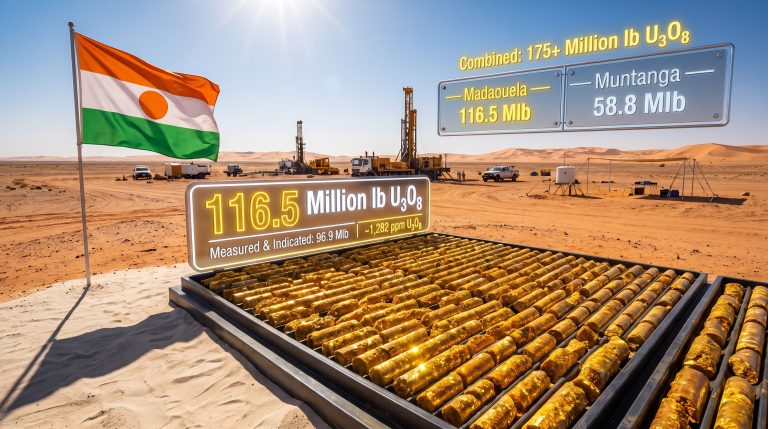
That is precisely the context in which the Atomic Eagle Madaouela uranium project agreement in Niger deserves to be understood. The resolution of a contested resource tenure situation through a commercially negotiated framework, rather than prolonged international arbitration, adds a project exceeding 116 million combined pounds of U3O8 back into the advanced development pipeline at a moment when supply-side optionality is under pressure globally.
When big ASX news breaks, our subscribers know first
From Dispute to Convention: Understanding the Corporate Journey
A Permit Withdrawn, Then Rebuilt
The Madaouela story is inseparable from Niger's 2023 political transition. Following a military coup that displaced the elected government, Niger's new administration moved assertively to reassert sovereignty over strategic mineral assets. In July 2024, this posture resulted in the formal withdrawal of the Madaouela exploitation permit from its then-holder, Canada-based GoviEx Uranium Inc.
GoviEx responded by initiating international arbitration proceedings, a legally conventional but commercially costly pathway that offered uncertain timelines and outcomes.
The pivot came in January 2025, when both parties agreed to suspend arbitration in favour of direct negotiation. This shift from adversarial legal proceedings to bilateral commercial dialogue was not guaranteed to succeed, but it ultimately created the conditions for a durable resolution.
The Corporate Transformation That Made Resolution Possible
GoviEx Uranium merged with Tombador Iron in November 2025 to form Atomic Eagle Limited, an Australian Securities Exchange-listed company with restructured leadership and a mandate to resolve the outstanding dispute through commercially pragmatic means. The emergence of new management at Atomic Eagle appears to have been a facilitating factor in advancing negotiations with Niger's Ministry of Mines.
The formal withdrawal of arbitration proceedings is to be completed within seven days of signing the new mining convention, drawing a clear line under years of legal uncertainty and opening the path to active project development.
What the Madaouela Resource Base Actually Represents
Scale, Grade, and Development Readiness
Madaouela is not an early-stage exploration play. It carries a substantial body of historical technical work and a resource estimate that places it among the more significant undeveloped uranium assets in the West African region.
| Resource Category | Estimated Pounds U3O8 | Grade (ppm) |
|---|---|---|
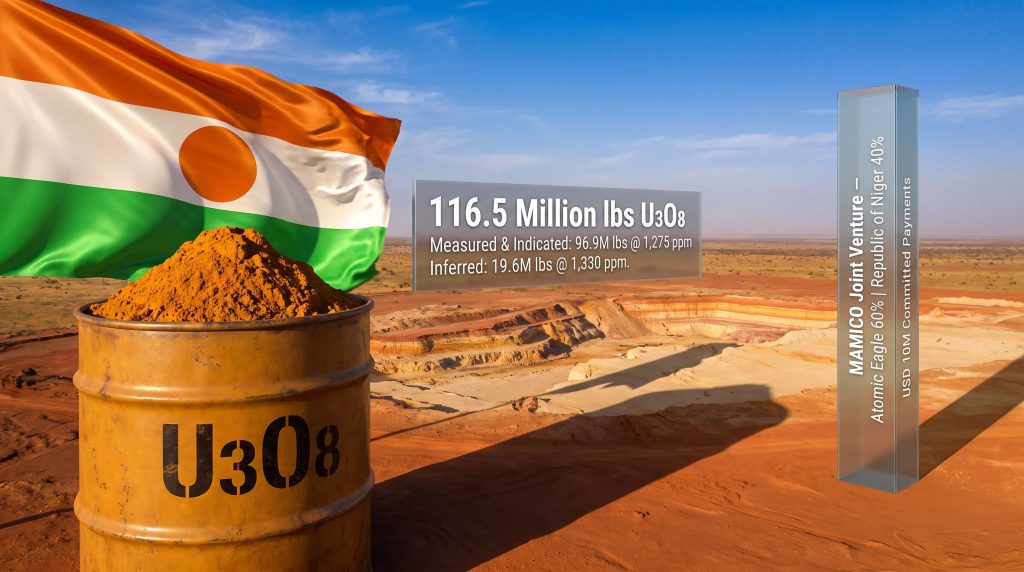
| Measured and Indicated | 96.9 million lbs | 1,275 ppm |
| Inferred | 19.6 million lbs | 1,330 ppm |
| Combined Total | ~116.5 million lbs | ~1,275 to 1,330 ppm |
To contextualise the grade profile: 1,275 ppm U3O8 is broadly competitive with several producing African uranium operations, though it sits below the ultra-high-grade deposits of Canada's Athabasca Basin, where grades can exceed 15,000 ppm. In the context of conventional open-pit or underground mining in West Africa, grades in the 1,200 to 1,400 ppm range are considered commercially viable, particularly as uranium prices have remained elevated relative to the lows experienced between 2013 and 2020.
The inferred resource category carrying a slightly higher grade of 1,330 ppm than the measured and indicated component suggests that further infill drilling could potentially upgrade both the resource quantity and average grade simultaneously, a dynamic worth monitoring as Atomic Eagle advances its technical work programme.
Why the JORC Upgrade Is More Than a Paperwork Exercise
The current Madaouela resource estimate is classified as a foreign estimate prepared under Canadian National Instrument 43-101 standards, the regulatory framework used by GoviEx under its Canadian corporate structure. As an ASX-listed entity, Atomic Eagle must bring this estimate into compliance with the JORC Code, the Australasian Joint Ore Reserves Committee standard recognised by Australian securities regulators.
A JORC-compliant resource estimate is not merely a reporting formality. It is a prerequisite for institutional investment mandates, project-level debt financing, and offtake contract negotiations with nuclear utilities that require bankable technical documentation.
Atomic Eagle has already commenced resource verification and technical optimisation work, with the full JORC upgrade targeted for completion later in 2026. This represents a near-term, company-controlled catalyst that does not depend on commodity prices, regulatory approvals, or macroeconomic conditions. The upgrade process may also reveal opportunities to expand or upgrade the resource itself, given that the existing estimate was prepared under previous ownership with potentially different drilling priorities.
It is worth noting that NI 43-101 and JORC share broadly similar philosophies around competent person requirements and resource classification criteria. The conversion process is therefore unlikely to dramatically alter the headline resource figures, though differences in classification boundaries and reporting conventions can produce variation. Investors should watch for any accompanying technical commentary when the JORC estimate is published.
The Architecture of the New Mining Convention
Ownership Structure and Operational Control
The exploitation permit under the newly agreed mining convention is held by MAMICO, a purpose-incorporated Nigerien subsidiary established specifically to operate the Madaouela project. Atomic Eagle holds a 60% interest in MAMICO, with the Republic of Niger retaining 40%, structured across two components:
- A 15% free-carried interest, meaning the Nigerien state participates in project economics without being required to contribute capital
- A 25% contributing interest, under which the state contributes proportionally to ongoing project costs
Atomic Eagle retains full operational control over MAMICO and the conduct of all mining activities, subject to the agreed governance framework. This control provision is commercially significant: it means that day-to-day decisions about mining methods, contractor selection, and operational scheduling remain with the majority shareholder rather than being subject to state veto.
Financial Commitments: A Milestone-Linked Structure
| Payment Milestone | Amount (USD) | Trigger |
|---|---|---|
| Initial payment | USD 5 million | Within 30 days of exploitation permit issuance |
| Construction commencement payment | USD 5 million | At the start of construction |
| Total committed payments | USD 10 million | Across two defined milestones |
The milestone-linked payment structure reduces upfront capital exposure while aligning financial commitments with project progress. This approach is common in junior mining agreements with resource-sovereign host governments and serves the mutual interest of both parties by ensuring that payments reflect genuine development momentum rather than option premiums paid against uncertain outcomes.
State Marketing Rights and Offtake Ring-Fencing
Niger's government retains the right to purchase and market a portion of uranium production up to its proportional shareholding in MAMICO. Under specific circumstances, the state may also exercise pre-emption rights or requisition as much as 50% of mine output.
Critically, these state rights are explicitly subordinated to any binding offtake contracts already entered into by MAMICO. This ring-fencing provision is architecturally important for any future uranium supply agreements Atomic Eagle negotiates with nuclear utilities. Utilities purchasing uranium under long-term contracts require certainty that sovereign intervention cannot unilaterally redirect their contracted volumes. Without this protection, offtake negotiations would face a structural impediment.
Tenure Security and Stabilisation Provisions
The exploitation permit carries an initial 10-year term, renewable in five-year increments for the operational life of the mine. The convention also embeds legal, tax, and regulatory stabilisation clauses, along with internationally recognised dispute resolution mechanisms that replace the previously contested arbitration pathway.
A two-year development window has been established for Atomic Eagle to complete feasibility updates, secure project financing, and advance development structures. This timeframe creates a defined decision gate rather than leaving development obligations open-ended.
Niger's Uranium Sector in a Global Context
Historical Significance and Geological Endowment
Niger has been among the world's most significant uranium-producing nations for more than five decades. Production from the Arlit and Akouta mining districts, operated for many years by French nuclear operator Orano (formerly Areva), established Niger as a foundational supplier to the European nuclear fuel cycle. At its peak, Niger ranked as the world's fourth-largest uranium producer by volume.
The country's uranium geology is associated with Proterozoic sandstone-hosted deposits in the Tim Mersoï Basin, a geological setting that has proven highly productive across multiple mining operations. Madaouela sits within this same broad geological province, lending geological credibility to the resource scale identified through historical drilling programmes. Furthermore, the broader uranium supply challenges facing the global market reinforce the strategic importance of assets such as Madaouela.
Regional Comparison: West and Central African Uranium Endowments
| Country | Development Status | Notable Projects |
|---|---|---|
| Niger | Multiple advanced projects | Madaouela, Imouraren, Arlit district |
| Namibia | Active production | Husab, Rossing, Langer Heinrich |
| Tanzania | Advanced exploration | Mkuju River |
| Central African Republic | Exploration stage | Bakouma |
Note: Development status and project listings are indicative based on publicly available industry data.
Post-Coup Resource Governance: What Niger's Approach Signals
The Madaouela resolution offers an instructive precedent for how resource-sovereign governments in the Sahel are calibrating their engagement with foreign mining capital. Niger's military administration faced a genuine dilemma: asserting resource sovereignty through expropriation satisfies domestic political audiences but destroys the foreign investment credibility needed to monetise those same resources.
The negotiated outcome, which preserves Niger's 40% economic interest while returning operational control and investment responsibility to Atomic Eagle, reflects a pragmatic synthesis of both objectives. The government secures a meaningful revenue stake in a project it could not develop alone, while Atomic Eagle regains access to an advanced asset it could not replicate elsewhere at comparable cost.
This type of commercially structured resolution, combining state participation with private operational control and stabilisation protections, is increasingly the template that resource-sovereign governments across Africa are using to attract foreign mining investment without fully surrendering resource ownership claims.
Investor Considerations and Risk Factors
Near-Term Catalysts to Monitor
Several identifiable milestones over the coming months will shape how the market prices Atomic Eagle's Madaouela exposure:
- Formal signing of the mining convention and subsequent withdrawal of arbitration proceedings within seven days
- Issuance of the exploitation permit by Niger's Ministry of Mines, triggering the initial USD 5 million payment obligation
- Publication of the JORC-compliant resource estimate, expected later in 2026, which will establish an ASX-recognised baseline for institutional analysis
- Completion of updated feasibility work within the two-year development window specified in the convention
- Announcement of any offtake negotiations with nuclear utility counterparties, which would validate the project's commercial trajectory
Risk Factors That Investors Should Weigh
No assessment of a uranium development project in the Sahel would be complete without acknowledging the risk landscape. The factors most relevant to Madaouela include:
- Sovereign and political risk remains elevated in Niger. The 2024 permit withdrawal is itself evidence that political transitions can override commercial agreements. The new convention's stabilisation clauses mitigate but do not eliminate this exposure.
- Development financing risk is non-trivial for a project of this scale in a jurisdiction with elevated country risk. Securing project-level debt on acceptable terms will require robust feasibility documentation and potentially the involvement of development finance institutions.
- Commodity price sensitivity is inherent to any pre-production uranium asset. While the current price environment is constructive relative to the post-Fukushima decade, uranium markets are cyclical and subject to utility contracting cycles, reactor fleet decisions, and geopolitical supply disruptions.
- Operational and infrastructure risk in the landlocked Sahel region includes logistics, power supply, water access, and workforce considerations that add complexity to any mine development plan.
In addition, investors tracking the spot and term price divergence in uranium markets will recognise that the current pricing environment, while supportive, does not eliminate the execution risks inherent to projects at this stage of development.
This article is intended for informational purposes only and does not constitute financial advice. Investors should conduct their own due diligence and consider their individual risk tolerance before making investment decisions related to any uranium sector company or project.
The next major ASX story will hit our subscribers first
The Broader Signal: What Madaouela Means for Uranium Supply Planning
From a supply chain perspective, the re-entry of Madaouela into the active development pipeline matters beyond Atomic Eagle's corporate story. Global uranium demand projections, driven by reactor restarts across Europe and Asia, an expanding fleet of operating reactors in China, and a growing pipeline of small modular reactor projects, are creating a forward supply gap that the existing producing fleet cannot close without significant new mine development.
Large, advanced-stage projects with established resource estimates, existing infrastructure studies, and host government agreements are exactly the assets that utilities and uranium streaming companies prioritise when planning long-term supply portfolios. Understanding uranium market dynamics helps contextualise why Madaouela, with its 116-million-pound resource base, historically extensive technical work programme, and now a commercially structured mining convention, belongs in that category.
Whether it ultimately reaches production on schedule will depend on factors ranging from Niger's political stability to global uranium prices and Atomic Eagle's ability to finance construction. However, the re-establishment of a legitimate, contractually protected development path is a material first step that the market had not been able to assign value to for more than two years.
Consequently, the Atomic Eagle Madaouela uranium project agreement in Niger does not guarantee a producing mine. What it does provide is a commercially coherent framework within which one can be built — and in a market defined by long lead times and constrained supply optionality, that distinction carries genuine weight.
Want to Stay Ahead of the Next Major Uranium Discovery?
Discovery Alert's proprietary Discovery IQ model scans ASX announcements in real time, instantly identifying significant mineral discoveries across uranium and over 30 other commodities — transforming complex data into clear, actionable opportunities for investors at every level. Explore how historic mineral discoveries have generated substantial returns on Discovery Alert's dedicated discoveries page, and begin your 14-day free trial today to position yourself ahead of the broader market.