August 8, 2026
Strategic Imperatives Behind Ocean Mining Acceleration
Global supply chain vulnerabilities have created unprecedented pressure for diversified mineral sourcing strategies. The concentration of critical battery metals in geopolitically sensitive regions has prompted policy makers to evaluate alternative extraction methods that bypass traditional terrestrial mining dependencies. Deep-sea polymetallic nodules represent one of the few untapped resources capable of supplying industrial-scale quantities of nickel, cobalt, copper, and manganese without relying on land-based operations in politically unstable jurisdictions.
This strategic imperative has accelerated regulatory frameworks designed to expedite a deep-sea mining permit under Trump rules. The consolidation of previously fragmented approval processes reflects a fundamental shift toward treating seabed resources as national security assets rather than purely commercial ventures. Understanding these regulatory changes requires examining both the technical mechanisms enabling faster approvals and the broader geopolitical context driving policy acceleration.
When big ASX news breaks, our subscribers know first
Consolidated Permitting Framework Mechanics
The National Oceanic and Atmospheric Administration implemented consolidated permitting regulations on January 22, 2026, fundamentally restructuring how companies access deep-sea mining rights in international waters. This regulatory overhaul eliminated the dual-phase authorization system that previously required separate exploration and commercial production approvals, creating a unified review process administered through a single federal agency.
Under the previous framework, applicants faced sequential authorization requirements that extended project development timelines by an estimated 18 to 24 months. The exploration phase required demonstrating technical feasibility and environmental impact assessments before advancing to commercial licensing consideration. This bifurcated structure created regulatory redundancies where environmental reviews, resource assessments, and technical evaluations occurred multiple times across different authorization stages.
The streamlined system integrates these review components into a comprehensive evaluation conducted simultaneously rather than sequentially. Companies now submit unified applications containing environmental impact documentation, resource characterization data, technological specifications, and commercial viability projections as part of a single regulatory submission. Furthermore, this consolidation reduces administrative overhead while maintaining environmental protection standards through integrated assessment protocols.
Key regulatory improvements include:
• Elimination of sequential approval requirements between exploration and commercial phases
• Integration of environmental impact assessment with technical feasibility review
• Standardisation of application documentation requirements across all review criteria
• Establishment of unified timeline targets for comprehensive application evaluation
The regulatory amendment operates under statutory authority established by the Deep Seabed Hard Mineral Resources Act of 1980, which grants the United States independent jurisdiction to permit mining operations in international waters beyond continental shelf boundaries. However, this legislation predates contemporary international governance frameworks and provides legal foundation for unilateral permitting decisions without requiring International Seabed Authority coordination.
Clarion-Clipperton Zone Resource Concentration Analysis
The Clarion-Clipperton Zone encompasses approximately 4.5 million square kilometres of abyssal plain located between Hawaii and Mexico at depths ranging from 4,000 to 6,000 metres below sea level. Within this vast area, polymetallic nodule concentrations vary dramatically based on oceanographic conditions, sediment composition, and geological formation patterns developed over millions of years.
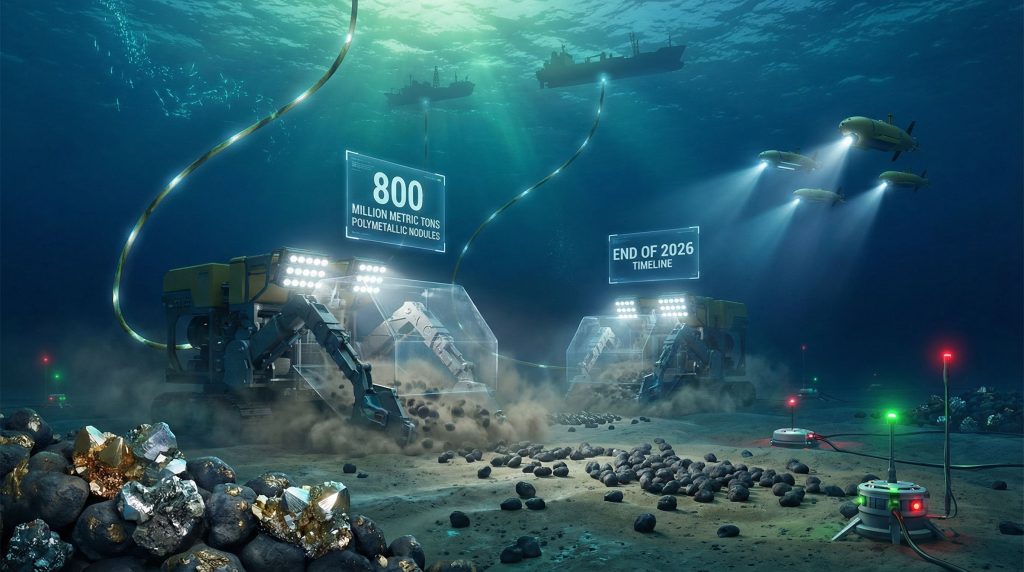
Recent geological surveys have identified specific high-grade zones containing an estimated 800 million metric tons of polymetallic nodules with exceptional mineral concentrations. These formations represent some of the richest deep-sea mineral deposits discovered globally, with nodule densities exceeding 15 kilograms per square metre in premium extraction areas.
Critical mineral composition breakdown:
| Mineral | Concentration Range | Global Significance |
|---|---|---|
| Nickel | 1.3% – 1.5% | Higher than most laterite deposits |
| Cobalt | 0.25% – 0.30% | 3x concentration of land-based nickel mines |
| Copper | 0.15% – 0.25% | Comparable to medium-grade terrestrial ores |
| Manganese | 20% – 30% | Highest concentration globally available |
The geological formation process creates nodules through electrochemical precipitation occurring under extreme pressure and anaerobic conditions. Consequently, these ferromanganese concretions grow at rates of approximately 1 to 10 millimetres per million years, indicating resource renewal occurs on geological timescales far exceeding human industrial planning horizons. The nodules form around nucleation sites such as shark teeth, fish bones, or mineral fragments, creating spherical to ellipsoidal shapes ranging from 2 to 10 centimetres in diameter.
Spatial distribution patterns within the zone demonstrate clustering effects where nodule concentrations correlate with specific seafloor topography and sediment characteristics. Areas with slower sedimentation rates and moderate current flows show the highest nodule accumulations, creating discrete high-grade zones suitable for targeted extraction operations. This heterogeneous distribution enables selective mining approaches that focus on premium resource areas while avoiding lower-grade regions.
The strategic importance extends beyond simple mineral content to include processing advantages. Unlike terrestrial ores requiring crushing, grinding, and chemical beneficiation, polymetallic nodules benefits include mechanical separation from sediment and processing through relatively straightforward metallurgical techniques. This processing efficiency reduces energy consumption and waste generation compared to traditional mining and smelting operations.
Commercial Applications and Industry Positioning
The Metals Company emerged as the first entity to formally pursue deep-sea mining permit under Trump rules authorization under the consolidated permitting framework, submitting its application on January 23, 2026, within 24 hours of the regulatory amendment's implementation. This Vancouver-based operation represents a strategic convergence of technology development, regulatory positioning, and market timing that positions the company as the leading commercial applicant for ocean floor mining rights.
The company's rapid application submission demonstrates organisational readiness and regulatory pathway understanding developed through previous engagement with the dual-authorization system. Their original application, filed in April 2025 under the previous regulatory structure, provided foundational documentation that could be rapidly adapted to the new consolidated framework requirements.
Strategic partnership with Glencore provides several critical advantages:
• Guaranteed offtake agreements securing revenue streams regardless of commodity price volatility
• Access to established refining and processing infrastructure for polymetallic nodule materials
• Integration with existing supply chains serving battery manufacturing and energy transition markets
• Financial backstop reducing project financing risk through contracted metal sales
Glencore's participation represents significant market validation for deep-sea mining commercial viability. As one of the world's largest commodity trading and mining companies, Glencore's commitment indicates institutional confidence in extraction technology readiness and market demand sustainability. In addition, the offtake agreement structure provides predictable cash flow projections essential for securing project financing and operational capital.
The company projects permit approval by the end of 2026, establishing an aggressive timeline that would enable infrastructure development and commercial production commencement ahead of potential competitors. This first-mover advantage creates substantial barriers to entry for subsequent applicants while establishing operational precedents for technology deployment and environmental compliance.
Projected development timeline includes:
• Permit approval: Q4 2026
• Infrastructure deployment: 2027-2028
• Commercial production commencement: 2029
• Full-scale operation: 2030-2031
The accelerated timeline reflects both regulatory streamlining benefits and technological maturity in deep-sea collection systems. Recent advances in remotely operated vehicle technology, subsea processing capabilities, and deep-water transportation systems have reduced technical risk factors that previously extended development cycles.
Industry analysts recognise that early permitting success establishes regulatory precedent and operational validation that facilitates subsequent applications while creating competitive advantages through infrastructure development and supply chain positioning.
Environmental Impact Assessment and Mitigation Strategies
Deep-sea mining operations present unique environmental challenges that differ fundamentally from terrestrial mining impacts. The abyssal zone ecosystem operates under extreme conditions including perpetual darkness, near-freezing temperatures, and pressures exceeding 400 atmospheres, supporting specialised biological communities adapted to these harsh environments over evolutionary timescales.
Environmental advocacy organisations have expressed substantial deep‐sea mining environmental concerns regarding the irreversible nature of seafloor disturbance. The slow-growing nature of deep-sea ecosystems means recovery from mining activities could require centuries or millennia, fundamentally different from terrestrial mining restoration projects that achieve ecosystem recovery within decades.
Primary environmental impact categories include:
• Habitat destruction through nodule collection and sediment disturbance
• Water column contamination from suspended sediment plumes
• Noise pollution affecting marine mammal migration and communication patterns
• Disruption of carbon sequestration processes in deep-ocean sediments
Sediment plume management represents the most technically challenging environmental control requirement. Nodule collection processes generate suspended particle clouds that can extend hundreds of kilometres from extraction sites, potentially affecting pelagic ecosystems and commercial fisheries across vast ocean areas. Furthermore, advanced monitoring systems using acoustic sensors, water column sampling, and satellite observation enable real-time tracking of sediment dispersion patterns.
Technological mitigation strategies include closed-loop processing systems that minimise waste discharge into marine environments. These systems recycle process water and sediment materials, reducing the volume of suspended particles released during collection operations. Buffer zones around extraction sites provide additional protection for sensitive habitat areas while enabling continued ecosystem monitoring throughout operational periods.
Biodiversity protection measures encompass:
• Pre-operational baseline surveys documenting existing species populations and habitat characteristics
• Continuous monitoring using remotely operated vehicles and autonomous underwater sensors
• Adaptive management protocols enabling operational modifications based on environmental impact data
• Post-operational restoration efforts including habitat reconstruction and species reintroduction programmes
Deep-sea mining proponents argue that ocean floor extraction represents an environmentally superior alternative to terrestrial mining expansion. Land-based mining operations require deforestation, topsoil removal, tailings pond construction, and extensive infrastructure development that affects larger geographic areas and established terrestrial ecosystems. Comparative life cycle assessments suggest that deep-sea mining could reduce overall environmental impact per unit of critical mineral production.
Geopolitical Dimensions and International Governance Tensions
The United States' unilateral approach to deep-sea mining permit under Trump rules creates significant tension with multilateral governance frameworks established through international maritime law. The UN Convention on the Law of the Sea designates the International Seabed Authority as the governing body for mining activities in international waters beyond national jurisdiction, creating jurisdictional conflicts with domestic permitting systems.
Regulatory authority comparison reveals fundamental governance conflicts:
| Framework | Authority | Jurisdiction | Implementation Status |
|---|---|---|---|
| US Domestic | NOAA | International waters via 1980 Act | Active permitting |
| International | ISA | "The Area" under UNCLOS | Standards development |
| Regional | Pacific States | Territorial waters only | Varied approaches |
The Deep Seabed Hard Mineral Resources Act of 1980 established US authority to permit mining in international waters without requiring International Seabed Authority approval. This statute was enacted during a period when international governance frameworks were still under development, creating legal precedent for unilateral action that predates contemporary multilateral agreements. However, those interested in broader mining permitting insights can see how these frameworks influence terrestrial operations as well.
International governance tensions extend beyond legal technicalities to encompass broader questions of resource equity and environmental stewardship. Developing nations argue that deep-sea minerals represent common heritage of mankind and should be managed through international frameworks that distribute benefits equitably among all countries. Consequently, the US approach concentrates benefits among nations with advanced maritime technology and capital resources to fund deep-sea extraction operations.
Geopolitical implications include:
• Precedent for other nations to pursue unilateral deep-sea mining programmes
• Potential for conflicting territorial claims in premium resource areas
• Trade disputes over mining-derived critical minerals and processed materials
• Diplomatic tensions with countries lacking deep-sea mining capabilities
Pacific Rim nations face particular pressure to develop domestic responses to US deep-sea mining policies. Countries with extensive exclusive economic zones, including Japan, Australia, and New Zealand, possess territorial waters containing substantial mineral resources that could be developed through national permitting systems similar to the US approach.
The regulatory acceleration reflects broader strategic competition over critical mineral supplies, particularly regarding Chinese dominance in rare earth processing and battery metal refining. Moreover, the connection to the broader critical minerals executive order demonstrates how deep-sea mining represents one of the few pathways for Western nations to establish supply chains independent of Chinese processing infrastructure, creating national security imperatives that override traditional multilateral governance preferences.
The next major ASX story will hit our subscribers first
Technology Infrastructure and Operational Requirements
Commercial deep-sea mining requires sophisticated technology systems capable of operating reliably at depths exceeding 4,000 metres under extreme environmental conditions. The technological infrastructure represents substantial capital investments with specialised equipment designed specifically for abyssal zone operations that cannot be readily adapted from other maritime industries.
Core technology components include:
• Remotely operated collection vehicles with polymetallic nodule harvesting systems
• Deep-water transportation mechanisms for lifting collected materials to surface vessels
• Onboard processing equipment for initial mineral separation and concentration
• Real-time monitoring systems for environmental compliance and operational safety
Collection vehicle technology utilises sophisticated robotic systems equipped with mechanical arms, suction devices, and sorting mechanisms capable of selectively harvesting polymetallic nodules while minimising sediment disturbance. These vehicles operate autonomously using artificial intelligence systems that optimise collection patterns based on real-time nodule density mapping and environmental conditions.
Transportation infrastructure requires high-capacity lifting systems capable of moving thousands of tons of collected materials from abyssal depths to surface processing vessels. Riser pipe systems, pneumatic lift technologies, and continuous belt conveyors represent alternative approaches with different efficiency and environmental impact characteristics. Furthermore, the selection of transportation method significantly affects overall project economics and environmental compliance requirements.
Surface vessel processing capabilities enable initial mineral concentration and waste reduction before transportation to shore-based facilities. Shipboard processing reduces transportation costs while enabling real-time quality control and environmental monitoring. Advanced separation technologies can achieve mineral concentration levels exceeding 30% cobalt, 15% nickel, and 10% copper before materials leave the extraction site.
Operational cost structure includes:
• Vessel charter and maintenance: $50,000-$100,000 daily
• Technology deployment and recovery: $10,000-$25,000 per operation cycle
• Environmental monitoring and compliance: $5,000-$15,000 daily
• Crew and logistics support: $15,000-$30,000 daily
Technology reliability represents a critical factor in commercial viability. Equipment failures at abyssal depths require expensive recovery operations and extended downtime that can eliminate project profitability. Redundant systems, predictive maintenance programmes, and rapid response capabilities are essential for maintaining operational continuity in the challenging deep-sea environment.
Market Dynamics and Investment Considerations
Deep-sea mining investment decisions require comprehensive risk assessment encompassing regulatory uncertainty, technology readiness, environmental compliance costs, and commodity market volatility. The sector represents a convergence of high capital requirements with substantial technical and regulatory risks that create complex investment evaluation challenges.
Investment risk categories include:
• Regulatory changes affecting deep-sea mining permit under Trump rules timelines and operational requirements
• Technology failure risks in extreme operational environments
• Environmental compliance costs and potential operational restrictions
• Commodity price volatility affecting project economics and financing availability
• International governance disputes creating legal and operational uncertainties
Market demand for critical minerals continues expanding driven by electric vehicle production growth and renewable energy infrastructure development. Global battery manufacturing capacity is projected to increase by 400% between 2025 and 2030, requiring substantial increases in nickel, cobalt, and copper availability that existing terrestrial mining operations cannot readily supply.
Critical mineral demand projections:
| Mineral | 2025 Demand | 2030 Projected Demand | Supply Gap |
|---|---|---|---|
| Cobalt | 180,000 tonnes | 350,000 tonnes | 40% shortfall |
| Nickel | 3.2 million tonnes | 5.8 million tonnes | 35% shortfall |
| Copper | 25 million tonnes | 35 million tonnes | 20% shortfall |
Supply chain diversification strategies increasingly prioritise sources outside traditional mining regions concentrated in politically sensitive areas. Democratic Republic of Congo cobalt production, Indonesian nickel operations, and Chilean copper mining face political risks, labour disputes, and environmental restrictions that create supply uncertainty for critical mineral consumers.
However, deep-sea mining offers geographic diversification benefits through resource access in international waters not subject to individual country political risks. This aligns with the broader US mineral production order strategy that seeks to reduce dependence on foreign suppliers. Ocean-based extraction operations can continue producing regardless of terrestrial political instability, trade disputes, or resource nationalism policies affecting land-based mining operations.
Investment evaluation metrics include:
• Capital expenditure requirements: $500 million – $2 billion per project
• Internal rate of return projections: 15% – 25% depending on commodity prices
• Payback periods: 8 – 12 years including development and ramp-up phases
• Net present value sensitivity to regulatory delays and environmental compliance costs
Portfolio diversification benefits must be weighed against concentration risks inherent in emerging technology sectors with limited operational track records. Early investors face first-mover advantages but also bear technology development risks and regulatory uncertainty that could affect long-term project viability.
Strategic Scenarios and Future Pathways
Multiple regulatory and market scenarios could emerge from the current acceleration in deep-sea mining permitting, each with substantially different implications for industry development, international relations, and environmental outcomes. Strategic scenario analysis enables stakeholders to prepare for alternative future pathways while identifying key decision points that could influence outcome probabilities.
Scenario 1: Accelerated Global Adoption
Successful US permitting and initial commercial operations demonstrate technological feasibility and economic viability, prompting rapid adoption of similar regulatory frameworks by Pacific Rim nations and European countries. International competition accelerates technology development while reducing extraction costs through economies of scale and operational experience. Multiple operating companies achieve commercial production by 2030, substantially increasing global critical mineral supplies and reducing dependence on terrestrial mining operations.
Scenario 2: Environmental Opposition Intensifies
Initial deep-sea mining operations reveal unexpected environmental impacts that mobilise international opposition and scientific criticism. Environmental advocacy groups successfully lobby for international moratorium agreements, while legal challenges delay permitting processes. Technology development slows due to regulatory uncertainty, and investment capital shifts toward alternative mineral supply strategies including recycling expansion and substitute material development.
Scenario 3: Technology Breakthrough Transformation
Advances in robotics, artificial intelligence, and materials science dramatically reduce deep-sea mining operational costs while improving environmental performance. Breakthrough technologies enable selective nodule harvesting with minimal ecosystem disturbance, addressing environmental concerns while maintaining extraction efficiency. Furthermore, reduced costs accelerate adoption while improved environmental performance facilitates regulatory approval and social acceptance.
Scenario 4: Geopolitical Fragmentation
International governance disputes escalate into competing regulatory frameworks with incompatible standards and conflicting territorial claims. Trade disputes emerge over mineral exports from unilaterally permitted operations, while developing nations establish alternative international frameworks excluding countries pursuing unilateral permitting. Market fragmentation increases transaction costs and reduces operational efficiency while creating opportunities for regulatory arbitrage.
Key indicators for scenario development include:
• Permit approval timelines under the consolidated US framework
• Environmental impact data from initial commercial operations
• International Seabed Authority responses to unilateral permitting decisions
• Technology cost reduction rates and environmental performance improvements
• Market acceptance of deep-sea mining-derived materials by end-users
Investment strategies must account for scenario uncertainty while maintaining flexibility to capitalise on positive developments or mitigate negative outcomes. Diversified approaches combining direct investment in mining operations with supporting technology development and environmental services can provide exposure to sector growth while reducing single-project risk concentration.
Disclaimer: This analysis contains forward-looking statements and projections based on current information and industry trends. Deep-sea mining represents an emerging sector with substantial regulatory, technological, and environmental uncertainties. Actual results may differ materially from projections due to changes in commodity prices, regulatory requirements, technology performance, environmental impacts, or international governance developments. Investors should conduct independent due diligence and consider consulting with qualified financial advisors before making investment decisions related to deep-sea mining or critical mineral sectors.
Ready to Capitalise on Critical Mineral Opportunities?
As deep-sea mining regulations accelerate and critical mineral demands surge, investors need immediate insights into significant discoveries across all commodities. Discovery Alert's proprietary Discovery IQ model delivers real-time notifications on major ASX mineral discoveries, transforming complex geological data into actionable investment opportunities that keep you ahead of regulatory shifts and market movements. Begin your 30-day free trial today through Discovery Alert's platform and position yourself to benefit from the next wave of critical mineral discoveries.