August 21, 2026
When Energy Markets Hold Equities Hostage: The US$100 Oil Threshold Explained
There is a particular type of market stress that defies simple categorisation. It is not a recession, not a financial crisis, and not a corporate earnings collapse. It is the slow, grinding pressure of an energy price shock working its way through every layer of the economic system simultaneously. That is precisely the environment Australian investors are navigating as the ASX soft open as oil heads towards US$100 a barrel intensifies amid rising geopolitical pressure, with crude oil price trends pointing toward the psychologically and technically significant US$100 per barrel threshold.
When big ASX news breaks, our subscribers know first
The Geopolitical Fault Lines Feeding the Oil Price Surge
The current trajectory of crude prices cannot be understood without first understanding the geography of global oil supply risk. The Persian Gulf and surrounding waterways remain the world's most critical energy chokepoints, and renewed instability across the region has reintroduced a substantial risk premium into crude benchmarks.
Intensified Houthi activity targeting commercial shipping routes has created measurable supply-route anxiety, while economic pressure campaigns directed at Iran have further complicated the reliability of Persian Gulf output. These are not hypothetical supply threats. They represent active disruptions to the physical movement of crude, and markets are pricing accordingly.
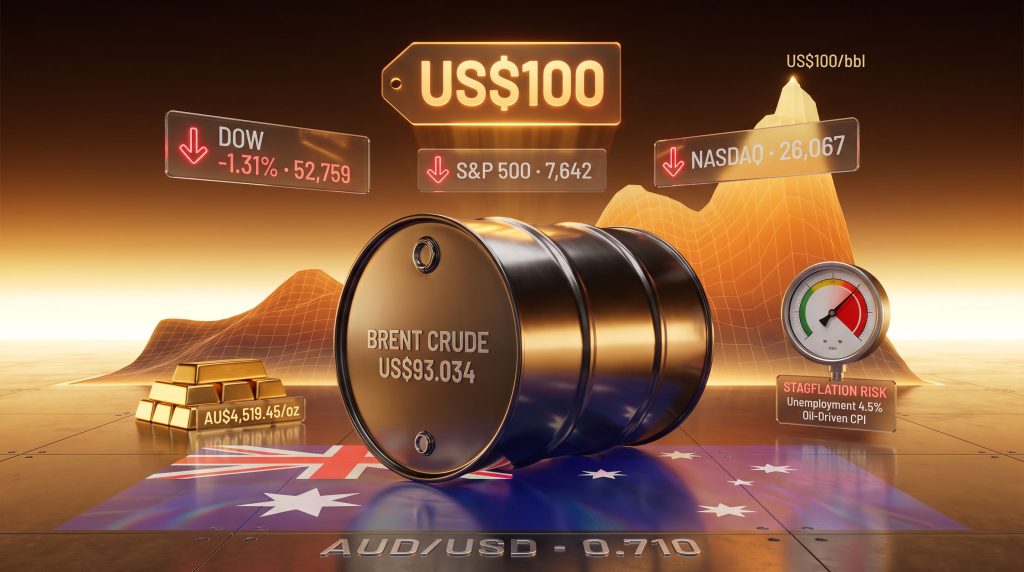
Brent crude briefly pushed above US$100.69 per barrel in late July 2026, a level not seen for several years. By 21 August 2026, Brent had settled at US$93.034 per barrel, representing a 1.54% gain on the day, with West Texas Intermediate tracking in a similarly elevated range near US$92 per barrel. For context, every sustained period of Brent trading above US$90/bbl historically triggers a measurable repricing of inflation expectations in oil-importing economies, and Australia sits squarely in that category.
"When geopolitical disruptions rather than demand growth drive oil prices higher, the economic transmission is fundamentally different. Demand-led oil rallies typically accompany broader economic expansion. Geopolitically-driven rallies compress margins, lift inflation, and dampen growth simultaneously."
A Snapshot of Global Commodity and Currency Markets
| Asset | Level (21 Aug 2026) | Daily Movement |
|---|---|---|
| Brent Crude | US$93.034/bbl | +1.54% |
| WTI Crude | ~US$92/bbl | Elevated |
| Gold | US$4,519.45/oz | Firm |
| Iron Ore (Singapore) | US$95.16/tonne | -0.01% |
| US Natural Gas Futures | US$2.7591/GJ | -1.92% |
| AUD/USD | US$0.710 | Stable |
The commodity picture is notably bifurcated. While energy prices surge on supply-side anxiety, iron ore price trends show the metal remaining range-bound and natural gas has softened, suggesting the rally is specifically geopolitical rather than a broad demand-driven commodity cycle. Gold's firm positioning at US$4,519.45 per ounce reflects safe-haven capital rotation rather than speculative excess.
How Oil Price Shocks Travel From the Persian Gulf to the ASX
The transmission mechanism between a Middle East supply disruption and an ASX soft open as oil heads towards US$100 a barrel operates across several distinct channels. Understanding each one is essential for investors trying to separate signal from noise.
The Inflation Expectations Channel
Rising crude prices feed directly into transport and logistics costs, which in turn flow through to consumer goods pricing. In Australia, fuel represents a meaningful component of the Consumer Price Index basket. When Brent sustains above US$90/bbl, domestic petrol and diesel prices rise, eroding household purchasing power and lifting headline inflation metrics.
This matters enormously for the Reserve Bank of Australia, which must balance any impulse toward rate relief against the risk of entrenching higher inflation expectations. Furthermore, the market volatility impacts of sustained elevated crude prices ripple far beyond the petrol bowser.
The Equity Valuation Channel
Overnight on Wall Street, the dual pressure of rising oil costs and climbing US Treasury yields proved decisive. The results were unambiguous:
- The Dow Jones Industrial Average fell 1.31% to close at 52,759
- The S&P 500 dropped 66.82 points to settle at 7,642
- The Nasdaq declined 1.0% to finish at 26,067
- All three major indices touched two-week lows in the same session
Rising Treasury yields compress equity valuations by increasing the discount rate applied to future earnings. When oil-driven inflation expectations push yields higher, growth stocks with long earnings duration are typically hit hardest, while value-oriented energy and materials names provide relative shelter.
The ASX Futures Signal
ASX futures pointed to a soft open on 21 August 2026, reflecting the overnight Wall Street decline. According to Market Index, the ASX cash market opens at 10:00 am Sydney time, with opening prices calculated from a pre-market auction beginning at 09:59:45. This brief window is where the overnight US session sentiment most directly influences Australian equity pricing before domestic catalysts can reassert themselves.
Which ASX Sectors Sit in the Crosshairs?
The sectoral impact of sustained elevated oil prices is far from uniform. Investors who treat an oil surge as uniformly negative for equities risk misallocating capital in a way that creates both unintended losses and missed opportunities.
Energy Producers: The Paradox of Benefit
ASX-listed upstream oil producers with oil-weighted production profiles stand to benefit directly from higher crude realisation prices. When Brent exceeds US$90/bbl, revenue per barrel increases significantly, often outpacing any marginal increase in operating costs. However, this benefit is not universal across the energy sector.
Downstream businesses, refiners with thin crack spreads, and transport-dependent operators face genuine margin pressure as input costs rise faster than they can pass through price increases.
Materials and Mining: The Hidden Cost Burden
Diesel is not a minor line item for Australian miners. It powers drilling rigs, haul trucks, processing facilities, and camps across remote operations. When crude prices surge, all-in sustaining costs (AISC) for gold, copper, and iron ore producers rise meaningfully. With iron ore already sitting at a relatively modest US$95.16 per tonne, producers operating near cost thresholds have limited buffer to absorb fuel cost escalation without margin compression.
Gold miners occupy a more complex position. Higher fuel costs increase AISC, but gold safe-haven demand surges during geopolitical stress events. At US$4,519.45 per ounce, the gold price provides an exceptionally wide margin above typical production costs for most ASX-listed producers, effectively insulating them from fuel cost headwinds.
Consumer and Retail: Stagflation's Most Vulnerable Targets
Fuel price rises are not absorbed in isolation. They cascade through logistics, freight, cold-chain distribution, and ultimately retail shelf prices. For mortgage-sensitive consumer discretionary stocks, this compounds existing pressure. If oil-driven inflation delays anticipated RBA rate cuts, borrowing costs remain elevated while consumer confidence softens further.
Financial Sector: Yield Curve Dynamics
Rising US Treasury yields affect Australian bank stocks through two primary channels: increased international funding costs and reduced risk appetite for growth equities. If the US yield curve steepens materially, the cost of offshore wholesale funding for Australian banks rises, potentially compressing net interest margins at the very moment the domestic economy is already under pressure.
Australia's Domestic Economic Backdrop: A Complicating Layer
The external oil shock arrives at a genuinely inconvenient moment for the Australian economy. The Australian Bureau of Statistics reported that the seasonally adjusted unemployment rate climbed to 4.5% in July 2026, with male employment contracting by 11,000 persons and female employment recording a smaller decline of 5,000 persons.
This combination of rising unemployment and energy-driven inflation pressure creates the conditions for what economists describe as a stagflationary environment.
The Stagflation Policy Trap: When unemployment is rising while energy costs are simultaneously lifting consumer prices, central banks face a genuinely constrained policy toolkit. Cutting rates risks inflaming inflation. Holding rates steady risks deepening labour market weakness. Neither option is comfortable, and both outcomes carry negative implications for equity markets.
The RBA's mandate centres on maintaining inflation within a 2-3% target band while supporting full employment. When these two objectives pull in opposite directions, the policy response becomes slower, less decisive, and more unpredictable — precisely the conditions that sustain equity market uncertainty.
Corporate Earnings Providing Partial Counter-Narrative
Against this challenging macro backdrop, several ASX earnings results delivered meaningful positive signals, particularly from the gold sector.
| Company | Metric | Result |
|---|---|---|
| Regis Resources (RRL) | Net Profit After Tax | Record $715 million |
| Regis Resources (RRL) | EBITDA | Record $1.345 billion |
| Regis Resources (RRL) | Operating Cash Flow | Record $1.247 billion |
These results from Regis Resources demonstrate something important for investors parsing the current environment: underlying corporate earnings quality in resource-weighted sectors can diverge substantially from index-level sentiment during macro stress events. Consequently, record cash flows at gold producers while the broader market softens is not a contradiction — it reflects how gold and mining equities translate safe-haven strength into real financial performance.
On the corporate actions front, James Hardie's divestiture of its European operations represents a strategic portfolio rationalisation. In addition, Perenti's agreement to sell BTP Group for $100 million continues the trend of mining services companies streamlining to focus capital on core competencies. MGX Resources maintained balance sheet strength as it advances its pivot toward the Central Tanami gold project.
The next major ASX story will hit our subscribers first
Three Scenarios for Oil's Next Move and ASX Implications
| Scenario | Trigger | Brent Trajectory | ASX Implication |
|---|---|---|---|
| Escalation Deepens | Further supply route disruptions; Iran sanctions tighten | US$100-US$110+ | Significant risk-off; energy outperforms; consumers under pressure |
| Diplomatic De-escalation | Ceasefire progress; shipping routes reopen | Pullback to US$85-US$88 | Broad relief rally; rate-cut narrative revives |
| Demand Destruction | Global growth slowdown caps oil ceiling | Stabilises near US$95 | Mixed; stagflation risk persists despite oil plateau |
History offers useful reference points. The 2011-2014 period of sustained Brent trading above US$100/bbl coincided with elevated global inflation, central bank tightening across multiple economies, and compressed price-to-earnings multiples on equity markets worldwide. The 2022 oil price spike following geopolitical disruption produced a similar pattern. As noted in coverage from Vantage Markets, the US$100/bbl level functions as more than a round number — it represents a threshold above which energy cost pain becomes broadly measurable across consumer spending data, corporate margin reports, and central bank inflation forecasts simultaneously.
A Framework for Navigating a Soft Open Day
For investors opening their terminals on a day when macro forces are driving the index lower before a single domestic stock reports, a structured approach reduces emotionally driven decision-making.
- Identify the primary driver — Is weakness macro-driven (oil, yields) or domestically specific (earnings disappointments, regulatory action)?
- Assess sector rotation logic — Energy producers and gold miners typically attract capital rotation during geopolitical oil shocks; defensives including utilities and healthcare outperform risk-off sessions.
- Monitor the AUD/USD cross — At US$0.710, the Australian dollar's relative stability limits the imported inflation amplification effect, but further commodity price pressure could shift this dynamic.
- Use gold as a sentiment gauge — Gold trading above US$4,500/oz signals sustained institutional safe-haven demand; this typically supports gold-weighted portfolios relative to the broader index.
- Watch US Treasury yield direction — The 10-year yield's movement determines whether overnight Wall Street weakness extends into the Asian trading session or stabilises before the ASX soft open as oil heads towards US$100 a barrel creates additional downward pressure.
"For long-term investors, a critical distinction applies: a soft open driven by external macro factors rather than fundamental deterioration in Australian corporate earnings does not automatically signal a sustained downtrend. Event-driven volatility and structural market weakness require very different responses, and conflating the two is among the most common and costly errors investors make during geopolitical stress events."
Frequently Asked Questions
Why does rising oil cause the ASX to open lower?
Higher crude prices increase operating costs across transport, logistics, and manufacturing while simultaneously lifting inflation expectations. When Wall Street declines overnight in response to these pressures, ASX futures typically follow, creating a softer cash market open before domestic catalysts can provide any offsetting influence.
What makes US$100 per barrel significant for markets?
Beyond its psychological weight as a round number, US$100/bbl represents a historically consistent threshold above which oil price effects become measurable across multiple economic indicators simultaneously — including consumer price inflation, corporate AISC in resource industries, and central bank policy positioning.
Which ASX sectors typically outperform when oil prices surge?
Oil and gas producers with upstream, oil-weighted production profiles benefit directly from higher realisation prices. Gold miners also tend to outperform during geopolitical stress periods as safe-haven demand lifts the gold price. Airlines, road transport operators, and consumer discretionary businesses typically underperform.
What does a 4.5% unemployment rate mean for RBA decision-making?
Rising unemployment normally builds the case for rate cuts to support economic activity. However, when oil-driven inflation simultaneously threatens to breach the RBA's target band, the policy calculus becomes significantly more complex. The likely outcome is a more cautious, slower approach to rate relief, extending uncertainty across interest-rate-sensitive equity sectors.
The material in this article is for informational purposes only and should not be considered investment advice. Readers are encouraged to conduct their own research and consult a qualified financial adviser before making investment decisions. Commodity price forecasts and scenario analyses represent possible outcomes only and carry no guarantee of accuracy.
Want to Stay Ahead of Major ASX Mineral Discoveries Amid Market Volatility?
When geopolitical shocks send oil prices surging and equity markets into a soft open, identifying high-conviction resource opportunities becomes even more critical — Discovery Alert's proprietary Discovery IQ model delivers real-time alerts on significant ASX mineral discoveries, instantly cutting through market noise to surface actionable investment opportunities. Explore how historic discoveries have generated substantial returns on Discovery Alert's dedicated discoveries page, and begin your 14-day free trial today to position yourself ahead of the broader market.