May 19, 2026
When Diplomacy Moves Markets: How Geopolitical Risk Premiums Work in Oil Trading
Crude oil markets are among the most geopolitically sensitive asset classes on the planet. Unlike equities, where conflict risk is diffused across sectors, oil prices respond with surgical precision to any signal that threatens or protects the physical flow of barrels from producer to consumer. Understanding how this mechanism functions — and tracking oil price movements in real time — helps explain why a single presidential announcement can shave billions of dollars off the market value of global crude stockpiles in a matter of hours.
That dynamic played out with striking clarity in early Asian trading on Tuesday, May 19, 2026, when oil falls as Trump pauses attack on Iran became the defining market headline. The repricing was immediate, substantial, and technically illuminating for anyone who tracks how embedded war premiums are constructed and unwound.
When big ASX news breaks, our subscribers know first
The Price Action: Breaking Down What Actually Moved
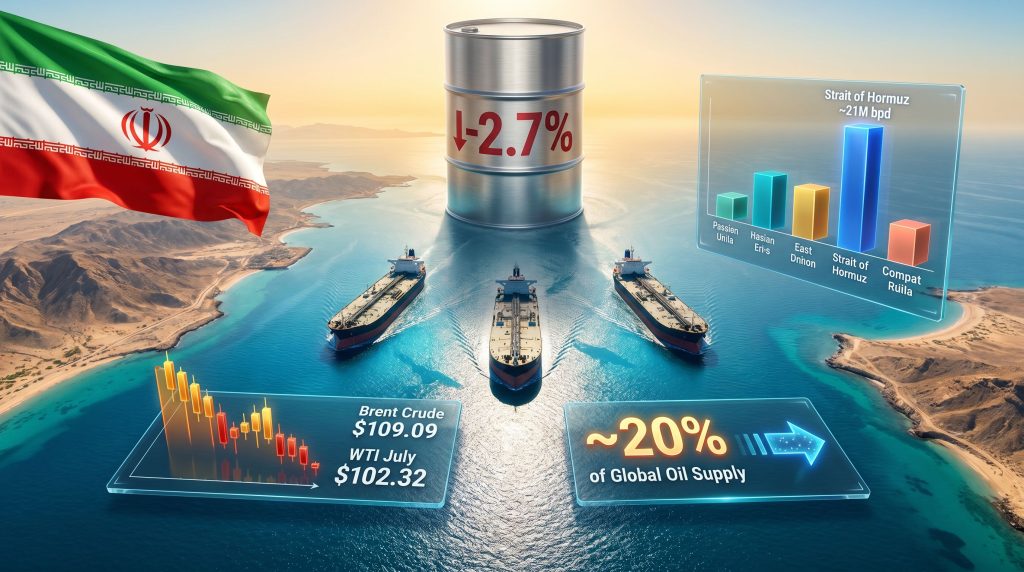
The numbers told a precise story. Brent crude for July delivery declined $3.01, or approximately 2.7%, to $109.09 per barrel in early Asian trade, while the front-month WTI June contract dropped $1.38, or 1.3%, to $107.28 per barrel. The more liquid WTI July contract, which carries greater market weight given the imminent expiry of the June contract, fell a steeper $2.06, or 2%, to $102.32 per barrel.
What makes this move especially instructive is the context around it. Both Brent and WTI had reached multi-week highs in the prior session, with Brent touching its highest point since May 5 and WTI reaching levels last seen on April 30. Intraday trading data indicates WTI had briefly traded in the $115 to $117 range before the announcement, meaning the total repricing from peak to post-announcement trough was considerably larger than the headline percentage suggests.
A geopolitical risk premium in crude oil is not an abstract concept. It is a measurable, tradeable component of price that reflects the market's collective probability-weighted assessment of supply disruption. When that probability shifts, the premium adjusts within minutes.
This kind of rapid repricing is not unusual in energy markets, but the magnitude matters. Geopolitical risk premiums during acute Middle East tension episodes have historically ranged from $10 to $20 per barrel, and the speed with which they collapse when diplomatic signals emerge is a key feature of modern algorithmic trading in crude futures.
The Strait of Hormuz: Why This Waterway Defines Global Energy Security
To understand why the market embedded such a large risk premium in the first place, it is necessary to appreciate just how structurally critical the Strait of Hormuz is to global oil supply architecture. Furthermore, understanding the broader trade war impact on oil provides essential context for how compounding geopolitical pressures can amplify price sensitivity.
This narrow maritime passage, separating the Persian Gulf from the Arabian Sea between Iran and Oman, serves as the transit corridor for roughly 20% of the world's total daily oil supply, approximately 21 million barrels per day. No other single physical geography carries this level of concentrated energy exposure.
The conflict had effectively disrupted normal shipping operations through the waterway, raising concerns that were not merely theoretical. When tanker operators begin rerouting supertankers around the Cape of Good Hope rather than transiting the Strait, the cost and time implications cascade through the entire global supply chain.
How Traders Read Tanker Data as a Leading Indicator
One of the less widely understood aspects of crude oil trading is how deeply analysts have integrated real-time maritime intelligence into their price formation models. Tanker tracking data, vessel AIS signals, and port-call records have become as important as inventory reports in assessing near-term supply conditions.
Any reduction in vessel traffic through the Strait, changes in vessel speeds suggesting risk avoidance, or reports of maritime incidents near Iranian territorial waters can trigger immediate upward pressure on Brent and WTI benchmarks, often before official data confirms any physical supply impact.
The table below contextualises how the Strait of Hormuz compares with other major global oil chokepoints.
| Chokepoint | Daily Oil Flow (Approx.) | Share of Global Supply | Primary Risk Factor |
|---|---|---|---|
| Strait of Hormuz | ~21 million bpd | ~20% | Iran-US tensions, naval activity |
| Strait of Malacca | ~16 million bpd | ~15% | Piracy, geopolitical friction |
| Suez Canal | ~9 million bpd | ~9% | Regional conflict, blockages |
| Bab el-Mandeb | ~6 million bpd | ~6% | Houthi activity, Red Sea disruption |
No other chokepoint combines the volume concentration and geopolitical volatility of the Strait of Hormuz, which is why its operational status commands such outsized influence over global crude benchmarks.
Three Scenarios the Market Is Simultaneously Pricing
The critical analytical challenge facing energy traders is not simply interpreting what happened, but constructing a probability-weighted view of what comes next. Tim Waterer, Chief Market Analyst at KCM Trade, captured this uncertainty precisely, noting that while the pause eased immediate pressure, fundamental supply risks remained intact. His assessment highlighted that tanker movement data through the Strait and Iran's official response would serve as the most meaningful real-time indicators of price direction.
Markets are rarely binary. In this case, three distinct scenarios are being priced simultaneously.
-
Genuine De-Escalation: Diplomatic negotiations produce a verifiable framework agreement. Sanctions on Iranian oil exports are eased or removed, adding an estimated 1 to 1.5 million barrels per day of additional supply to global markets and placing sustained downward pressure on crude benchmarks over the medium term.
-
Tactical Pause: Diplomatic progress stalls, negotiations collapse under competing demands, and military posturing resumes. Crude prices likely return to or exceed pre-pause highs, potentially above $115 per barrel for WTI, with the speed of the reversal mirroring the speed of the initial decline.
-
Prolonged Strategic Ambiguity: Neither clear progress nor visible deterioration, with ongoing uncertainty sustaining a moderate risk premium and creating elevated volatility across energy markets for weeks or months.
| Scenario | Primary Driver | Brent Price Implication |
|---|---|---|
| Full diplomatic breakthrough, sanctions eased | Verifiable agreement reached | Downside toward $90 to $95/bbl |
| Talks stall, military posture restored | Negotiation failure | Rebound toward $115 to $120/bbl |
| Prolonged diplomatic ambiguity | Inconclusive signals | Range-bound $100 to $110/bbl |
| Strait of Hormuz shipping incident | Maritime escalation | Spike above $120/bbl |
Disclaimer: Price scenario projections are speculative and should not be treated as financial advice. Oil markets are subject to rapid and unpredictable change based on geopolitical developments.
The Diplomatic Architecture: What the Back-Channel Signals
The mechanics of the diplomatic engagement reveal as much about the fragility of the situation as the price action does. Iranian Foreign Ministry spokesperson Esmaeil Baghaei confirmed publicly that Tehran's formal position had been communicated to Washington via Pakistan, though no specific details of that communication were disclosed. A Pakistani official, speaking anonymously, acknowledged that Islamabad had transmitted a new proposal between the two governments but noted that progress remained slow.
This kind of multi-party mediation through a third-country intermediary is a well-established feature of diplomacy between states with no direct bilateral communication channels. It also means that the information flow to markets is inherently incomplete, fragmented, and subject to competing interpretations.
The sanctions question added another layer of uncertainty. Iran's semi-official Tasnim news agency reported that Washington had agreed to waive sanctions on Iranian oil exports as part of the negotiating framework. A U.S. official directly contradicted this claim. This divergence in official narratives is precisely the kind of information asymmetry that creates volatility in energy markets, because traders cannot reliably determine which version of reality is closer to the truth.
When two official sources contradict each other on a market-critical question like Iranian oil sanctions, the result is not clarity, it is sustained uncertainty. And uncertainty in oil markets tends to preserve, rather than erode, risk premiums over time.
Trump separately indicated he believed there was a strong probability the United States could reach an agreement with Iran to prevent Tehran from obtaining a nuclear weapon, framing the pause as a genuine diplomatic opening rather than a temporary tactical measure. Whether that framing reflects substantive progress or aspirational positioning remains the central question for energy markets.
SPR Depletion and the IEA Warning: The Supply Buffer Is Shrinking
Even before the latest diplomatic developments, structural supply conditions had been deteriorating in ways that amplify the market's sensitivity to any further disruption. U.S. Energy Department data revealed that a record 9.9 million barrels were drawn from the Strategic Petroleum Reserve in a single week, reducing total SPR stockpiles to approximately 374 million barrels, the lowest level recorded since July 2024.
The Strategic Petroleum Reserve, a system of underground salt caverns along the U.S. Gulf Coast, was established after the 1973 Arab oil embargo as an emergency buffer against supply shocks. At its current drawdown rate, the SPR's capacity to absorb future disruptions is meaningfully reduced.
International Energy Agency Executive Director Fatih Birol issued a stark assessment alongside this data: commercial oil inventories globally were declining at an accelerated pace, with only a limited number of weeks of supply buffer remaining. This inventory erosion dynamic is critically important because it means the market has far less cushion to absorb any re-escalation than it would under normal stock conditions.
At 374 million barrels, the U.S. SPR is operating near its lowest level in over a year, and rebuilding those reserves takes time, budget allocation, and stable market conditions that currently do not exist.
What SPR Depletion Means for Price Sensitivity
A well-stocked Strategic Petroleum Reserve acts as a psychological and practical dampener on oil price spikes. When inventories are thin, the market's reflexive response to any supply threat is amplified because there is less confidence that emergency releases can compensate for physical shortfalls. This structural vulnerability means that even a moderate re-escalation in Middle East tensions could produce a disproportionately large upward price move compared to historical precedent. Examining crude oil and geopolitics more broadly illustrates just how frequently these structural pressures interact with diplomatic flashpoints to create outsized market moves.
The next major ASX story will hit our subscribers first
The Russian Sanctions Waiver: A Parallel Complexity
Separate from the Iran situation, U.S. Treasury Secretary Scott Bessent extended an existing sanctions waiver by 30 days, permitting what the administration described as energy-vulnerable economies to continue purchasing Russian seaborne crude oil. This decision reflects the enduring tension between geopolitical sanctions strategy and the practical energy security needs of import-dependent nations. The broader Russian oil sanctions impact on global supply chains has consequently become a persistent variable in energy market modelling.
The simultaneous management of Iranian and Russian oil sanctions creates a policy environment of considerable complexity. Any shift in either regime carries immediate global supply implications.
- The Russian waiver extension provides short-term price relief for economies that depend on discounted Russian barrels.
- It also signals that Washington is calibrating its sanctions posture with energy market stability as an explicit secondary consideration.
- For traders, the waiver introduces uncertainty about whether further extensions are likely, and whether the underlying policy framework is becoming more flexible or simply deferring harder decisions.
How Oil-Importing Economies Are Watching This Unfold
The macroeconomic stakes of this diplomatic episode extend well beyond the energy sector. For major oil-importing nations, the difference between $102 and $115 per barrel WTI is not a trading abstraction. It translates directly into import bills, inflation dynamics, current account balances, and monetary policy flexibility.
| Economy | Annual Oil Import Cost Sensitivity (per $10/bbl change) | Key Macroeconomic Impact |
|---|---|---|
| India | ~$15 to $20 billion | Significant CPI relief, eases fuel subsidy burden |
| European Union | ~$40 to $50 billion | Reduces energy inflation pressure |
| Japan | ~$15 billion | Improves trade balance |
| South Korea | ~$10 billion | Supports export sector competitiveness |
Improved risk sentiment following the pause announcement also extended into equity markets. Instruments such as Gift Nifty futures moved higher in early Asian trading as investors began unwinding the conflict-risk discount that had been embedded across regional and global equities. This cross-asset correlation reflects how deeply Middle East risk had become embedded in broader market pricing.
The Four Variables That Will Determine Where Crude Goes Next
For investors and analysts monitoring the situation, the following variables carry the highest signal value for anticipating oil price direction. In addition, OPEC's market influence over production decisions remains an ever-present backdrop that could either amplify or dampen any price trajectory that emerges from the current diplomatic process.
-
Diplomatic progress and timeline: Whether structured negotiations between the U.S. and Iran produce a verifiable framework within weeks, or whether competing demands cause talks to stall before substance is reached.
-
Strait of Hormuz tanker data: Real-time vessel movement analytics remain the most immediate leading indicator of physical supply risk, preceding official data by days or weeks.
-
Iran's public and diplomatic posture: How Tehran frames the pause, whether as a genuine opportunity or as a tactical concession, will reveal whether de-escalation is mutual or asymmetric.
-
SPR replenishment signalling: Any indication that the U.S. government intends to accelerate SPR rebuilding would carry meaningful downward implications for medium-term price expectations by signalling confidence in supply normalisation.
The oil market's next major directional move will not be determined by OPEC production quotas or demand forecasts. It will be determined by a diplomatic process happening through back-channels between governments that have not spoken directly for decades.
Frequently Asked Questions
Why did oil fall when Trump paused the Iran attack?
The announcement reduced the market's perceived probability of near-term supply disruption through the Strait of Hormuz. Traders unwound the geopolitical risk premium that had been built into crude prices over preceding sessions, producing an immediate and significant decline across both Brent and WTI benchmarks. Oil falls as Trump pauses attack on Iran captured precisely this mechanism — diplomatic signalling directly translating into measurable price action within hours.
How much did oil prices fall following the announcement?
Brent crude fell approximately 2.7%, or $3.01 per barrel, to $109.09, while the active WTI July contract declined around 2%, or $2.06 per barrel, to $102.32, in early Asian trading on Tuesday, May 19, 2026. However, when accounting for intraday highs reached before the announcement, the total price swing was considerably larger than end-of-session figures suggest.
What would a U.S.-Iran nuclear agreement mean for oil supply?
A comprehensive agreement that lifts or significantly reduces sanctions on Iranian oil exports could theoretically add between 1 and 1.5 million barrels per day of additional supply to global markets, placing meaningful downward pressure on crude benchmarks if demand conditions remain stable.
How serious is the current U.S. Strategic Petroleum Reserve depletion?
At approximately 374 million barrels, following a record weekly drawdown of 9.9 million barrels, the SPR is at its lowest level since July 2024. This reduced buffer amplifies the market's sensitivity to any future supply disruption, making crude prices more reactive than they would be under normal inventory conditions.
Could oil prices rebound sharply if talks fail?
Yes. Given the speed and magnitude of the downward repricing, a breakdown in negotiations or any resumption of military posturing could trigger a rapid and substantial reversal in crude prices. The same algorithmic and risk-premium mechanisms that saw oil falls as Trump pauses attack on Iran drive prices lower can operate with equal force in the opposite direction.
Disclaimer: This article contains forward-looking analysis, scenario projections, and market commentary that are inherently speculative. Nothing in this article constitutes financial or investment advice. Oil markets are subject to rapid change based on unpredictable geopolitical, economic, and policy developments.
Want To Know Which ASX Discoveries Could Benefit From Shifting Energy Markets?
Discovery Alert's proprietary Discovery IQ model delivers real-time alerts on significant ASX mineral discoveries — including energy commodities directly exposed to geopolitical price swings like those explored above — instantly translating complex market data into actionable investment insights. Explore how historic discoveries have generated substantial returns and begin your 14-day free trial at Discovery Alert to position yourself ahead of the market.